
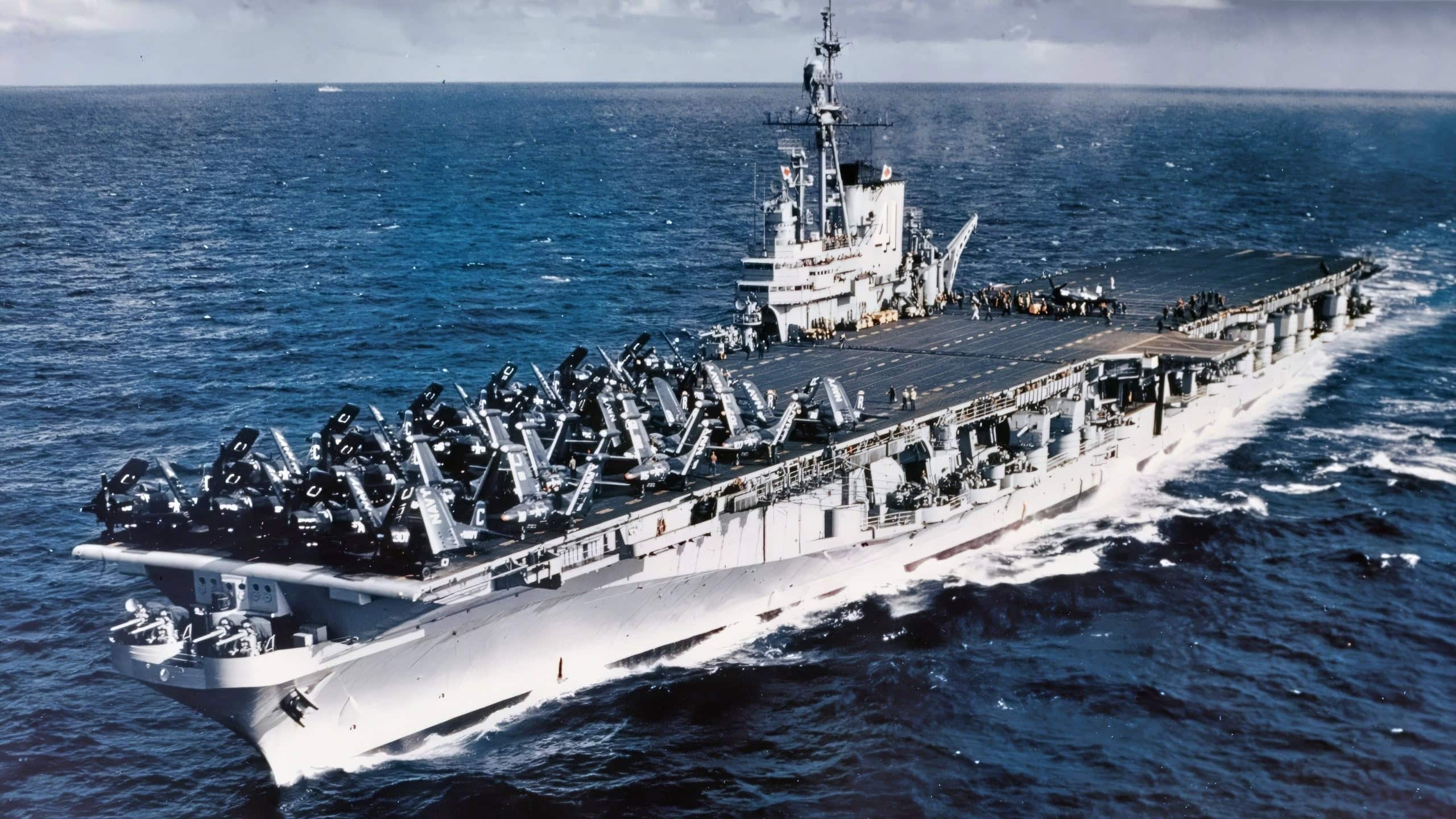
The Navy Built USS Midway Too Late For World War II. It Served For 47 Years Anyway: USS Midway entered service on Sept. 10, 1945, eight days after Japan’s surrender ceremony aboard USS Missouri. The war that shaped her design had already ended. The aircraft carrier, built to absorb the lessons of World War II, missed the conflict by days and remained in U.S. Navy service until 1992.
That long career is why the Midway-class carriers deserve more attention. They were not wartime mass-production ships in the Essex-class mold. They were larger, armored-deck carriers built from the Navy’s experience in the Pacific, then repeatedly adapted for a future that arrived faster than expected.
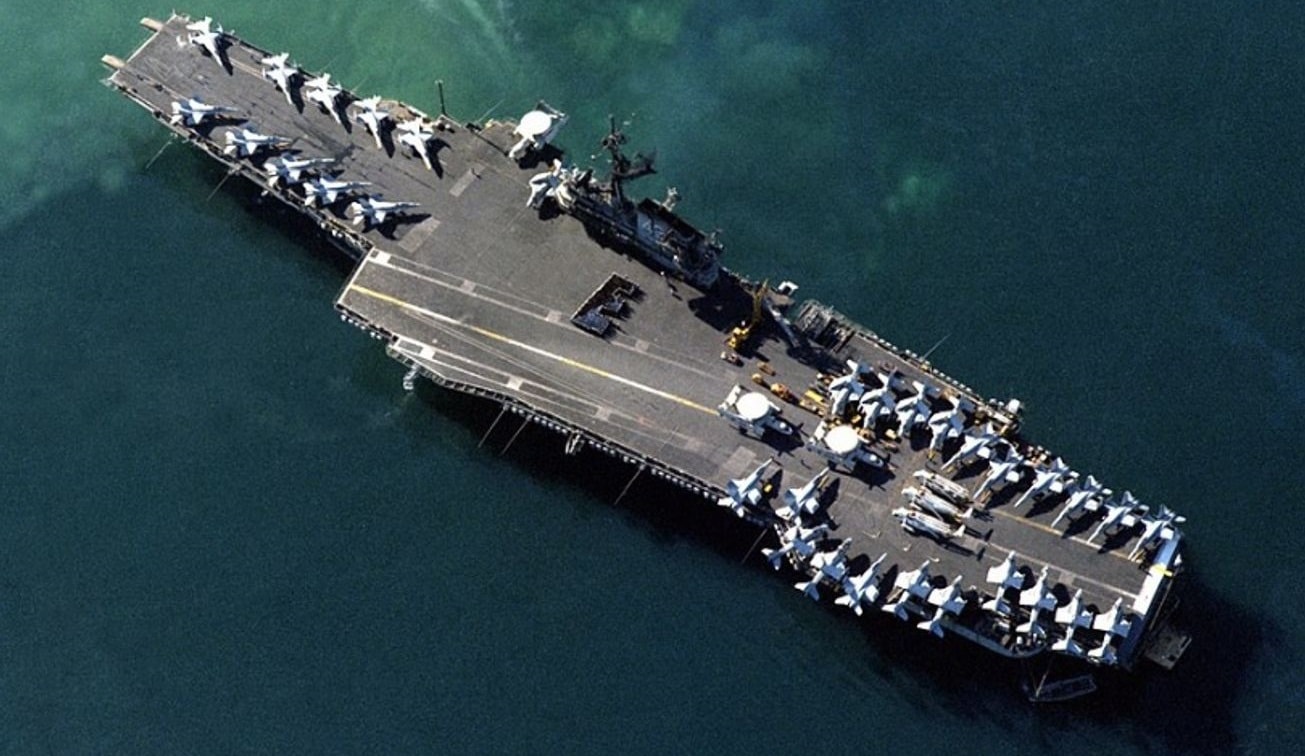
Image of Midway-class aircraft carrier. Image Credit: Creative Commons.
Jets got heavier. Landing speeds increased. Carrier decks needed new layouts. Catapults had to launch aircraft far more demanding than the propeller-driven planes the Navy had flown during World War II. The Midway class became a bridge between wartime carrier design and the modern supercarrier era.
Midway, Franklin D. Roosevelt, and Coral Sea were the only three ships of the class. Each followed a different service path. Together, they showed why the Navy needed larger carriers after World War II, and why even large carriers had to be rebuilt to survive the jet age.
USS Midway Was Built Too Late For World War II
The Navy’s official history says USS Midway was commissioned on Sept. 10, 1945, with Capt. Joseph F. Bolger is in command. At the time, Midway was the largest ship in the world and the first U.S. aircraft carrier too large to transit the Panama Canal, according to the Naval History and Heritage Command’s USS Midway overview.
The dates matter. Midway was not a World War II combat veteran. She was a carrier built from World War II experience that entered service after the shooting stopped. That gave the ship an unusual place in U.S. naval history: late for the war that produced her, but early for the Cold War that would define her.
The USS Midway Museum says the ship was built in 17 months, missed World War II by one week, and became the first in a three-ship class with an armored flight deck and a 120-plane air group. The museum also describes Midway as the longest-serving aircraft carrier of the 20th century, with a 47-year career that ended in San Diego in April 1992 before the ship opened as a museum in June 2004. Those details appear in the museum’s ship history.
That combination gives Midway its central importance. The ship was large enough to reflect wartime damage lessons, but old enough to require major modification as naval aviation moved into the jet era.
The Midway-Class Carriers Were Larger Than Essex For A Reason
The Midway class followed the Essex class, but it belonged to a different design era. Essex-class carriers gave the Navy wartime numbers. Midway-class carriers gave the Navy a larger and more heavily protected answer to what carrier warfare had revealed in the Pacific.
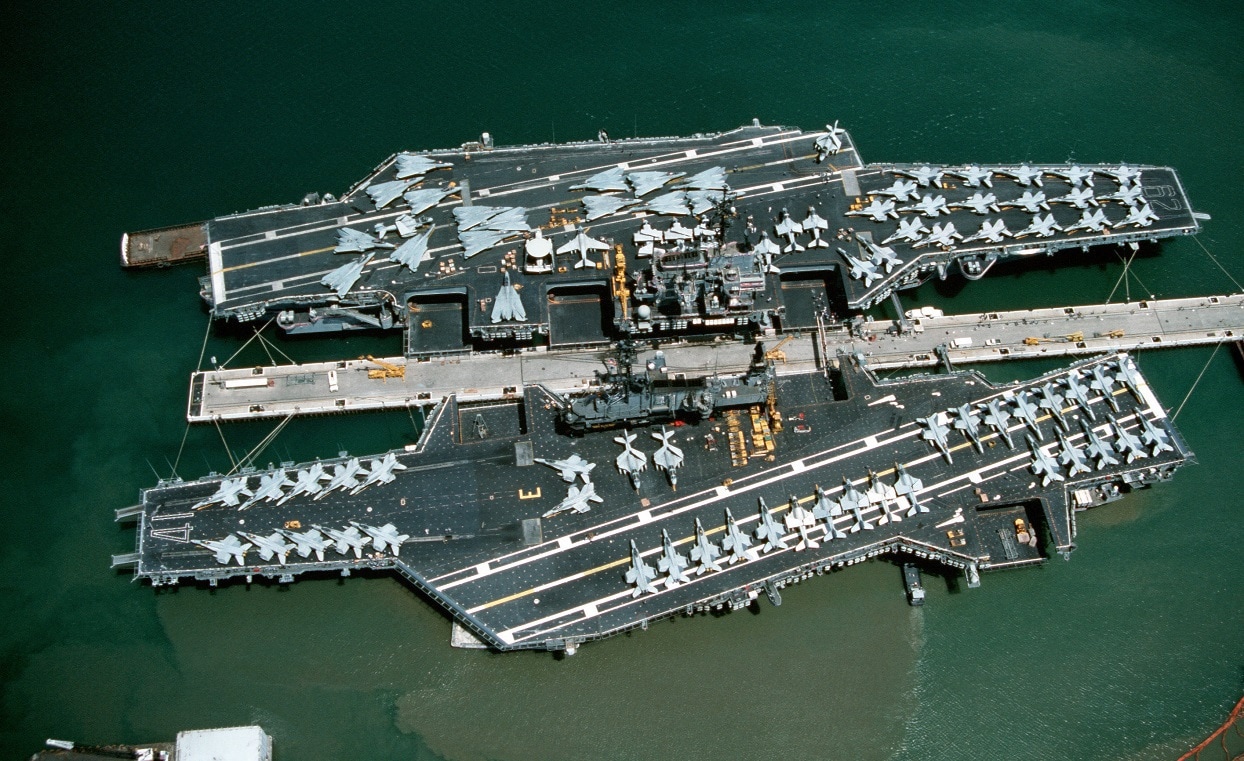
An aerial view of various aircraft lining the flight decks of the aircraft carrier USS INDEPENDENCE (CV-62), right, and USS MIDWAY (CV-41) moored beside each other in the background. The MIDWAY is en route from Naval Station, Yokosuka, Japan, to Naval Air Station, North Island, California, where it will be decommissioned in the spring of 1992. The INDEPENDENCE will travel to Yokosuka to take over as the Navy’s forward-based aircraft carrier.
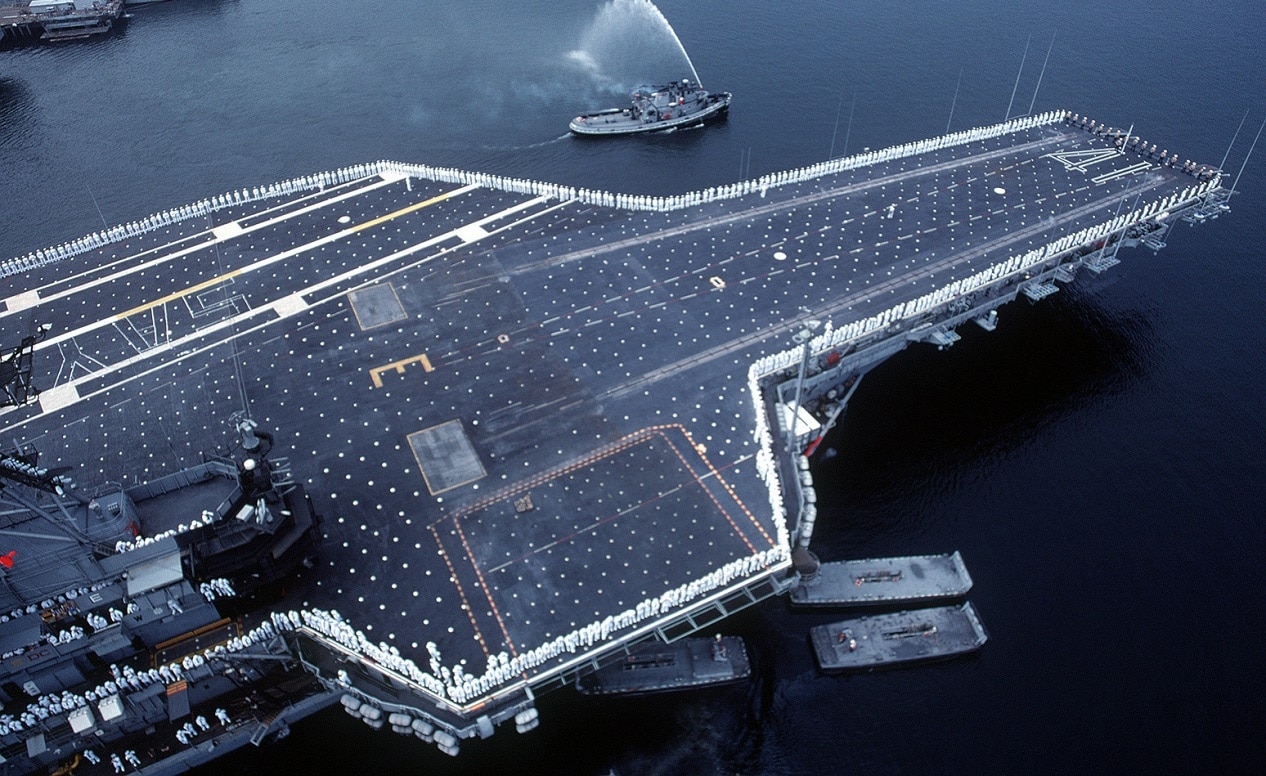
The aircraft carrier USS MIDWAY (CV-41) moves away from the pier as it departs from Yokosuka for the last time. The MIDWAY, which has been based in Japan since 1973, will be replaced by the aircraft carrier USS INDEPENDENCE (CV-62) as the Navy’s forward-based aircraft carrier.
The armored flight deck was central to that logic. British carriers had shown the value of deck armor under air attack, while U.S. wartime experience showed how vulnerable carriers could be to bombs, kamikazes, fires, and flight-deck damage. The Navy wanted a carrier that could take punishment and keep operating aircraft.
That choice came at a cost. A heavier, larger carrier required more displacement, deeper design tradeoffs, and a larger hull. Midway was no longer constrained by the same Panama Canal logic that had shaped earlier U.S. fleet-carrier planning. The Navy accepted that trade because carrier aviation had become the center of fleet combat.
The class had three ships. Franklin D. Roosevelt was laid down at the New York Navy Yard on Dec. 1, 1943, launched on April 29, 1945, renamed after President Franklin D. Roosevelt on May 8, 1945, and commissioned on Oct. 27, 1945, according to the Navy’s FDR record. Coral Sea was launched by Newport News Shipbuilding on April 2, 1946, and commissioned on Oct. 1, 1947, according to the Navy’s Coral Sea history.
Only Midway would survive into the 1990s, but all three ships belonged to the same postwar problem: how to carry the Navy from the piston-engine carrier war into an era of jets, nuclear weapons, and Cold War power projection.
Jets Forced USS Midway To Change
Midway’s original straight flight deck reflected the era in which the ship was designed. That layout worked for World War II aircraft, but it was poorly suited to the heavier, faster jets that followed. Jet aircraft changed landing speeds, launch requirements, deck cycles, and safety margins.
The angled flight deck became one of the most important carrier innovations of the postwar era. Instead of forcing aircraft launches and recoveries into a straight-line deck arrangement, the angled deck allowed a landing aircraft that missed the arresting wires to add power and take off again without crashing into aircraft parked forward.
Midway eventually received an angled flight deck as part of a major modernization. The Naval History and Heritage Command’s DANFS entry says the ship was out of commission until Sept. 30, 1957, while being modernized with innovations including an enclosed bow and angled flight deck. The Midway Museum’s explanation of the angled deck puts the change in plain terms: the old straight-deck arrangement limited simultaneous launch and recovery operations, while the angled deck better supported jet operations.
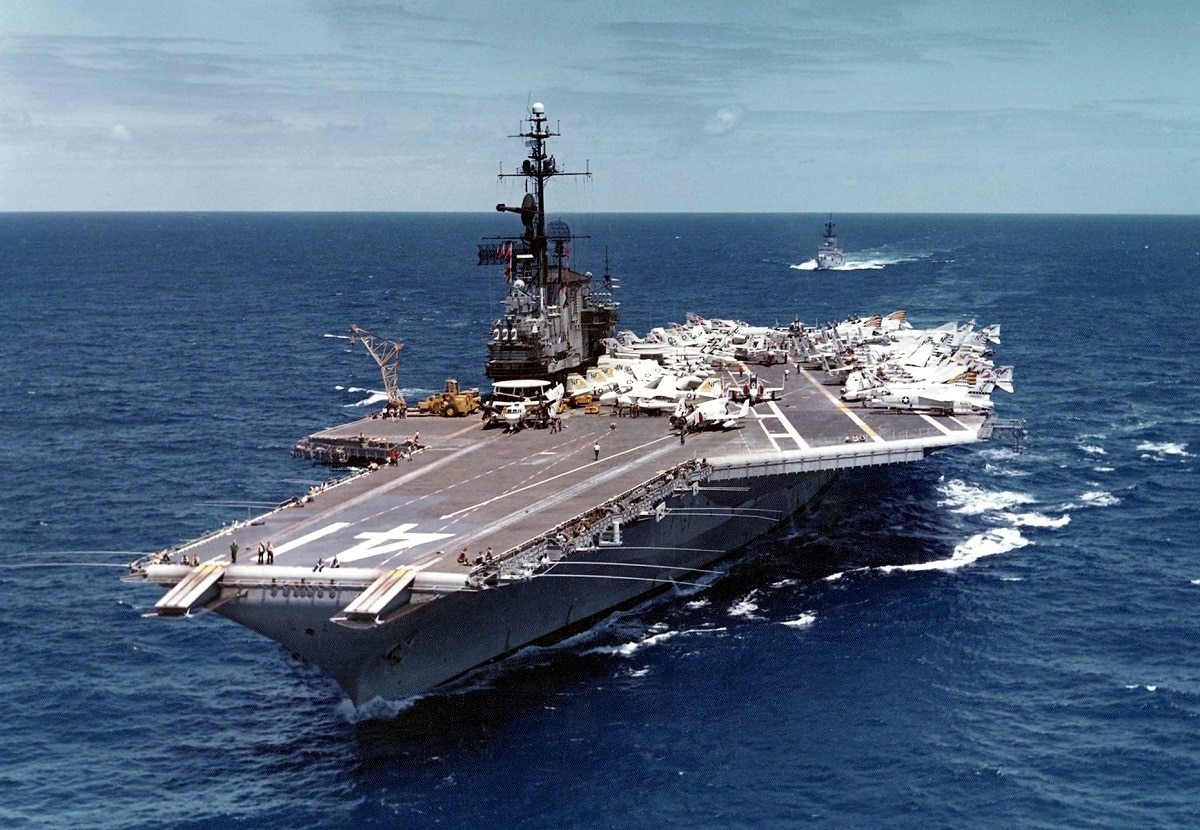
Midway-Class Aircraft Carriers. Image: Creative Commons.
That conversion showed both the strength and the limits of the class. Midway was large enough to be rebuilt for jet operations. However, the need for such extensive work made it clear that the Navy’s future carriers would need to be designed around jets from the beginning.
USS Midway Took The Midway Class Into Vietnam
Midway’s first combat deployment came in Vietnam. The ship launched strikes against North Vietnam in 1965, moving from postwar showpiece to combat carrier. The Midway Museum says aircraft from the ship shot down three MiGs during that cruise, including the first air kill of the war, while 17 Midway aircraft were lost to enemy fire.
That record reflected the reality of Cold War carrier aviation. Midway had been built from World War II lessons, but its pilots and aircrews fought in a very different air war. Carrier aircraft now had to conduct strike missions, air defense, reconnaissance, interdiction, and close coordination in a conflict shaped by surface-to-air missiles, MiGs, radar-directed air defenses, and political limits on airpower.
The Midway class did not enter Vietnam as a new design. It entered as an older class rebuilt for new demands. That distinction matters. The Navy got more life out of the ships because the original hulls had size and strength. At the same time, every major modernization proved that carrier aviation had moved beyond the assumptions of the 1940s.
The Coral Sea also played a major role during the Cold War and the Vietnam War, while Franklin D. Roosevelt’s career ended earlier. The class was never uniform in its later years. Midway became the most durable symbol of the design because it lasted the longest and saw the widest span of operations.
Operation Frequent Wind Gave USS Midway A Different Mission
Midway’s role in Operation Frequent Wind gave the ship one of the most memorable episodes of its career. In April 1975, as South Vietnam collapsed, Midway served as a floating base for helicopters during the evacuation from Saigon.
The Midway Museum says that by the following morning, Midway’s helicopters had lifted 3,073 refugees out of Saigon. The account also describes South Vietnamese military helicopters flying out to sea looking for a place to land, with some allowed to drop passengers before ditching or being cleared from the deck. The museum’s Frequent Wind history records the scale and pressure of those hours.
That mission had little in common with the fleet battles imagined in the 1940s. Midway was not launching a strike package against an enemy fleet. It was absorbing refugees, managing helicopters, clearing deck space, and supporting one of the final American actions of the Vietnam War.
The episode showed another side of carrier utility. A large deck, aviation fuel, command spaces, communications, medical support, and trained deck crews gave the Navy a mobile platform that could respond when events ashore collapsed faster than planned.
USS Midway Fought One Last War In Operation Desert Storm
Midway’s final combat chapter came in the Persian Gulf. After Iraq seized Kuwait in 1990, Midway deployed to the region and became part of the naval force used to eject Iraqi forces from Kuwait. During Operation Desert Storm, Midway served as the flagship for naval air forces in the Gulf and launched more than 3,000 combat missions without loss, according to the museum’s ship history.
A USS Midway Museum publication provides a more detailed figure, stating that the air wing flew 3,339 combat missions and dropped more than 2,000 tons of ordnance during Desert Storm. That account also notes that Midway did not lose any aircraft during the conflict. The museum published that history in its Desert Storm retrospective.
That performance was remarkable for a ship commissioned in 1945. Midway had begun as a post-World War II armored-deck carrier. By 1991, it was operating F/A-18 Hornets and A-6 Intruders in a modern air campaign over the Persian Gulf region.
Midway was no longer the Navy’s newest or largest carrier. Nuclear-powered Nimitz-class carriers had already redefined the top end of American carrier power. Yet Midway still generated combat sorties in a major war. That was the achievement of the class: not that it remained unchanged, but that it kept adapting.
The Midway Class Pointed Toward The Supercarrier Era
The Midway class did not become the final model for U.S. carrier design. It pointed toward the next one. Larger decks, larger air groups, heavier aircraft, greater aviation support, and the need for more growth margin all pushed the Navy beyond the limits of wartime carrier design.
USS Forrestal became the next major step. The Naval History and Heritage Command identifies Forrestal as the Navy’s first supercarrier. That title matters because Forrestal was designed from the start around larger jet aircraft and a postwar carrier air wing. Midway had to be converted to keep up with the jet age. Forrestal represented a carrier built for that age from the keel up.
That does not diminish Midway’s importance. It clarifies it. Midway was the bridge. The ship carried the Navy from the deck armor and massed air groups of World War II into the angled decks, jet aircraft, and Cold War deployments that shaped later American carrier power.
The modern nuclear supercarrier traces part of its ancestry through that transition. Today’s carrier fleet is built around size, aviation capacity, sortie generation, survivability, and global reach. Midway helped prove why the Navy needed bigger and more adaptable carriers after World War II.
Why USS Midway Still Matters
USS Midway was decommissioned in San Diego on April 11, 1992. The ship remained in the inactive fleet at Bremerton until 2003, when it was donated to the San Diego Aircraft Carrier Museum organization. It opened as the USS Midway Museum in June 2004 and remains one of the most visible preserved warships in the United States.
That preservation gives Midway a rare place in naval memory. Essex-class carriers explain wartime mass production. Forrestal explains the supercarrier’s arrival. Nimitz and Ford explain the age of nuclear-powered carriers. Midway sits between those worlds.
The ship missed World War II, but its career spanned the early Cold War, the Vietnam War, the fall of Saigon, the Persian Gulf War, and the start of the post-Cold War era. Few American warships better show how rapidly naval aviation changed after 1945.
The Midway-class carriers were built from World War II experience and then forced to survive everything that came next. USS Midway lasted because the Navy kept rebuilding the ship for new aircraft, new missions, and new wars.
About the Author: Harry J. Kazianis
Harry J. Kazianis (@Grecianformula) was the former Senior Director of National Security Affairs at the Center for the National Interest (CFTNI), a foreign policy think tank founded by Richard Nixon based in Washington, DC. Harry has over a decade of experience in think tanks and national security publishing. His ideas have been published in the NY Times, The Washington Post, The Wall Street Journal, CNN, and many other outlets worldwide. He has held positions at CSIS, the Heritage Foundation, the University of Nottingham, and several other institutions related to national security research and studies. He is the former Executive Editor of the National Interest and the Diplomat. He holds a Master’s degree focusing on international affairs from Harvard University.

