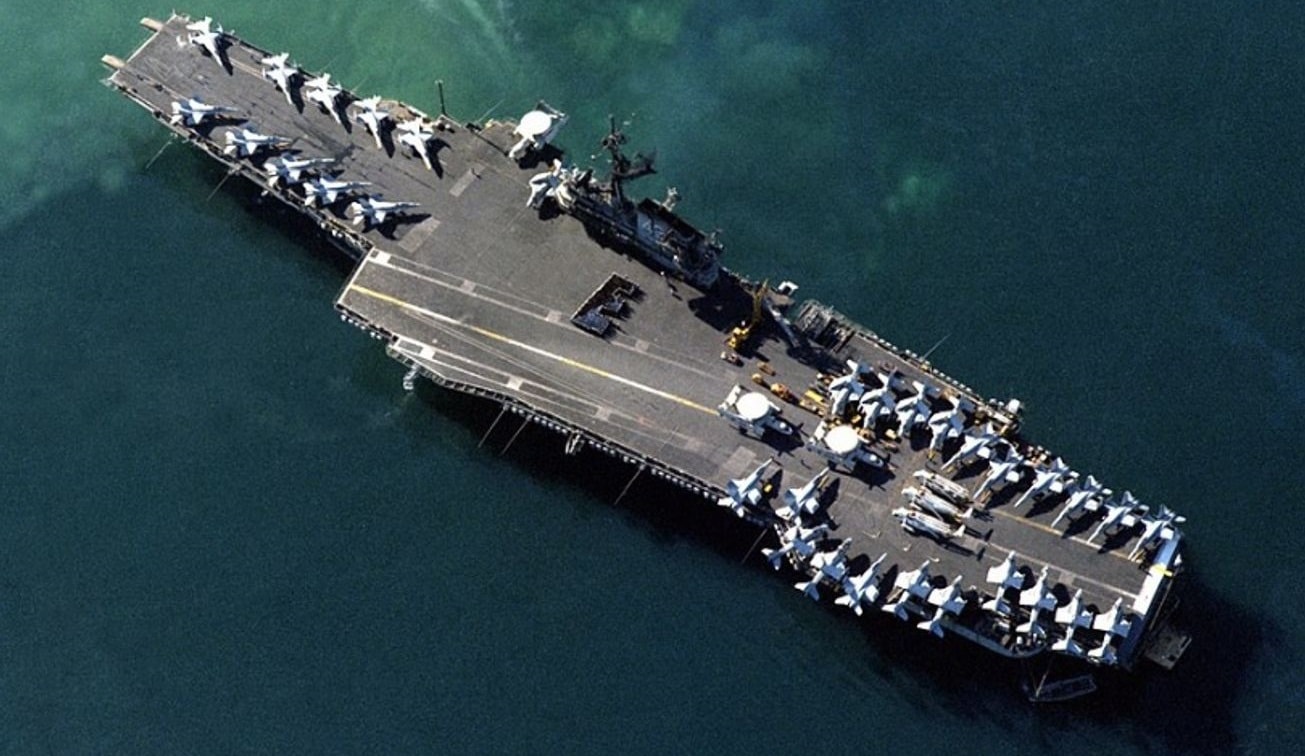
Article Summary – The Midway-class aircraft carriers were conceived during World War II but entered service too late to see combat, emerging instead as a crucial bridge between wartime flattops and Cold War supercarriers.
-Designed with British lessons in mind, they traded larger air wings for armored flight decks and tight compartmentalization, boosting survivability against bombs and kamikaze-style attacks.
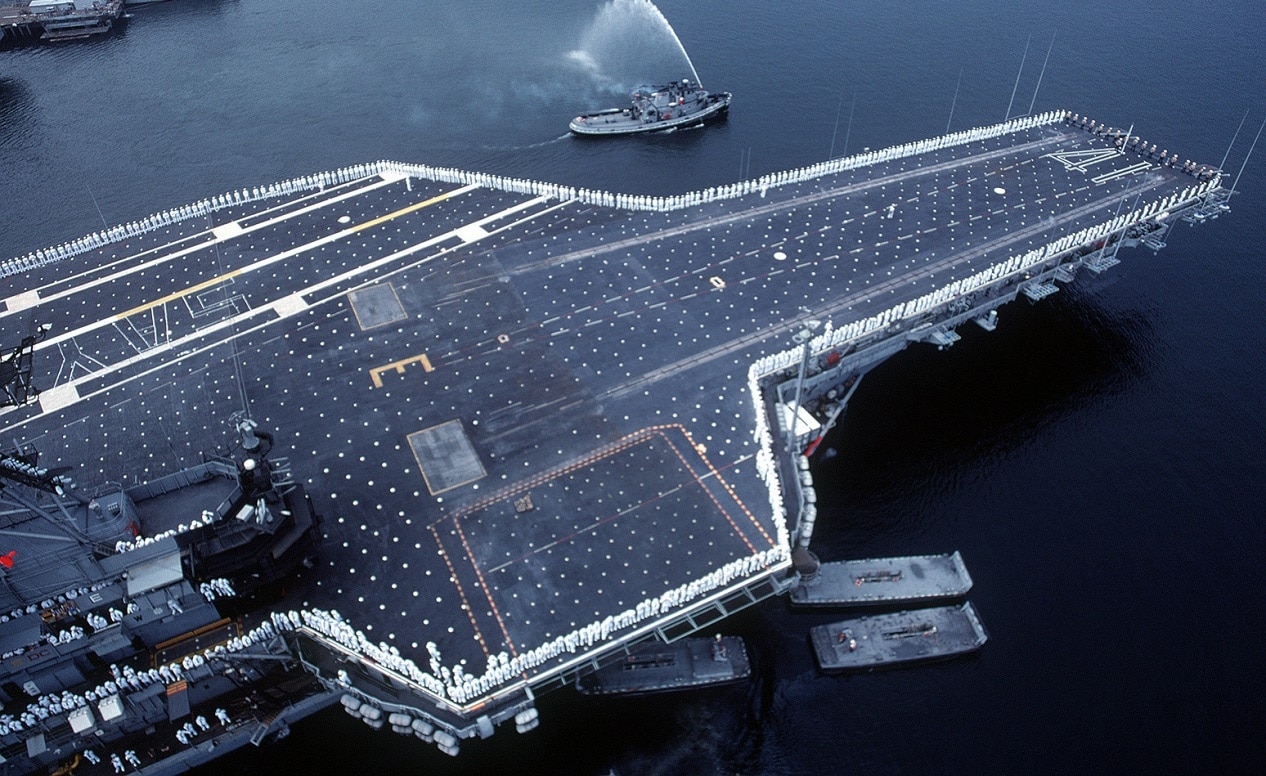
The aircraft carrier USS MIDWAY (CV-41) moves away from the pier as it departs from Yokosuka for the last time. The MIDWAY, which has been based in Japan since 1973, will be replaced by the aircraft carrier USS INDEPENDENCE (CV-62) as the Navy’s forward-based aircraft carrier.
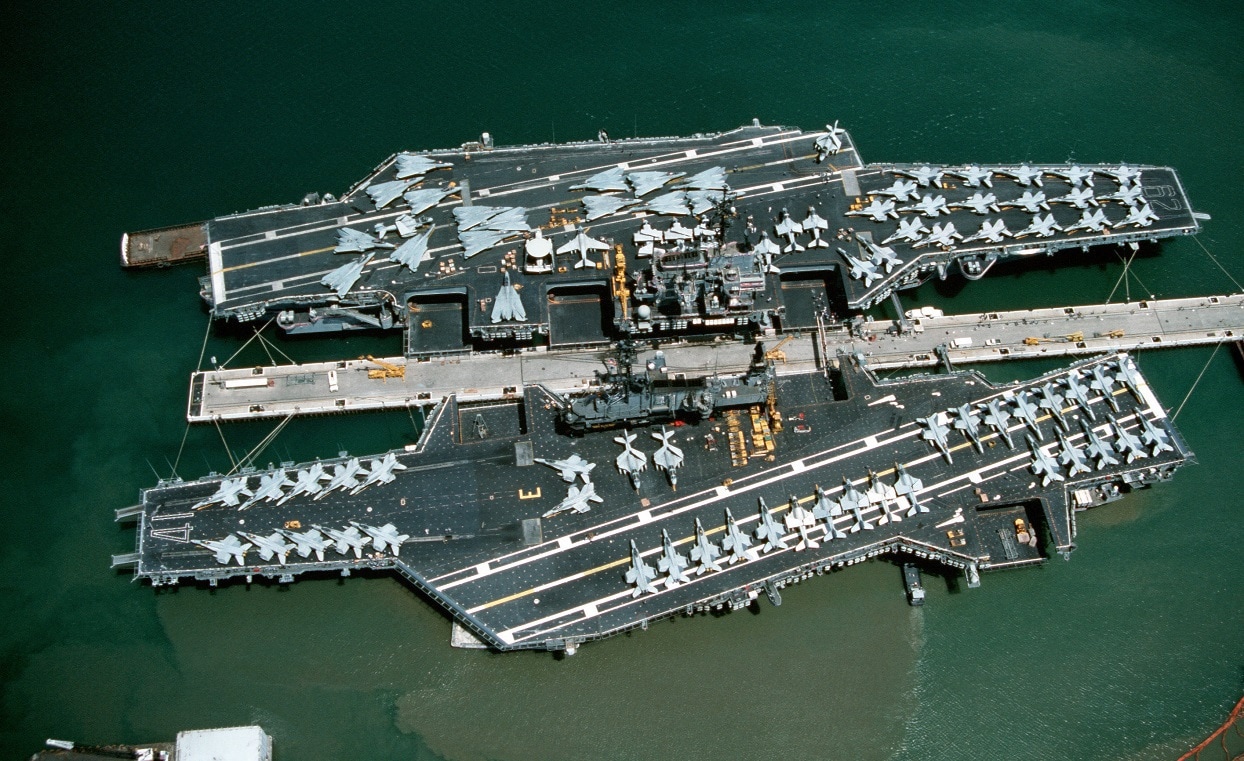
An aerial view of various aircraft lining the flight decks of the aircraft carrier USS INDEPENDENCE (CV-62), right, and USS MIDWAY (CV-41) moored beside each other in the background. The MIDWAY is en route from Naval Station, Yokosuka, Japan, to Naval Air Station, North Island, California, where it will be decommissioned in the spring of 1992. The INDEPENDENCE will travel to Yokosuka to take over as the Navy’s forward-based aircraft carrier.
-Though initially optimized for piston aircraft, their sheer size and strengthened decks made them ideal for jet operations after extensive postwar modernizations.
-With only three hulls built, the Midway-class nevertheless served for decades and secured a distinctive place in U.S. naval history.
The Midway-Class Aircraft Carriers: The World War II Giants That Missed the War
The Midway-class aircraft carriers hold the unique distinction of being the first American carriers laid down during World War II, but they were not completed until after the war.
Particular attention was paid to their design, which drew on the lessons of other Navy vessels, as well as those of allies, to ensure the ships were sufficiently armored to withstand hits from Japanese pilots.
Conceived in 1940 and 1941, the carriers represented a transitional carrier design midway between the innovative but imperfect prewar aircraft carriers and the enormous supercarriers of the Cold War.
In 1 Word: Superpowers
Ahead of the Midway-class build, planners in the Navy sought to construct an aircraft carrier roughly the size of the large Essex-class, but also equipped with an armored flight deck.
This defensive measure would significantly enhance the ship’s ability to withstand fire. While the Essex-class aircraft carriers could ship up to 100 airplanes, the US Navy concluded that the necessary armor plating and other modifications would hamstring air wing sizes to just 64 aircraft.
The warships of the Royal Navy had several years of experience in facing the then-new threat of bombs dropping out of the air while at sea and onto their ships.
The expertise, gleaned from British battle reports, was put to use in the Midway-class design. “The damage experiences of several British carriers,” a US Navy war damage report says, “which, unlike US Carriers, were fitted with armored flight decks, demonstrated the effectiveness of such armor in shielding hangar spaces from GP bombs and vital spaces below the hangar deck from semi-armor-piercing (SAP) bombs.” But that armor came at a cost: weight.
To ship a near-triple-digit carrier flight wing, the Midway-class had to trim where it could. The first to be scrapped were the planned 8-inch guns, large batteries that would have given the Midway-class the firepower of a cruiser. Its anti-aircraft guns, 5-inch mounts, were also modified, from double to single mounts, to save weight.
In some places, the Midway-class flight deck sported up to three or four inches of armor plating integrated into the ship’s structure.
Consequently, below-deck hangar space was scarcer when compared to the Essex-class, but survivability, particularly against kamikaze attacks and direct hits on the flight deck, improved.
Reflecting the influence of British warships on the Midway-class design, the American carriers prioritized compartmentalization, dividing the ship into separate areas for ammunition, machinery, fuel, crew quarters, and other vital compartments that protected the volatile compounds that could explode and the Sailors who would have found themselves in harm’s way.
Compared to their contemporaries, the Midway-class was massive. Under standard load conditions, the carrier’s displacement amounted to 45,000 tons, a figure that increased to 60,000 tons under full load, making them the largest displacement carriers in the world until the US Navy’s Cold War-era nuclear-powered carriers surpassed them. So wide were the ships at the beam, at 113 feet, that they were not designed to transit the Panama Canal.
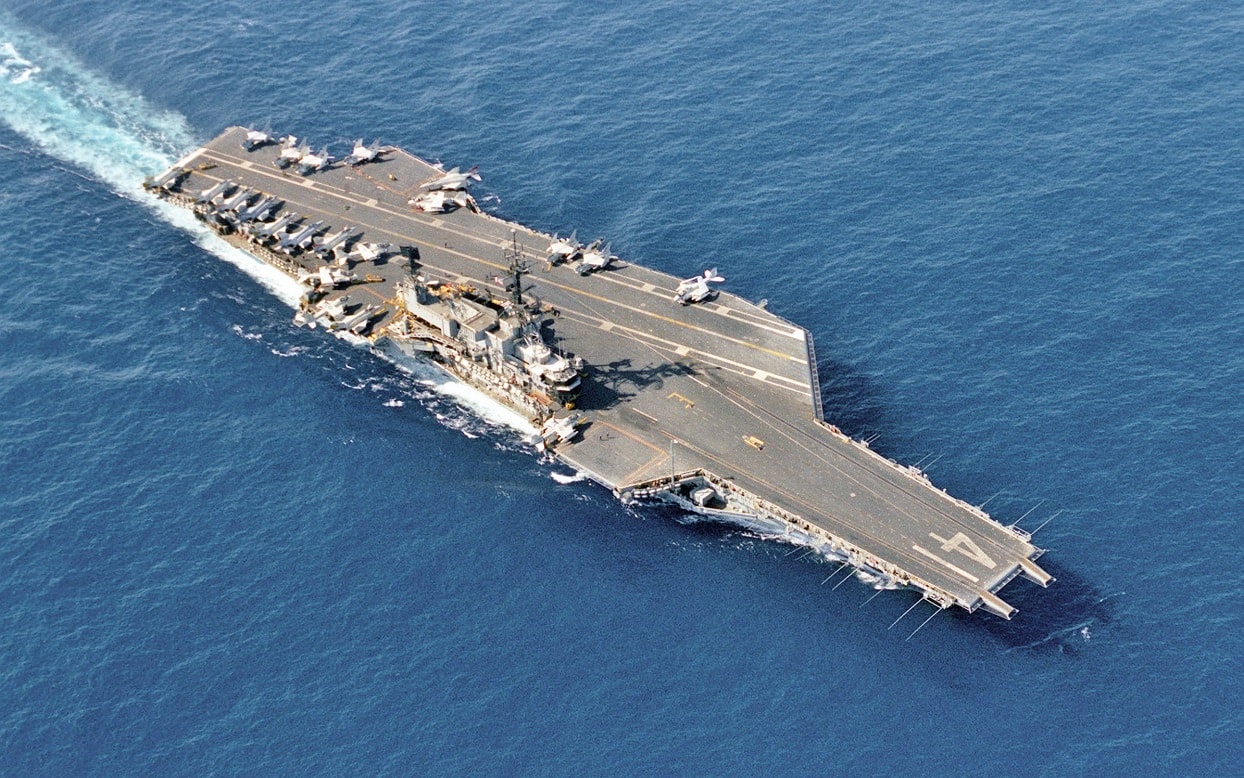
An elevated starboard bow view of the aircraft carrier USS MIDWAY (CV 41) underway off the coast of Okinawa, Japan.
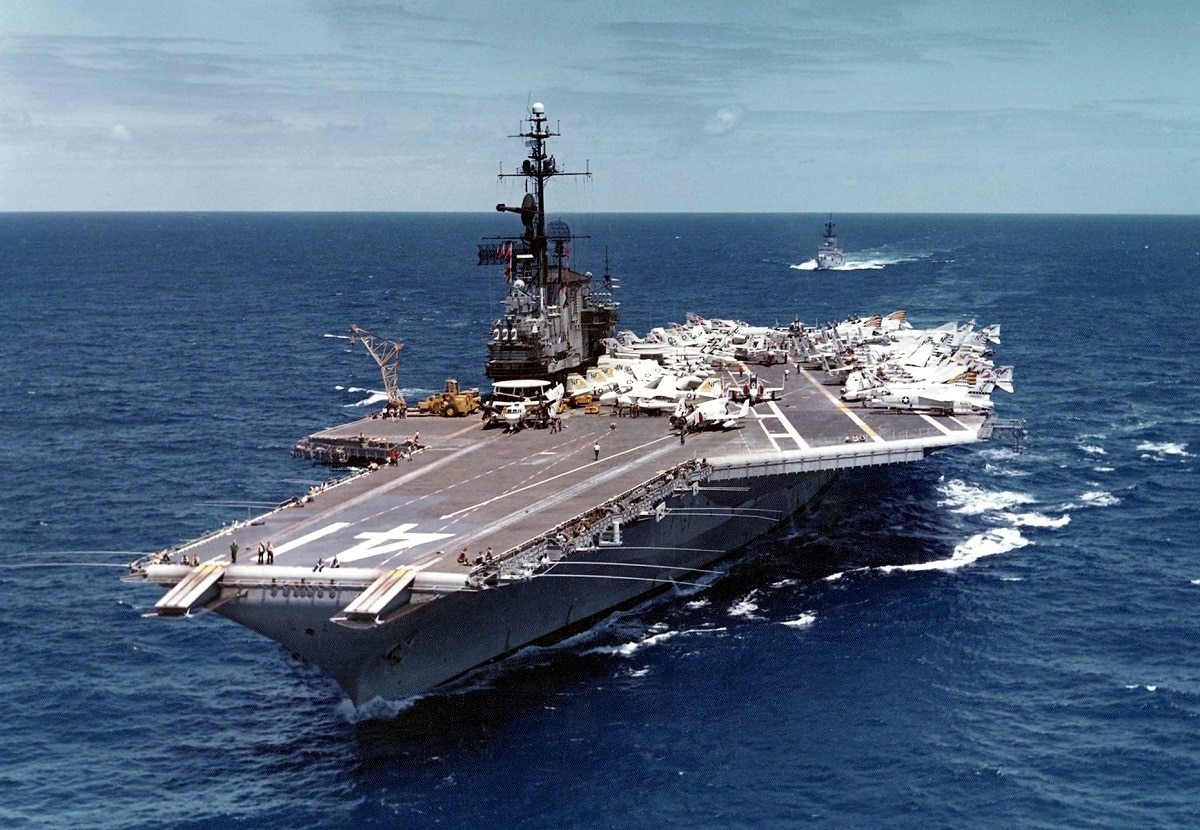
Midway-Class Aircraft Carriers. Image: Creative Commons.
Originally, the Navy intended the Midway-class to operate with 120 to 130 of the era’s piston-powered aircraft. This future was scaled back when it became apparent that there would not be enough space to accommodate that many.
However, as the Navy transitioned into the jet age, leaving behind the majority of the piston-powered aircraft that had propelled America to victory, the Midway-class’s large size became an asset.
The Midway-class could better handle the rigors of jet aircraft operations despite those planes’ higher weight, a consequence of the Midway’s larger size and flight decks.
The Ships
Compared to the Nimitz-class or the upcoming Gerald R. Ford-class, both nuclear-powered aircraft carriers, the Midway class was a small one: just three hulls entered service with the US Navy: the lead of the class, USS Midway, USS Franklin D. Roosevelt, and USS Coral Sea. The ships were commissioned over two years, from 1945 to 1947, and thus missed the Second World War.
However, they were just in the nick of time for the Cold War. They served for decades thanks in part to comprehensive modernization programs that included deck strengthening for jet aircraft, a redesigned bow for better handling, steam catapults for launching aircraft, and reangled flight decks. Their adaptability was one of their strengths: the USS Midway served until after the Cold War, retiring in 1992.
It is incredible to think the Midways survived as long as they did. As one U.S. Naval Institute Publication notes, “When the CVB-41 [the first of the Midways] was launched on March 20, 1945, the U.S. Navy had 88 aircraft carriers of all types and sizes in commission. Another 25 were under construction, and an additional 31 were on order. Although more than two-thirds of the flattops in service were escort carriers, 26 fast carriers were in service with 16 more in various stages of construction.” The Midway-class was a cut of a different cloth indeed.
The Midway-Class and a Place in Naval History
The Midway-class was one of those rare projects that were forward-thinking and innovative enough to survive, remaining useful to the Navy for decades.
Their forward-thinking design lent itself, perhaps inadvertently, to the jet age, straddling the divide between Second World War carriers and their later nuclear-powered supercarrier behemoths.
About the Author: Caleb Larson
Caleb Larson is an American multiformat journalist based in Berlin, Germany. His work covers the intersection of conflict and society, focusing on American foreign policy and European security. He has reported from Germany, Russia, and the United States. Most recently, he covered the war in Ukraine, reporting extensively on the war’s shifting battle lines from Donbas and writing on the war’s civilian and humanitarian toll. Previously, he worked as a Defense Reporter for POLITICO Europe. You can follow his latest work on X.