
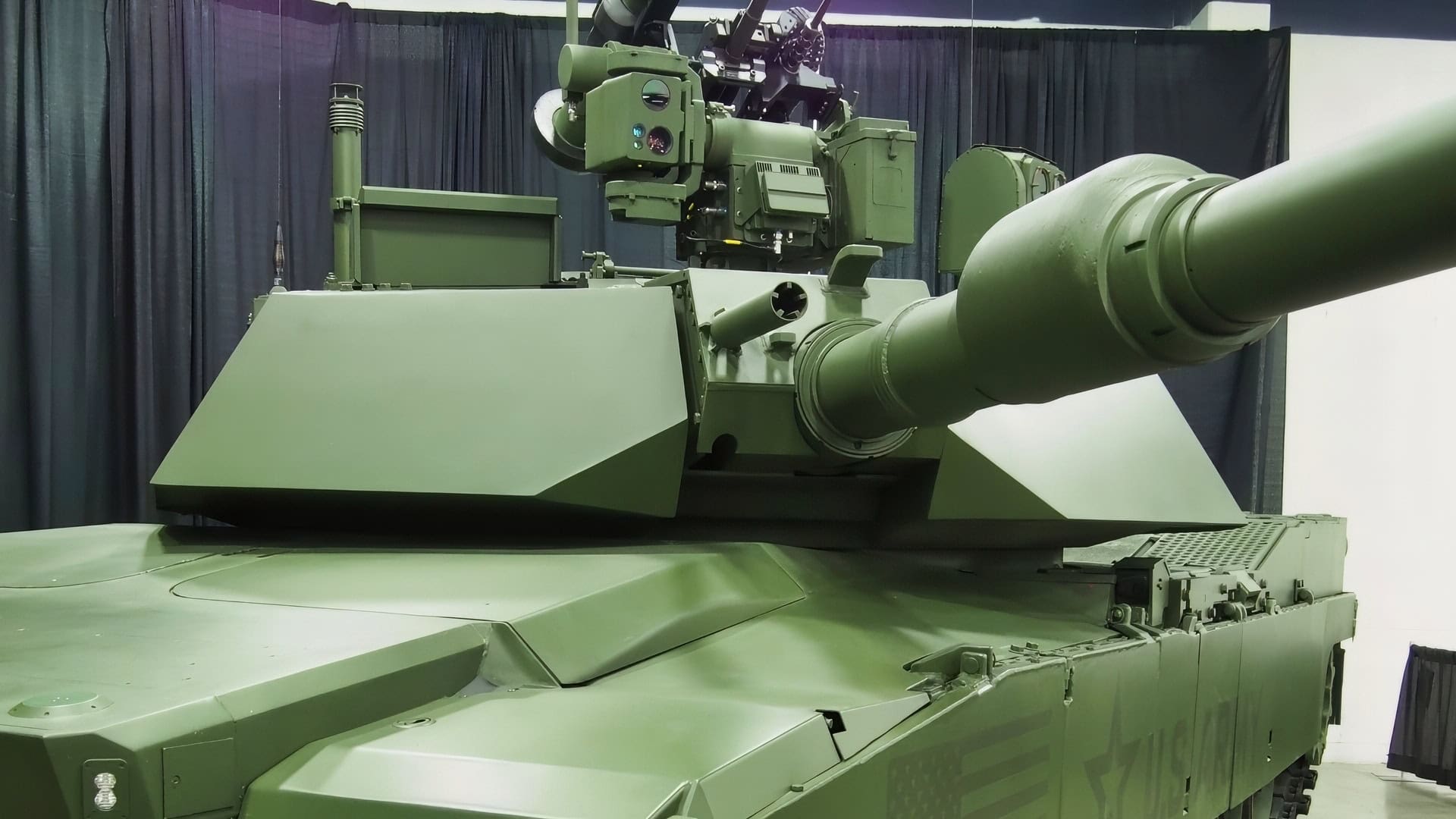
The war in Ukraine has been a rough wake-up call for many militaries around the world. Initially, shrugged off the heavy armored casualties as due to poor-quality Soviet materiel and poor tactics. However, when Western-made main battle tanks (MBTs) entered combat in 2023, they too were decimated by drones and other contemporary anti-tank weapons.
The uncomfortable truth that NATO realized is that most modern tanks are unprepared for the drone-centric era of warfare that we are now in. This realization prompted the U.S. to shift its priorities when designing its next-generation MBT. The M1A2 SEPv4 was canceled in favor of the M1E3, a heavily modified Abrams variant designed for today’s drone-centric battlefield. But is it enough?
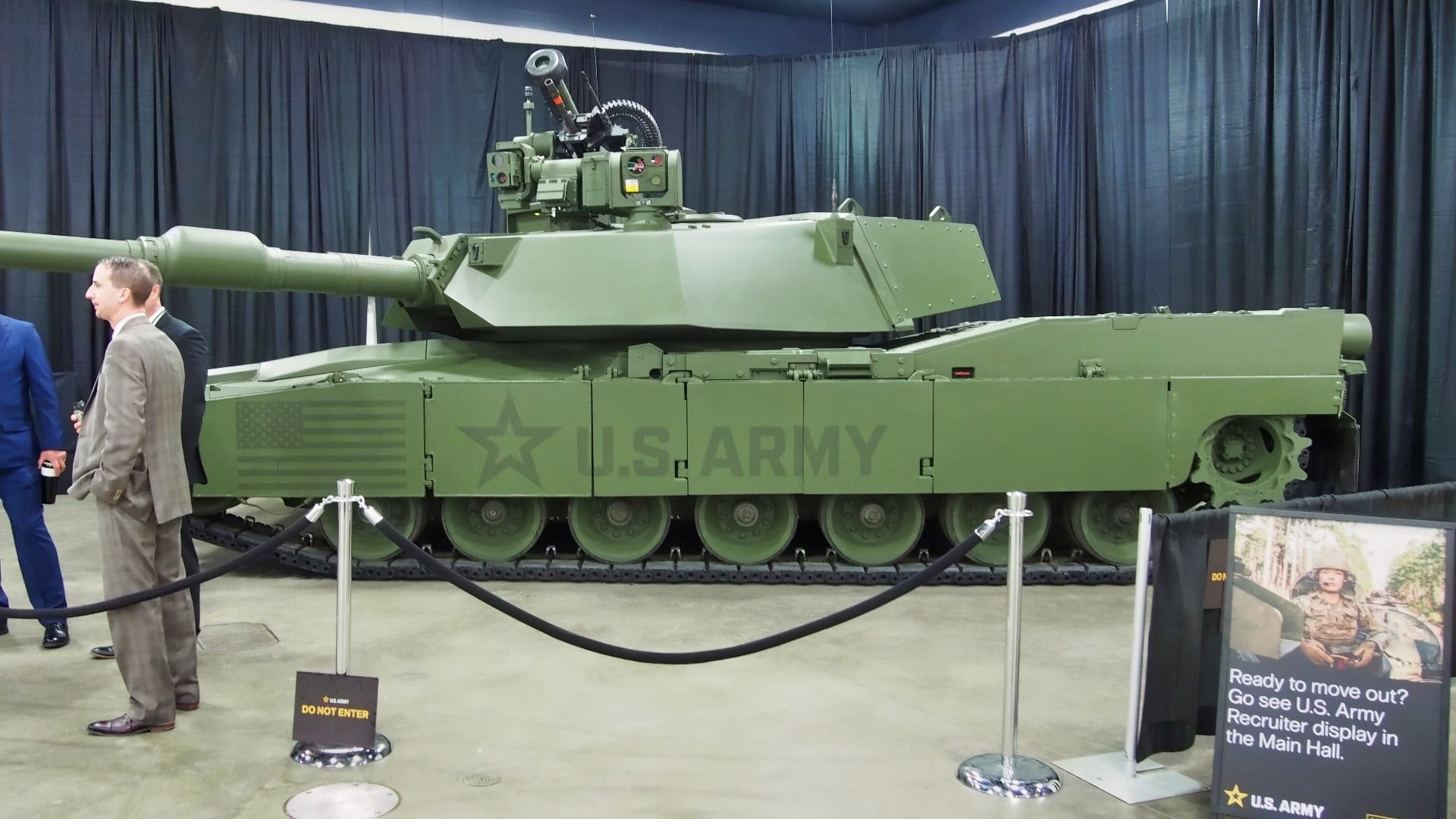
M1E3 Abrams Tank. Taken by 19FortyFive.com
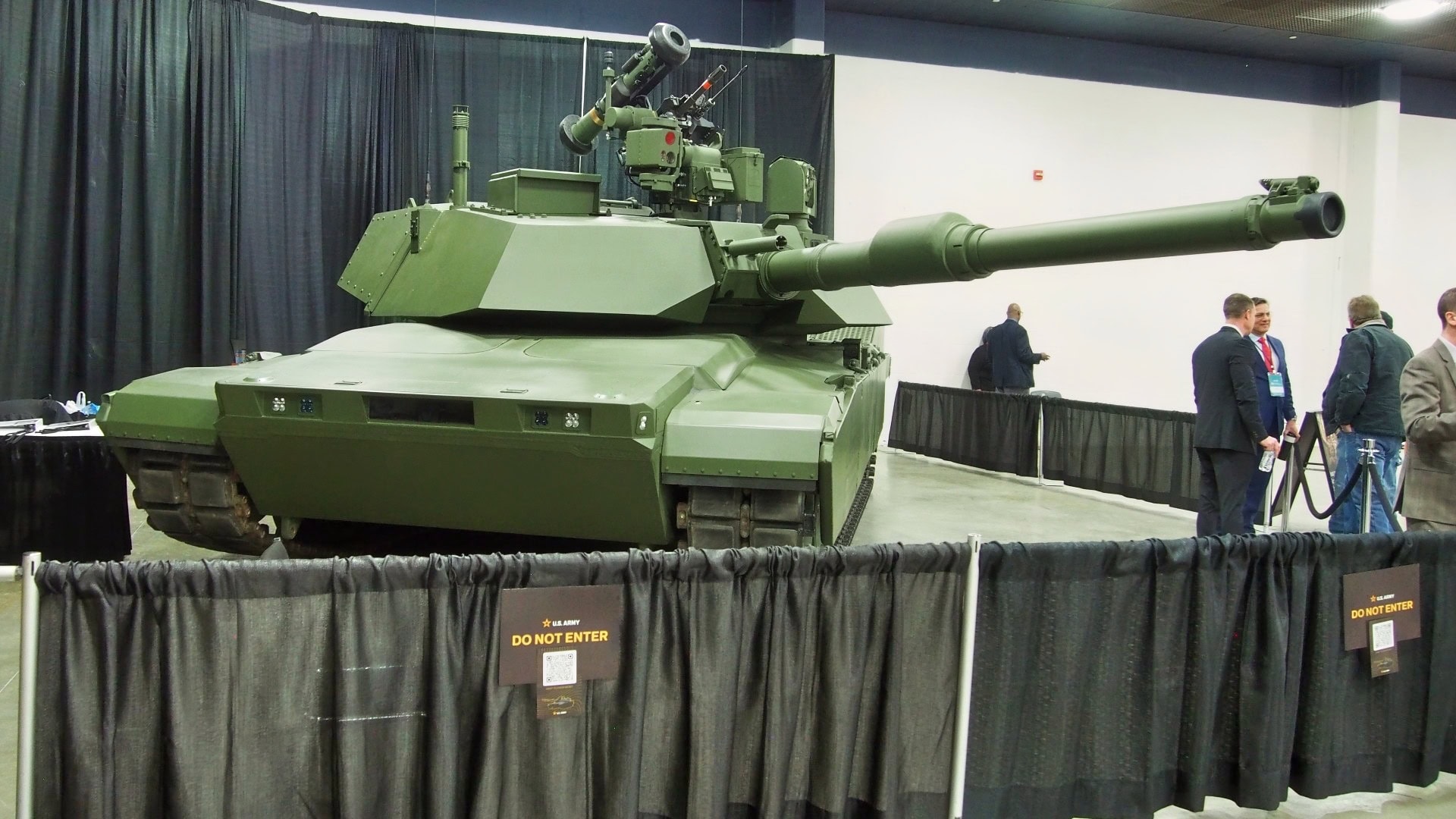
M1E3 Abrams Tank. Taken by 19FortyFive.com
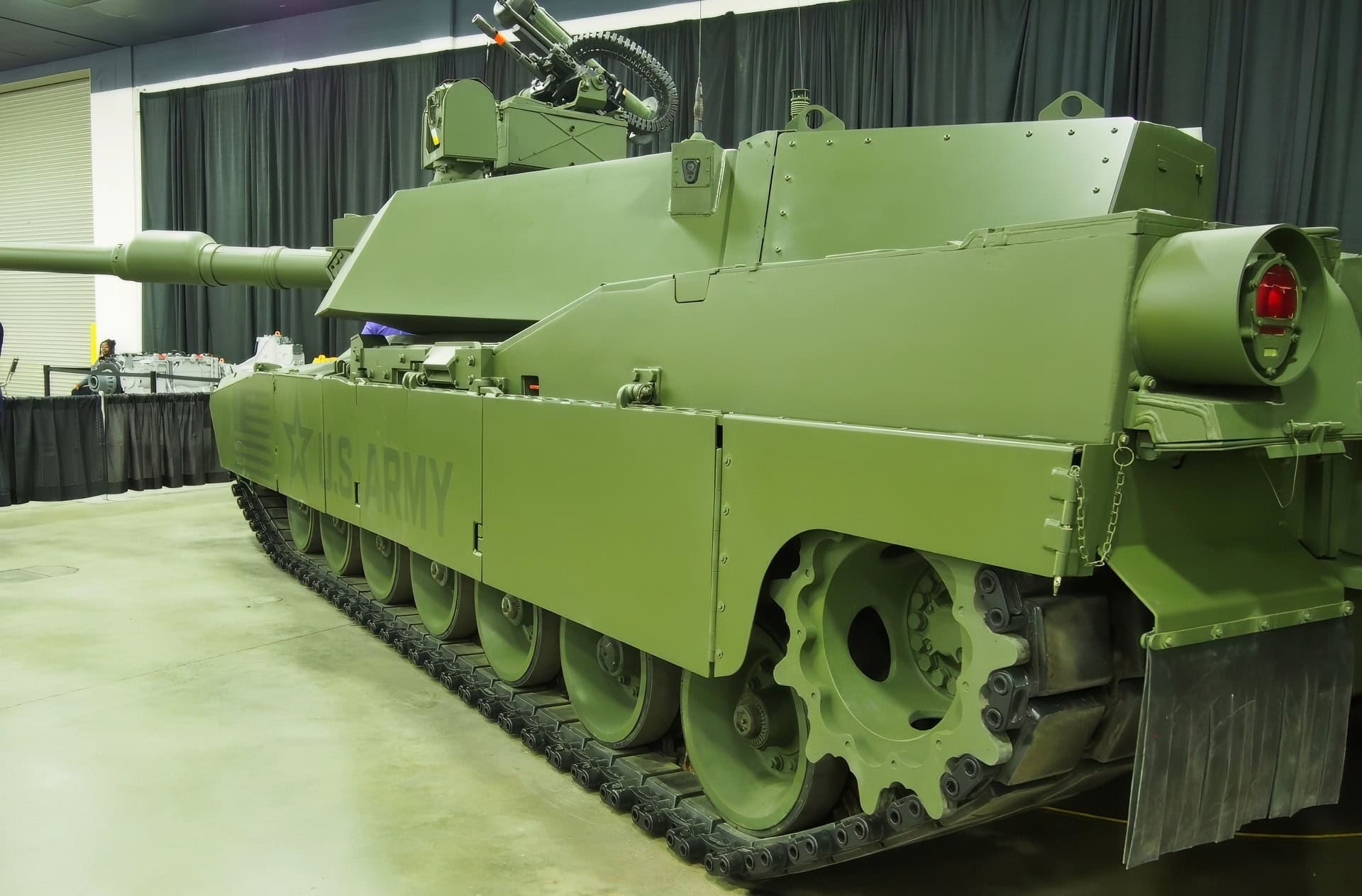
M1E3 from Detroit Auto Show. 19FortyFive.com Original Image.
Industrial Challenge: The M1E3 Abrams Tank vs Drones
The M1E3 is not a “revolutionary” change to the Abrams in a traditional sense. The tank retains much of what makes the Abrams family effective on the battlefield, i.e., its armor, chassis, main armament, and so on.
The new variant does, however, introduce some radical changes to the tank. The turret is completely unmanned, with the designated loader removed, thereby reducing the crew to only three members. The main idea behind this change is to drastically increase crew safety and survivability. By repositioning the crew away from the turret, they are also completely isolated from any ammunition, which eliminates the possibility of ammo cook-offs killing the crew. While most Western MBTs have blowout panels for the ammo compartment, there is still a significant risk to the crew if any ammo were to detonate during the reloading process.
The M1E3 appears to be taking a hard-kill/soft-kill dual approach to the drone problem. The tank will reportedly be equipped with the M251, an American license of the Israeli Iron Fist active protection system (APS) to protect against incoming threats.
Unlike previous Abrams tanks that used the Trophy system as an add-on package, the M1E3 will have APS integrated directly into the turret architecture to eliminate dead weight, a problem with the SEPv3 and SEPv4. The Iron Fist APS has recently been configured not only to counter missiles but also to intercept drones, an especially important capability on today’s battlefields. Some experts theorize that the tank could also be fitted with EW systems to mask the tank’s electronic signatures or disrupt incoming drones.
General Dynamics Has a New Idea: A New Abrams For Today’s Battlefields
Other changes to the tank include mobility improvements. The M1E3 is shifting away from the Abrams’ traditional gas turbine engine and now shifting to a hybrid diesel-electric powerplant.
The demonstrator tank unveiled in January used a CAT C13D 6-cylinder engine rated at 1,100 hp, along with a 250-hp electric motor for auxiliary power. This new configuration, along with changes to the tank’s suspension, is designed for several purposes. First, it improves energy efficiency by eliminating the fuel-hungry gas turbine and reducing the tank’s acoustic signature. Second, the smaller power pack and reworked suspension allow for greater internal space for the new armored capsule that will now house the entire crew.
The tank also includes numerous sensor suites to increase its networked capabilities and situational awareness. Many of the upgrades originally intended for the M1A2 SEPv4 are being used on the M1E3, such as improved forward-looking infrared (FLIR) sights and a distributed vision system, which allows the crew to “see” through the tank’s hull.
New sensors and battle management systems are being added to the tank to ensure the crew always has a complete, continually updated picture of the battlefield. The tank’s onboard computers will automatically detect and designate targets and are designed to allow the gunner, commander, or even the driver to fire the tank’s main gun if necessary.
While some of these features do not necessarily address drone-related issues, they are still important for the next generation of MBTs.
Understanding the Role of Tanks in Drone-Centric Warfare
Returning to the original question, does the M1E3 incorporate enough defensive systems to survive on the battlefields of today? No, but also yes.
Here’s the thing: no tank on its own will ever be enough to survive the drone age, no matter how many APS or EW systems are added. No tank will ever be able to survive on its own in any age. Tanks are not designed to operate on their own.
According to American armored doctrine, tanks are one component of a broader combined-arms fighting force comprising infantry, support vehicles, aircraft, artillery units, and more. In any well-planned operation, the tank will almost never be operating alone and should always have support on call if the situation goes south.
The introduction of drones complicates matters for sure, but the central tenets of combined arms doctrine remain fundamentally sound.
The U.S. Army need not change its whole doctrine to account for drones; rather, it needs to integrate UAS and counter-UAS into its already existing doctrine. The M1E3 is therefore the right course of action for the Army.
The tank incorporates everything that still works in the Abrams family, while also incorporating new technology and leaving plenty of room for improvement. Alone, the tank is still vulnerable to drones, but the tank is not designed to fight alone.
It is designed to fight alongside infantry and support vehicles, some of which will be configured specifically to counter drones.
About the Author: Isaac Seitz
Isaac Seitz, a Defense Columnist, graduated from Patrick Henry College’s Strategic Intelligence and National Security program. He has also studied Russian at Middlebury Language Schools and has worked as an intelligence Analyst in the private sector.