
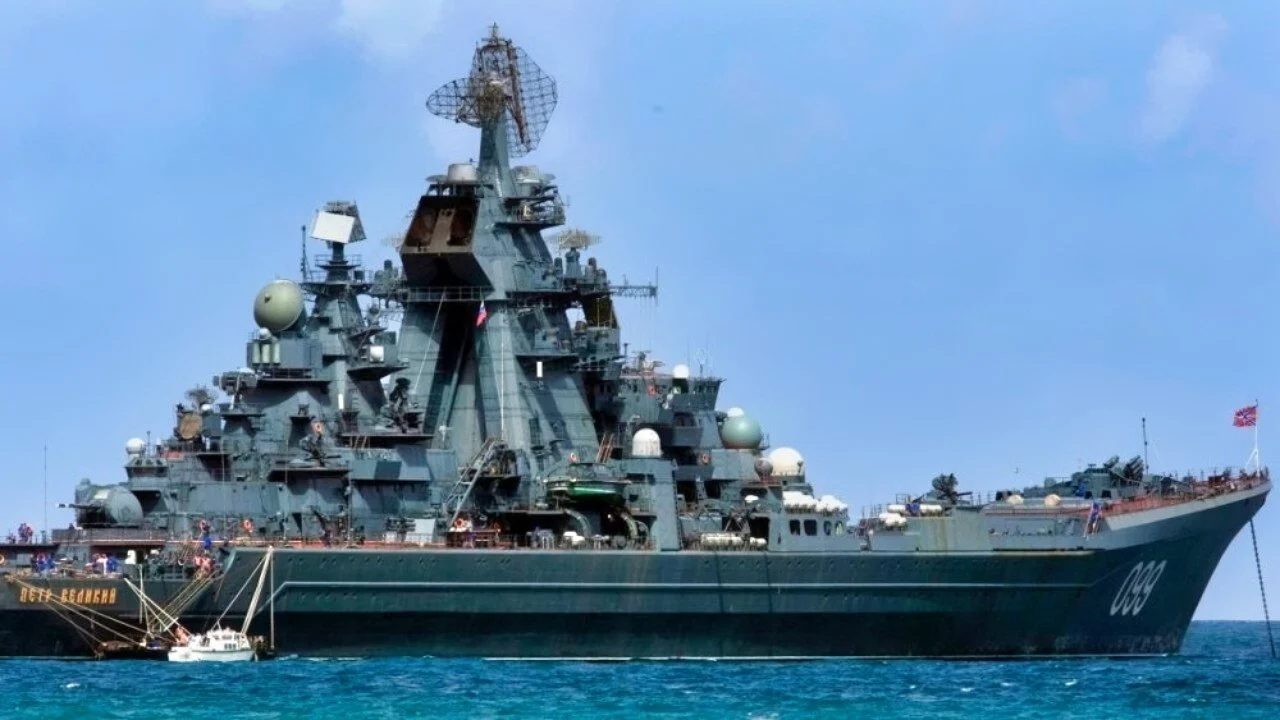
Summary and Key Points: Russia has returned the nuclear-powered battlecruiser Admiral Nakhimov to sea trials after a modernization at the Sevmash shipyard that ran 27 years from the ship’s 1999 arrival, longer than its entire frontline career as a Soviet warship. The United Shipbuilding Corporation project grew from a 50-billion-ruble contract in 2013 to unofficial estimates of nearly 200 billion rubles, about 2.67 billion dollars, a fourfold increase. The rebuilt cruiser carries roughly 176 vertical launch cells, the largest air-defense magazine of any surface combatant, and two nuclear reactors driving it at nearly 32 knots. The open question is whether concentrating that much capability and money into one irreplaceable hull was the right choice for a strained fleet.
Introduction
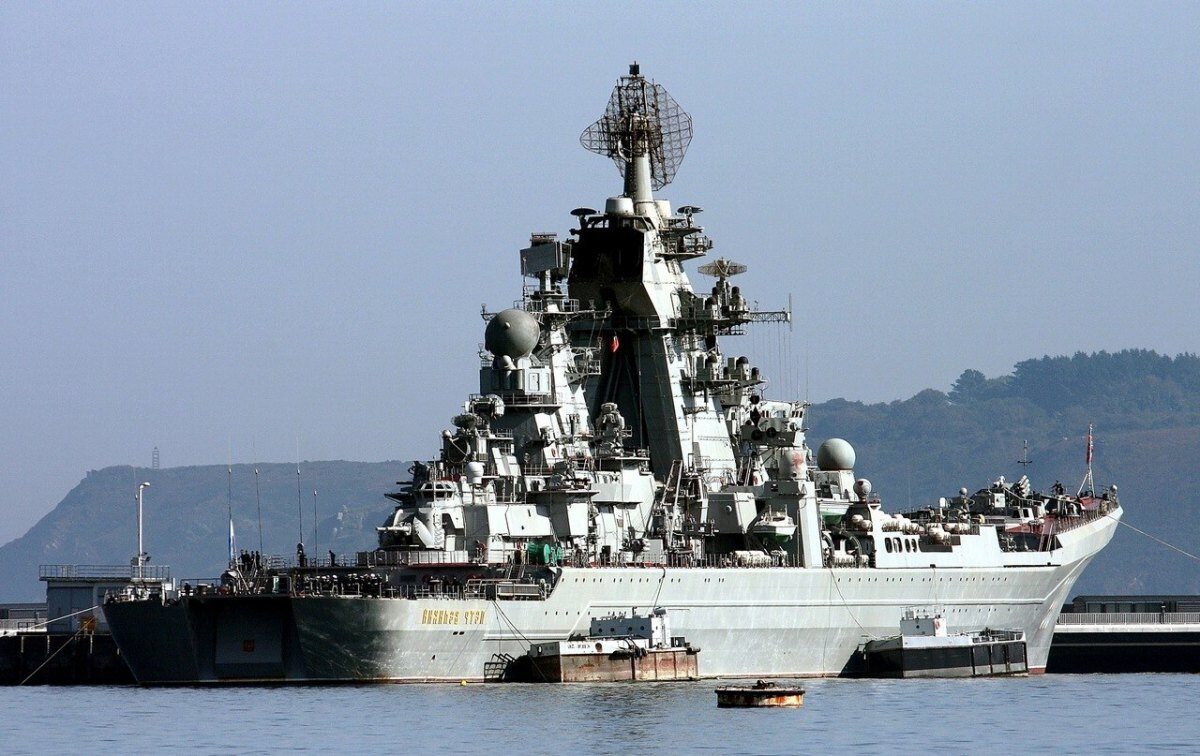
Kirov-Class. Image Credit: Creative Commons.
The United Shipbuilding Corporation and the Sevmash shipyard have spent the better part of three decades and, by unofficial estimates, roughly 200 billion rubles, turning a laid-up Soviet cruiser into what Russian media now presents as essentially a new warship. The result, the nuclear-powered battlecruiser Admiral Nakhimov, is impressive by any raw measure of naval power. It is also a case study in a philosophy of naval warfare that the rest of the world, and the evidence of the past three years, has moved away from. Nakhimov is unquestionably powerful. The harder question is whether concentrating this much capability, and this much money, into one irreplaceable ship makes sense in 2026.
What Sevmash Actually Rebuilt: 80 Strike Cells and the World’s Largest Naval Air-Defense Magazine
The modernization stripped the ship down to the hull and replaced its entire combat system, and the firepower it emerged with is real.
During the refit at Sevmash, engineers removed the Cold War-era launchers that once held 20 P-700 Granit anti-ship missiles and installed banks of universal UKSK 3S14 vertical launch cells. Open-source reporting and shipyard imagery point to roughly 80 of these strike cells, capable of firing the Kalibr family of land-attack and anti-ship cruise missiles, the supersonic P-800 Oniks, and the 3M22 Zircon hypersonic missile. Russian sources describe a total vertical-launch fit as high as 176 cells when the air-defense magazine is included, split between roughly 80 for strike weapons and 96 for air defense.
That air-defense magazine is the ship’s most genuinely distinctive feature. Nakhimov carries a modernized version of the Fort family, the naval S-300 lineage, augmented in reporting by point-defense systems intended to handle sea-skimming missiles and drones.
The combined figure, well above that of any Western surface combatant, gives the ship by far the largest surface-to-air missile arsenal afloat. For comparison, the United States Navy’s Arleigh Burke-class destroyers carry up to 96 vertical launch cells total, and China’s Type 055 cruisers up to 112, and both of those figures cover strike and air-defense weapons together.
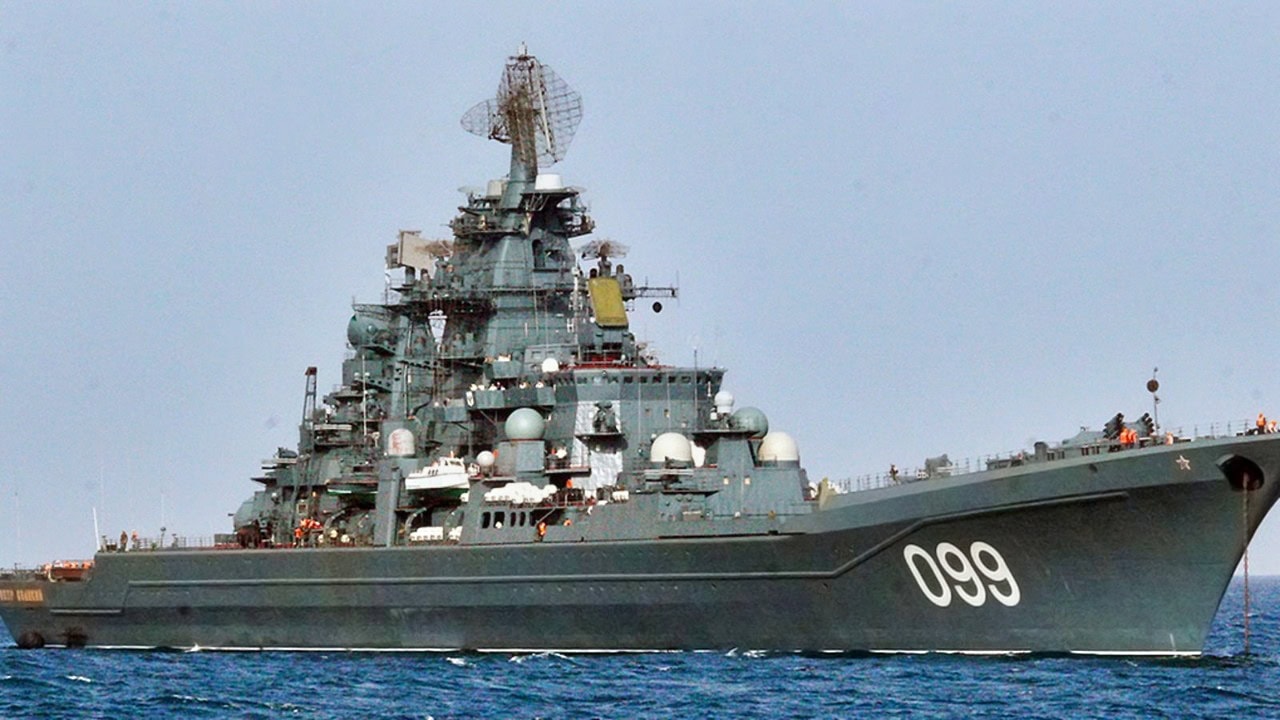
Kirov-Class Battlecruiser Russian Navy. Image Credit: Creative Commons.
On magazine depth alone, Nakhimov has no peer among surface combatants. The ship pairs that arsenal with two KN-3 nuclear reactors producing about 140,000 shaft horsepower, giving it a top speed near 32 knots and effectively unlimited range, the only nuclear-powered surface combatant class still in service anywhere.
A 27-Year, Fourfold Cost Overrun for a Single Hull
The bill for that capability is where the strategic problem begins. Sevmash signed the modernization contract in 2013 for about 50 billion rubles, then roughly $667 million, with the ship due back in the fleet by 2018. Neither figure held.
The work dragged across more than a decade of funding interruptions and technical complexity; the reactors were not restarted until December 2024 and February 2025, and the ship did not enter final sea trials until June 2026. Unofficial cost estimates by then had climbed to around 200 billion rubles, roughly $2.67 billion, a fourfold increase over the original contract. Measured from the ship’s arrival at the shipyard in 1999 to its expected return, nearly 27 years will have passed, a span longer than the cruiser’s entire frontline career as a Soviet warship.
The delays are not merely embarrassing. They frame the central question because $2.67 billion and 27 years of a shipyard’s time represent choices not made elsewhere. Russia has struggled to build large surface warships since the Soviet collapse, and the resources poured into one rebuilt cruiser are resources a strained navy and defense budget could have distributed very differently.
That is the standard against which the ship’s firepower must be measured, and it is a standard that the concentration of capability in a single hull does not meet well.
The Case for Distribution: What $2.7 Billion Buys Across a Fleet
Modern naval powers have spent the last two decades moving deliberately in the opposite direction from Nakhimov. American and Chinese fleet development increasingly emphasizes distributed firepower, sensor networking, and large numbers of interoperable combatants rather than concentrating capability into a few capital ships. The logic is straightforward, and it is about how fleets absorb losses.
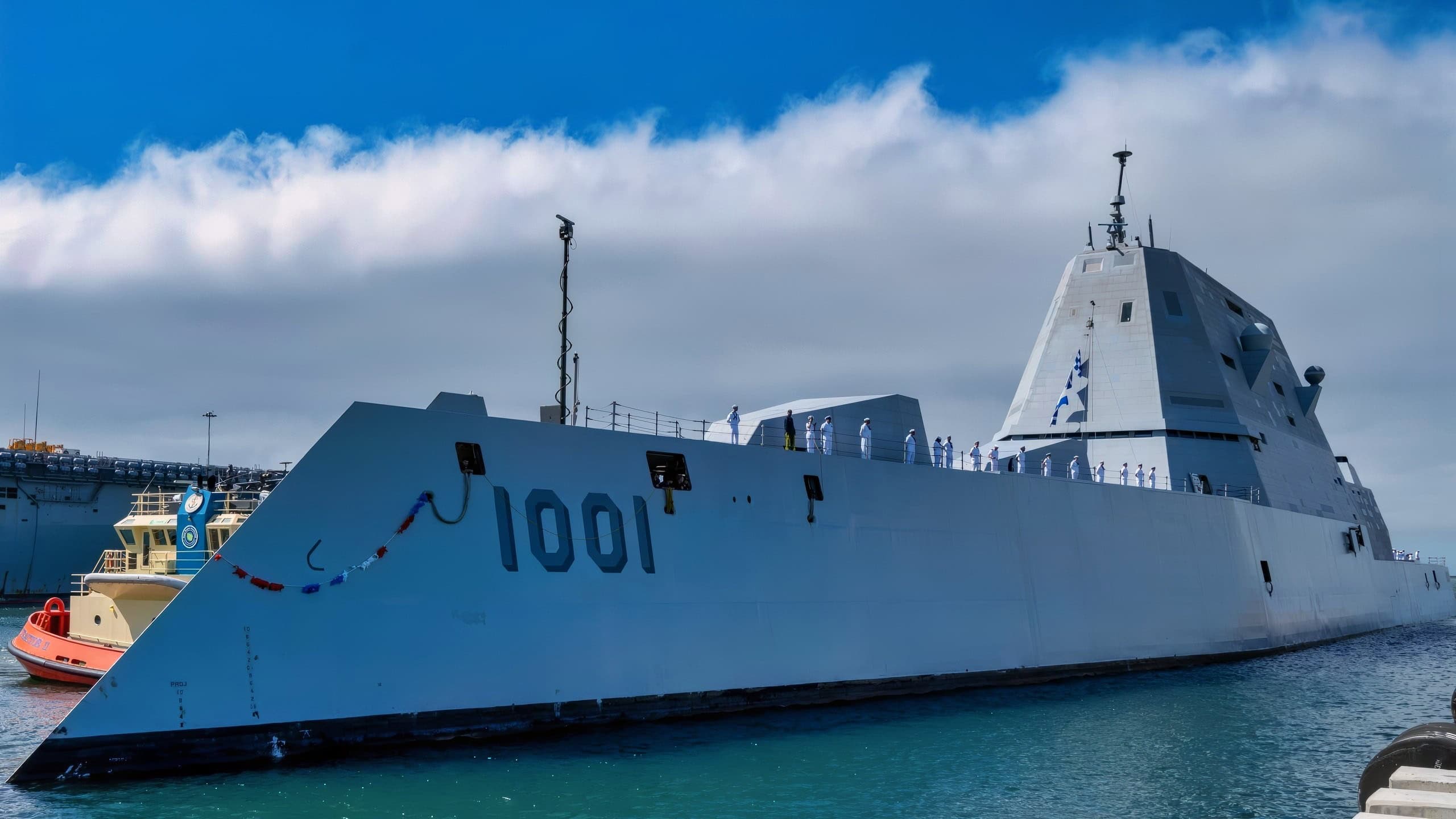
The Zumwalt-class guided missile destroyer USS Michael Monsoor (DDG 1001) returns to its homeport following routine operations in the U.S. 3rd, and 7th Fleet areas of operations to maintain a free and open Indo-Pacific, Oct. 3. An integral part of the U.S. Pacific Fleet, U.S. 3rd Fleet leads naval forces in the Indo-Pacific and provides the realistic, relevant training necessary to execute the U.S. Navy’s role across the full spectrum of military operations. U.S. 3rd Fleet works together with allies and partners to advance freedom of navigation and overflight, the rule of law and other principles that underpin security for the Indo-Pacific region. (U.S. Navy photo by Gunner’s Mate 2nd Class Timothy Weber)
A Russian Project 22350 frigate carries 16 UKSK strike cells, the same launcher family as Nakhimov. The strike firepower concentrated in the battlecruiser’s roughly 80 cells, distributed instead across frigates, would spread that capability over five or more separate hulls, and the roughly $2.67 billion spent rebuilding one cruiser would fund a meaningful number of them.
The difference matters enormously in wartime. Losing one frigate from a fleet of many degrades overall capability only marginally, because the missiles and the launch platforms are spread across many ships. Losing Nakhimov means losing a single platform that carries a disproportionate share of the Russian surface fleet’s missile inventory in a single event, along with the navy’s largest air-defense magazine.
A distributed force is resilient by design. A fleet built around a handful of irreplaceable capital ships is brittle, and Nakhimov is the most concentrated, most expensive, and least replaceable node in the entire Russian surface navy. Every missile and every ruble packed into that one hull is a capability that cannot be in two places at once and cannot survive the loss of the ship.
The Moskva Precedent: Cheap Weapons Against Expensive Ships
The argument against concentration is not theoretical, because Russia has already lived it. In April 2022, the cruiser Moskva, the flagship of Russia’s Black Sea Fleet, was struck by two Ukrainian Neptune anti-ship missiles and sank, the largest warship lost in combat in decades.
The weapons that killed a flagship were far cheaper than the ship they destroyed, and the loss was as much a strategic and narrative blow as a material one.
Since then, Ukrainian uncrewed surface vessels, essentially inexpensive drone boats packed with explosives, have driven much of Russia’s Black Sea Fleet into port and damaged or destroyed additional vessels, despite those ships carrying close-in defensive systems meant to stop exactly such attacks.
The lesson that applies to Nakhimov is direct. Uncrewed systems share a decisive advantage: they are expendable, and no one mourns a destroyed drone boat, but a single successful strike can inflict damage out of all proportion to the attacker’s cost. Large capital ships are not meaningfully better armored than the vessels Russia has already lost, and a battlecruiser is not immune to the physics that sank the Moskva.
Analysts have pointedly noted that the money spent on adding new long-range air defenses and cruise missiles to Nakhimov might have been better invested in fire suppression and damage control that could actually help a ship survive a hit. The more value concentrated into one hull, the more attractive that hull becomes as a target, and the more catastrophic its loss. Nakhimov places more value than any other surface ship that Russia operates.
The Counterweight: Why the Arctic Is Not the Black Sea
The case against Nakhimov is strong, but it is not the whole picture, and the ship’s actual assigned mission complicates the obsolescence argument in ways worth stating plainly. Nakhimov is not headed for the drone-saturated Black Sea.
It is assigned to the Northern Fleet at Severomorsk, and its primary role is to protect the bastion in the Barents Sea where the majority of Russia’s ballistic missile submarines operate, the submarines that anchor the survivable leg of Moscow’s nuclear deterrent. In that theater, the calculus shifts. There is no equivalent to Ukraine’s fleet of cheap surface drones operating in the high Arctic, and the vast distances and sparse port infrastructure of the northern waters are exactly where nuclear propulsion and effectively unlimited range become a genuine operational advantage that no conventionally powered ship can match.
For that mission, the ship’s attributes are real assets rather than liabilities. Its enormous air-defense magazine makes it a formidable protective node for the bastion, its Zircon and Oniks missiles pose a real threat to any NATO surface group operating in the region, and its 32-knot speed lets it move quickly to reinforce the Greenland-Iceland-United Kingdom gap, the chokepoint separating the Arctic from the North Atlantic.
Nuclear power enables sustained operations across the Arctic in conditions that would strain a conventional warship’s fuel and endurance. In its designed niche, protecting the nuclear deterrent in home waters under the cover of coastal aviation, Nakhimov is a defensible platform performing a mission where survivability against drone swarms matters far less than it does in the Black Sea.
The fair verdict, then, is not that Nakhimov is useless, but that it is a questionable allocation of scarce resources.
The ship will do its Arctic job with real capability. Whether that job justified 27 years, $2.67 billion, and the concentration of so much of a shrinking navy’s firepower into one irreplaceable hull is a different question, and the answer runs against the ship.
Russia is retiring, not modernizing, its sister ship Pyotr Velikiy, and its lone aircraft carrier remains mired in endless yard work. A navy with those constraints chose to pour a fortune and three decades into a single Cold War hull, at a moment when the cheapest weapons at sea have repeatedly proven they can sink the most expensive ships. Nakhimov is a magnificent warship and, most likely, the wrong one to have built.
About the Author: Harry J. Kazianis
Harry J. Kazianis (@Grecianformula) was Senior Director of National Security Affairs at the Center for the National Interest (CFTNI), a foreign policy think tank founded by Richard Nixon based in Washington, DC. Harry has over a decade of experience in think tanks and national security publishing. His ideas have been published in the NY Times, The Washington Post, The Wall Street Journal, CNN, and many other outlets worldwide. He has held positions at CSIS, the Heritage Foundation, the University of Nottingham, and several other institutions related to national security research and studies. He is the former Executive Editor of the National Interest and the Diplomat. He holds a Master’s degree focusing on international affairs from Harvard University.

