
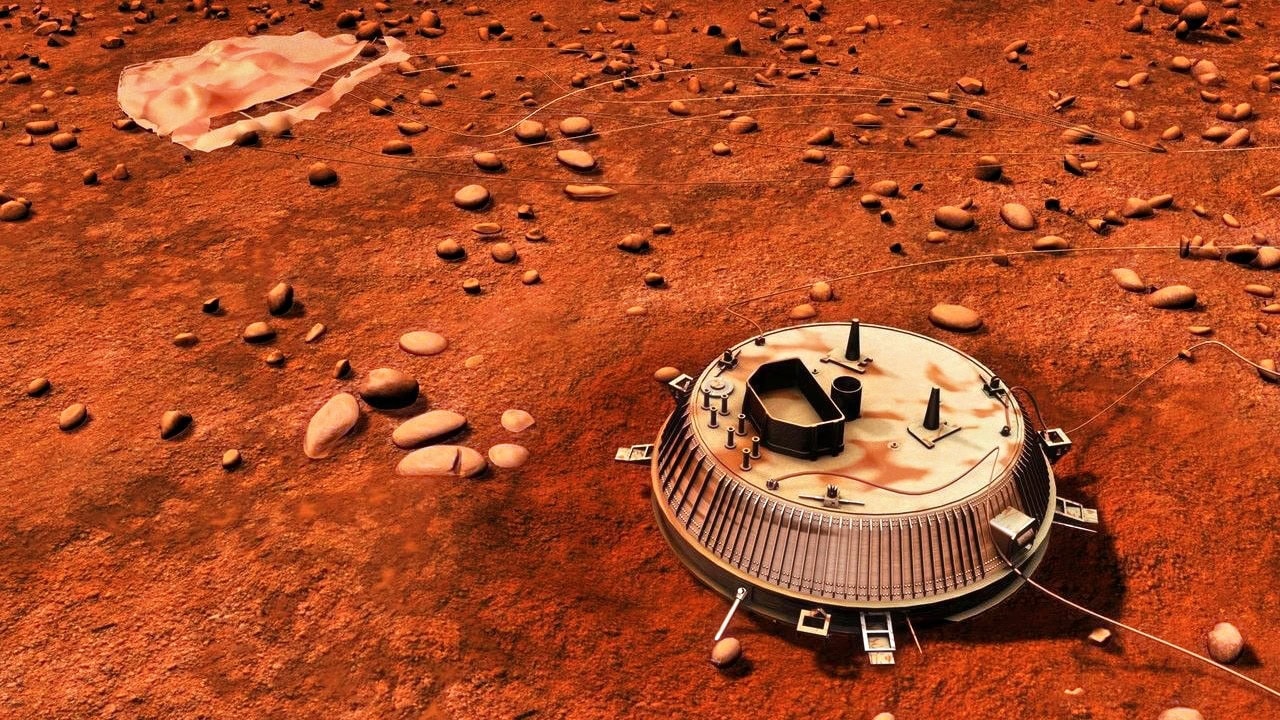
Summary and Key Points: The European Space Agency’s Huygens probe remains the only spacecraft ever to land on Titan, Saturn’s largest moon, and the only landing humanity has made anywhere in the outer solar system. Carried to Saturn by NASA’s Cassini orbiter after launching in 1997, Huygens separated in December 2004 and descended by parachute for two and a half hours on January 14, 2005, touching down on a plain of ice and frozen hydrocarbons. Its cameras revealed river channels, shorelines, and rounded pebbles shaped by flowing liquid methane, a landscape remarkably like Earth built from entirely different materials. Twenty years later, no spacecraft has returned to Titan’s surface.
How A Probe Touched Down on Titan
Most planetary probes either orbit worlds or fly past them—very few attempt to land. But in January 2005, ESA’s Huygens became the first, and still only, spacecraft to land on Titan, the largest moon of Saturn. Carried to Saturn by NASA’s Cassini spacecraft, Huygens spent more than seven years traveling across our solar system before landing on Titan and transmitting data from one of the most Earth-like environments ever explored.
Why Titan Matters
Scientists care about Titan, viewing it as more than just another moon. Rather, Titan is unique because it features a dense atmosphere, complete with weather. Titan also features rivers and lakes, rain and clouds, and active geology. Titan is the only moon in the solar system with a substantial atmosphere, with an atmospheric pressure about 1.5 times Earth’s and a temperature of -290 degrees Fahrenheit. Because of these features and similarities with Earth, scientists prioritized the exploration of Titan.
The Partnership
Huygens never traveled alone. The mission was a joint effort between NASA, ESA, and ASI.
Instead, the mission consisted of NASA’s Cassini, an orbiter that remained around Saturn and served as a relay for Huygens’ data.
NASA Space Shuttle Atlantis taken at the Kennedy Space Center by 19FortyFive’s Harry J. Kazianis.
Meanwhile, Huygens itself was a European-built entry probe that detached from Cassini and entered Titan independently.
The mission served as an excellent example of international cooperation.
The Journey
Saturn and Titan are extremely close when viewed on a cosmic scale. But in Earth terms, the distance is significant, taking years to cover. The mission began with a launch in October 1997. Using gravity assists with Venus, Earth, and Jupiter, the Cassini orbiter gradually made its way to Saturn, arriving in 2004. The Huygens probe was released in December 2004 and landed on Titan on January 14, 2005, nearly eight years after leaving Earth.
After separating from Cassini, Huygens coasted for three weeks. The journey was conducted autonomously—no one could “fly” the spacecraft because radio signals would have taken about an hour to travel the 900 million miles or so between Earth and Saturn.
So the descent was preprogrammed to occur at about 13,000 miles per hour. The probe’s massive heat shield absorbed tremendous friction, and then, once the probe had slowed sufficiently, a drogue parachute was deployed.
The main parachute followed, and finally a smaller parachute enabled a faster descent (which prevented the probe from exhausting its batteries before reaching the moon’s surface).
The descent lasted 2 hours and 27 minutes.
On Titan
Titan’s atmosphere is unlike anything else in the solar system except Earth’s, featuring about 95 percent nitrogen, along with methane and trace hydrocarbons.
So Titan contrasts significantly with Earth: on Earth, there are clouds, rivers, and lakes made of water, but on Titan, the clouds, rivers, and rain are made of methane. The chemistry is different—but many of the physical processes look surprisingly familiar.
NASA Space Shuttle Atlantis taken at the Kennedy Space Center by 19FortyFive’s Harry J. Kazianis.
Titan is described as Earth-like but, of course, completely inhospitable to human life.
Huygens was outfitted with cameras, which revealed something unexpected. Rather than a frozen landscape, Titan featured branching river channels, drainage networks, hills, broad plains, possible coastlines, and evidence of erosion.
The images looked quite similar to aerial photographs of deserts or dry river valleys on Earth. Scientists discovered that Titan was geologically active, with a surface shaped by flowing liquids for millions of years.
The Science
Huygens touched down on relatively firm ground, which behaved somewhat like damp sand or wet clay. Scientists believe it consisted of water ice, frozen hydrocarbons, and organic material deposited from the atmosphere.
This was generally a relief, as scientists were concerned Huygens might touch down in a global methane ocean, deep sludge, or solid ice. So the landing facilitated scientific exploration.
After landing, Huygens continued operating for more than an hour, measuring temperature, atmospheric pressure, wind speed, atmospheric chemistry, and surface composition.
Notably, Huygens photographed rounded rocks that appeared to have been smoothed by flowing liquid.
On Earth, that usually indicates long-term erosion by rivers, leading scientists to conclude that methane rainfall and river systems likely sculpt the landscape in much the same way water shapes Earth.
About the Author: Harrison Kass
Harrison Kass is a writer and attorney focused on national security, technology, and political culture. His work has appeared in Tablet, City Journal, The Hill, The Spectator, and The Cipher Brief. He holds a JD from the University of Oregon and a master’s in Global & Joint Program Studies from NYU. More at harrisonkass.com.