
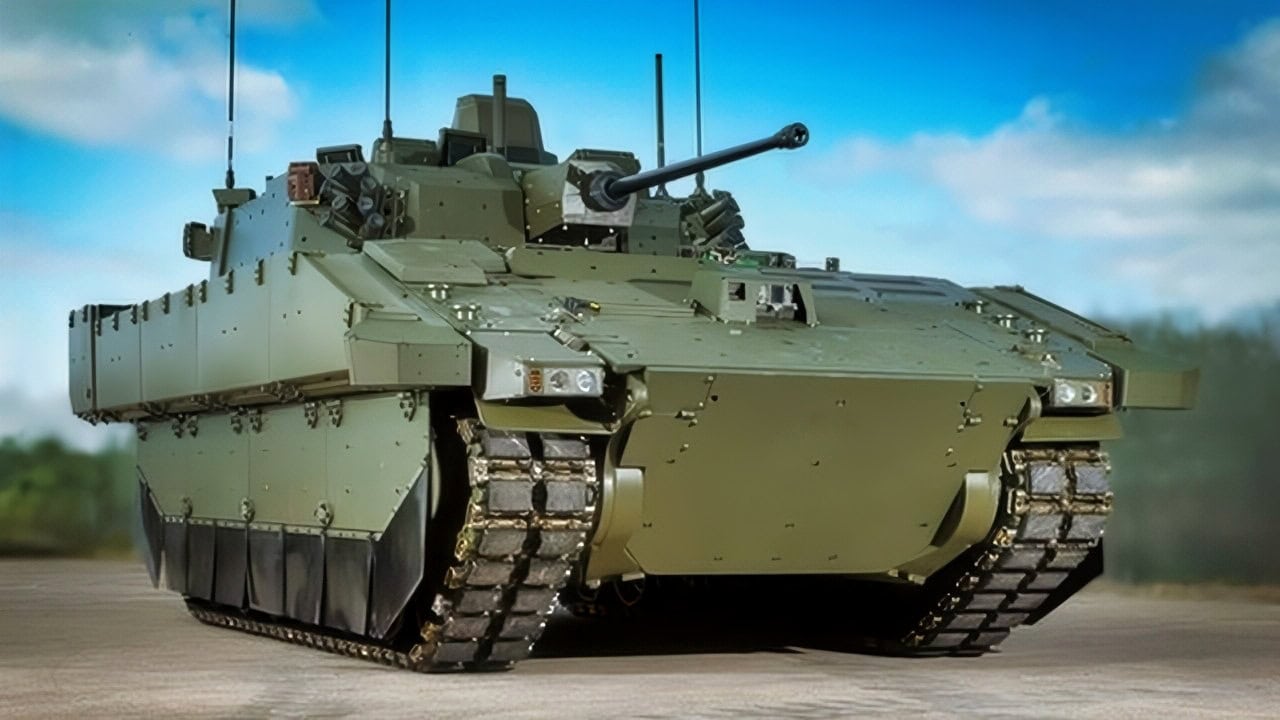
Summary and Key Points: Britain’s next-generation armored fighting vehicle, the General Dynamics UK Ajax, has become the subject of a parliamentary rebuke after a £6.3 billion ($8.4 billion) program that a Public Accounts Committee report described as not fit for purpose. According to a June 2026 Telegraph report, field trials left soldiers vomiting and with permanent hearing damage; an estimated 310 troops required hearing assessments, and officials advised that the vehicle be serviced every time it stops. Originally expected to enter service in 2017, the Ajax was not cleared until late 2025, before trials were paused again, and MPs have challenged the Ministry of Defense to explain how it will make the vehicle usable and what that will cost.
The Ajax Challenge
Much like Great Britain’s Royal Navy, the British Army, which for so many years made the truism in the statement “The sun never sets on the British Empire” true, is a shell of its former self.
The Army’s sad state of affairs is now being epitomized in a fiasco plaguing its would-be next-generation armored fighting vehicle (AFV), the General Dynamics (UK) Ajax.
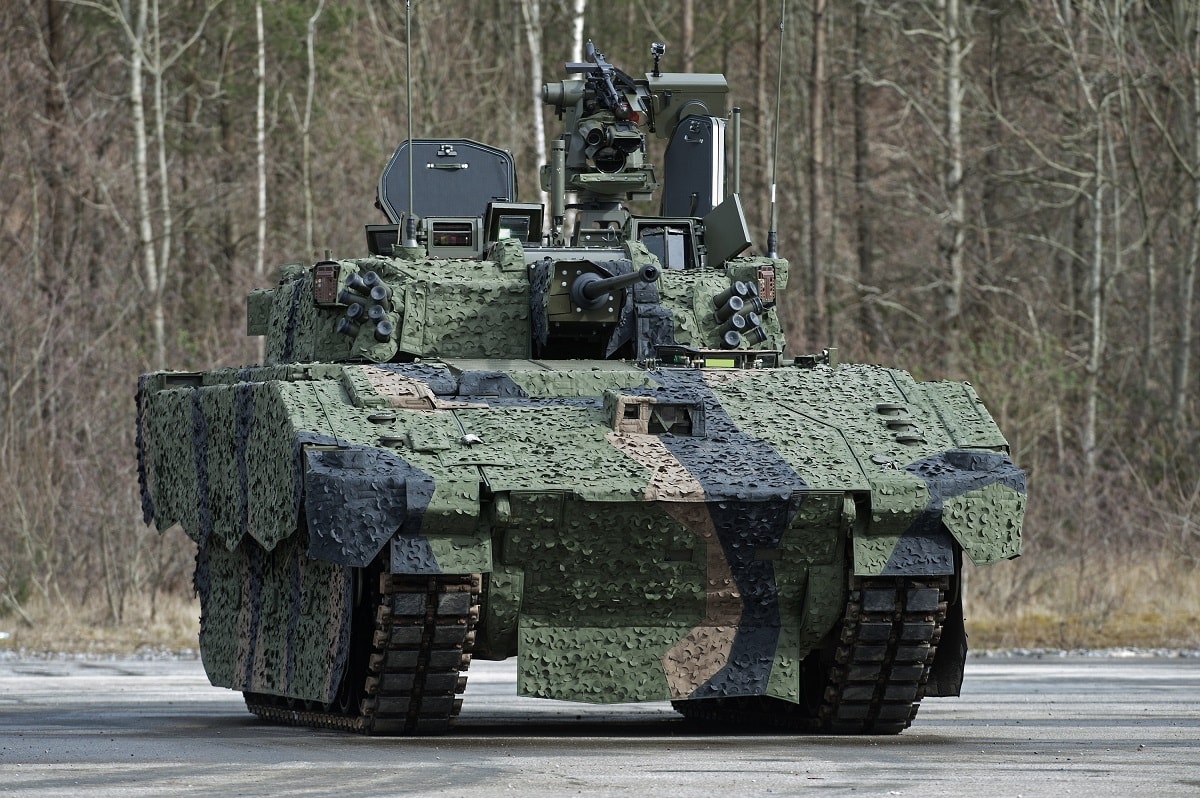
British Ajax Armored Vehicle. Image Credit: British Army
Bottom Line Up Front (BLUF): Meet Ajax
Our primary source of information is a 7 June 2026 report in The Telegraph (aka The Daily Telegraph, a British newspaper that dates back to 1855) titled “Army’s troubled Ajax may never reach battlefield,” authored by Tim Sigsworth; beneath the headline is a blurb stating “MPs challenge MoD to explain why £6.3bn programme has produced an armoured vehicle that is ‘not fit for purpose.’” (NOTE: For the benefit of our Stateside readers, the current exchange rate of £6.3 billion is equivalent to $8.4 billion.)
Mr. Sigsworth elaborates with (1) disturbing specifics such as the AFV’s penchant for “leaving soldiers vomiting and with permanent hearing damage during field trials” and (2) citing a report published by the UK Parliament’s Public Accounts Committee which unearthed embarrassing revelations such as instructions to the Ajax’s crew members to mitigate the issues by conducting maintenance checks **literally every time** they stop the vehicle!
Those instructions conspicuously fail to explain how the long-suffering troops would conduct such checks while “operating Ajax for long periods in combat.”
Sigsworth goes on to quote the remarks of committee chairman Sir Geoffrey Clinton-Brown (a member of Britain’s Conservative Party, aka the Tories): “’Our thoughts are with all those soldiers who reported symptoms from noise and vibration after operating these vehicles, and we were frankly astounded to hear officials explain that proper use of Ajax requires maintenance checks every time it is stopped…This is frankly an insult to intelligence, and much good may this advice do our fighting men and women if called upon to operate Ajax in combat. The MoD [Ministry of Defense] must now explain how it will make Ajax fit for purpose, and how much this will cost.’”
Digging Deeper
Just how bad are the health & safety issues affecting the British soldiers assigned to Ajax duty?
An estimated 310 such soldiers required hearing assessments, with 17 undergoing treatment for hearing loss. An additional 33 troops fell ill during Exercise Titan Storm in November 2025 (in turn a component of a wider national exercise comprising over 5,000 UK military personnel), and one soldier was injured in December 2025 by noise and vibration.
Originally expected to go operational in 2017, the Ajax wasn’t finally cleared until last November…and then the trials were halted until this past April; strict new controls were put in place, starting with “limited testing under highly controlled circumstances to rebuild user confidence,” per Sigsworth.
Tech Specs and Hypothetical Promise
On paper, the Ajax looks pretty impressive. The manufacturer’s official product info page proudly proclaims that “Providing best-in-class protection and survivability, reliability and mobility, and all-weather Intelligence, Surveillance, Target Acquisition and Recognition (ISTAR), the AJAX Family of Vehicles (FoV) enable sustained, expeditionary, full-spectrum and network-enabled operations with a reduced logistics footprint.”
Tech specs include a max speed of 70 km/h (43 mph) and armament consisting of a 40 mm (1.6 in) CTA International CTAS40 cannon (primary) and a 7.62 mm L94A1 (aka EX-34) coaxial chain gun (secondary).
Ajax = Britain’s Bradley?
The technical issues afflicting the Ajax are reminiscent of the early teething problems that plagued the U.S. Army’s longstanding AFV, the Bradley Fighting Vehicle.

M2 Bradley. Image Credit: Creative Commons.
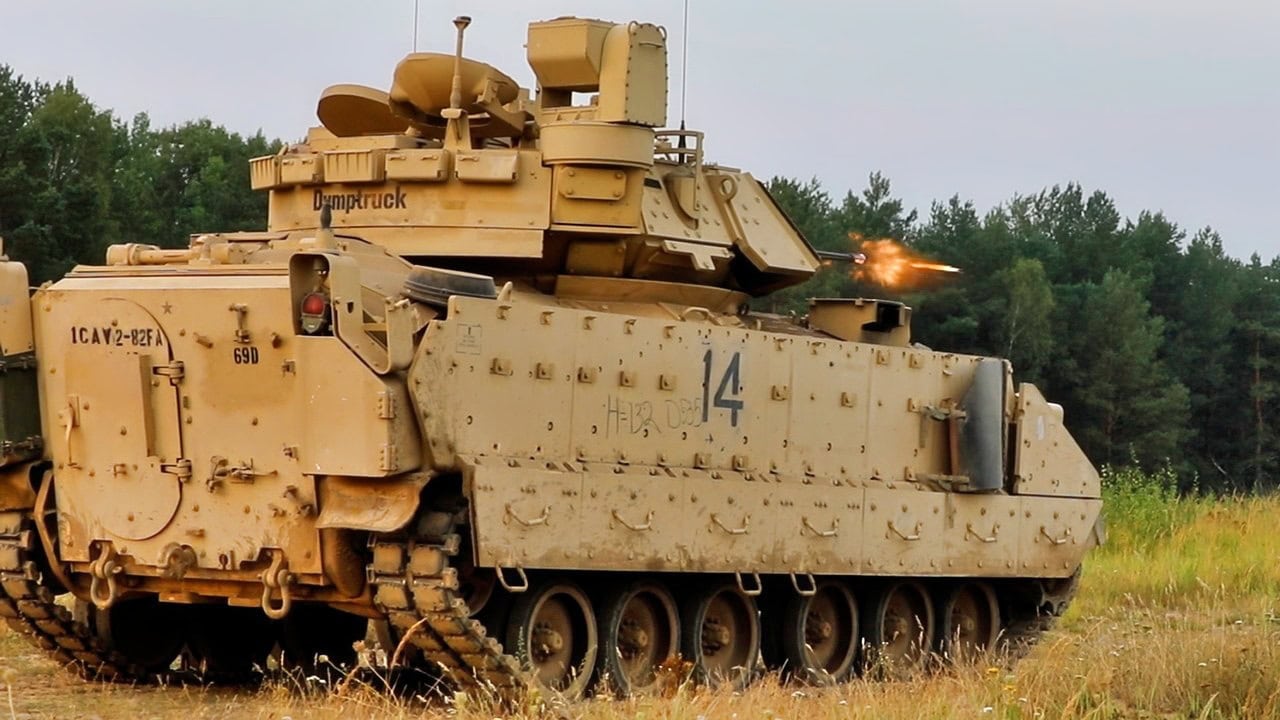
Troopers with 3rd Armored Brigade Combat Team, 1st Cavalry Division firing the 25mm canon on a Bradley fighting vehicle in order to zero the vehicles weapons systems at a range in Poland. Ranges such as these familiarize troopers with the vehicles systems in order to ensure combat readiness.
The Bradley program stalled in “development hell” (to use a film industry slang term analogy) for 17 years at a running cost of $14 billion to the U.S. taxpayers, maligned by the mainstream media as a death trap and satirized in the 1998 motion picture comedy “The Pentagon Wars” (starring Cary Elwes and Kelsey Grammer; based on the 1993 non-fiction book by retired U.S. Air Force Colonel James G. Burton fully titled The Pentagon Wars: Reformers Challenge the Old Guard).
However, the Bradley eventually overcame those setbacks, serving operationally for 45 years, with an impressive array of accomplishments along the way, such as (1) destroying more of Iraqi dictator Saddam Hussein’s main battle tanks (MBTs) than the vaunted M1 Abrams main battle tank during the 1991 Persian Gulf War aka Operation Desert Storm, and (2) the current Russia-Ukraine War, during which there is at least one recorded instance of a Ukrainian Bradley crew destroying one of Russia’s ultramodern T-90M MBTs.
However, as these words are being typed, Ajax’s prospects of emulating Bradley’s long-term perseverance and success story appear bleak at best. Time will tell.
About the Author: Christian D. Orr
Christian D. Orr is a Senior Defense Editor. He is a former Air Force Security Forces officer, Federal law enforcement officer, and private military contractor (with assignments worked in Iraq, the United Arab Emirates, Kosovo, Japan, Germany, and the Pentagon). Chris holds a B.A. in International Relations from the University of Southern California (USC) and an M.A. in Intelligence Studies (with a concentration in Terrorism Studies) from American Military University (AMU). He is also the author of the book “Five Decades of a Fabulous Firearm: Celebrating the 50th Anniversary of the Beretta 92 Pistol Series,” the second edition of which was recently published.