
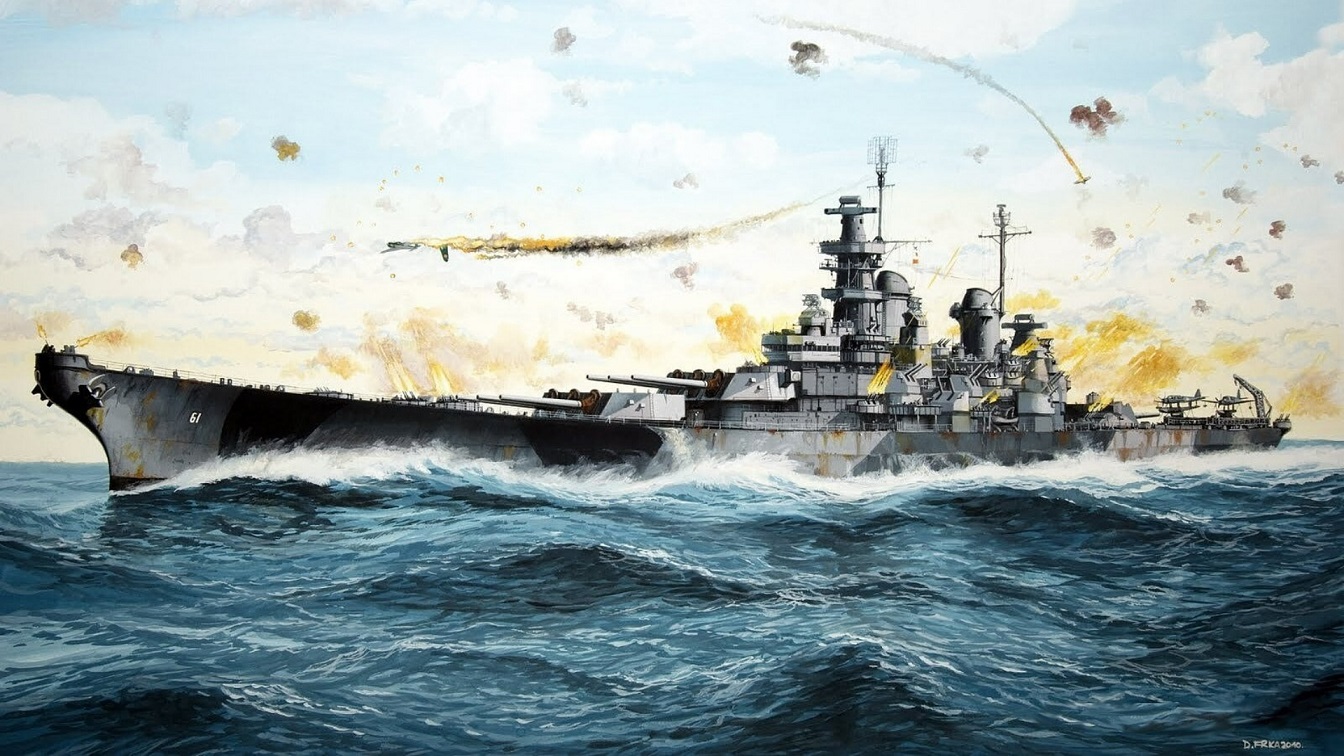
Summary and Key Points: The United States Navy designed the Montana class as its last and most powerful battleships, ordering five hulls in 1940 that would have surpassed the Iowa-class in firepower and protection. Each ship was to carry twelve 16-inch guns in four turrets, wear the heaviest armor ever fitted to an American battleship, and displace roughly 60,500 tons standard, so wide that the Navy would have needed new, larger locks to move them through the Panama Canal. The class was intended to match Japan’s Yamato in a gun-to-gun engagement. After the attack on Pearl Harbor in December 1941 confirmed the aircraft carrier as the decisive naval weapon, the Navy suspended and then canceled all five in 1943 before a single keel was laid.
The Montana Class Battleship Was Too Big: Introduction
The Montana class was supposed to be the largest, most heavily armored battleship the United States ever built — so large it wouldn’t fit through the Panama Canal. Rather than shrink the ships, the Navy set out to widen the canal, and in 1940, crews began excavating a third set of locks partly to let five battleships that existed only on paper cross between oceans.
The ships were canceled in 1943 without a single keel laid. The hole dug for them was abandoned. Then, seventy years later, Panama built its modern locks on the same ground — so the excavation for battleships that never sailed became part of the canal that today’s supertankers and warships actually use.
On February 12, 1940, the Secretary of the Navy quietly deleted a rule that had governed American warship design for a quarter century: the requirement that every U.S. Navy combatant be able to fit through the Panama Canal. For twenty-six years, the canal’s lock chambers, 110 feet wide, had been an invisible ceiling on how big an American warship could be, because a battleship that couldn’t shuttle between the Atlantic and Pacific was a battleship stranded in one ocean. The Montana class was the first U.S. warship design ever permitted to exceed that limit, and the decision to free it set in motion one of the era’s strangest construction projects: America began digging a bigger canal to accommodate ships it would never finish building.
Defense History: The Battleship Too Big for Its Own Canal
The Montanas were conceived without limits, which was exactly the problem. Every previous modern American battleship had been shaped by a treaty or a canal. The Washington and London naval treaties capped displacement through the 1920s and 1930s; when those collapsed at the end of the decade, the only remaining constraints were physical, and the biggest was the canal. The Iowa-class battleships then under construction had been deliberately squeezed to fit, their long, narrow hulls threading the locks with only a few inches of room between steel and concrete on either side. The Montanas refused that compromise. Freed of the Panamax ceiling in February 1940 and authorized under the Two-Ocean Navy Act that July, they were drawn at roughly 921 feet long with a 121-foot beam and a standard displacement of around 60,500 tons, nearly a third larger than the Iowas, armed with twelve 16-inch guns in four turrets against the Iowas’ nine, and armored heavily enough to survive the same 16-inch shells they fired. They were the only American battleships ever designed to be properly protected against guns as powerful as their own.
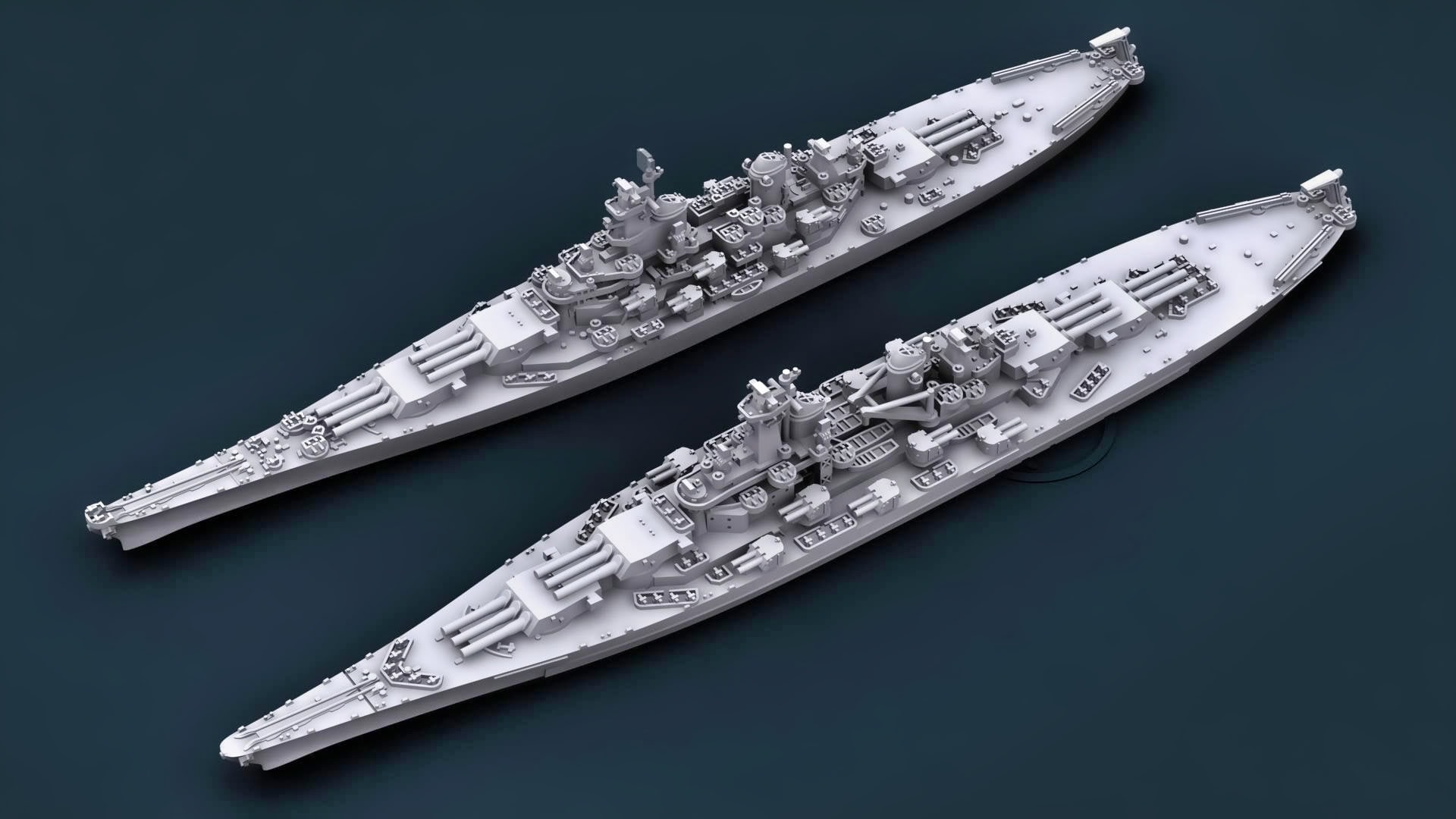
Montana-Class Battleship vs. Iowa-Class. Image Credit: Creative Commons.
The width was the point and the penalty. At 121 feet in the beam, a Montana could not pass through a 110-foot lock, which meant one of these ships built on the East Coast could never reach the Pacific without a months-long voyage around South America. For a navy expecting to fight Japan, that was close to useless. Something had to give, and since the Navy would not narrow the ships, it moved to widen the canal.
Aerospace of the Sea: A Third Set of Locks for Five Paper Ships
The Third Locks Project was not invented for the Montanas — the Canal had studied a larger third lane since 1938 on security grounds, to guard against the waterway being disabled by sabotage or air attack — but the battleships rapidly became its driving purpose.
The plan called for a new set of single lock chambers running parallel to the existing double locks, 200 feet longer and 30 feet wider than the 1914 originals, sized to pass the new super-battleships. Dredging began on July 1, 1940, when the dredge Cascades started cutting the approach channel at the Pacific end near Miraflores; dry excavation of the new Gatun locks followed on February 19, 1941. And by the project’s own account, the need to accommodate the 58,000-ton Montana-class ships “soon began to override” the security rationale as the principal reason for the entire effort. Tens of millions of cubic yards of Panamanian earth were being moved, in significant part, to let five battleships that had not yet been ordered cross between two oceans.
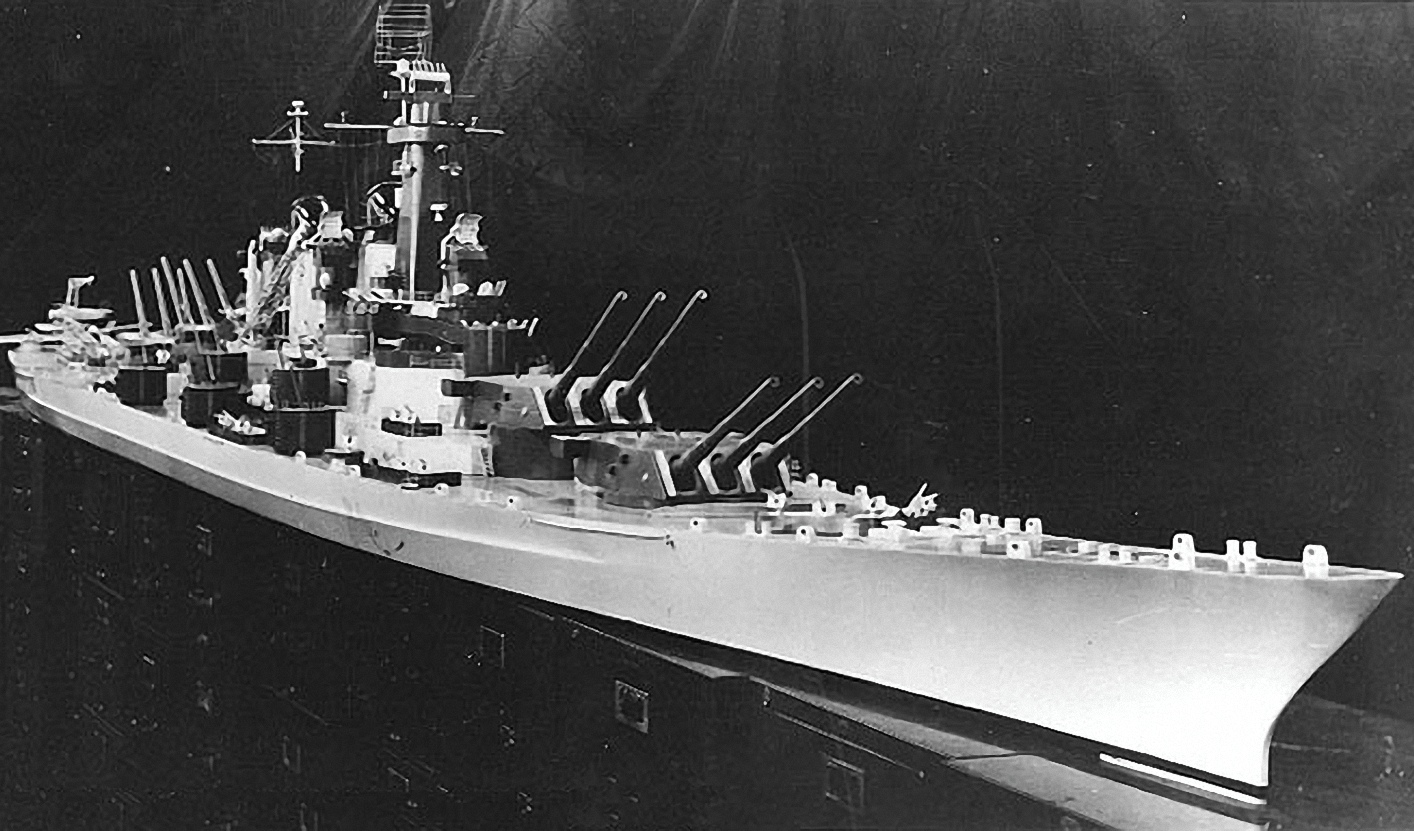
Montana-class artist rendering.
The scale of ambition is worth pausing on. Completed, the Montana class would have given the late-1940s U.S. Navy seventeen new battleships and the only American ships to approach the size of Japan’s monster Yamato. To make them work, the country was simultaneously building the ships and rebuilding the geography the ships required. Both halves of that plan were about to collide with a different kind of warfare.
Fleet Reality: Two Cancellations, One Month Apart
The verdict arrived from the Pacific itself. The carrier battles of 1942 and the broader demonstration that aircraft rather than big guns now decided naval engagements rewrote American shipbuilding priorities almost overnight. Steel, shipyard capacity, and manpower were needed for aircraft carriers, escorts, submarines, and amphibious ships, not for the most expensive gun platforms ever conceived. In late spring 1942, the two projects died within days of each other: the Montana class was suspended by presidential direction before any keel was laid, and the Secretary of War directed the Governor of the Canal to halt nearly all work on the third locks, deferring the excavation on the same logic that had just doomed the ships it was meant to serve. The battleship and the canal built for it were canceled together, in the same weeks, for the same reason.
The formality came a year later. On July 21, 1943, with the battleship’s day as the dominant element of sea power unmistakably over, the Navy canceled all five Montanas outright — Montana, Ohio, Maine, New Hampshire, and Louisiana — none of which ever laid down. Not everything was wasted: the propulsion arrangement used on the Montanans was adapted for the Midway-class aircraft carriers, three of which were completed and served for decades. But the ships themselves vanished into the archive as the most powerful American warships that never existed, and the widened canal dug on their behalf was left as a set of abandoned excavations in the Panamanian jungle.
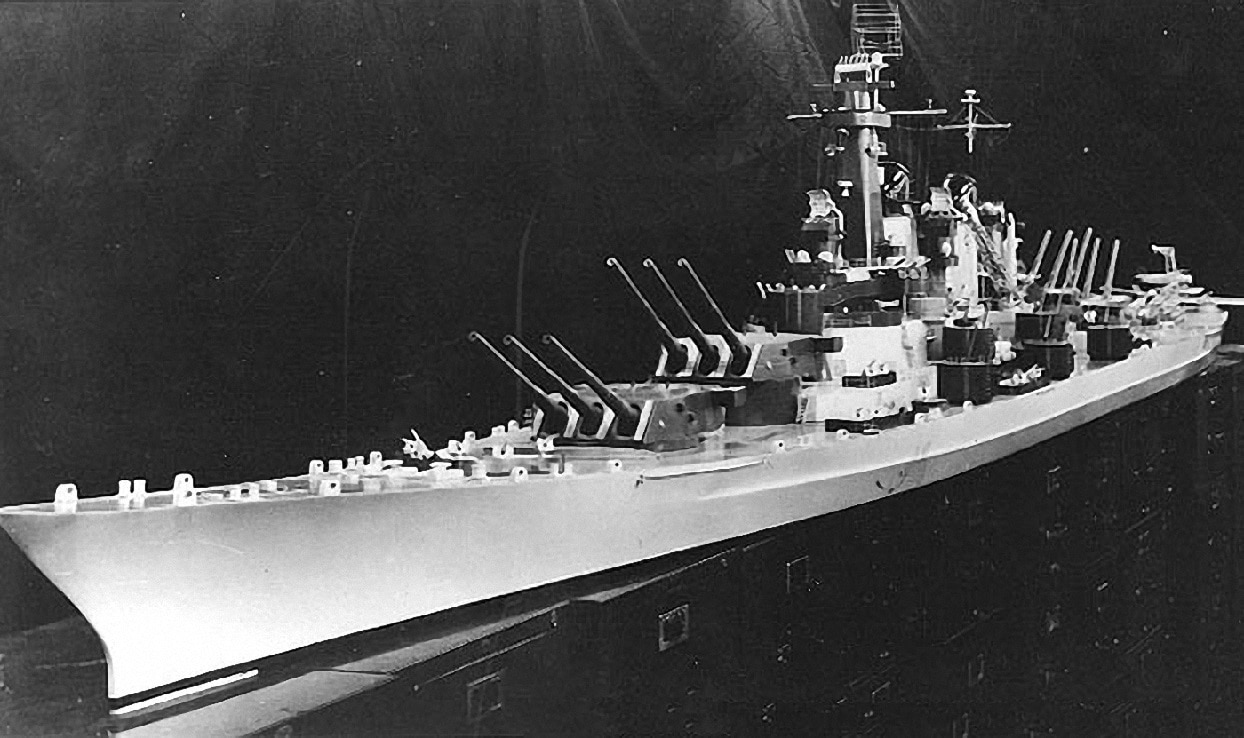
Montana-class Battleships. Image: Creative Commons.
Defense Ledger: The Ditches That Outlived the Doctrine
Here, the story takes the turn that redeems it. The excavations did not disappear. For six decades, the half-dug channels and lock sites sat unused, a monument to a naval doctrine that expired before its concrete could be poured. Then, in the 2000s, Panama — which had taken full control of the Canal in 1999 — confronted the same problem the Americans had: the largest modern ships no longer fit. Panama’s answer was a third set of locks, approved by national referendum in 2006 and opened on June 26, 2016, and the engineers building them reached for ground that had already been broken. By the Panama Canal Authority’s own account, the new locks reused part of the area the United States had excavated from 1939 to 1942 and abandoned during the war. The dredged approaches and cuts begun for the Montanas became, three generations later, part of the physical footprint of the Neopanamax canal that today’s post-Panamax container ships, supertankers, and warships actually transit.
There is a final irony folded into the coda, and it belongs to the ship’s own name. Montana is the only state in the continental United States that has never had a commissioned battleship bear its name — not by chance, but by a double cancellation.
The first USS Montana, BB-51, was a battleship of an earlier South Dakota class, laid down at Mare Island in 1920 and scrapped on the building ways in 1922 at 27.6 percent complete, killed by the Washington Naval Treaty.
The second, BB-67, was the lead ship of the class in this story, canceled in 1943.
Two battleships named for the same state, two decades apart, each erased by a different force — one by a disarmament treaty, one by the aircraft carrier. The name finally went to sea in 2022, on a Virginia-class attack submarine, the mission the battleship was built for having long since passed to vessels the battleship’s designers never imagined.
The Montana class is usually remembered, when it is remembered, as the biggest battleship America chose not to build.
The more remarkable fact is what the choice left behind in the ground. A nation set out to reshape a continent’s geography for five ships, abandoned both the ships and the earthworks when the war changed shape, and then watched, most of a century later, as another country finished the excavation for its own reasons.
The battleships never floated. The hole dug for them carries global shipping to this day.
About the Author: Harry J. Kazianis
Harry J. Kazianis (@Grecianformula) was the former Senior Director of National Security Affairs at the Center for the National Interest (CFTNI), a foreign policy think tank founded by Richard Nixon based in Washington, DC. Harry has over a decade of experience in think tanks and national security publishing. His ideas have been published in the NY Times, The Washington Post, The Wall Street Journal, CNN, and many other outlets worldwide. He has held positions at CSIS, the Heritage Foundation, the University of Nottingham, and several other institutions related to national security research and studies. He is the former Executive Editor of the National Interest and the Diplomat. He holds a Master’s degree focusing on international affairs from Harvard University.

