
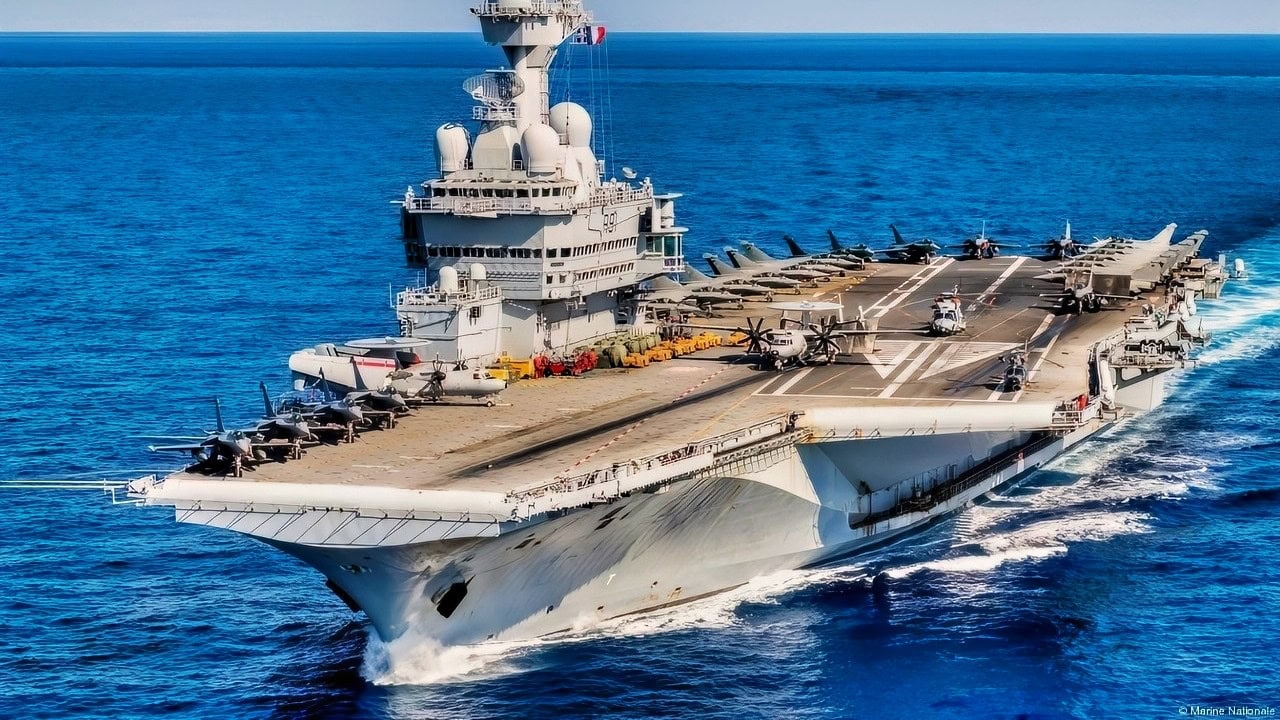
Summary and Key Points: In March 2026, France named its next aircraft carrier the France Libre and began building the most ambitious warship in European history, an 80,000-ton nuclear supercarrier designed from the keel up to launch a sixth-generation stealth fighter teamed with combat drones. In June 2026, the fighter program collapsed. The Franco-German effort to produce the jet was canceled before a prototype ever flew, and France now faces the prospect of finishing the most advanced carrier in Europe in 2038 with essentially the same Rafale fighters that its predecessor flew in 2001. The ship is racing ahead. The aircraft it was built for has gone missing.
France’s New Libre Nuclear Aircraft Carrier Is Missing a New 6th-Generation Fighter
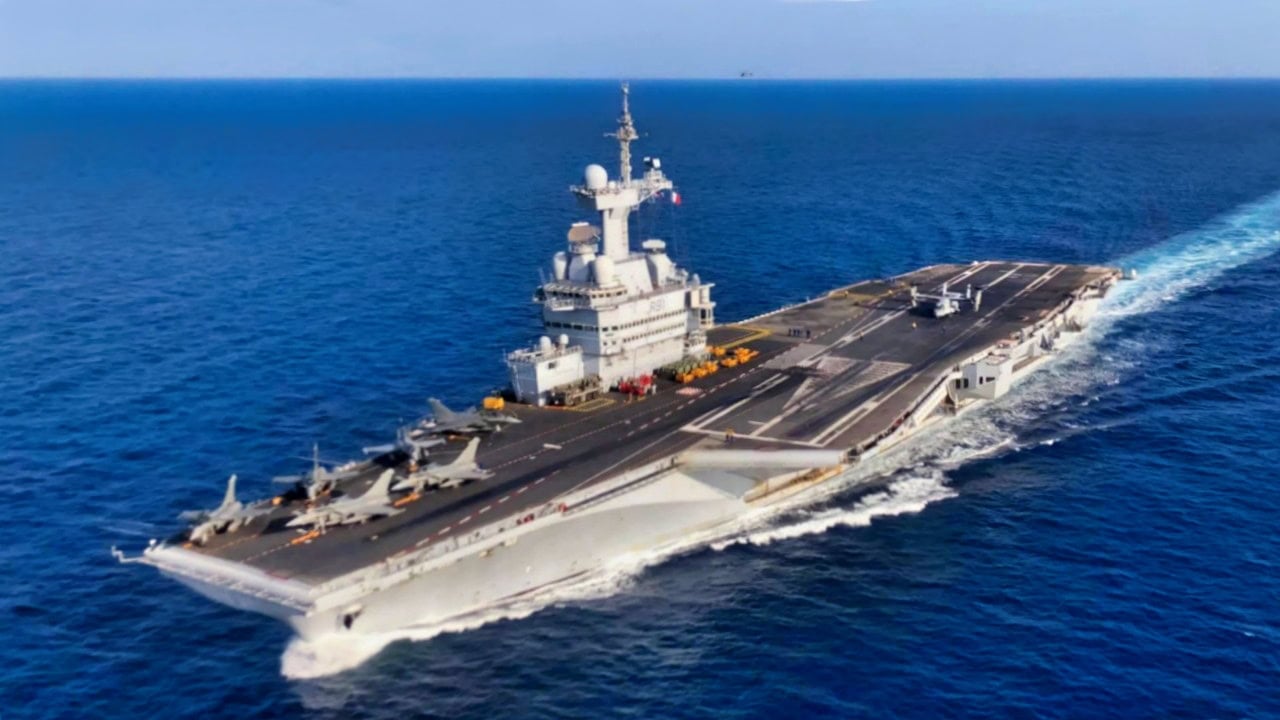
U.S. 5TH FLEET AREA OF OPERATIONS (April 24, 2019) A U.S. Marine MV-22 Osprey assigned to the 22nd Marine Expeditionary Unit sits on the flight deck of France’s Marine Nationale aircraft carrier FS Charles De Gaulle (R 91). This was the second time that Ospreys have landed aboard the French vessel. Marines and Sailors assigned to the 22nd MEU and Kearsarge Amphibious Ready Group are currently deployed to the U.S. 5th Fleet area of operations in support of naval operations to ensure maritime stability and security in the Central region, connecting the Mediterranean and the Pacific through the western Indian Ocean and three strategic choke points. (U.S. Marine Corps photo by Maj. Joshua Smith/Released)
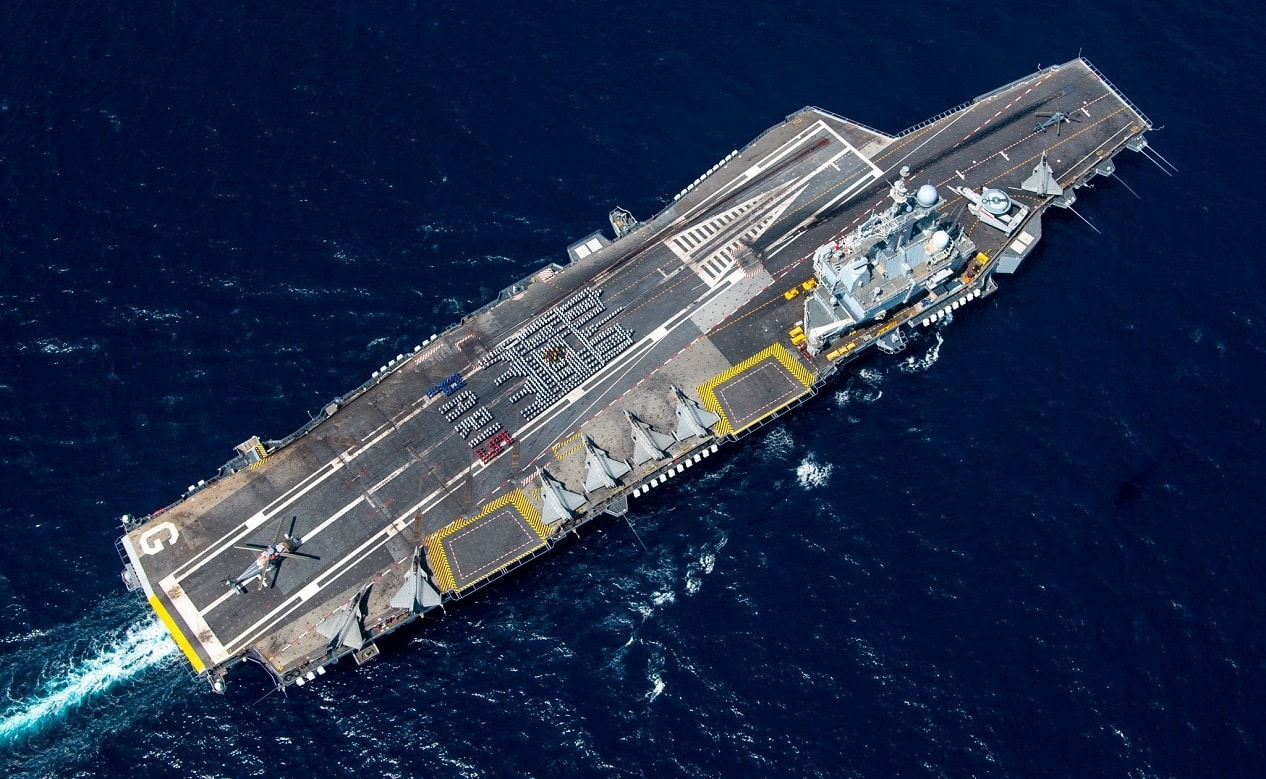
French Aircraft Carrier Charles de Gaulle.
France is building a carrier for an air wing that does not yet exist, and after this summer, it is no longer clear when, or whether, that air wing will arrive. The France Libre, the vessel that will replace the Charles de Gaulle at the end of the next decade, is a genuinely impressive piece of naval engineering, larger and more capable than anything Europe has put to sea in generations. But a warship is only as formidable as the aircraft it launches, and the France Libre was designed around a next-generation fighter whose development program has just fallen apart. That mismatch between a supercarrier entering construction and a sixth-generation jet entering limbo is the defining problem of the most expensive shipbuilding effort in modern French history.
The Most Ambitious Warship in European History
Start with what France is actually building, because the ambition is real. On March 18, 2026, President Emmanuel Macron traveled to a Naval Group site near Nantes to announce that the vessel long known only by its program name, the Porte-Avions de Nouvelle Génération, would be named France Libre, after the Free France government-in-exile that Charles de Gaulle led from London after the fall of France in 1940. Macron framed the choice as a direct lineage from de Gaulle himself, and closed his address with a line that captured the ship’s purpose bluntly: that to remain free, a nation must be feared. The name deliberately echoes the carrier it replaces, and it carries the same message of sovereign French power that has defined the country’s carrier ambitions for forty years.
The vessel behind the name is enormous by European standards. The France Libre will displace around 80,000 tons, nearly double the roughly 42,000 tons of the Charles de Gaulle, and, at 310 meters long, will be the largest warship France has ever built and the largest in Europe by physical dimensions. That size is not vanity. A larger flight deck, covering some 17,200 square meters, gives deck crews the room to prepare, arm, and move aircraft far more efficiently, and for the first time on a French carrier, it allows simultaneous launch and recovery of aircraft, a capability the cramped Charles de Gaulle never had. Under high-tempo operations, the ship is designed to generate around 60 sorties per day, a substantial increase over its predecessor.
The propulsion also addresses one of Charles de Gaulle’s oldest weaknesses. That carrier was built around two K15 reactors derived from French submarines, which left it notably underpowered for its size. The France Libre will use two new TechnicAtome K22 reactors, each producing roughly 220 megawatts of thermal power against the K15’s 150, a large jump in output. Interestingly, that extra power will not make the ship dramatically faster, as its top speed stays around 27 knots, matching the Charles de Gaulle. Instead, the additional energy feeds the ship’s heavily electrified systems, above all its electromagnetic catapults, and stretches the interval between reactor overhauls to about ten years. The program is valued at more than €10 billion, with some estimates as high as €15 billion (roughly $12 billion), and will mobilize around 800 French suppliers and create up to 14,000 jobs, with the overwhelming majority of spending directed to French industry. Construction is set to run at the Chantiers de l’Atlantique shipyard from around 2031, with sea trials in 2036 and commissioning in 2038, the year the Charles de Gaulle is due to retire.
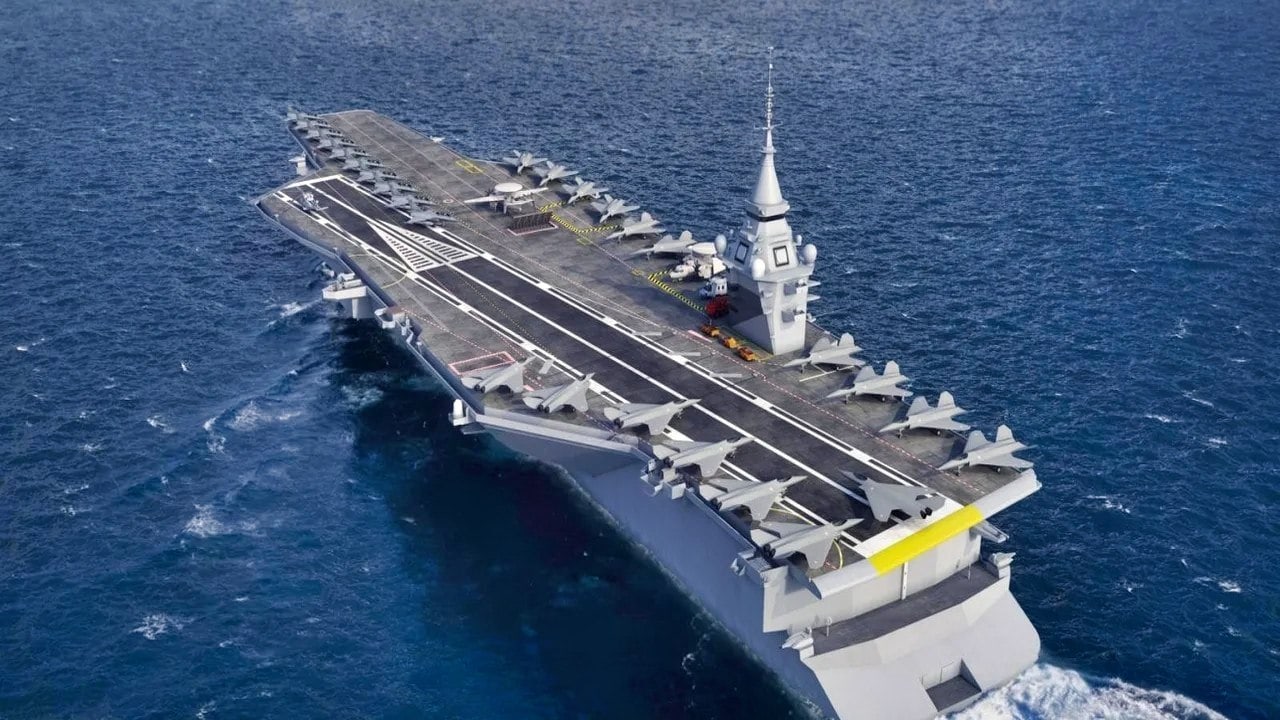
PANG Aircraft Carrier from France. Image Credit: French Navy.
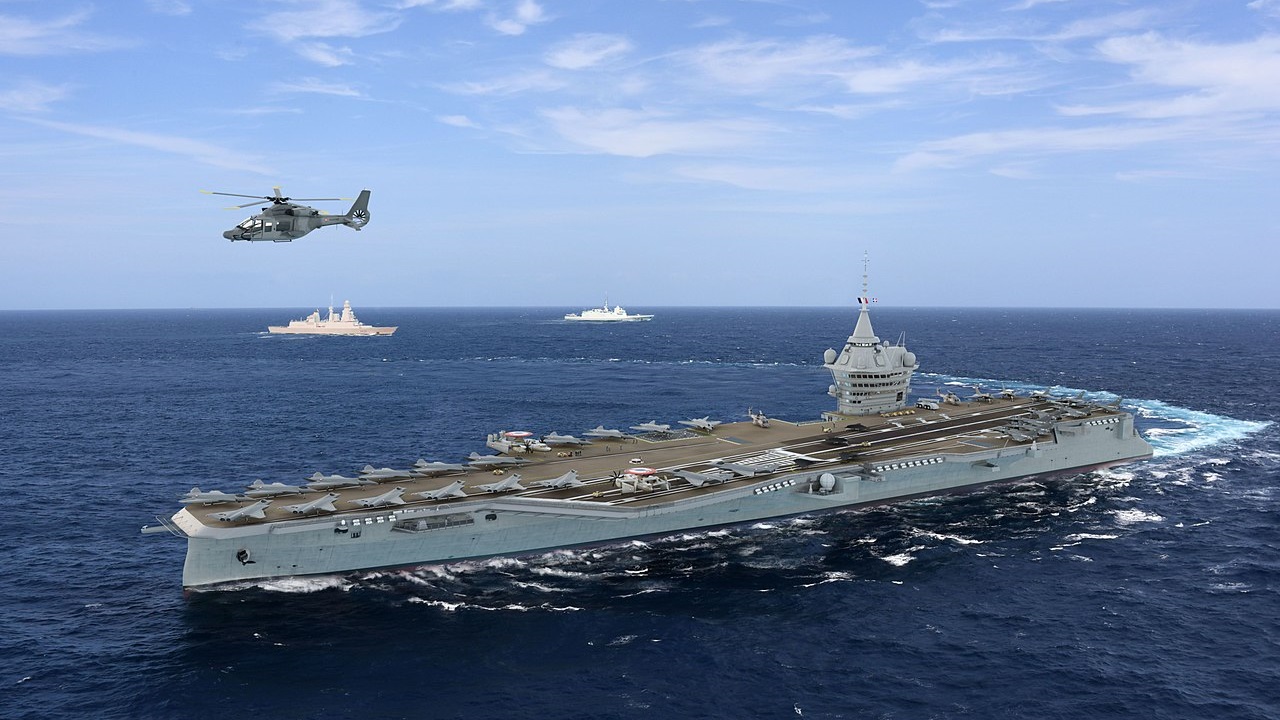
PANG Aircraft Carrier. Image Credit: Creative Commons.
Designed Around a Fighter That No Longer Exists
Here the problem begins. The France Libre was not designed to fly the aircraft that France has now. It was designed around a future air wing, and the renderings Naval Group released told the story plainly. Alongside the Dassault Rafale M and the E-2 Hawkeye, the official imagery of the carrier’s deck showed a sixth-generation stealth fighter, presumed to be the aircraft from the Future Combat Air System program, accompanied by uncrewed combat drones. The whole point of the larger deck, the more powerful reactors, and the electromagnetic catapults was to operate heavier, more advanced aircraft and to integrate the crewed-and-uncrewed teaming that defines sixth-generation air combat.
The ship was a bet on the future of naval aviation, and that future had a specific shape.
Then the fighter died. On June 8, 2026, German Chancellor Friedrich Merz confirmed that the crewed fighter at the heart of the Future Combat Air System, the Next Generation Fighter meant to replace the Rafale and the Eurofighter Typhoon, was dead, killed by a nine-year work-share dispute between Airbus and France’s Dassault Aviation over who would lead the program. No prototype was ever built, and no demonstrator ever flew, in an effort valued at over €100 billion. The program that was supposed to produce the France Libre’s primary combat aircraft collapsed under corporate politics roughly three months after the carrier that would carry that aircraft was named and moved toward construction.
This is the naval dimension of a failure that has already reshaped European air power, and it lands with particular force on the France Libre, because a carrier is a platform for its aircraft and nothing more. The most sophisticated flight deck in Europe is of limited value without an aircraft worthy of it, and the jet the France Libre was drawn around no longer has a development path shared with France’s partners. The FCAS collapse turned the carrier’s central design assumption into an open question.
France Now Goes It Alone
With the joint program dead, France has chosen to pursue a sixth-generation fighter on its own. Dassault will now develop a French sixth-generation aircraft independently, funded in part through money committed to the Rafale F5 upgrade, and Paris has signaled it intends to keep the capability sovereign rather than seek new partners.
That decision fits France’s long tradition of insisting on its own combat aircraft, the same instinct that produced the Rafale after France walked away from the Eurofighter in the 1980s. But going it alone carries real risk, because sixth-generation fighters are staggeringly expensive to develop, and France would now be shouldering that cost without the German and Spanish funding the joint program was meant to share.
The timeline is the sharpest uncertainty. A French national sixth-generation fighter is a program that has barely begun, and there is no guarantee that a carrier-capable naval variant, always the harder and later version of any fighter to develop, will be ready when the France Libre enters service in 2038. Britain, Italy, and Japan are years ahead with their Global Combat Air Programme, which is already building a demonstrator, and France now has no comparable partner effort to draw on. The country that prized its independence most has ended up furthest behind, with a carrier on the way and no next-generation aircraft on a confirmed path to fly from it.
The Rafale Bridge and the Catapult Irony
France’s fallback is the Rafale, and specifically the forthcoming Rafale F5 standard, which the France Libre’s air wing will initially be built around. The F5 is a genuine upgrade, adding new sensors, weapons, and the ability to control accompanying combat drones, and it is designed to remain relevant into the 2040s. It is also, fundamentally, an evolution of the same fourth-generation-plus fighter that the Charles de Gaulle has flown since the 2000s.
If the France Libre commissions in 2038 with an air wing of Rafale F5s and drones, it will be a capable force, but it will not be the leap in combat aviation the ship was designed to enable, and it will leave Europe’s most advanced carrier flying a direct descendant of the jet its predecessor carried at launch.
There is a second irony threaded through the program, one that cuts against the sovereignty that the France Libre is meant to embody. The carrier’s electromagnetic catapults and advanced arresting gear are not French. They are the EMALS and Advanced Arresting Gear built by the American firm General Atomics, the same systems on the U.S. Navy’s Gerald R. Ford class, supplied to France under a Foreign Military Sales agreement. France chose American catapults because no European equivalent exists, and testing to confirm the Rafale M’s compatibility with EMALS is already underway in the United States. For a warship named after French wartime independence and built to guarantee France’s ability to act alone, depending on American technology for the single system that lets it launch aircraft is a notable compromise, and one that has drawn quiet unease in Paris, given how wary France has traditionally been of relying on foreign suppliers for critical military technology.
The Honest Counterweight
None of this makes the France Libre a mistake, and the case for the program remains strong. A carrier is designed to serve for around 45 years, far longer than any single fighter generation, so the ship will outlast whatever aircraft it launches first, and France has time, if not as much as it would like, to sort out its next fighter before the current Rafale becomes obsolete.
The Rafale F5 paired with combat drones, is a serious combat capability in its own right, and the drone half of the sixth-generation vision may arrive on schedule even if the crewed fighter does not, since France and others are advancing uncrewed combat aircraft on their own tracks. A larger, more powerful, more efficient carrier is worth building regardless of which specific aircraft fill its hangar, and the France Libre solves real deficiencies that dogged the Charles de Gaulle throughout its career.
It is also worth remembering that the Charles de Gaulle itself was ridiculed during its troubled construction and then became the hardest-working carrier in Europe, flying combat missions from Afghanistan to Libya to the campaign against the Islamic State. France has navigated the gap between a carrier’s ambition and its available aircraft before, and it may do so again.
The problem is one of sequencing and risk. France committed to a $12 billion supercarrier optimized for a specific next-generation air wing, and the centerpiece of that air wing collapsed before the ship’s hull was even laid down.
The France Libre will still be the most capable carrier in Europe when it arrives, but it now risks entering service as a twenty-first-century warship carrying a twentieth-century air wing, waiting years for the aircraft it was actually built to fly.
The ship is a monument to French strategic autonomy, and its fate now depends on France’s ability to build, alone and on time, the sixth-generation fighter that a nine-year international program could not.
That is a heavy bet to place on a flight deck that will not be finished until 2038, and the aircraft meant to make it worthwhile is, for now, a rendering without a program.
About the Author: Harry J. Kazianis
Harry J. Kazianis (@Grecianformula) was the former Senior Director of National Security Affairs at the Center for the National Interest (CFTNI), a foreign policy think tank founded by Richard Nixon based in Washington, DC. Harry has over a decade of experience in think tanks and national security publishing. His ideas have been published in the NY Times, The Washington Post, The Wall Street Journal, CNN, and many other outlets worldwide. He has held positions at CSIS, the Heritage Foundation, the University of Nottingham, and several other institutions related to national security research and studies. He is the former Executive Editor of the National Interest and the Diplomat. He holds a Master’s degree focusing on international affairs from Harvard University.

