
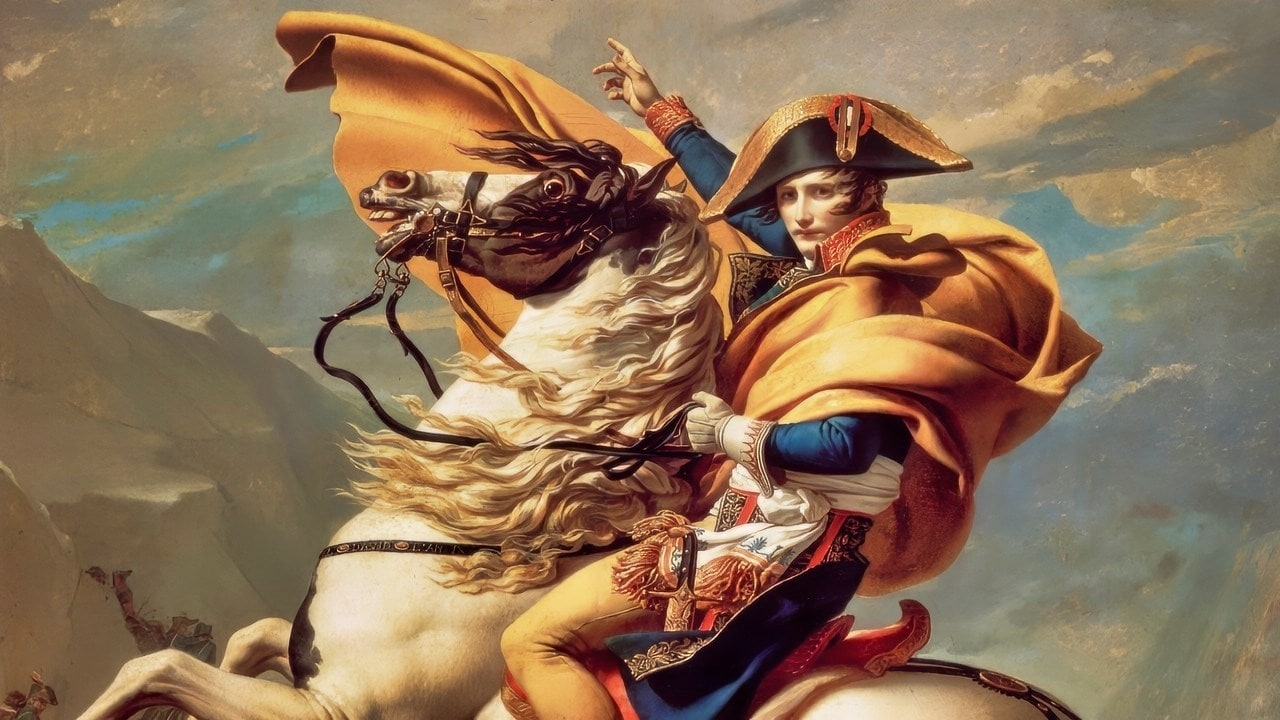
“An army marches on its stomach” is the most quoted line in military logistics, and it is attributed to Napoleon Bonaparte on thousands of mugs, posters, and staff-college slides. He almost certainly never said it; the phrase traces to Frederick the Great, and Napoleon himself presided over one of history’s worst feats of army feeding, the starvation of half a million men in Russia. Yet the quote matters anyway, because the problem it describes drove a French government prize that produced canned food. The line that isn’t really his points to the one lasting thing his logistics crisis created.
Quote of the Day by Napoleon: He Likely Never Said It

Napoleon with the Crown. Image Credit: Creative Commons.
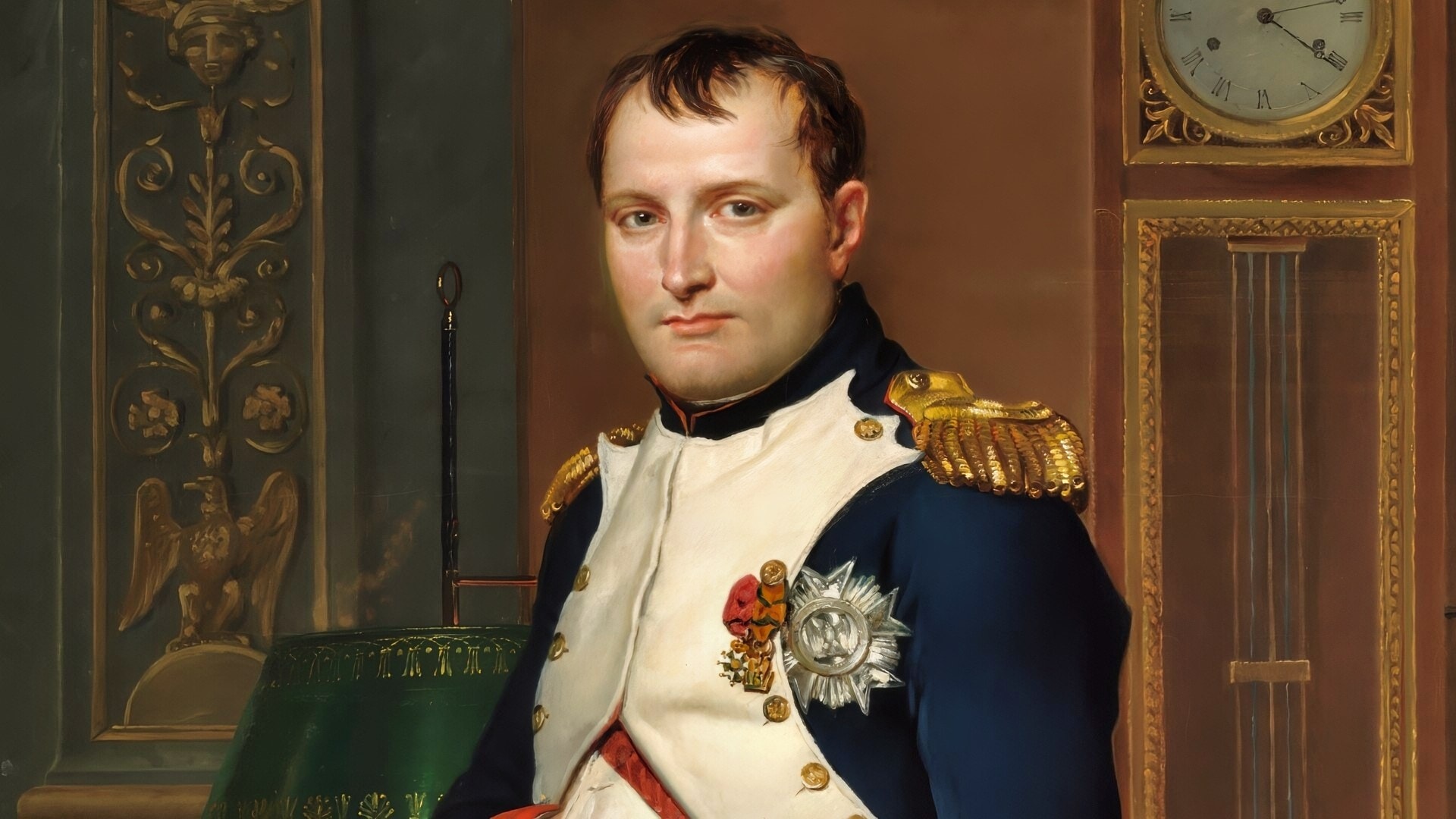
Napoleon Painting Creative Commons Image
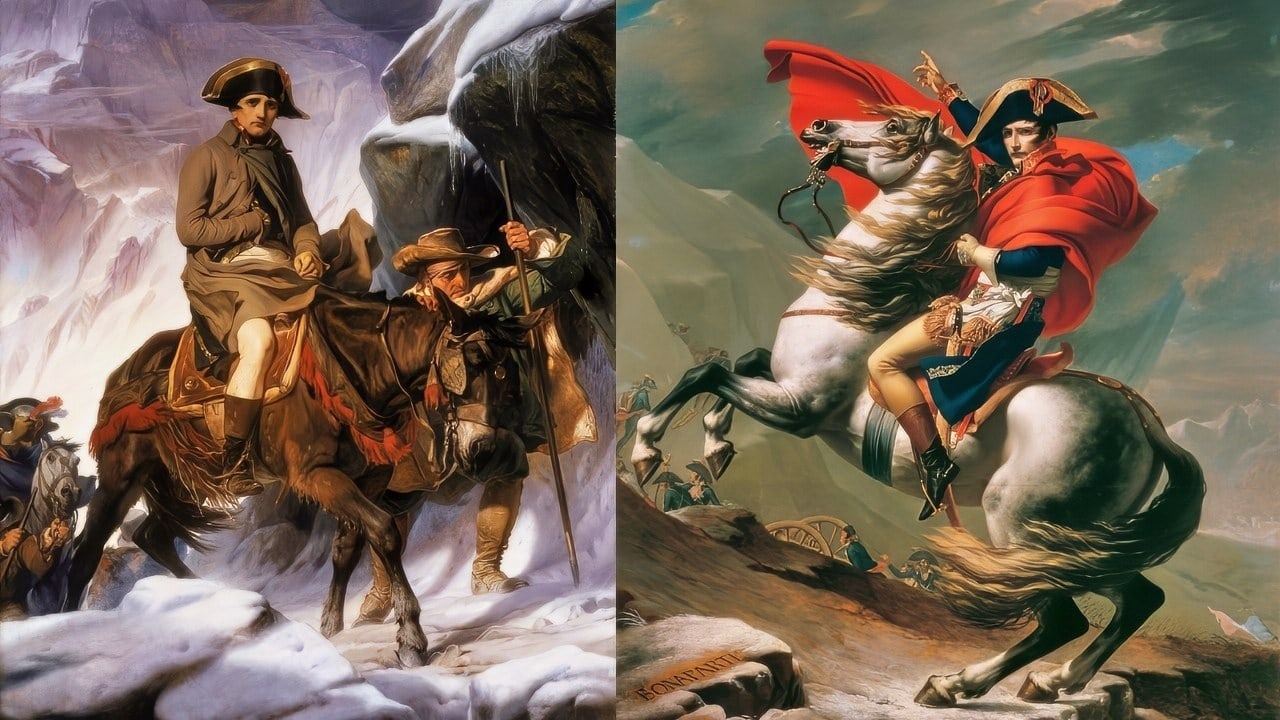
Napoleon Quote of The Day Two Looks. Image Credit: Creative Commons.
Every good military quote deserves a fact-check, and this one collapses under the first push. The saying most people file under Napoleon has a cleaner paper trail leading somewhere else. The Quote Investigator research service traces the earliest strong match to Thomas Carlyle’s 1858 history of Frederick the Great, where Carlyle writes that “an Army, like a serpent, goes upon its belly,” and in later volumes explicitly credits the adage to Frederick II of Prussia, who died in 1786, more than a decade before Napoleon took power. Oxford Reference lists the saying as attributed to both men and notes that it is recorded in English only from the early twentieth century, long after either was alive to claim it.
How it migrated onto Napoleon is itself a lesson in how misquotes are born. Quote Investigator identifies a common mechanism, a reader transferring the credit for one line onto a neighboring line, and points to 1860s American newspapers that pinned the “belly” version on Napoleon while, in the very same era, Carlyle was still crediting Frederick. Napoleon did make thematically similar remarks recorded in memoirs of his exile, musings that “it is hunger that makes the world move,” but nothing matching the crisp phrase the world now hangs on him. The most famous thing Napoleon supposedly said about supply was, in all likelihood, said by the Prussian king he studied.
The Emperor Who Starved His Own Army
The deeper irony is that Napoleon was a poor practitioner of the principle he is credited with coining. His supply doctrine leaned heavily on an old method, living off the land, in which armies requisitioned food from local villages and foraged from fields, moving fast enough to stay ahead of scarcity. That approach had served him brilliantly in the rich, densely farmed terrain of Italy and Central Europe. It was catastrophically wrong for Russia.
When Napoleon crossed into Russia in June 1812 with a force of roughly 600,000 men, the largest invasion army Europe had ever seen, he committed the classic error the quote warns against. The vast, poor, thinly settled Russian countryside could not feed an army that size, and the Russian scorched-earth retreat burned the crops and villages that foraging depended on. The result was not primarily a defeat by “General Winter,” as the popular myth holds. The Grande Armée lost roughly a third of its strength in the first eight weeks, before any major battle and long before the first snow, to starvation, disease, and exhaustion. Historians who have studied the campaign, from David Chandler to the logistics scholar Martin van Creveld, converge on the same conclusion: the supply system failed because the depots sat too far to the rear, the wagons could not move fast enough over broken roads, and the planners underestimated how much men and horses would consume. The man synonymous with feeding armies lost most of his to hunger.
The Prize That Fed the World
Here is why the quote still matters and why the story is more than a debunking. The principle was real and urgent even if Napoleon neither coined it nor mastered it, and the pressure to solve it, on his watch and for his wars, produced one of the most consequential inventions in the history of food.
In 1795, the French government offered a cash prize, 12,000 francs, to anyone who could devise a reliable method of preserving food for the army and navy. Feeding troops on distant campaigns was the era’s defining military problem, and spoilage was the enemy that no tactician could outmaneuver. A Parisian confectioner and brewer named Nicolas Appert took up the challenge and spent roughly fourteen years experimenting with sealing food inside glass jars, corking them, and heating them in boiling water. It worked, though no one yet understood why, decades before Louis Pasteur would explain the microbiology behind it. In 1810 Appert won the prize, published his method, and gave the world appertisation, the direct ancestor of all modern canning.
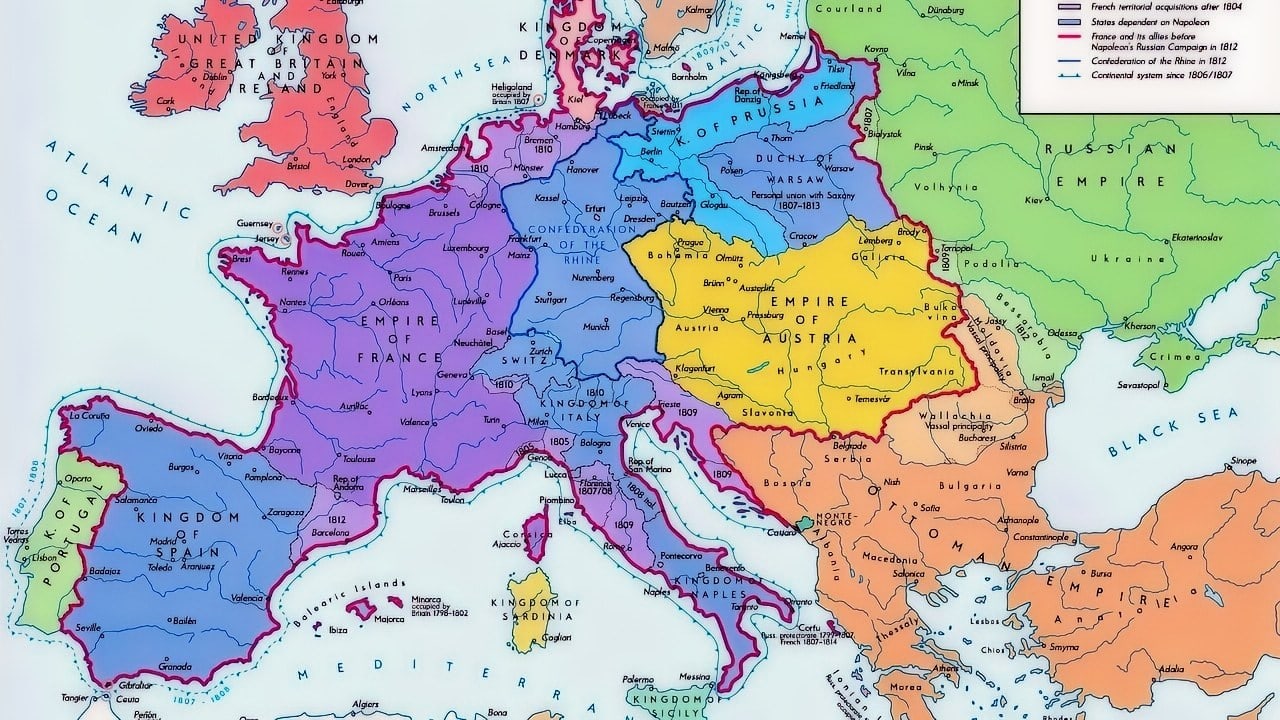
Map of Napoleon’s Empire. Image Credit: Creative Commons.
The technology spread almost immediately. That same year, the Englishman Peter Durand patented the use of tin-plated iron cans in place of Appert’s fragile glass, and the tin can as we know it was born.
Within a few years, preserved food in sealed containers was feeding the British Royal Navy, and over the following century it would remake not just how armies ate but how entire civilizations stored, shipped, and consumed food. The canned goods in every pantry on Earth descend from a French war-office contest to keep soldiers fed.
That is the payoff hiding inside a misattributed quote. “An army marches on its stomach” was probably Frederick’s line, and Napoleon proved its truth mainly by violating it on a catastrophic scale. But the challenge the phrase names, the brute difficulty of keeping fighting men fed far from home, forced a solution during the Napoleonic era that outlived the emperor, the wars, and the empire itself.
The quote endures not because the great man said it or lived by it, but because the problem behind it was real enough to change the way the world eats.
Sometimes the most important thing about a famous quote is not who said it, but what the world had to invent to make it true.
About the Author: Harry J. Kazianis
Harry J. Kazianis (@Grecianformula) was the former Senior Director of National Security Affairs at the Center for the National Interest (CFTNI), a foreign policy think tank founded by Richard Nixon based in Washington, DC. Harry has over a decade of experience in think tanks and national security publishing. His ideas have been published in the NY Times, The Washington Post, The Wall Street Journal, CNN, and many other outlets worldwide. He has held positions at CSIS, the Heritage Foundation, the University of Nottingham, and several other institutions related to national security research and studies. He is the former Executive Editor of the National Interest and the Diplomat. He holds a Master’s degree focusing on international affairs from Harvard University.

