

Summary and Key Points: Christian D. Orr, a senior defense editor and former Air Force officer, examines the Battle of Austerlitz, widely considered Napoleon Bonaparte’s tactical masterpiece.
-Facing the combined 89,000-man force of Tsar Alexander I and Holy Roman Emperor Francis I, Napoleon utilized his revolutionary Corps System and a daring deception on his right flank to lure the coalition into a fatal trap.
-This 19FortyFive report analyzes the collapse of the coalition center at Pratzen Heights, the role of 12-pounder field guns in breaking the Russian retreat, and the resulting dissolution of the Holy Roman Empire.
Quote of the Day: How Napoleon Dismantled Two Empires in One Afternoon
“An army’s effectiveness depends on its size, training, experience, and morale, and morale is worth more than any of the other factors combined.” – Napoleon
“—That quote is typically attributed to Napoleon Bonaparte (AKA Napoleon I, Emperor of France), France’s all-time greatest military genius (with all due respect to St. Joan of Arc, Charles de Gaulle, and Marshal Philippe Leclerc de Hauteclocque). It’s a truthful reflection of how a military force’s morale and motivation can be the make-or-break factor in combat, even with manpower size and technological advantages (or lack thereof) taken into account.
In his legendary life, Napoleon experienced his fair share of smashing victories and crushing defeats alike (with the Battle of Waterloo being the best-known example of the latter). Today, this writer will focus on what many historians consider his single greatest victory: the Battle of Austerlitz, AKA the Battle of the Emperor. Going back to the importance of morale and motivation over manpower, Napoleon’s French forces were actually outnumbered in the Battle of Austerlitz, but, as it turns out, on that red letter day of December 2, 1805, far from outmatched.
Backdrop to the Battle
The battle took place during the War of the Third Coalition, which commenced in April 1805, 13 months after Napoleon became Emperor of France and King of Italy; he was 36 years of age at the time of the battle. The Third Coalition was comprised of the United Kingdom, Naples, Sicily, Sweden, Austria, and Russia; however, only the latter two nations’ forces would participate in the Austerlitz engagement.
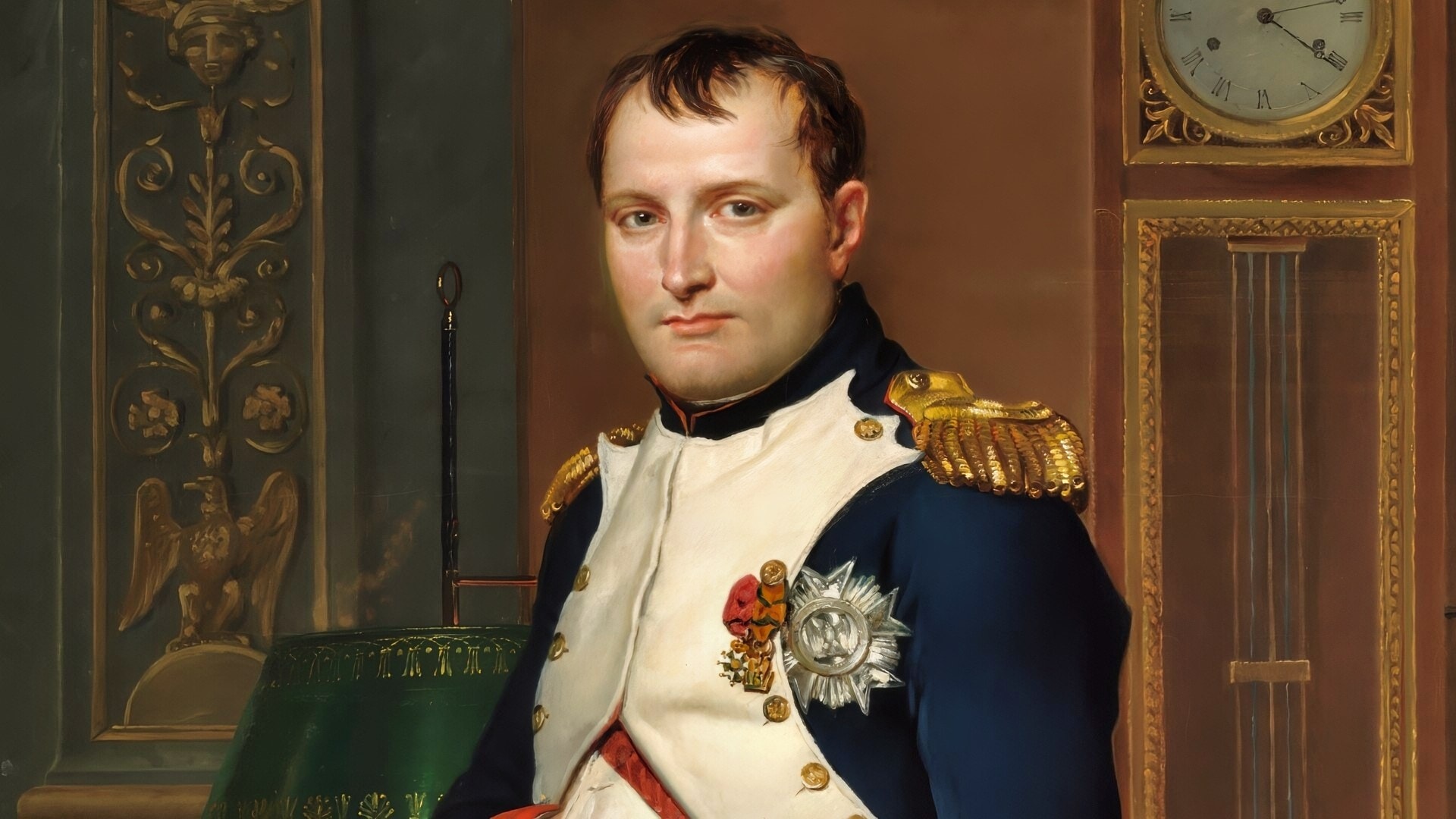
Napoleon Painting Creative Commons Image
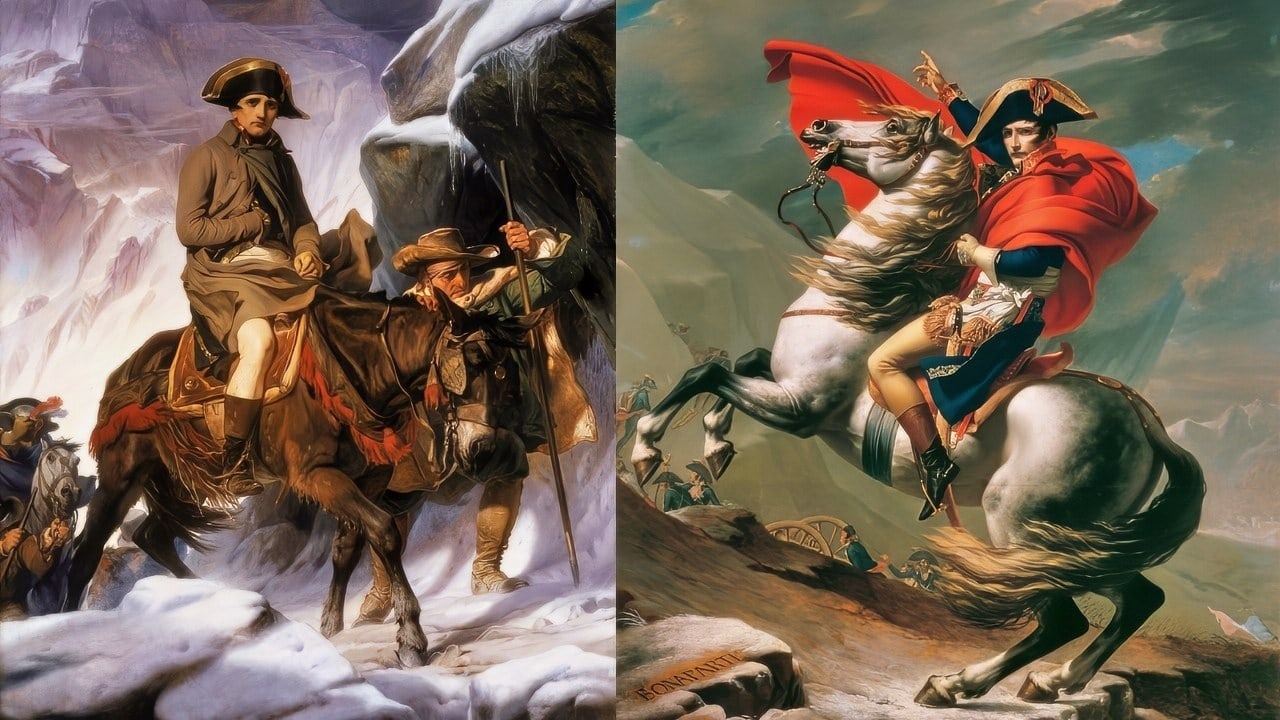
Napoleon Quote of The Day Two Looks. Image Credit: Creative Commons.
According to Praise Ojo in a September 21, 2018, article for War History Online, the newly crowned Emperor “knew he had to quell the enemy forces of Austria, Russia, and Prussia before they could team up against him.”
Napoleon’s Opposing Commanders
The engagement is also known as the Battle of the Three Emperors for a reason:
–Emperor #2: Alexander I of Russia (December 23, 1777 – December 1, 1805), nicknamed “the Blessed,” Emperor of Russia from 1801 to 1825. Along the way, he also became the first king of Congress Poland in 1815 and grand duke of Finland in 1809, thus making him “three emperors in one,” a mortal human trinity, in a manner of speaking. Alas, Sasha (that’s the diminutive for the name “Alexander” in Russian culture) wasn’t so blessed on this day.
–Emperor #3: Francis I (February 12, 1868 – March 2, 1835), Holy Roman Emperor, and another triple title holder, the other two being Archduke of Austria and King of Hungary, Croatia, and Bohemia.
These two emperors commanded a combined 89,000 troops against Emperor Napoleon’s 75,000. However, “L’Empereur” had the intangible but distinct advantage of a professionalized force forged over years of revolutionary and Napoleonic wars, with the confidence and swagger to match its battle-hardened experience. From a logistics standpoint, his corps system allowed him to move forces quickly and to deploy them flexibly while maintaining efficient supply. And Napoleon was blessed with generals, men such as Marshal Soult, Marshal Lannes, and Marshal Murat, who had extensive experience and understood his methods of warfare, thus ensuring unity of command.
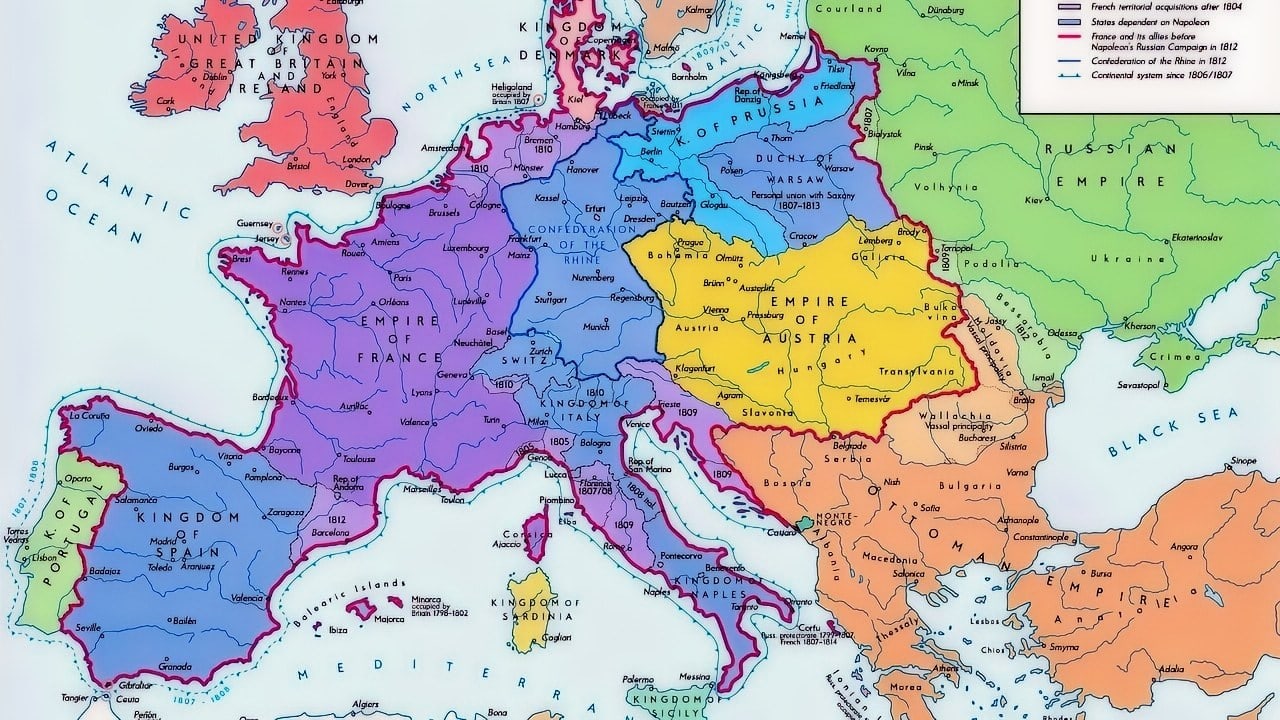
Map of Napoleon’s Empire. Image Credit: Creative Commons.
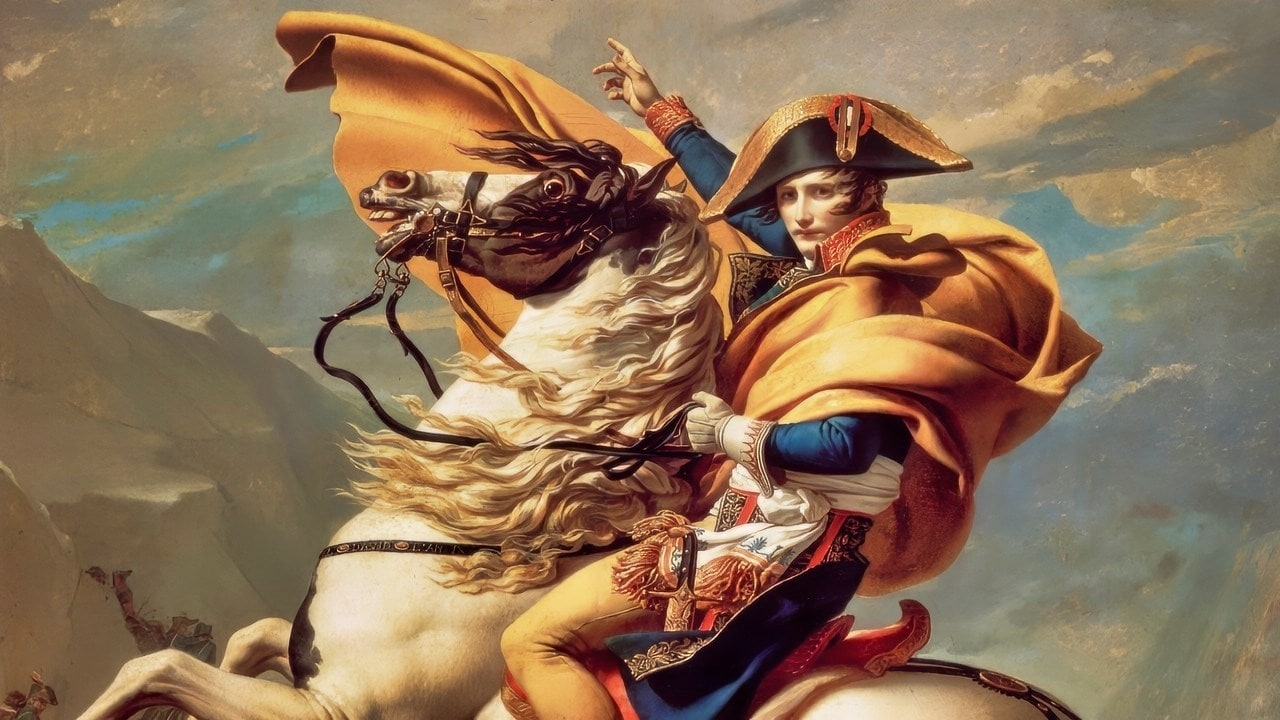
Napoleon Riding Off to War. Image Credit: Creative Commons.
By contrast, the Russians suffered from slower organization and less efficient command structures; this cobbled-together coalition struggled with cohesiveness due to language barriers, differences in military doctrine, and the overconfidence of senior commanders. Perhaps even worse, Alexander I overruled the advice of experienced officers despite his lack of military expertise.
Complacency kills, and so does hubris. All of this would come to a head on the fateful December day.
The Battle Unfolds
In the early hours, the Austrian and Prussian forces moved forward against Napoleon’s right flank, which they believed was vulnerable. This was actually clever deception on the crafty Corsican’s part, as he had deliberately weakened his right flank by leaving Marshal Davout’s corps exposed to tempt the coalition into committing large numbers of troops there, which created the opening for his main strike in the center. Moreover, Marshal Davout’s corps resisted repeated attacks despite their heavy numerical disadvantage, and their spirited defense allowed their Empereur to launch his main thrust.
At about 0900 Local Time, when the fog began to clear (the literal fog, that is, not Clausewitz’s metaphorical “fog of war”), Marshal Soult led a major attack on the center, that being Pratzen Heights. French columns advanced up the slopes, pushed back the disorganized coalition forces, and gained control of the ridge.
Meanwhile, the Russian right wing, under the command of Prince Bagration, engaged in intense fighting against Marshal Lannes’ forces on the opposite flank. Unfortunately for the Russian prince, the allied centre soon collapsed, prompting Napoleon to order a full exploitation of the gap in their line, enabling Marshal Lannes to press forward on the left. At the same time, Murat’s horsemen fought Russian cavalrymen in several intense clashes.
French momentum soon became the irresistible force. The coalition troops, however, were decidedly not the immovable object, as they were driven towards the frozen ponds of Satschan and, under heavy artillery fire, the ice broke apart, and many allied soldiers drowned as they attempted to retreat.
Granted, some of this mass drowning story may have been slightly exaggerated on Napoleon’s part; however, contemporary accounts still described heavy losses in the ponds.
When all was said and done by late afternoon, the allied army had collapsed, and the bedraggled survivors fled in disarray and disgrace.
Napoleonic Era French Artillery Tech Specs
As for the artillery used to break that ice, it was most likely comprised of:
–12-pounder field guns (the heaviest caliber, requiring 15 crew members to load, aim, and fire, achieving 1–2 rounds per minute under ideal conditions)
-8-pounders
-6-inch howitzers
However, the so-called “artillery charge,” which is oftentimes attributed to Napoleon, is properly credited to another one of his senior officers, General Alexandre-Antoine Hureau de Sénarmont, who first used it at the Battle of Friedland in 1807, i.e., two years after Austerlitz. But, as we’ve already seen, during the Battle of the Three Emperors, Napoleon’s forces fared just fine without the artillery change, merci beaucoup.
Aftermath Part I: Comparing Casualty Figures
The sports-to-military analogy is way overused and abused. As proof of this point, battles aren’t always won on the “scoreboard” (so to speak), i.e., the side that inflicts the most casualties and inflicts the most materiel damage isn’t necessarily always the side that actually wins the battle.
History is replete with examples of battles wherein the side that inflicted more casualties still ended up losing, from the Battle of Bunker Hill during the American Revolution in 1775 (the Redcoats technically achieved their objective despise the terrible losses they suffered at the hand of the American rebels) to the Battle of the Alamo in 1836 (the Texians killed more than twice their number in General Santa Anna’s Mexican troops before getting completely wiped out) to the Battle of Kursk during World War II, or as even the post-Soviet era Russians still prefer to call it, “the Great Patriotic War” (the Red Army suffered 1.5 times as many dead and wounded and more than twice as many tank losses as Nazi Germany’s Wehrmacht, yet Kursk is still considered an epic victory for the Soviets).
However, in the case of the Battle of Austerlitz, the kill-to-loss ratio truly reflects the magnitude of the victors’ accomplishments. As noted by the Battlefield Anomalies website, “However, despite not being an annihilating victory, it remains, nevertheless, one of the greatest military achievements in history.
The Allies lost an estimated **25,000 to 30,000** in killed, wounded, or prisoners, in other words, one third of their army. The French losses numbered in all around **10,000**. Russian and Allied troops fought well, considering that their tactics and overall command structure were sadly inferior to those of the French. Time and attrition would change this over the next decade of conflict, and for the French Emperor and his armies, the campaigns of 1805 and 1806 marked the high watermark of their superior cohesion and control on the battlefield.” [emphases added]
That amounts to a casualty ratio of anywhere from 2.5:1 to 3:1. To make matters even worse for Napoleon’s adversaries, the History Skills website adds the following sobering facts in an article appropriately titled “Why the Battle of Austerlitz was Napoleon’s greatest triumph”: “The French captured around 180 guns, 50 standards, and thousands of horses … Among the fallen were numerous senior officers, along with large numbers of artillery pieces and vital supplies … The destruction of such a significant allied force in one day shocked Europe and showed how effective Napoleon’s military system was.”
Aftermath Part Deux: Political Impacts
Austria was utterly humbled, Russia suffered a severe setback, and France emerged from the dust and smoke as Europe’s supreme military power. The Holy Roman Empire was dissolved, and the Confederation of the Rhine was created. (Granted, that Confederation only lasted for seven years before it was dissolved in the wake of Napoleon’s defeat in the War of the Sixth Coalition, but that’s a separate discussion in and of itself.)
Though Francis I went down in history as the last Holy Roman Emperor, he still ended up with a nice consolation prize, as he ascended from Archduke to Emperor of Austria.
The Battlefield Today
The battlefield site is located several klicks west of the present-day town of Slavkov u Brna in the Vyškov District of the South Moravian Region of Czechia (AKA the Czech Republic).
About the Author: Christian D. Orr, Defense Expert
Christian D. Orr is a Senior Defense Editor. He is a former Air Force Security Forces officer, Federal law enforcement officer, and private military contractor (with assignments worked in Iraq, the United Arab Emirates, Kosovo, Japan, Germany, and the Pentagon). Chris holds a B.A. in International Relations from the University of Southern California (USC) and an M.A. in Intelligence Studies (concentration in Terrorism Studies) from American Military University (AMU). He is also the author of the newly published book “Five Decades of a Fabulous Firearm: Celebrating the 50th Anniversary of the Beretta 92 Pistol Series.”