
Summary and Key Points: The USS Zumwalt has been rebuilt at extraordinary cost into the U.S. Navy’s first hypersonic strike ship, and the number at the center of that transformation deserves to be said out loud: twelve. For roughly $9.5 billion per hull, the Navy’s futuristic stealth destroyer will carry a hypersonic magazine of twelve missiles, on a ship whose launch tubes sit empty today and will not fire those weapons for years. Measured against the ships it is meant to stand beside, or against, that magazine is strikingly thin, and the gap between what was spent and what was bought is the real story of the Zumwalt’s second life.
The Zumwalt-Class Destroyer Mistake?
The conversion itself is genuinely impressive engineering. Beginning in 2023, the Navy pulled the USS Zumwalt out of the water at Ingalls Shipbuilding, stripped out the two 155mm Advanced Gun Systems that had left the ship with no usable main weapon, and installed four 87-inch-diameter missile tubes in the bow, each holding an Advanced Payload Module packed with three Conventional Prompt Strike rounds. Four tubes, three missiles apiece, and the arithmetic lands at twelve. That is the entire hypersonic battery, and once those dozen rounds are expended, the ship reloads in port because these tubes, like the rest of the Navy’s vertical launch cells, are not rearmed at sea.
Twelve, and Not Even Yet
The number is small, and the timeline makes it smaller. The tubes are installed, but the missile is not. Conventional Prompt Strike remains in land-based testing, and the Navy does not expect to begin firing the weapon from the Zumwalt itself until 2027 or 2028, after the program already slipped from a Fiscal Year 2025 target to FY2026 and beyond. The Navy’s director of strategic programs, Vice Admiral Johnny Wolfe, explained that the round is so large it has to be cold-gas ejected from the ship before its rocket motor ignites, in his words, “You don’t light this thing off inside.” So the accurate description of the Navy’s first hypersonic destroyer, as it sails today, is a ship with twelve empty tubes for a weapon it cannot yet fire.
None of this is cheap. Each Zumwalt now runs to approximately $9.5 billion, with the Conventional Prompt Strike integration adding about $452 million to each ship, on a program that ultimately delivered just three hulls of a planned 32. The missile program itself drew a $1.356 billion contract to Lockheed Martin in March 2026, just to push it from development toward fielding. This is among the most expensive rounds of fire the Navy has ever pursued.
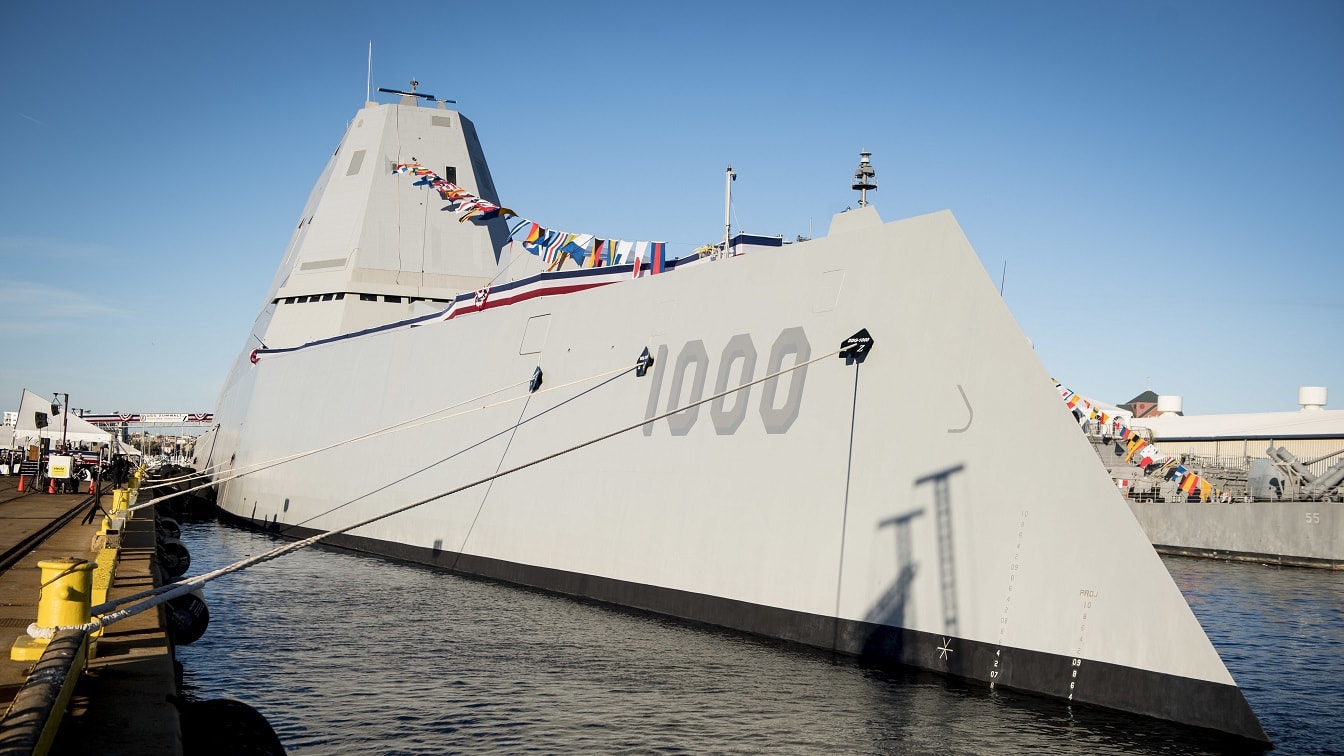
(Oct. 15, 2016) The Navy’s newest and most technologically advanced warship, USS Zumwalt (DDG 1000), is moored to the pier during a commissioning ceremony at North Locust Point in Baltimore. (U.S. Navy photo by Petty Officer 1st Class Nathan Laird/Released)
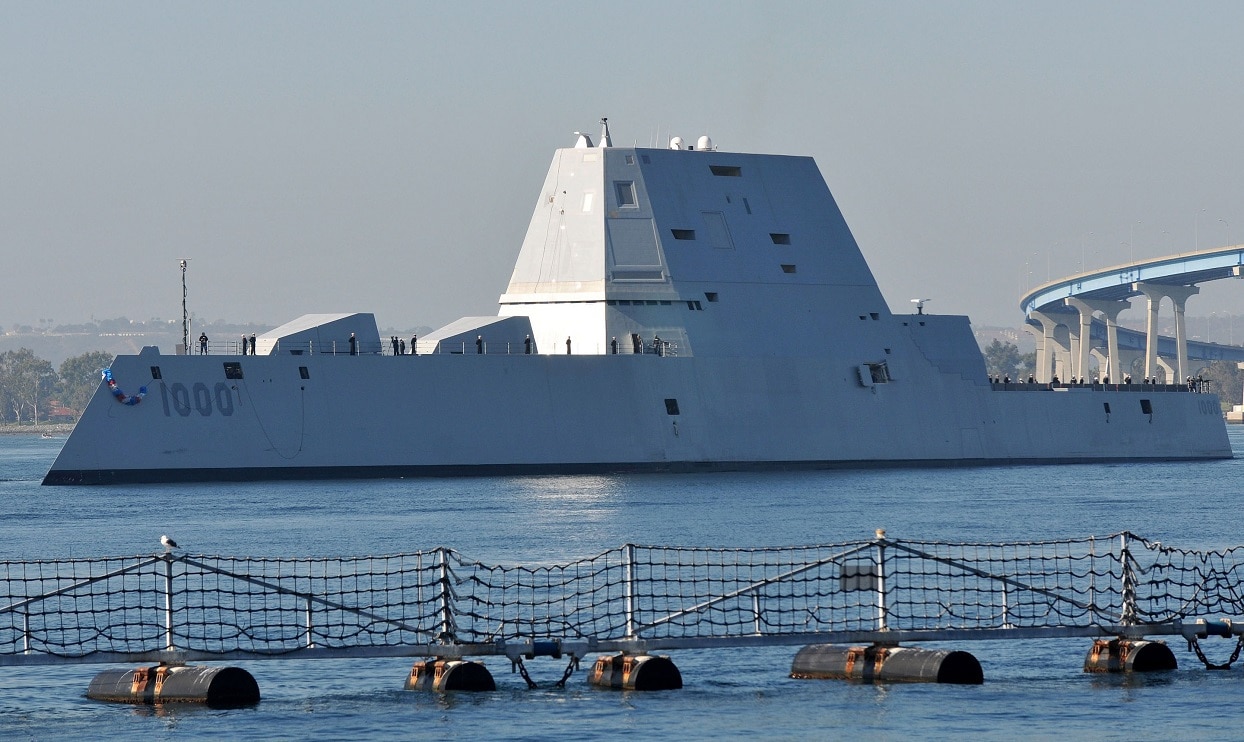
FROM 2016: The U.S. Navy’s newest warship, USS Zumwalt (DDG 1000) passes Coronado bridge on its way to Naval Base San Diego. Zumwalt is the lead ship of a class of next-generation multi-mission destroyers, now homeported in San Diego. (U.S. Navy photo by Petty Officer 3rd Class Anthony N. Hilkowski/Released)
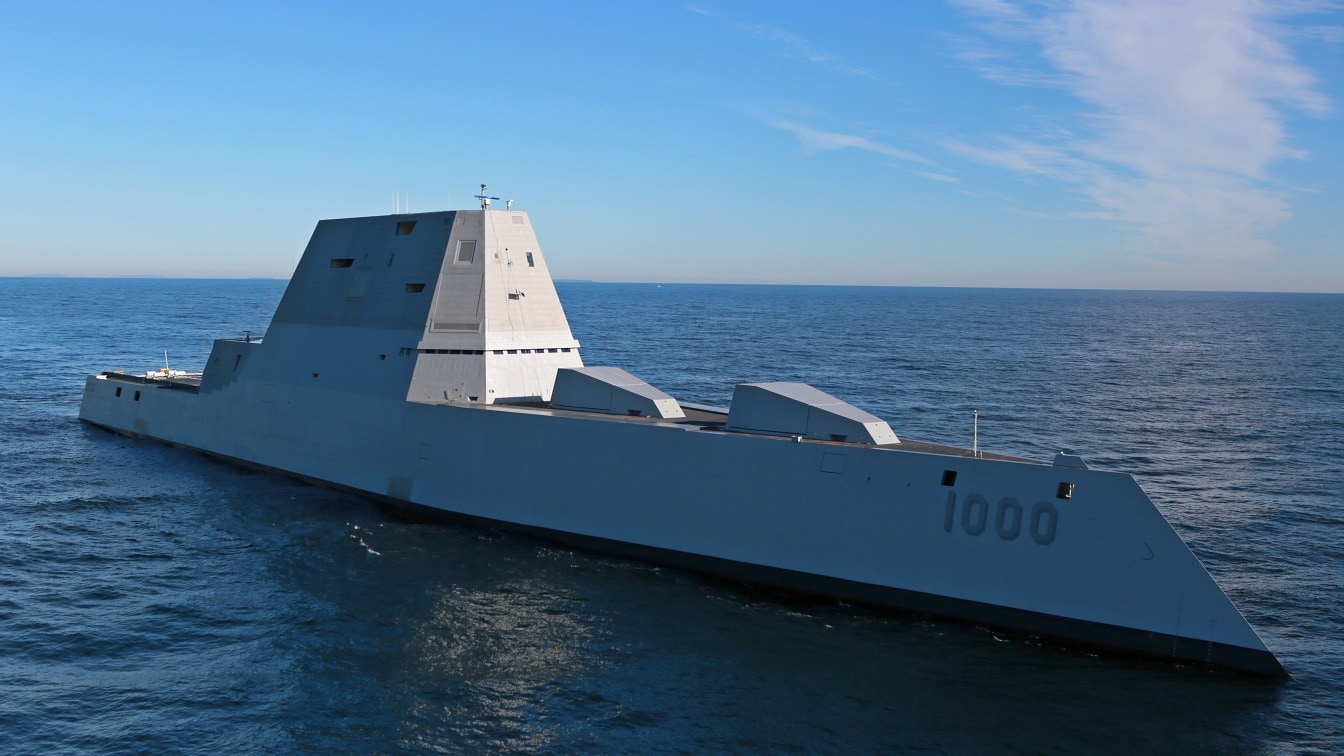
(Dec. 7, 2015) The future USS Zumwalt (DDG 1000) is underway for the first time conducting at-sea tests and trials in the Atlantic Ocean Dec. 7, 2015. The multimission ship will provide independent forward presence and deterrence, support special operations forces, and operate as an integral part of joint and combined expeditionary forces. (U.S. Navy photo courtesy of General Dynamics Bath Iron Works/Released). Zumwalt-Class
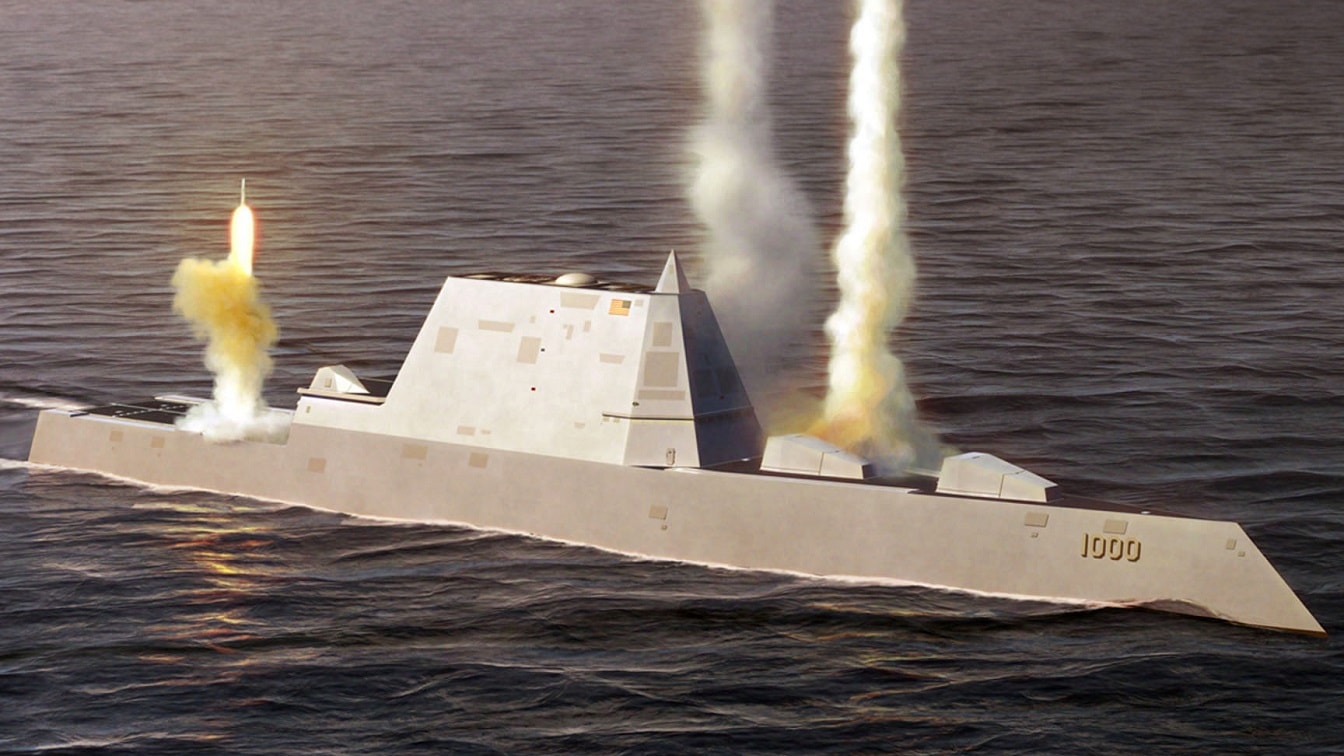
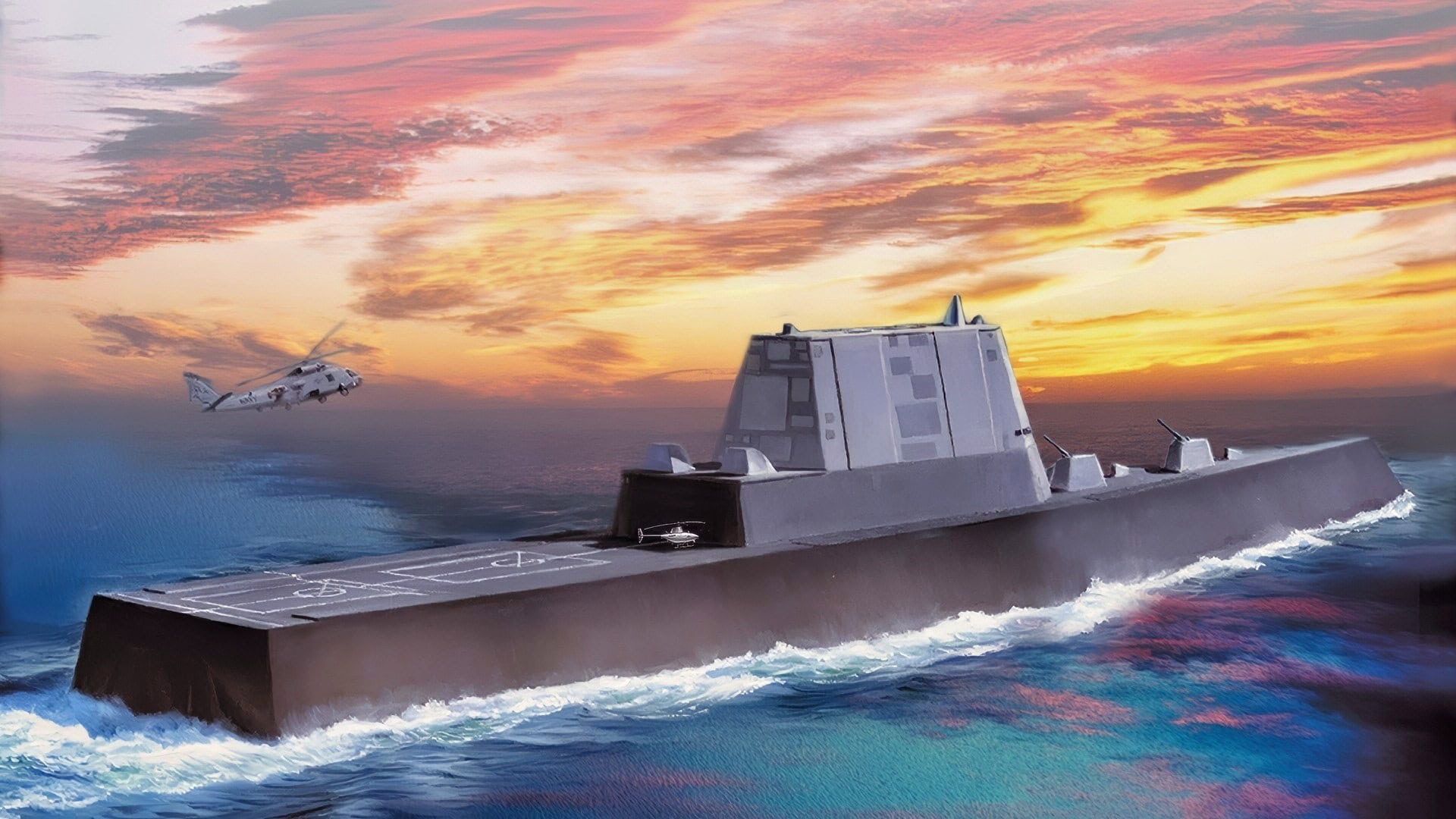
An artist rendering of the Zumwalt class destroyer DDG 1000, a new class of multi-mission U.S. Navy surface combatant ship designed to operate as part of a joint maritime fleet, assisting Marine strike forces ashore as well as performing littoral, air and sub-surface warfare.
Ten Times the Cells, Down the Pier
Here is where the number does its damage. Set the Zumwalt beside the ships it shares an ocean with. To be fair and precise, the Zumwalt is not a twelve-missile ship in total: it retains 80 Mk57 peripheral vertical launch cells for Tomahawk cruise missiles and SM-6 interceptors, so the ship musters 92 launch positions all told. But even that fuller figure trails the field. A Ticonderoga-class cruiser, a design now four decades old and being retired as quickly as the Navy can manage, carries 122 vertical launch cells. A Flight III Arleigh Burke destroyer carries 96. China’s Type 055 carries 112. And Russia’s rebuilt Kirov-class battlecruiser Admiral Nakhimov, freshly returned from a multi-decade overhaul that cost an estimated $5 billion, carries roughly 176 cells, the largest missile magazine of any surface warship afloat.
The contrast sharpens when you isolate the hypersonic battery that the entire $452-million-per-ship conversion was built to deliver. That battery has twelve tubes. A Ticonderoga carries more than ten times the Zumwalt’s dedicated hypersonic count in total launch capacity, on a hull the Navy considers obsolete. The most advanced surface combatant the United States has ever built, and one of the most expensive, will go to sea with the smallest dedicated strike magazine of any capital-grade warship in its weight class.
And there are only three of these ships. The magazine question compounds across a class; the Navy cut from a planned 32 hulls down to three, one of which suffered an onboard fire last spring that underscored how few and how fragile the platforms carrying this capability really are. Do the arithmetic on the whole force, and it gets worse, not better: twelve rounds per ship, across three ships, comes to thirty-six hypersonic missiles for the entire class once every tube is finally armed, and today only the lead ship has its tubes even installed. A single Admiral Nakhimov, for all the fair criticism of concentrating firepower in one enormous target, can load hypersonic Zircon rounds across a large share of the cells that one Russian battlecruiser carries. The complete American hypersonic-destroyer force, when it finally exists, will field fewer dedicated hypersonic tubes than that single ship carries in reloadable launch cells.
The Same Mistake From Opposite Directions
There is an irony worth naming because 19FortyFive has made the opposite argument about the very ship at the top of this comparison. Russia spent an estimated $5 billion and the better part of three decades pouring 176 missile cells into a single Nakhimov hull, and the critique of that decision is that it concentrates too much irreplaceable firepower into one enormous target in an age of cheap drones and long-range missiles.
That criticism is sound. But the American answer runs off the same road in the other direction. Where Russia stacked everything into one hull, the U.S. Navy spent more per ship to field twelve hypersonic rounds each across three hulls, and neither approach solves the problem that matters most in a peer war, which is fielding enough magazine depth, on enough platforms, at a price that allows the fleet to absorb losses and keep shooting. One navy bought too many ships for too few hulls. The other bought too few missiles for too much money.
What the Twelve Actually Buy
The honest counterweight belongs here because the case for the Zumwalt conversion is real, even if the number is thin. Conventional Prompt Strike is a genuinely novel weapon, a boost-glide system that flies above Mach 5 on an unpredictable, non-ballistic path with no current intercept solution, and it is not meant to be a volume weapon.
Naval analysts describe it as a precision tool rather than a mass-strike system, a scalpel for the highest-value targets, an enemy carrier, a command node, an air-defense hub, where a handful of unstoppable rounds can change an adversary’s calculations before a single one is launched. By that logic, twelve is not an embarrassment but a deliberate choice, and the Zumwalts double as risk-reduction testbeds for the larger Conventional Prompt Strike load headed to Block V Virginia-class submarines, where the weapon may matter more. The conversion also rescued three otherwise useless $8 billion ships that had been reduced to sailing with guns they could not fire.
All of that is true, and none of it erases the number. If twelve hypersonic rounds are enough, then the Navy has quietly conceded that a $9.5 billion ship exists to deliver a niche capability against a short list of targets, which is a very expensive way to buy a scalpel. If twelve is not enough, the flagship of American surface innovation is going to war with a magazine a fraction of the size of a battlecruiser that Russia laid down during the Cold War. Either way, the transformation everyone is celebrating rests on a number nobody wants to say plainly. The Zumwalt is back, it is stealthy, it is fast, and when its tubes are finally full, it will carry twelve.
About the Author: Harry J. Kazianis
Harry J. Kazianis (@Grecianformula) was the former Senior Director of National Security Affairs at the Center for the National Interest (CFTNI), a foreign policy think tank founded by Richard Nixon based in Washington, DC. Harry has over a decade of experience in think tanks and national security publishing. His ideas have been published in the NY Times, The Washington Post, The Wall Street Journal, CNN, and many other outlets. He has held positions at CSIS, the Heritage Foundation, the University of Nottingham, and several other institutions related to national security research and studies. He is the former Executive Editor of the National Interest and the Diplomat. He holds a Master’s degree focusing on international affairs from Harvard University.