
On November 25, 1988, workers at the Black Sea Shipyard in Nikolayev laid down the Soviet Union’s first nuclear-powered aircraft carrier. Project 1143.7, named Ulyanovsk, was expected to launch in 1992 and enter service in December 1995. The keel marked the end of a long argument inside Moscow over whether the Soviet Navy needed a full-size carrier at all.
Ulyanovsk was designed as a ship of more than 73,000 tons at full load and roughly 321 meters in length. Four KN-3-43 reactors were to drive four shafts with 280,000 horsepower, giving the carrier a top speed near 30 knots. Two steam catapults, a bow ski jump and three aircraft elevators would support an air group of around 70 fighters, radar aircraft and helicopters.

Artist concept of a Soviet Kiev-class aircraft carrier in a floating drydock. “Soviet Military Power,” 1983, Page 82-83
Ulyanovsk followed some American design logic without becoming a Soviet copy of a Nimitz-class carrier. Its flight deck supported conventional naval aviation, but its hull also retained the weapons of a missile cruiser, including 12 P-700 Granit anti-ship missiles and layered air defenses. Soviet planners still classified it as a “heavy aircraft-carrying cruiser,” preserving the service’s preference for warships able to fight with their own missiles.
Construction stopped in November 1991, with estimates of completion ranging from roughly 20 to 40 percent depending on whether the measure covered the entire ship or visible hull work. The reactors had not been installed. After the Soviet Union dissolved, the yard and unfinished carrier stood inside independent Ukraine. Russia no longer controlled the shipyard; the state that financed the project had disappeared, the supply chain had split across new borders, and Ukraine formally ordered the hull dismantled.
The Soviet Navy Spent Decades Avoiding an American-Style Carrier
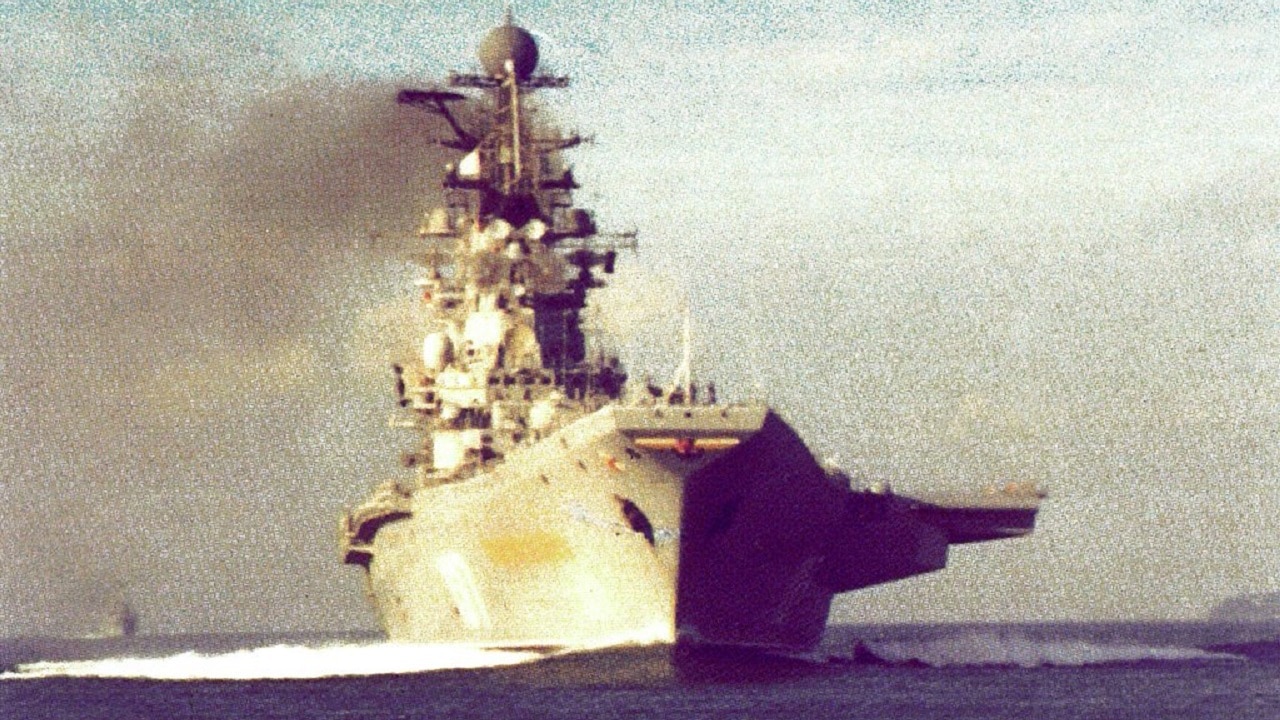
Soviet naval aviation developed through smaller steps. The Moskva class carried anti-submarine helicopters. The later Kiev-class ships combined a partial flight deck for Yak-38 vertical-takeoff aircraft with the missile battery of a cruiser. Those hybrids fit a navy centered on submarines, long-range missiles and the defense of Soviet naval formations, but their small air wings and limited aircraft never matched the reach of American carrier groups.

An aerial port bow view of the Soviet aircraft carrier KIEV underway.
Moscow had studied larger nuclear designs under Projects 1160 and 1153 during the 1970s. Defense Minister Andrei Grechko supported an 80,000-ton carrier with catapults and as many as 70 aircraft. After his death, Dmitry Ustinov favored smaller aviation cruisers, and the earlier carrier project died.
The troubled evolution toward a nuclear-powered Soviet carrier continued until the Nevskoye Design Bureau revived the concept as Ulyanovsk in 1984.
Ulyanovsk Was Meant to Fix the Kuznetsov’s Biggest Limits
Admiral Kuznetsov used a ski jump rather than catapults. Fighters launched from it, but takeoff weight, weapons and fuel became harder tradeoffs, and the ship lacked a fixed-wing airborne early-warning aircraft. Ulyanovsk kept a ski jump for fighters while adding two steam catapults.
Those launchers were intended to send the Yak-44 radar aircraft aloft and give heavily loaded Su-33 or MiG-29K fighters more flexibility.
The combination mattered more than nuclear endurance alone. Yak-44 aircraft would have extended the carrier group’s radar horizon and helped direct fighters beyond the range of shipboard sensors.

Yak-38: Only 50 of these VTOL-jets were built. This year (1993) was the last year they were in active service.
The nuclear plant supported sustained speed and long deployments, while the Granit missiles showed that Soviet designers still expected the ship itself to deliver a major anti-ship strike. Ulyanovsk joined two naval traditions that Moscow had never fully reconciled.
The Carrier Entered Construction as the Soviet Economy Was Failing
The timing was fatal. Ulyanovsk was ordered in June 1986 and laid down late in 1988, as Mikhail Gorbachev’s government faced worsening economic pressure and moved toward reduced confrontation with the West.
A contemporary U.S. Naval Institute assessment in 1990 still described an energetic Soviet shipbuilding program and treated Ulyanovsk as the follow-on to the new Tbilisi class, later renamed Kuznetsov.
Less than two years later, the same journal described Soviet naval construction as grinding to a halt. Ukraine’s December 1, 1991, independence vote placed the carrier yard beyond Russian control.
Reactors, weapons, electronics and aviation programs depended on factories and design bureaus spread across the former union. Even preserving the unfinished carrier required money that neither Moscow nor Kyiv was prepared to supply, leaving Russia with a far smaller carrier inheritance.
Ukraine Ordered the Nuclear Carrier Cut Apart on the Slipway
On February 4, 1992, the Ukrainian government issued Order No. 69-r.
The document cited the Black Sea Shipyard’s dire financial condition after funding and material support from the former Soviet Defense Ministry ended. It instructed the yard to stop building Ulyanovsk, dismantle the carrier for scrap on slipway No. 0 and sell its removable equipment and metal. The order also allocated 338.7 million karbovantsi to cover debts and disposal costs.
Dismantling began the next day.
An April 1992 U.S. Naval Institute report said the carrier was already being broken up, was about 40 percent complete by the estimate available to Western observers, and showed no sign that its reactors had arrived.
A 1995 survey of the former Soviet fleets listed the unfinished nuclear carrier as scrapped at Nikolayev.
Ulyanovsk never left the slipway, and its nuclear plant never reached the ship.
MORE – The J-20 Stealth Fighter Is Ready for a Showdown with the F-22
About the Author: Harry J. Kazianis
Harry J. Kazianis (@Grecianformula) was the former Senior Director of National Security Affairs at the Center for the National Interest (CFTNI), a foreign policy think tank founded by Richard Nixon based in Washington, DC. Harry has over a decade of experience in think tanks and national security publishing. His ideas have been published in the NY Times, The Washington Post, The Wall Street Journal, CNN, and many other outlets worldwide. He has held positions at CSIS, the Heritage Foundation, the University of Nottingham, and several other institutions related to national security research and studies. He is the former Executive Editor of the National Interest and the Diplomat. He holds a Master’s degree focusing on international affairs from Harvard University.

