
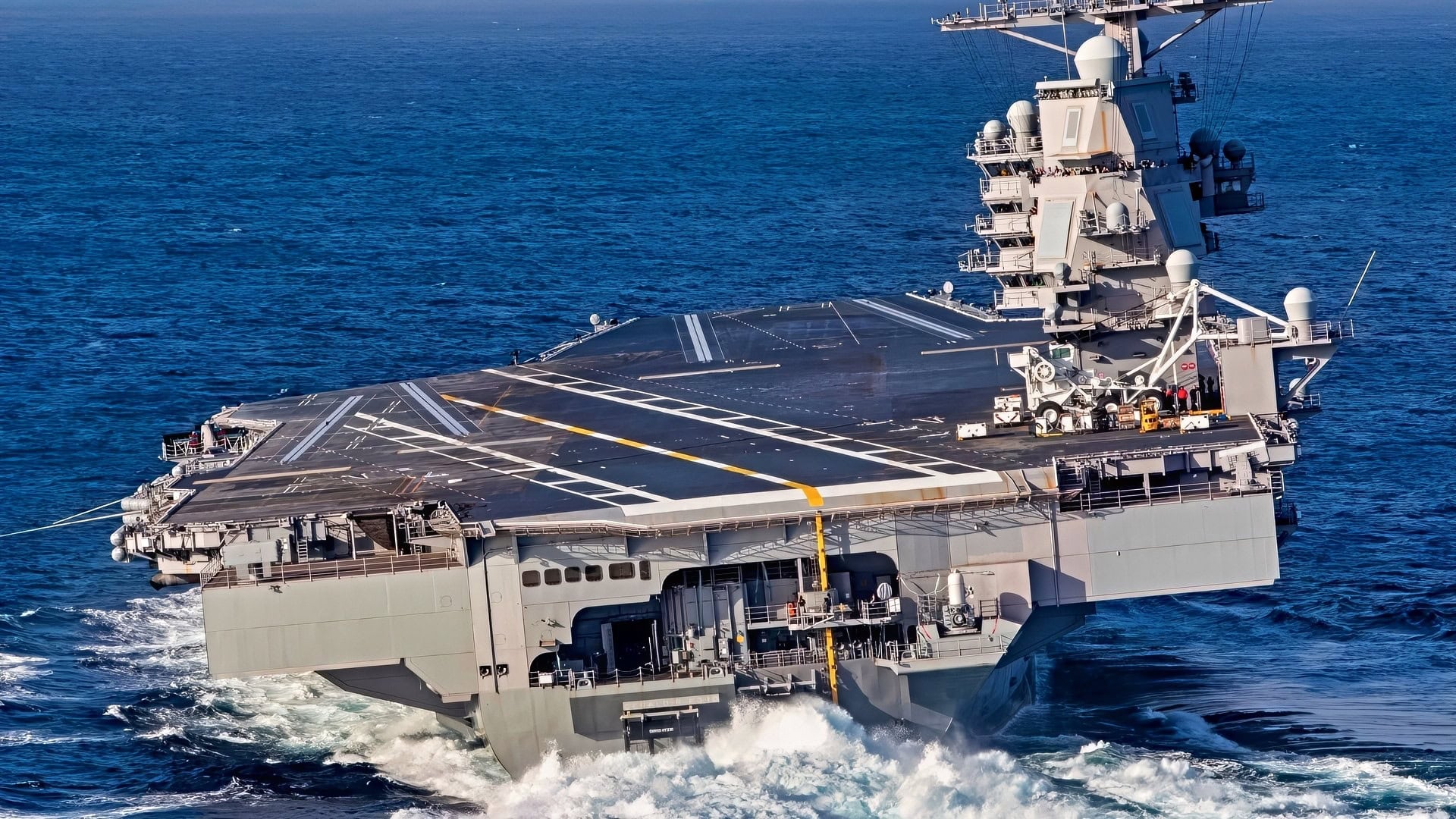
USS Gerald R. Ford’s Toilets Have Failed for Years. The Navy Is Finally Installing a Major Fix: Aircraft carrier USS Gerald R. Ford entered Norfolk Naval Shipyard on July 7, 2026, after a 326-day deployment. Among the scheduled jobs is an upgrade to the sewage network serving roughly 650 toilets. The work is intended to stop one failure from disabling a large section of the carrier.
The problem predates Ford’s first combat deployment. Its Vacuum Collection, Holding and Transfer system has suffered clogs, vacuum losses, sewage backups, and repeated maintenance calls. A 2020 Government Accountability Office review warned that regular acid cleaning would remain an unplanned expense throughout the ship’s service life.
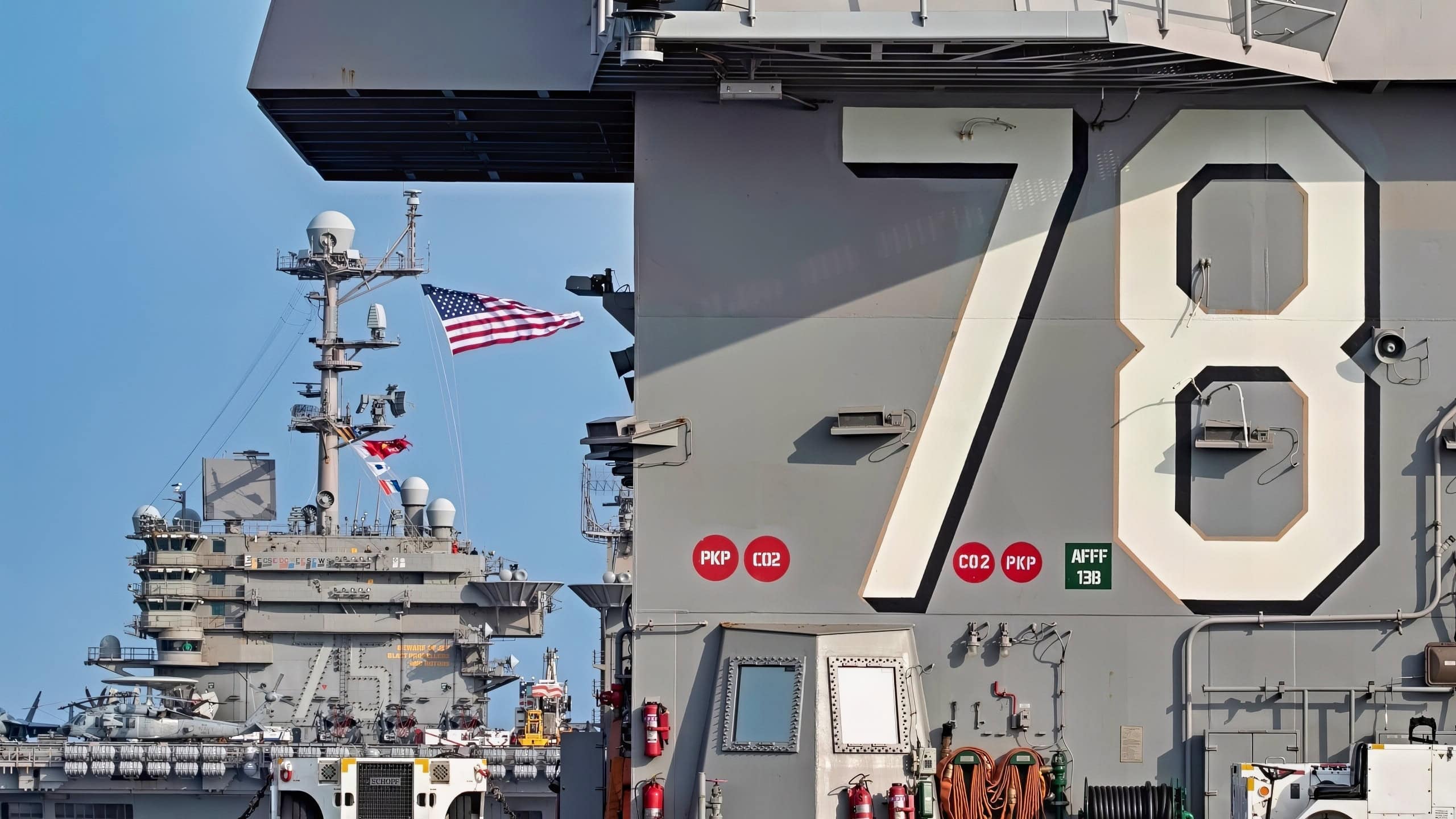
The Ford-class aircraft carrier USS Gerald R. Ford (CVN 78) and the Nimitz-class aircraft carrier USS Harry S. Truman (CVN 75) transit the Atlantic Ocean June 4, 2020, marking the first time a Ford-class and a Nimitz-class aircraft carrier have operated together underway. Ford is underway conducting integrated air wing operations, and the Harry S. Truman Carrier Strike Group remains at sea in the Atlantic as a certified carrier strike group force ready for tasking in order to protect the crew from the risks posed by COVID-19, following their successful deployment to the U.S. 5th and 6th Fleet areas of operation. (U.S. Navy photo by Mass Communication Specialist 2nd Class Ryan Seelbach)
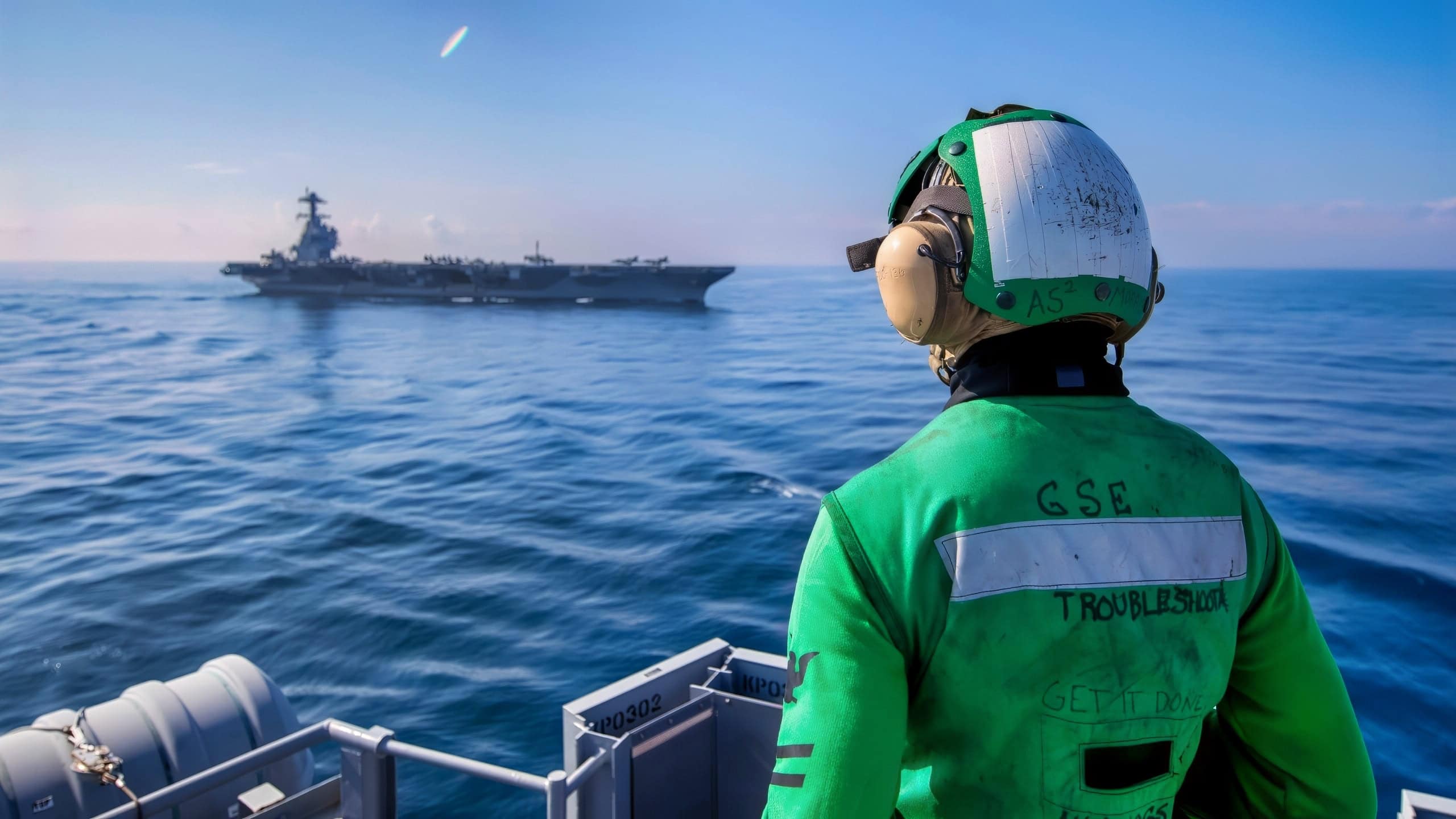
ATLANTIC OCEAN (June 27, 2025) Aviation Support Equipment Technician 2nd Class Jato Morris observes the Ford-class aircraft carrier USS Gerald R. Ford (CVN 78), conduct a vertical replenishment with the Nimitz-class aircraft carrier USS George H.W. Bush (CVN 77). George H.W. Bush is underway conducting Tailored Ship’s Training Availability and Final Evaluation Problem (TSTA/FEP). TSTA/FEP prepares the ship and crew for full integration as a carrier strike group through a wide range of mission critical operations. (U.S. Navy photo by Mass Communication Specialist 3rd Class Jayden Brown)
The issue sounds absurd beside a $13 billion nuclear carrier. It is not trivial for more than 4,000 sailors living at sea for months. Broken heads create sanitation risks, long lines, and heavy workloads for technicians.
Ford remained operational. During the 2025-2026 cruise, the carrier sailed 57,713 nautical miles and recorded 12,200 flight launches. The sewage system never stopped the air wing from flying, but it became a clear example of how an ordinary support system creates years of cost and frustration.
USS George H.W. Bush Gave the Navy an Early Warning
The Ford story began aboard USS George H.W. Bush, the final Nimitz-class carrier and the first American carrier fitted with a large vacuum-based waste system. The design used less water and smaller pipes.
Bush entered service in 2009. By 2011, published accounts described frequent repair calls and two incidents in which every commode went offline. Navy officials blamed foreign material in the pipes, but acknowledged that one fault could affect many fixtures.
The Navy later modified Bush to isolate failures more effectively. The experience became an early warning for the sanitation network installed on Ford. CVN-78 was already under construction when Bush’s problems became public, making a major redesign expensive.
The issue belonged to a wider pattern in which the Navy introduced several new systems on one carrier class. Electric catapults, arresting gear and weapons elevators drew most of the attention. The toilets became another system whose maintenance burden was not fully understood.
GAO Put the $400,000 Acid Flush Into the Public Record
GAO found unexpected and frequent clogging on Bush and Ford. Fleet maintenance officials said each acid flush cost about $400,000. The figure did not represent the repair of one toilet. It covered specialized cleaning of the shipwide sewage network to remove buildup from the piping.
The Navy did not know how often the treatment would be required. GAO classified it as an unplanned action expected throughout the ships’ service lives. USS John F. Kennedy also carried the same basic system.
The finding weakened part of the Ford program’s promised lifecycle savings. Reduced manning and advanced equipment save little when sailors need extraordinary labor to keep basic services working.
USS Gerald R. Ford’s Deployments Exposed the Daily Burden
Ford was commissioned in 2017 but did not begin its first full-length deployment until May 2023. Internal Navy records later obtained through the Freedom of Information Act said the ship generated a sewage-system trouble call every day the full crew was aboard from June 2023 onward.
The records described 42 requests for outside help between 2023 and early 2026, including 32 during 2025. One March 2025, an email counted 205 breakdowns over four days. Hull maintenance technicians reported 19-hour workdays as they cleared a backlog before deployment.
Some failures came from misuse. Technicians removed T-shirts, paper towels, and a four-foot length of rope. Other failures involved loose hoses or control valves that could break the vacuum across an affected section.
The Navy described the network as 10 zones, which limited many incidents. Internal correspondence still warned that the wrong valve failure could disable a much larger group of heads. The problem was never one defective commode. It was a maintenance-sensitive network spread across a 1,092-foot ship.
The 2025-2026 Deployment Turned Maintenance Into a Crew Problem
Ford left Norfolk in June 2025 and stayed away for 326 days. Family members supplied photographs to public-radio reporters showing wastewater around backed-up toilets. Navy officials said most clogs remained localized and were repaired within 30 minutes to two hours.
Calcium accumulation created a separate problem, especially in lower sections of piping. Documents reviewed by NPR indicated Ford received at least 10 acid flushes after 2023. The treatments occurred in port because the process was not available during normal deployed operations.
Ford was designed to operate with fewer sailors than a Nimitz-class carrier. Long shifts spent tracing vacuum leaks and clearing foreign material moved labor into an area expected to need less attention. The extended deployment also left the ship facing a long post-deployment repair list.
The Navy Says the Toilet Crisis Was Exaggerated
Chief of Naval Operations Adm. Daryl Caudle defended the design in May 2026. He told senators the system worked when sailors followed procedures and called reports of a broad crisis highly exaggerated. His rough calculation placed the ship near six million flushes during the deployment, with failures affecting less than 1 percent.
Fleet Forces Command said the problem had no effect on mission execution, and most outages were confined to a single section. Ford’s combat record supports that narrow point.
Operational success does not erase the sustainment record. A system serving thousands of sailors must tolerate a predictable level of misuse. Clothing and rope should never enter a toilet, but vacuum losses, mineral buildup, and wide-area outages explain why the Navy is changing the network. The carrier proved its combat value; its technicians also showed how much labor was needed to keep sanitation usable.
Norfolk Naval Shipyard Is Installing the Fix in 2026
As of July 29, Ford is inside its first Planned Incremental Availability at a public shipyard. The Navy began the availability on July 7. Sewage work includes an acid flush and a version of the isolation upgrade already used on George H.W. Bush.
Rear Adm. Kavon Hakimzadeh said the existing arrangement was divided so broadly that one failure could affect roughly a quarter of the carrier. The upgrade will create smaller sections, limiting the number of toilets lost when a valve, hose, or vacuum component fails.
The Navy has not published the total price of the sewage work or confirmed whether later ships will receive a redesigned network. Workers in Portsmouth now have a concrete assignment: clean the lines, add isolation points, and prevent one loose valve from sending sailors across several decks in search of an open head.
MORE – The Great Ford-Class Aircraft Carrier Delay
About the Author: Harry J. Kazianis
Harry J. Kazianis (@Grecianformula) was the former Senior Director of National Security Affairs at the Center for the National Interest, a foreign policy think tank founded by Richard Nixon in Washington, D.C. Harry has more than a decade of experience in think tanks and national security publishing. His ideas have been published in The New York Times, The Washington Post, The Wall Street Journal, CNN and many other outlets worldwide. He has held positions at CSIS, the Heritage Foundation, the University of Nottingham and several other institutions related to national security research and studies. He is the former Executive Editor of The National Interest and The Diplomat. He holds a master’s degree focusing on international affairs from Harvard University.

