
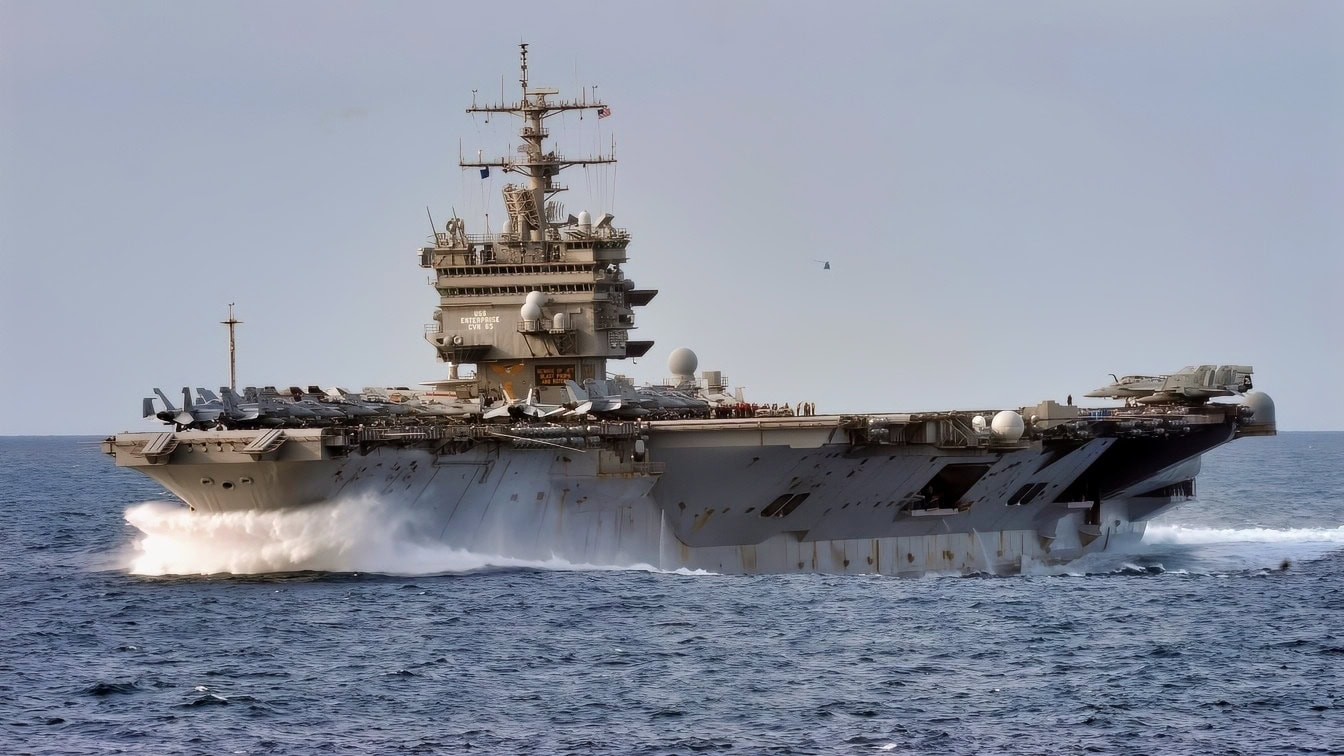
One of the most revered names in the annals of the United States Navy—in addition to inspiring the name of a certain iconic starship in a certain blockbuster sci-fi franchise—is that of the USS Enterprise, which has been bestowed upon more than one aircraft carrier, which in turn was affectionately nicknamed “The Big E.” Most recently, there was CVN-65, aka CVAN-65, which served proudly from 1961 to 2017, making history as the first nuclear-powered aircraft carrier in the U.S. Navy and the longest naval vessel ever built, with a hull length of 1,123 feet.
For good measure, this version of “Big E” lived up to her nickname with a displacement of 95,000 tons,
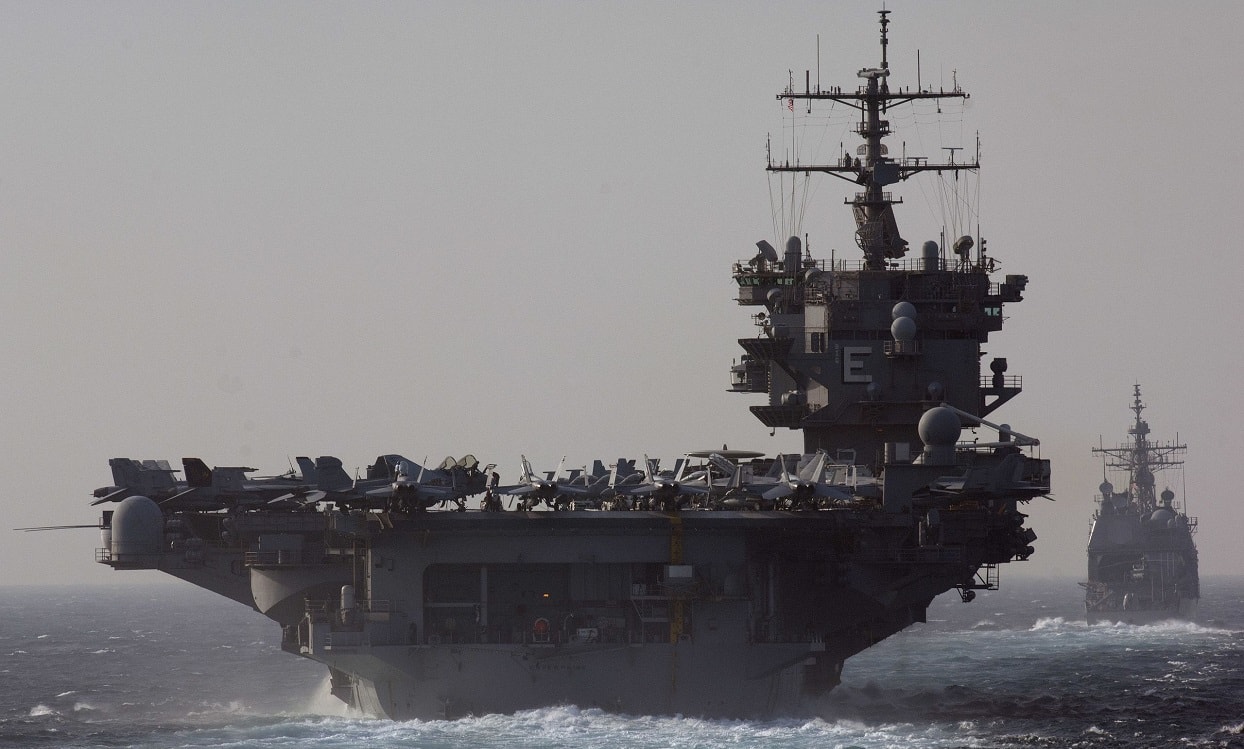
Image: Creative Commons.
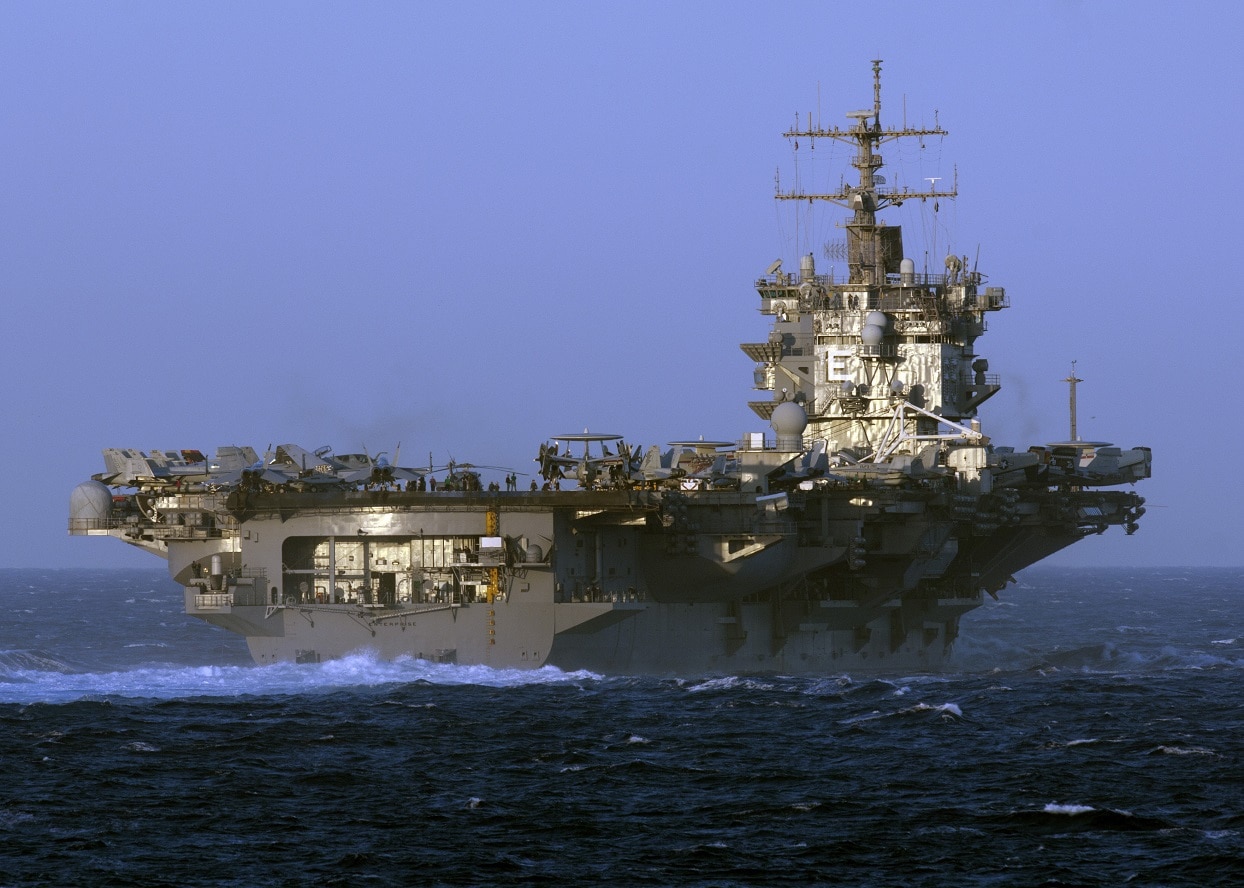
The aircraft carrier USS Enterprise (CVN 65) is underway in the Strait of Gibraltar. Enterprise is completing a deployment to the U.S. 5th and 6th Fleet areas of responsibility in support of maritime security operations and theater security cooperation efforts. The U.S. Navy has a 237-year heritage of defending freedom and projecting and protecting U.S. interests around the globe. Join the conversation on social media using #warfighting. (U.S. Navy photo by Mass Communication Specialist 3rd Class Daniel Meshel)
Alas, all good things must come to an end, even the mighty “Big E.” The venerable warship was withdrawn from active service on 1 December 2012, officially decommissioned on 3 February 2012, and consigned to the scrapyard rather than being converted to floating museum status for posterity.
Appropriately, the big ship will be going out with a big bang…not the literal big bang of being blown up, but rather big bucks being blown to carry out the scrapping process.
Bottom Line Up Front (BLUF)
The news comes to us from Sam Lagrone of USNI News—a publication of U.S. Naval Institute—in a 28 July 2026 article titled ” Final Bill for Inactivating, Scrapping Carrier Enterprise Now at $1.3B.” To wit, Mr. Lagrone reports that NorthStar Maritime Dismantlement Services—headquartered in New York City, with 23 locations nationwide— was awarded a $418.5 million contract earlier this month for the disposal of the famed former “flattop.”
According to a statement from Portfolio Acquisition Executive (PAE) Maritime provided to USNI News, that $418.5M is tacked onto the $902 million for the initial activation for Enterprise and $111 million for storage, hence the final tally of $1.3 billion referenced in the title of Mr. Lagrone’s article.
NorthStar’s chunk of that pot of money will cover the cost of towing the hulk from Pier 2 at Newport News Shipbuilding to Mobile, Alabama, for the final dismantling near the hulk of the former great ocean liner S.S. United States.
Digging Deeper
Another reason for that hefty price tag for taxpayers is that the cost of removing the remaining nuclear fuel has skyrocketed over the 14 years since Big E’s official withdrawal from service.
As stated back in 2024 by RADM Casey Moton, the USN’s Deputy Portfolio Acquisition Executive Maritime for Aircraft Carriers, during the standup of the Nuclear-Powered Aircraft Carrier Inactivation and Disposal Program Office (PMS 368), “It’s a task that touches stakeholders across Naval Sea Systems Command, Naval Reactors and the Departments of Navy, Defense, and Energy – and one that carries with it an opportunity to leverage the expertise and capacity of the industrial base to augment the capacity of the Nation’s public shipyards.”
Removing the remaining nuclear fuel is a daunting task, as the Enterprise has a total of eight nuclear reactors aboard, all requiring servicing.
As noted by former naval officer Bryan Clark, now Senior Fellow and Director, Center for Defense Concepts and Technology at the Hudson Institute—a prestigious Washington, DC think tank—“For submarines, you remove the reactor compartment as an entire section and ship it off to a disposal site. That’s difficult enough, but it’s straightforward. Here, the reactor compartment is too big, so you have to disassemble the hull itself.”
And even that defueling procedure is barely half the battle. Once that arduous task is completed, the octet of reactors will still need to be removed and properly disposed of at a Department of Energy (DOE) site in Hanford, Washington, where the Navy’s spent reactors are housed. Adds Mr. Lagrone, “That involves dealing with the low-level radiation of the compartments resident on the hull, according to the environmental assessment published in 2023.
The process is expected to last into 2030.”
What’s In a Name? The Future of the USS Enterprise Namesake
Fittingly and fortunately enough, the scrapping of CNV-65 certainly does not mean the end or final epitaph of the USS Enterprise name in the Naval Vessel Register.
The proverbial torch will be passed to one of the future ships of the ultramodern Gerald R. Ford class of supercarriers: CVN-80 is slated to be the third ship of the class, laid down back on 27 August 2022 with a projected commissioning date of March 2031.
Construction is being carried out by Huntington Ingalls Industries’ Newport News Shipbuilding division.
About the Author: Christian D. Orr
Christian D. Orr is a Senior Defense Editor. He is a former Air Force Security Forces officer, Federal law enforcement officer, and private military contractor (with assignments worked in Iraq, the United Arab Emirates, Kosovo, Japan, Germany, and the Pentagon). Chris holds a B.A. in International Relations from the University of Southern California (USC) and an M.A. in Intelligence Studies (with a concentration in Terrorism Studies) from American Military University (AMU). He is also the author of the book “Five Decades of a Fabulous Firearm: Celebrating the 50th Anniversary of the Beretta 92 Pistol Series,” the second edition of which was recently published.