
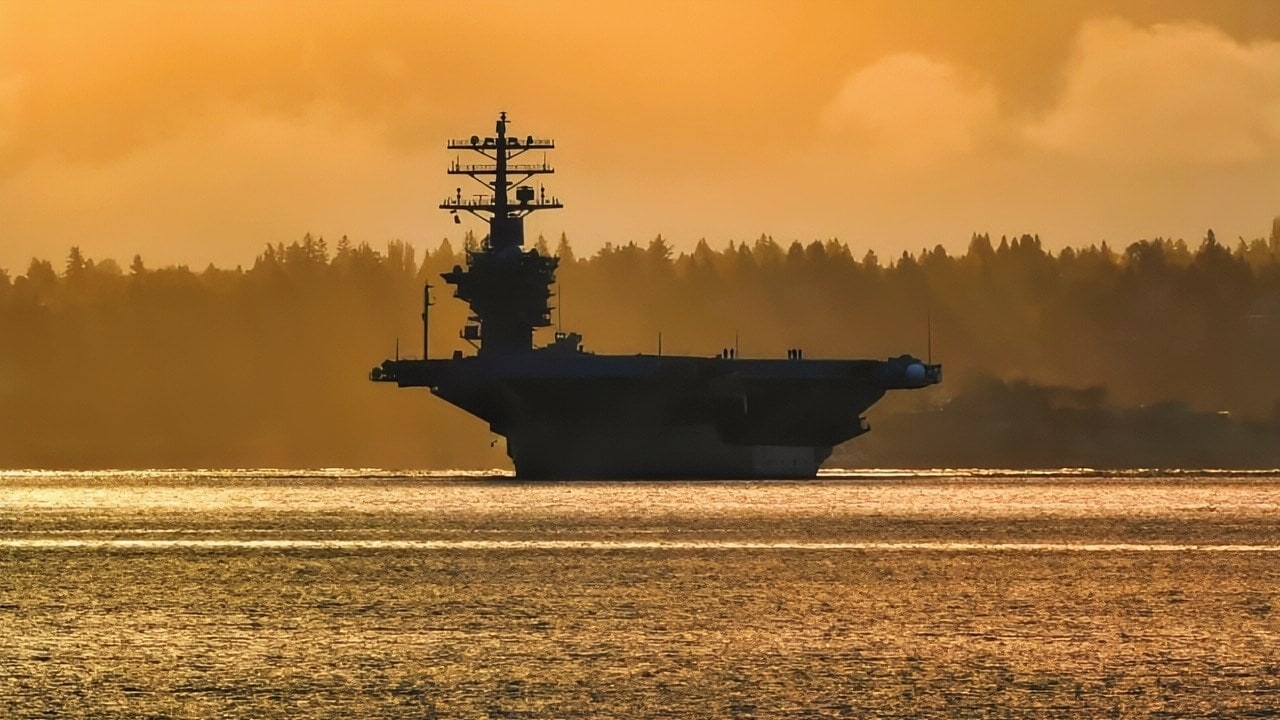
USS Nimitz Has Completed Its Final Operational Deployment After 51 Years: USS Nimitz arrived at Naval Station Norfolk on July 9, 2026, after a final overseas deployment and one last transit around South America. The Navy’s oldest aircraft carrier remains commissioned, but its schedule now centers on training and deactivation rather than another operational deployment.
The ship’s final deployment certified for national tasking ended at Bremerton on December 17, 2025. Over nine months, Nimitz operated in the Third, Fifth and Seventh Fleet areas. Its air wing generated more than 8,500 sorties and 17,000 flight hours, including combat missions against ISIS-Somalia.
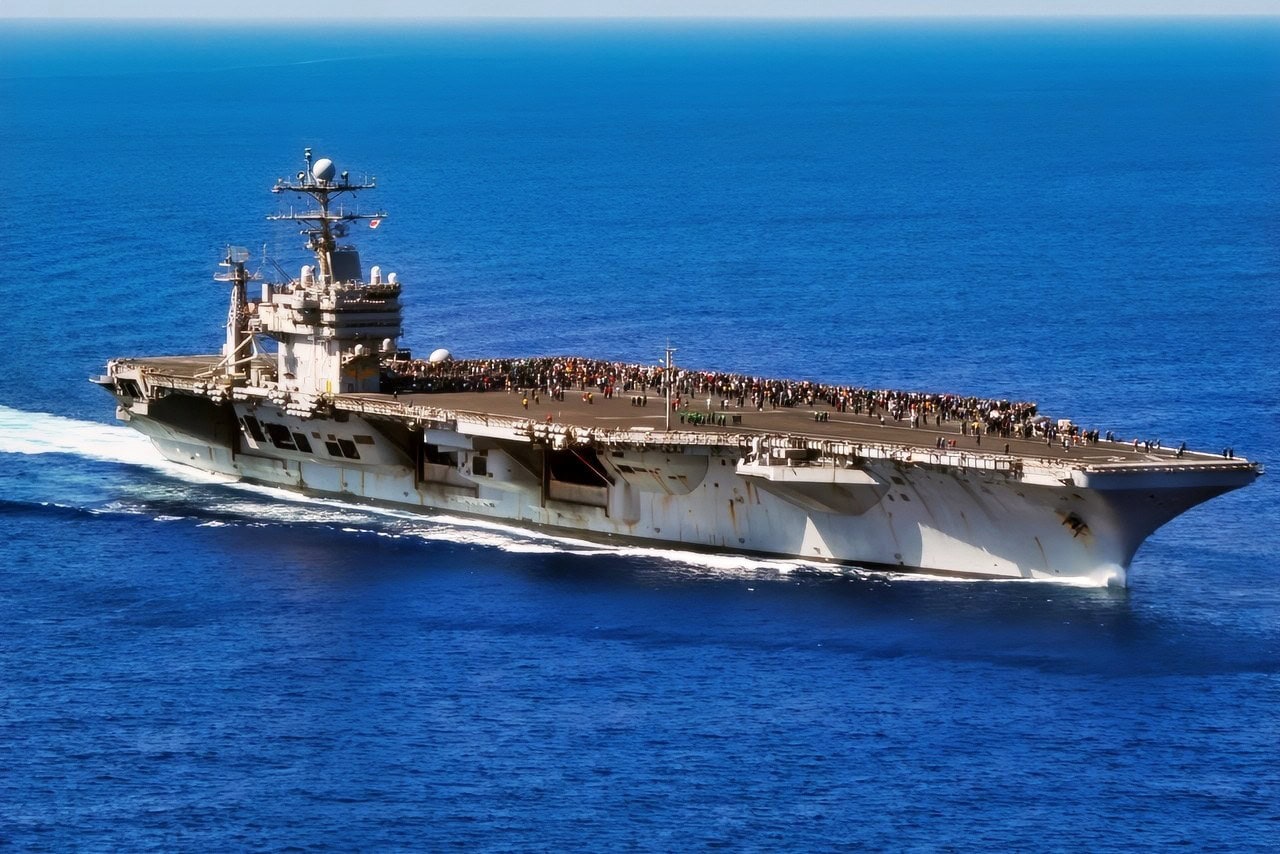
ATLANTIC OCEAN (Aug. 6, 2012) F/A-18 Hornets and Super Hornets from Carrier Air Wing (CVW) 2 fly in formation as MH-60S Seahawk helicopters assigned to the Golden Falcons of Helicopter Sea Combat Squadron (HSC) 12 fire flares during an air power demonstration above the Nimitz-class aircraft carrier USS Abraham Lincoln (CVN 72). Lincoln is returning to the United States after the completion of an eight-month change-of-homeport deployment during which she operated in the U.S. 5th, 6th and 7th Fleet areas of responsibility. (U.S. Navy photo by Mass Communication Specialist Seaman Zachary A. Anderson/Released)

USS Nimitz in November 2025. Image Credit: Creative Commons.
Nimitz returned to sea in March 2026 for Southern Seas, a partnership mission that took the carrier around Cape Horn before its homeport shift to Norfolk. The ship trained with regional forces and visited several South American ports, but the voyage did not place it back into the normal cycle for another combat deployment. By July, Nimitz had spent 21 of the previous 24 months underway.
The Navy extended Nimitz’s service by 10 months, moving deactivation from May 2026 to March 2027. The change helps cover the delayed delivery of the future USS John F. Kennedy and preserves the legally required force of 11 carriers. Nimitz is still formally active; its remaining work is expected to focus on carrier qualifications and training.
Nimitz Created the Modern American Supercarrier Standard
Newport News Shipbuilding laid the keel on June 22, 1968, christened the ship in 1972, and delivered it for commissioning on May 3, 1975. President Gerald Ford spoke at the Norfolk ceremony. The carrier was named for Fleet Adm. Chester W. Nimitz, commander of U.S. forces across the Pacific during World War II.
The design turned the nuclear carrier into a repeatable fleet program. USS Enterprise required eight reactors. Nimitz used two A4W reactors to drive four shafts while retaining nuclear endurance. At 1,092 feet and roughly 97,000 tons at full load, the ship became the foundation for a 10-carrier class that remained in production through 2009. It could exceed 30 knots and operate more than 65 aircraft.
The common design gave the Navy a durable supercarrier standard: four catapults, an angled landing area, deck-edge elevators, and enough aviation support to sustain a large air wing. Nimitz began its first Mediterranean deployment in July 1976 with F-4 Phantoms, A-6 Intruders, A-7 Corsair IIs and E-2 Hawkeyes aboard.
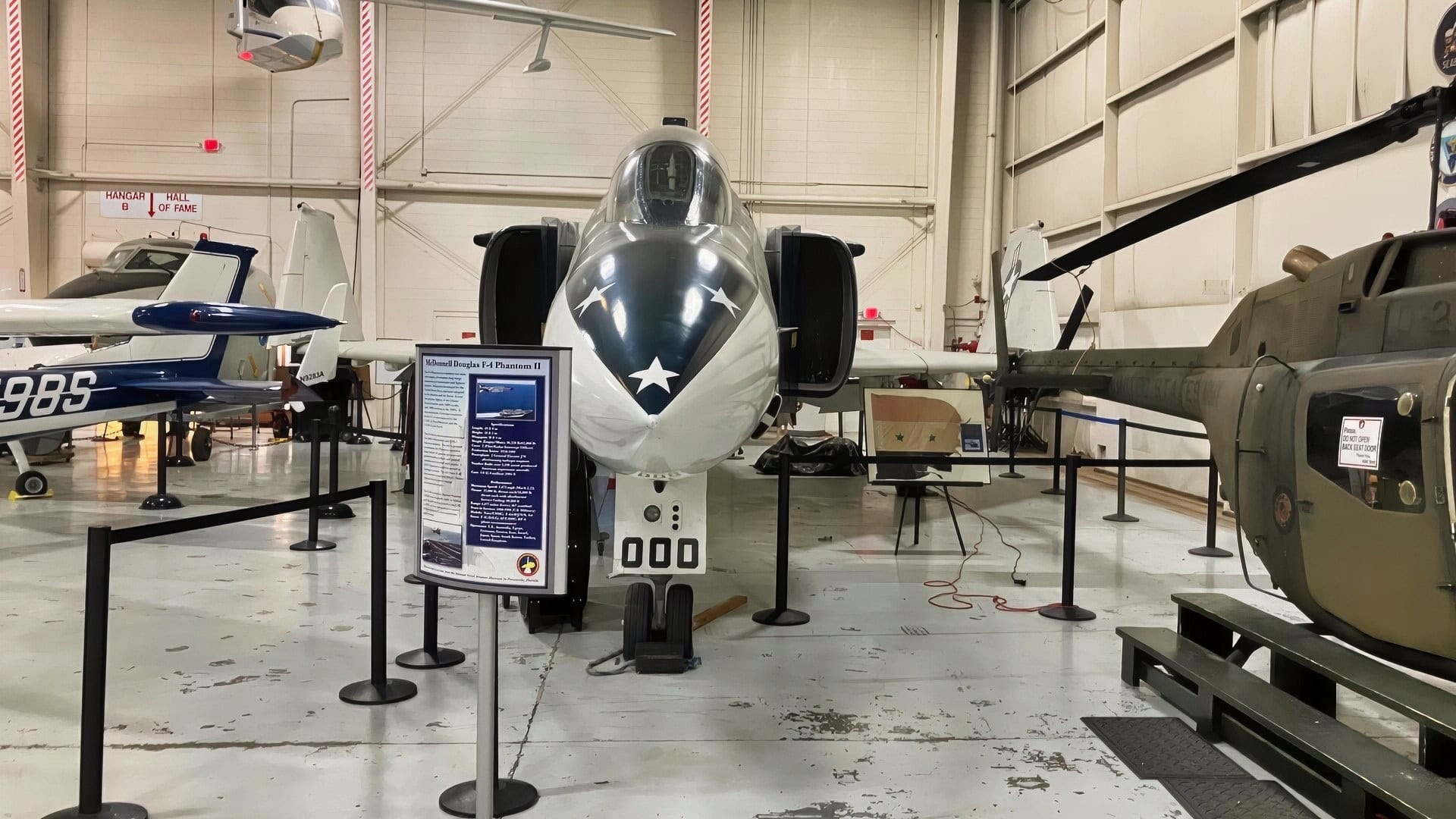
F-4 Phantom Fighter Aviation Museum of Kentucky. Taken by 19FortyFive on March 1, 2026.
The Iran Hostage Crisis Made Nimitz a Crisis Carrier
After militants seized the U.S. Embassy in Tehran in November 1979, Nimitz moved into the Indian Ocean and remained at sea for more than 140 consecutive days. On April 24, 1980, RH-53D helicopters launched from its flight deck for Operation Eagle Claw, the failed attempt to rescue the Americans held in Tehran.
Nimitz returned to the Mediterranean the next year. On August 19, 1981, two of its F-14 Tomcats shot down two Libyan Su-22 fighters over the Gulf of Sidra after a Libyan aircraft fired a missile. The engagement became an early demonstration of the F-14’s fleet-air-defense mission.
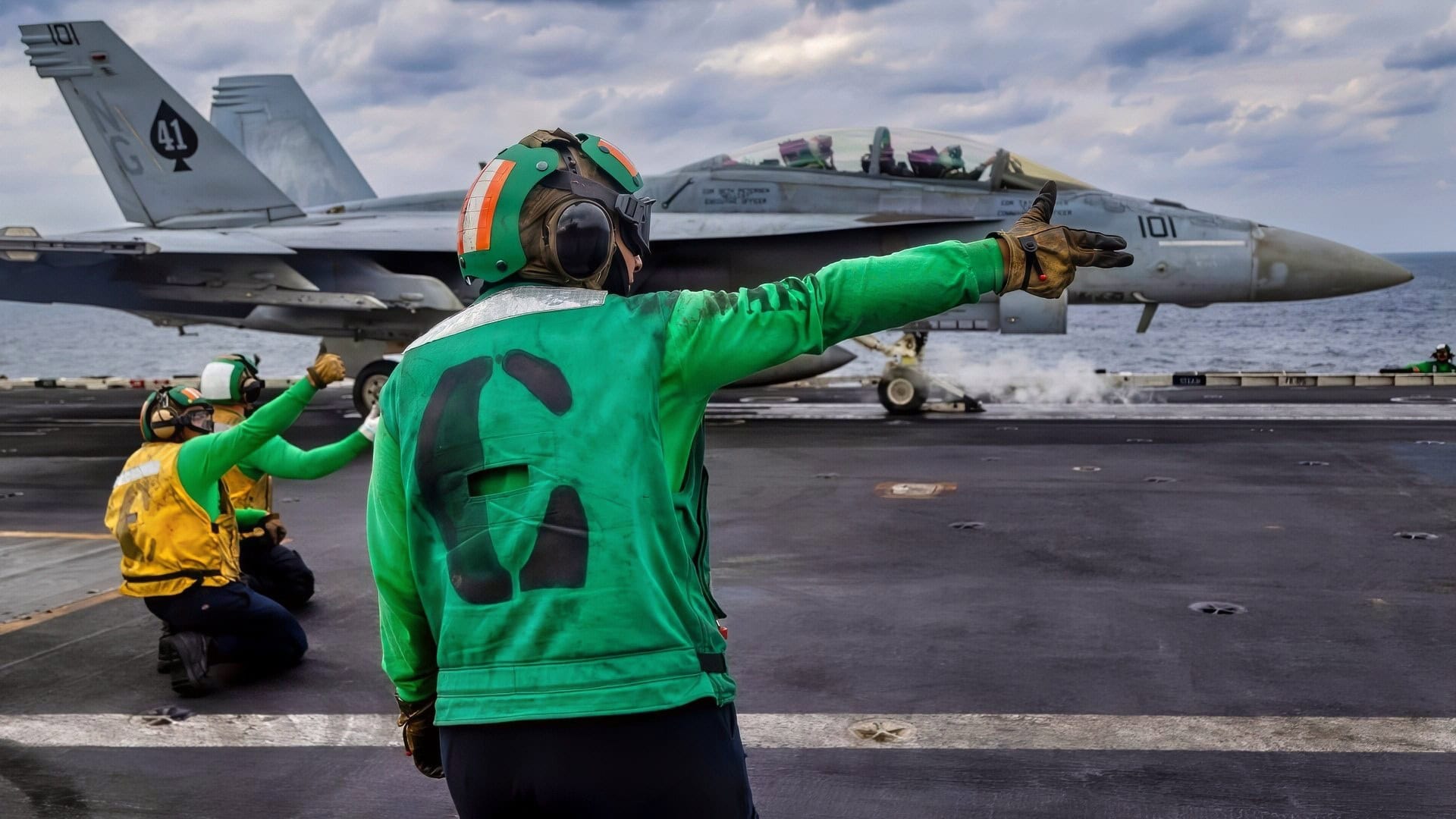
ARABIAN SEA (Jan. 28, 2026) An F/A-18F Super Hornet, attached to Strike Fighter Squadron (VFA) 41, prepares to launch from the flight deck of Nimitz-class aircraft carrier USS Abraham Lincoln (CVN 72) in the Arabian Sea, Jan. 28. Abraham Lincoln is deployed to the U.S. 5th Fleet area of operations to support maritime security and stability in the CENTCOM area of responsibility. (U.S. Navy photo by Mass Communication Specialist Seaman Zoe Simpson)
The same deployment included one of the ship’s worst accidents. An EA-6B Prowler crashed on the flight deck on May 26, 1981, striking parked aircraft and starting fires. Fourteen sailors and Marines were killed and 45 were injured.
The Cold War Ended, but Nimitz Stayed in Demand
Nimitz escorted reflagged oil tankers during Operation Earnest Will in 1988, operated in the Persian Gulf after the 1991 Gulf War and supported Operation Southern Watch over Iraq in 1993. The missions changed from deterring Soviet forces to protecting shipping and enforcing postwar restrictions.
The carrier also entered the Taiwan Strait crisis. Its battle group passed through the strait in December 1995 and returned to the region as China conducted another round of military exercises in March 1996. The deployment showed how a carrier could signal American resolve without opening fire.
A 1997 world cruise ended at Newport News, where Nimitz began its only refueling and complex overhaul. The work ran from 1998 to 2001, refueled the reactors and modernized the ship for another quarter-century of service. The overhaul marked the planned midpoint of the carrier’s 50-year design life. Nimitz then moved to the Pacific coast.
Nimitz Fought the Post-9/11 Wars and Tested the Next Air Wing
Nimitz deployed in March 2003 for operations over Iraq and Afghanistan. The cruise included one of the first operational deployments of the F/A-18E/F Super Hornet. More Middle East deployments followed as the Navy sustained campaigns in Iraq and Afghanistan through the next decade.
On November 3, 2014, an F-35C made the type’s first arrested carrier landing aboard Nimitz off California. The event connected a ship designed during the Vietnam era with the stealth fighter expected to serve aboard carriers well into this century.
The carrier’s 2020–2021 deployment lasted nearly 11 months as the Navy limited port visits during the COVID-19 pandemic. Nimitz operated in the Western Pacific, Indian Ocean and Middle East while thousands of sailors remained separated from their families for most of a year.
The Oldest Aircraft Carrier Kept Setting Records
On April 22, 2023, Nimitz recorded its 350,000th arrested landing, becoming the first active U.S. carrier to reach that figure. The number reflected five decades of flight-deck crews, maintainers, air-traffic controllers and pilots repeating one of aviation’s most demanding operations.
Age brought higher maintenance demands. The Nimitz-class fleet requires increasingly complicated upkeep, even as the Navy uses older ships to cover Ford-class delays. Keeping the lead carrier available through 2026 required support for equipment whose original supply chains had disappeared.
The final 2025 operational deployment still carried Nimitz across three fleet areas. Its strike group traveled a combined 82,000 nautical miles and completed 50 replenishments at sea. In March 2026, the carrier left Bremerton for the last time and rounded South America on the way to Norfolk.
Retirement Will Take Longer Than the Final Deployment
The Navy’s March 2027 date reflects the delay affecting John F. Kennedy. The second Ford-class carrier is expected to enter the fleet as Nimitz leaves it. That handoff matters because the carrier force remains thin relative to global demands.
Deactivation will require workers to remove ammunition and reusable equipment, drain systems, defuel both reactors and prepare the hull for dismantling. The inactivation phase carries a projected cost of hundreds of millions of dollars, while dismantling a nuclear supercarrier extends years beyond its retirement ceremony.
For its remaining months, Nimitz is expected to serve as a training carrier at Norfolk, including carrier qualifications for fleet aviators. The Navy’s published schedule contains no further operational deployment before deactivation in March 2027.
More – Toilets are the US Navy’s Biggest Aircraft Carrier Worry
About the Author: Harry J. Kazianis
Harry J. Kazianis (@Grecianformula) is the former Senior Director of National Security Affairs at the Center for the National Interest (CFTNI), a foreign policy think tank founded by Richard Nixon based in Washington, DC. Harry has over a decade of experience in think tanks and national security publishing. His ideas have been published in the NY Times, The Washington Post, The Wall Street Journal, CNN, and many other outlets worldwide. He has held positions at CSIS, the Heritage Foundation, the University of Nottingham, and several other institutions related to national security research and studies. He is the former Executive Editor of the National Interest and the Diplomat. He holds a Master’s degree focusing on international affairs from Harvard University.