
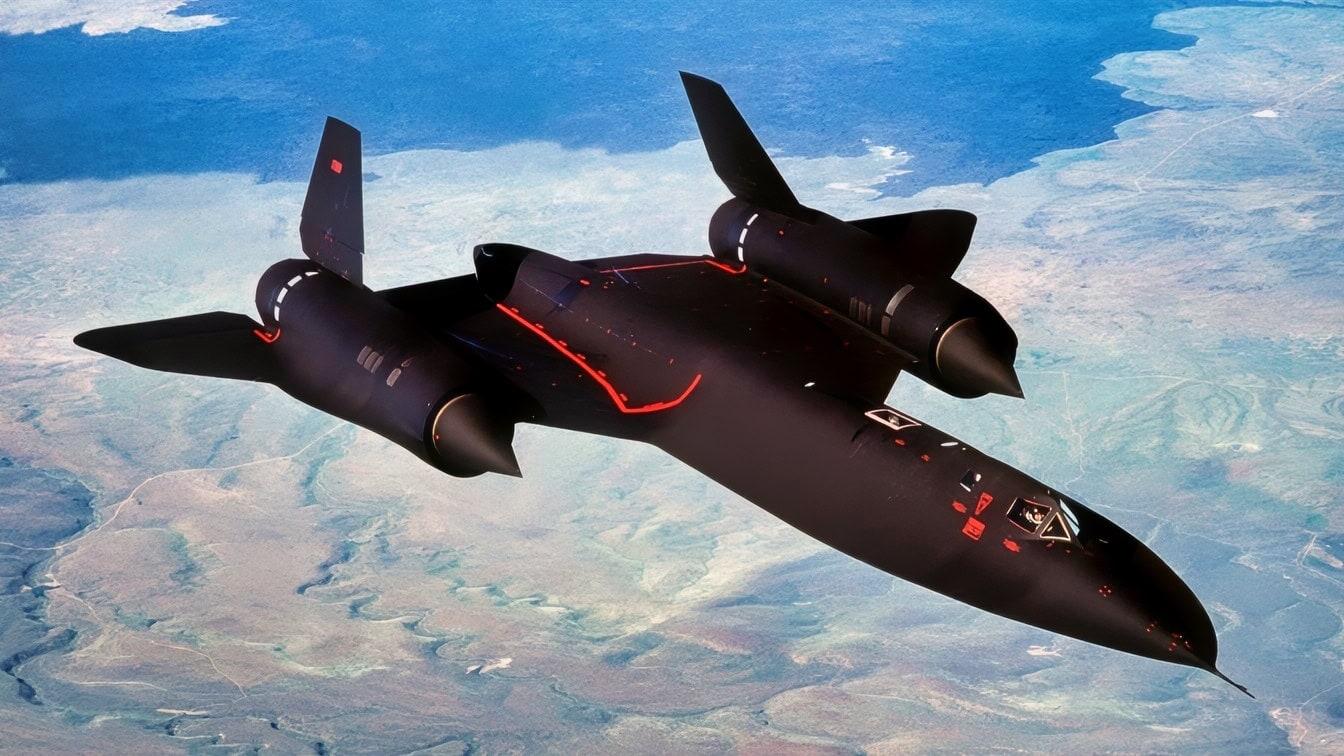
Summary and Key Points: There is a story, repeated at air shows and in hangar talk for half a century, of a Lockheed crew chief flicking a lit match or a burning cigarette into a bucket of the SR-71 Blackbird’s fuel to show a visitor what would happen. What happened, according to the legend, is nothing. The match went out. The story is almost certainly embellished, and any low-volatility fuel behaves the same way, but it points to something true and strange about the airplane that still holds the speed record six decades after it was built. The Blackbird could not run on ordinary jet fuel. It ran on a custom blend called JP-7, a fuel so reluctant to burn that the engineers who built the airplane had to invent a separate chemical system solely to light it, and so central to the aircraft’s survival that it doubled as the coolant keeping the machine from cooking itself at three times the speed of sound.
The Problem Heat Created: A Unique SR-71 Blackbird Problem
Everything about JP-7 traces back to a single hostile fact of high-speed flight: going fast makes things hot.
As the Blackbird pushed through the air at Mach 3.2, friction heated its skin to temperatures around 300 degrees Celsius across much of the airframe, climbing far higher at the leading edges and inlets, toward 1,000 degrees Fahrenheit.
That heat did not stay on the surface.
It radiated inward, into the structure, the systems, and above all the fuel tanks, which on the SR-71 were not insulated and, in fact, made up much of the airframe itself.
An ordinary jet fuel sitting in those tanks would have been a catastrophe waiting to happen.
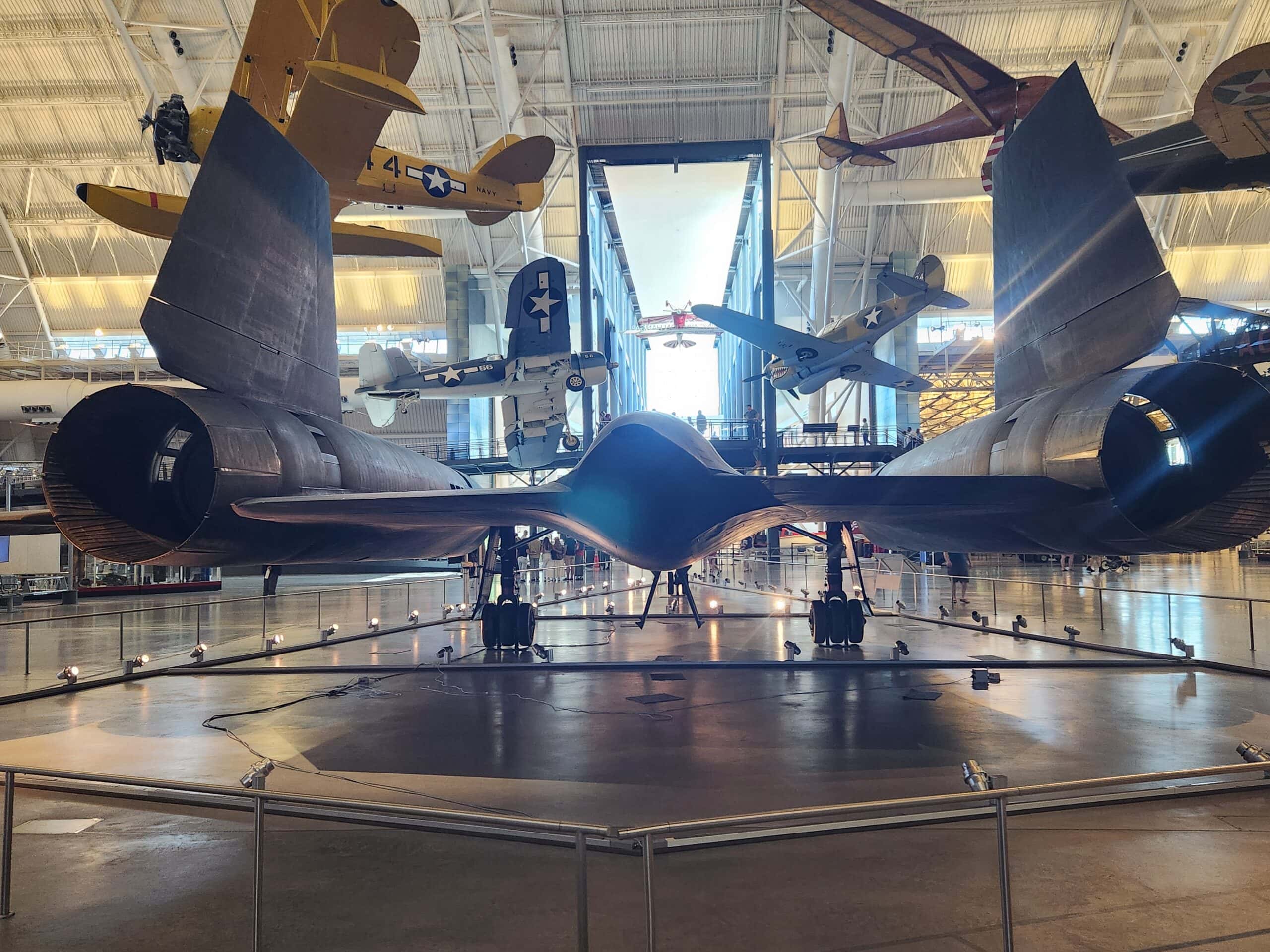
SR-71 from 19FortyFive.com original picture archive. Image taken at the Smithsonian.
Conventional fuels are relatively volatile, readily giving off ignitable vapors, and a volatile fuel heated toward its boiling point inside an uninsulated tank at altitude would vaporize, build pressure, and risk detonation.
The airplane needed a fuel that could be heated to extreme temperatures yet refuse to do so, remaining liquid, stable, and inert until the precise moment combustion was desired.
No such fuel existed, so one had to be created, and the requirements that shaped it read like a list of contradictions: stable when scorching, fluid when freezing, and willing to burn only on command.
What Shell Oil Brewed
The solution came from the laboratory rather than the refinery, because JP-7 is not a fuel in the ordinary sense of something distilled straight out of crude oil. It was engineered.
Working to meet specifications the aircraft’s designers laid down, the fuel maker Shell Oil devised a compound blend built from hundreds of hydrocarbons, with nearly all of the aromatic compounds, the reactive, flash-prone fractions like benzene and toluene, deliberately stripped out until only around 5 percent remained.
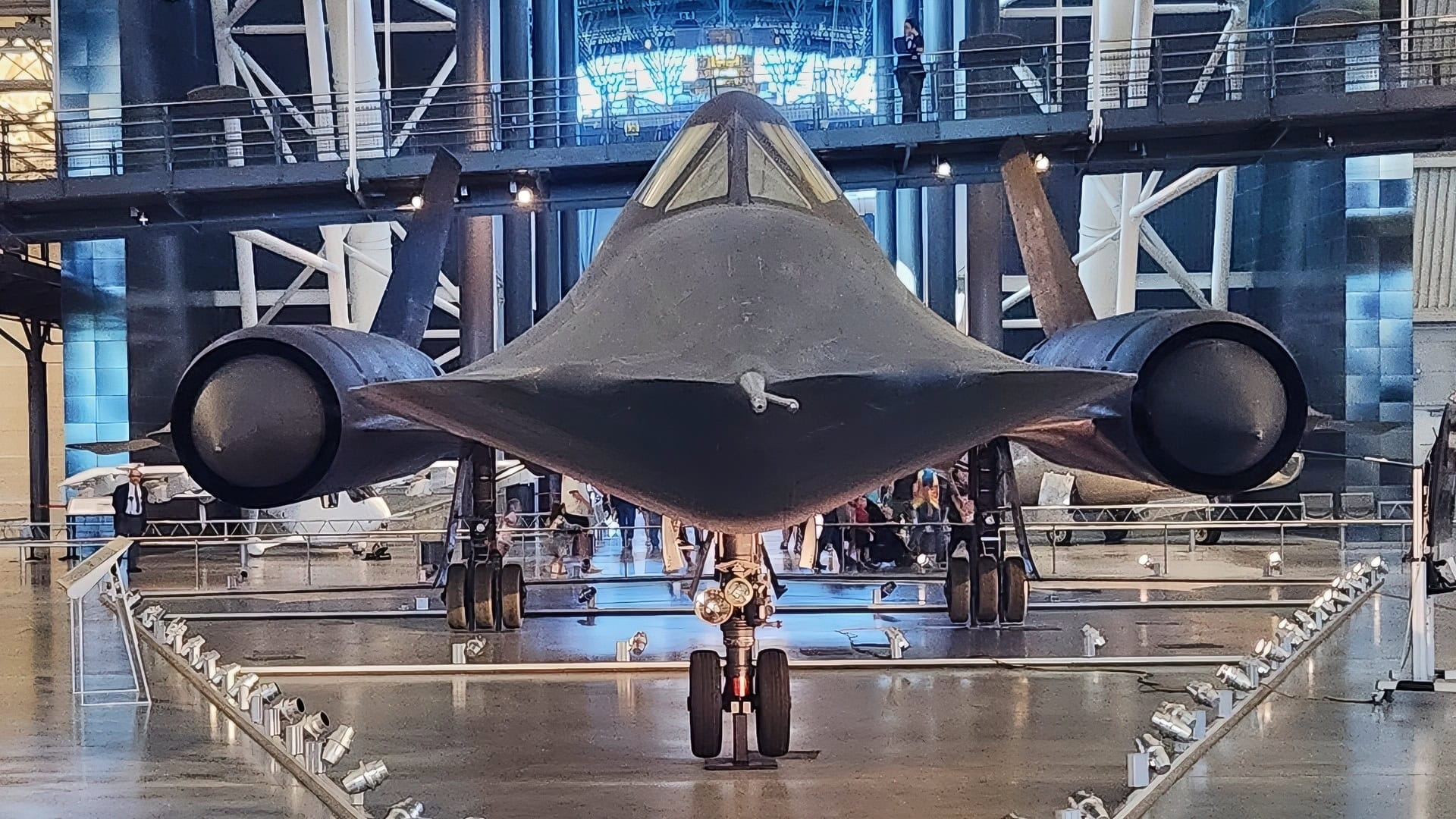
SR-71 At the Smithsonian. Image Credit: Creative Commons.
While normal jet fuel is a distillate, JP-7 was blended rather than distilled to eliminate the light, flash-prone fractions and the impurities that cause trouble at high temperatures, leaving a remarkably clean mixture with minimal sulfur, nitrogen, and oxygen.
The Air Force’s own fuel patents place JP-7 in a small family of aircraft-specific fuels developed for extreme flight, alongside JP-6, created for the XB-70 Valkyrie, and JPTS, still used by the U-2.
To the base blend, the chemists added a fluorocarbon compound to improve the fuel’s lubricating properties, since it had to lubricate pumps and controls as it flowed, and a cesium-bearing additive designated A-50 that helped suppress the radar and infrared signature of the engine’s exhaust plume, a small chemical contribution to the airplane’s stealth.
The result was a straw-colored liquid with a flash point near 60 degrees Celsius, a freezing point down to around minus 30, and thermal stability that allowed it to be heated severely without breaking down and depositing the carbon residue and varnish that would have clogged the fuel system’s narrow passages.
The Fuel That Would Not Catch Fire
The property everyone remembers about JP-7 is the one the match story dramatizes, and it rests on a technical point that is frequently reported backward.
JP-7 has a high flash point, not a low one, and the distinction matters.
A flash point is the lowest temperature at which a liquid gives off enough vapor to ignite; a high flash point means the fuel must be heated substantially before it produces any ignitable vapor.
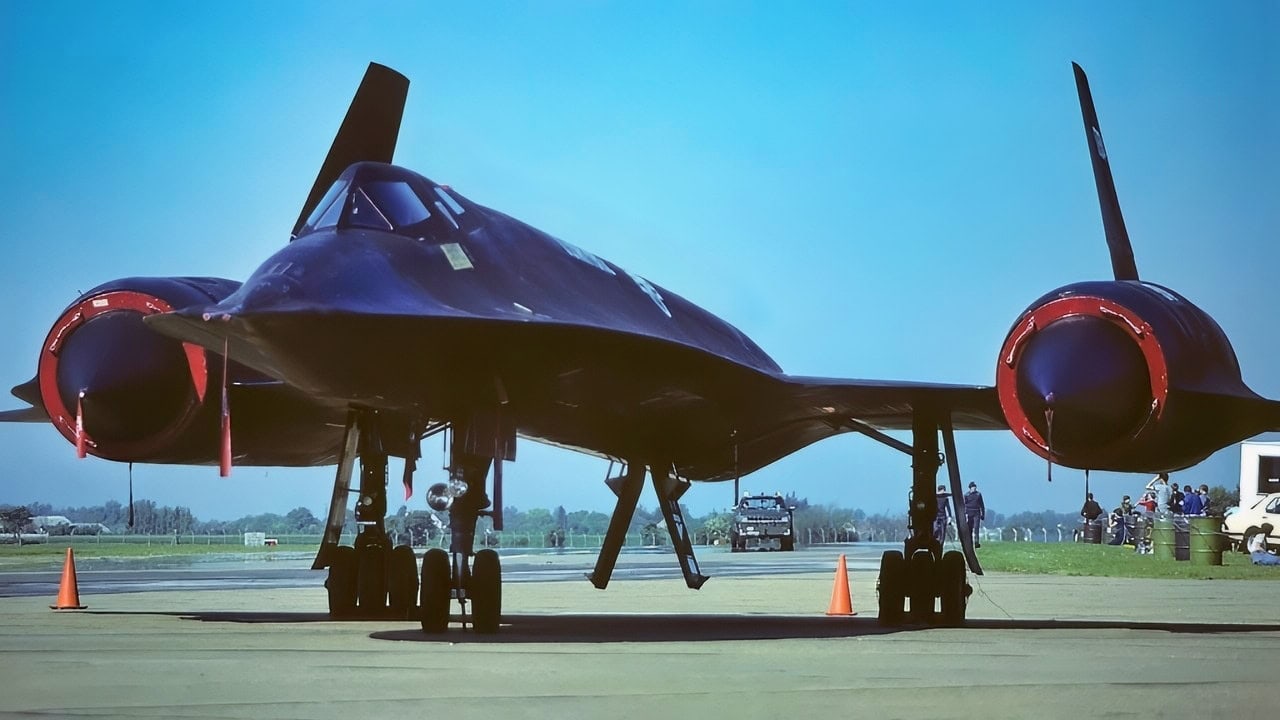
SR-71 Blackbird Creative Commons Photo on Tarmac
JP-7’s flash point sits around 140 degrees Fahrenheit, well above that of conventional jet fuels, which is precisely why a match dropped into it at room temperature finds nothing to light. That was the entire point.
A fuel with a high flash point and low volatility could remain in those uninsulated tanks at brutal skin temperatures without flashing into vapor, making the airplane survivable at speed.
The Smithsonian’s account of the Blackbird’s fuel makes the logic plain: the roughly 80,000 pounds of JP-7 the aircraft carried, about 12,000 gallons, needed a sufficiently high flash point to avoid unintended combustion, precisely because that same fuel served as the airplane’s primary heat sink.
Ground crews took the fuel’s stability seriously enough to verify it, using a small kit with a Bunsen burner to confirm each batch met the proper flash-point standard before it went into an aircraft.
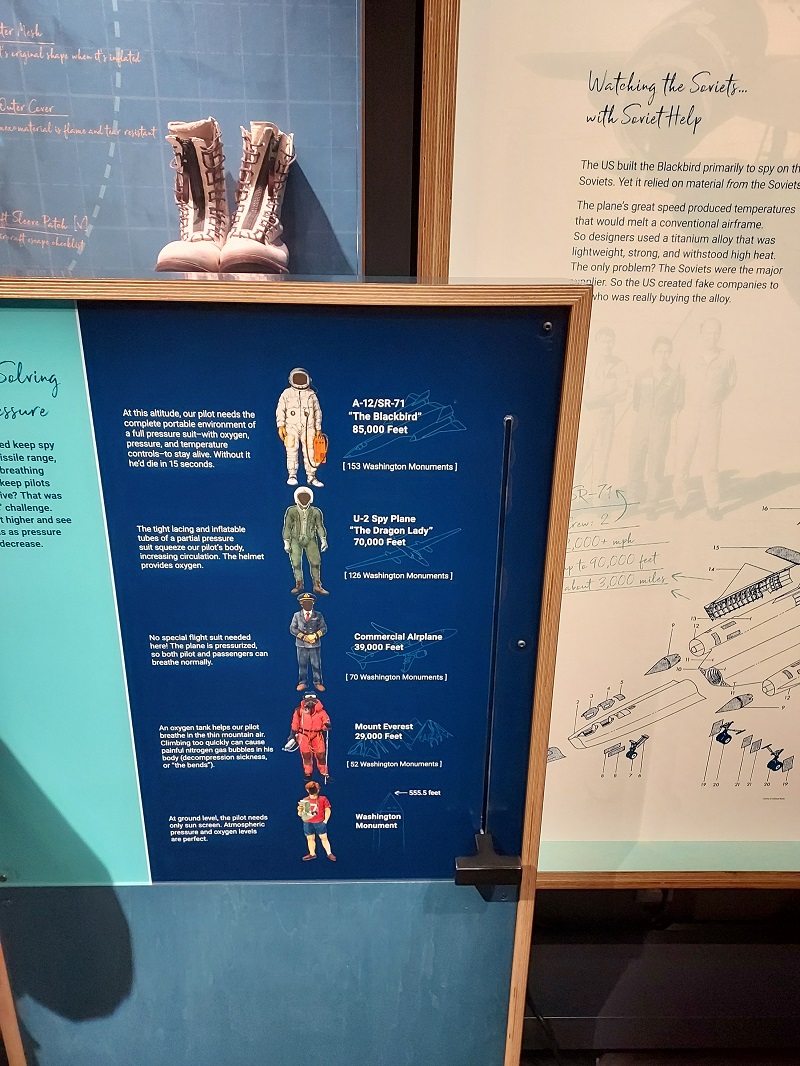
SR-71 Suit. 19FortyFive original image.

Flight suit. Image Credit: 19FortyFive Original Image.
Several popular accounts describe JP-7 as having a low flash point, which is a persistent error; the fuel’s resistance to ignition comes from its high flash point.
Lighting a Fuel That Refused to Burn
A fuel that will not ignite from a match will not ignite from a spark plug either, and that created the SR-71’s next problem: how to start engines burning a fuel engineered specifically not to burn. Conventional igniters were useless.
The answer was a chemical called triethylborane, TEB, a substance with the violent and useful property of bursting into flame the instant it touches air. Each of the two Pratt and Whitney J58 engines carried a small nitrogen-pressurized tank holding about 600 cubic centimeters of TEB, a little under 21 fluid ounces, sealed away from oxygen.
When the pilot moved a throttle from cutoff toward idle, the rising fuel pressure signaled the ignition system to inject a metered shot of TEB into the combustion section, where it hit the air, exploded into a hot flame, and lit the JP-7. The green flash seen at the exhaust of every starting Blackbird is that reaction, the signature color of burning boron.
TEB lit the engines on the ground and relit the afterburners in flight, and there was a hard limit on how many times it could do so, because each tank held enough for roughly 16 injections.
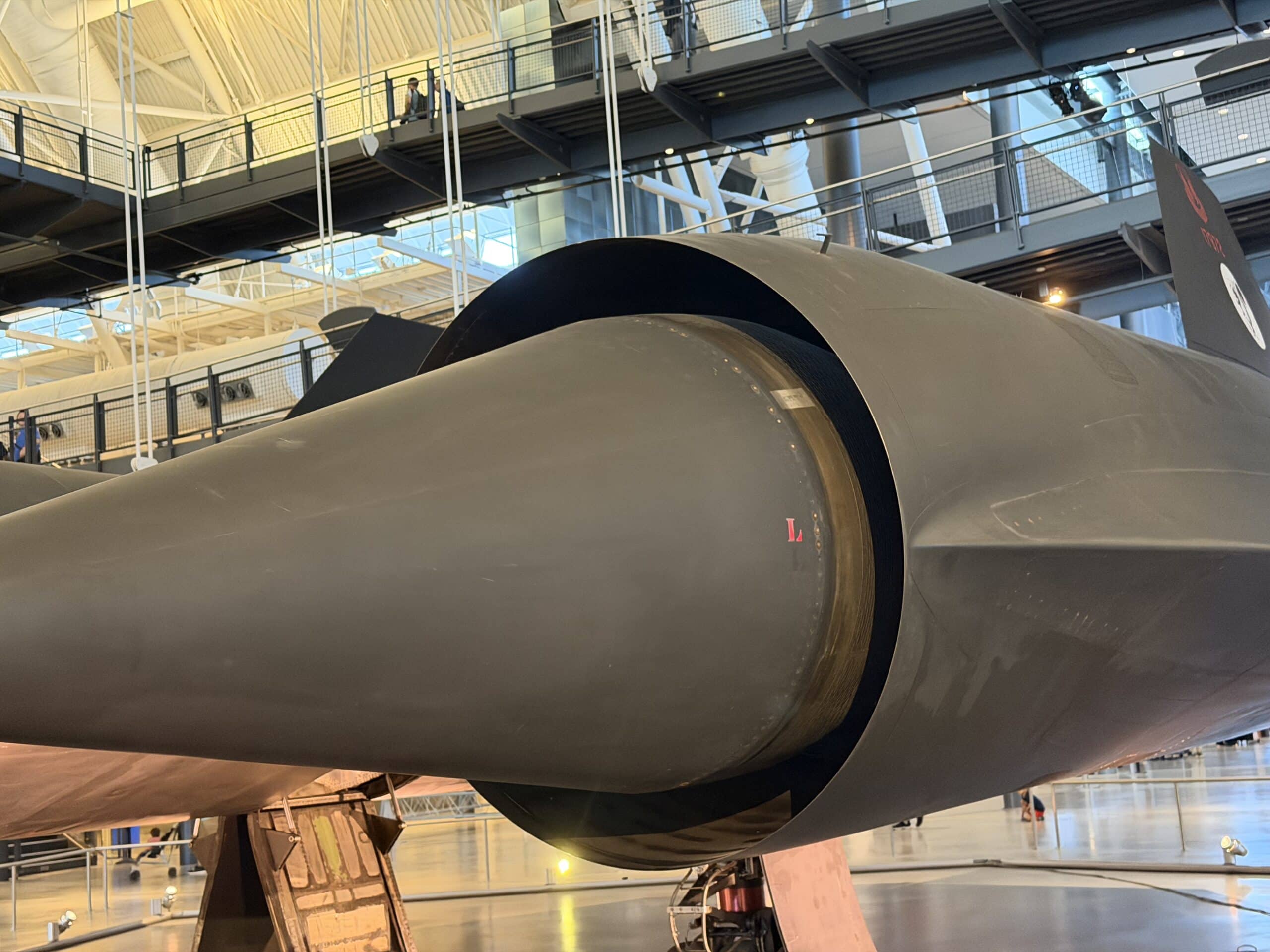
SR-71 Blackbird engine. Image taken at the Smithsonian on 6/30/2026 by 19FortyFive
Crews counted their TEB shots like ammunition, since running out meant an engine that could not be restarted no matter how much fuel remained. The chemical was chosen for reliability and simplicity over a mechanical igniter, but it demanded respect: TEB ignites spontaneously above-5minus 5 degrees Celsius, and refilling the tank was dangerous enough that the maintenance crews wore silver fire suits to do it.
Even starting the engines in the first place required outside help, since the airplane carried no starter of its own and relied on a ground cart, often built from a pair of Buick automobile engines mated together, to spin the big turbines up to speed.
The Fuel Was Also the Coolant
The most important thing JP-7 did was not burn, and this is the part of the story that explains how a fuel made an airplane fast.
Before it ever reached the engines, the fuel was the aircraft’s primary heat sink, the single system responsible for carrying away the enormous heat load that Mach 3 flight dumped into the airframe.
As it circulated, the fuel absorbed heat from the cockpit air conditioning, the hydraulic fluid, the engine and accessory oil, the TEB tank, the afterburner nozzle actuators, and the parts of the structure soaking up aerodynamic heat, cooling all of them by taking their heat into itself.
One detailed reckoning shows the fuel absorbing roughly 700 kilowatts of heat before reaching the burners, already hot at around 316 degrees Celsius, or 600 degrees Fahrenheit. The fuel even doubled as hydraulic fluid in parts of the engine’s control system.
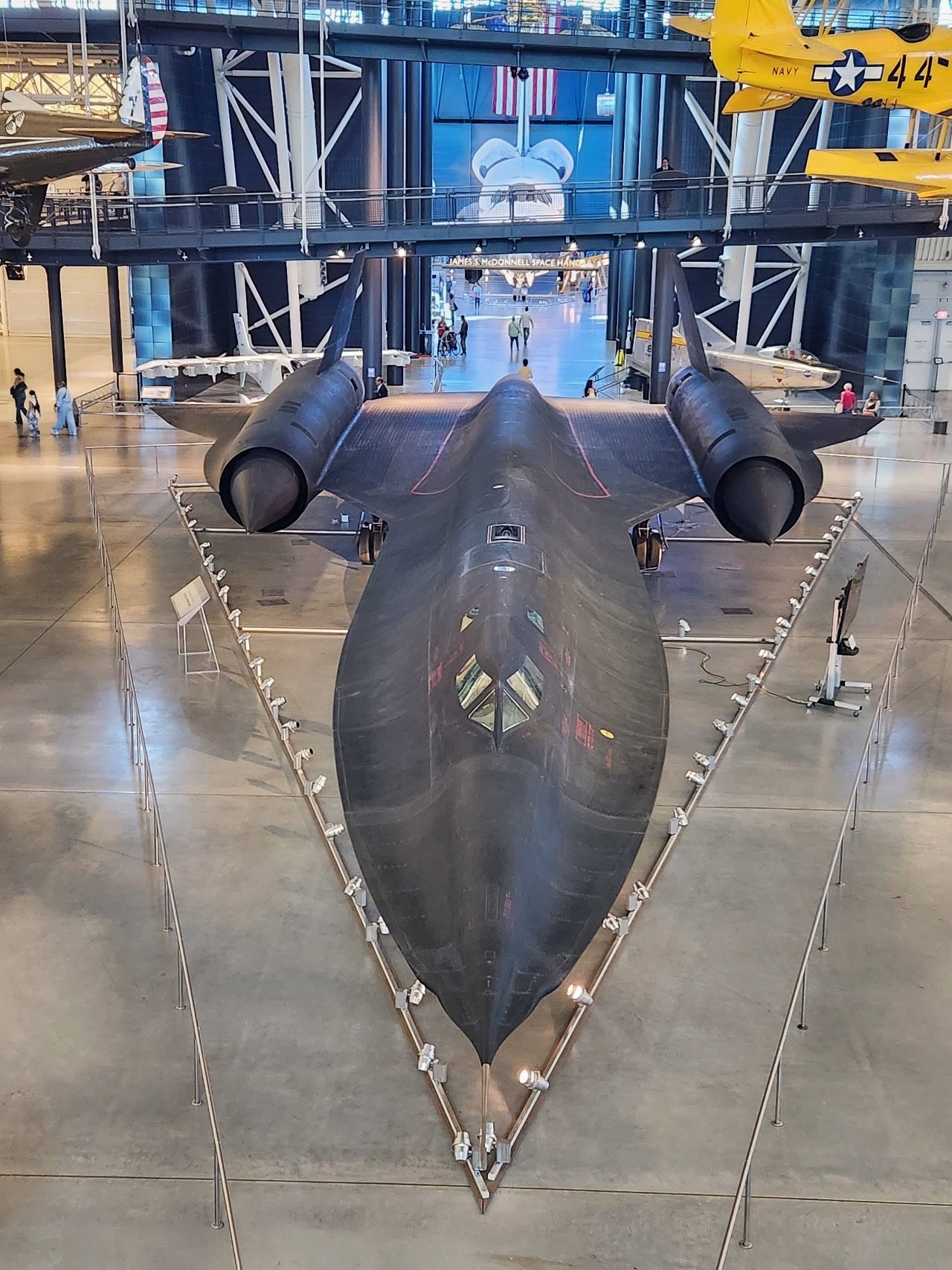
Long shot of SR-71. Image Credit: 19FortyFive.com
This is why the fuel’s thermal stability was not a nicety but the foundation of the whole airplane.
A fuel that broke down when heated would have coked up the same passages it was meant to flow through, failing as a coolant exactly when the coolant was needed most. Because JP-7 could take that heat and stay intact, the Blackbird could sustain Mach 3 cruise for hours rather than brief dashes, since the airframe had a way to shed the heat it generated continuously.
The house analysis of the airplane’s engines and thermal design makes the connection clear: propulsion and cooling were a single integrated system, and fuel was the working fluid at its center.
Speed created heat, heat had to go somewhere, and the fuel was where it went.
A New Tanker for a New Fuel
A fuel this specialized broke the entire logistics chain that supported normal military aviation, starting with the airplanes meant to refuel it. The SR-71 was a spectacular fuel hog, burning somewhere between 36,000 and 44,000 pounds of fuel per hour, and it launched with only a partial load to spare its brakes and tires, meeting a tanker shortly after takeoff to fill up before accelerating to altitude.
The trouble was that no existing tanker could carry JP-7, so the Air Force had to build one.
The result was the KC-135Q, a dedicated variant of the standard Stratotanker rebuilt with isolated fuel tanks and special plumbing that let it keep JP-7 separate from its own JP-4 and shuttle each fuel among different tanks as needed.
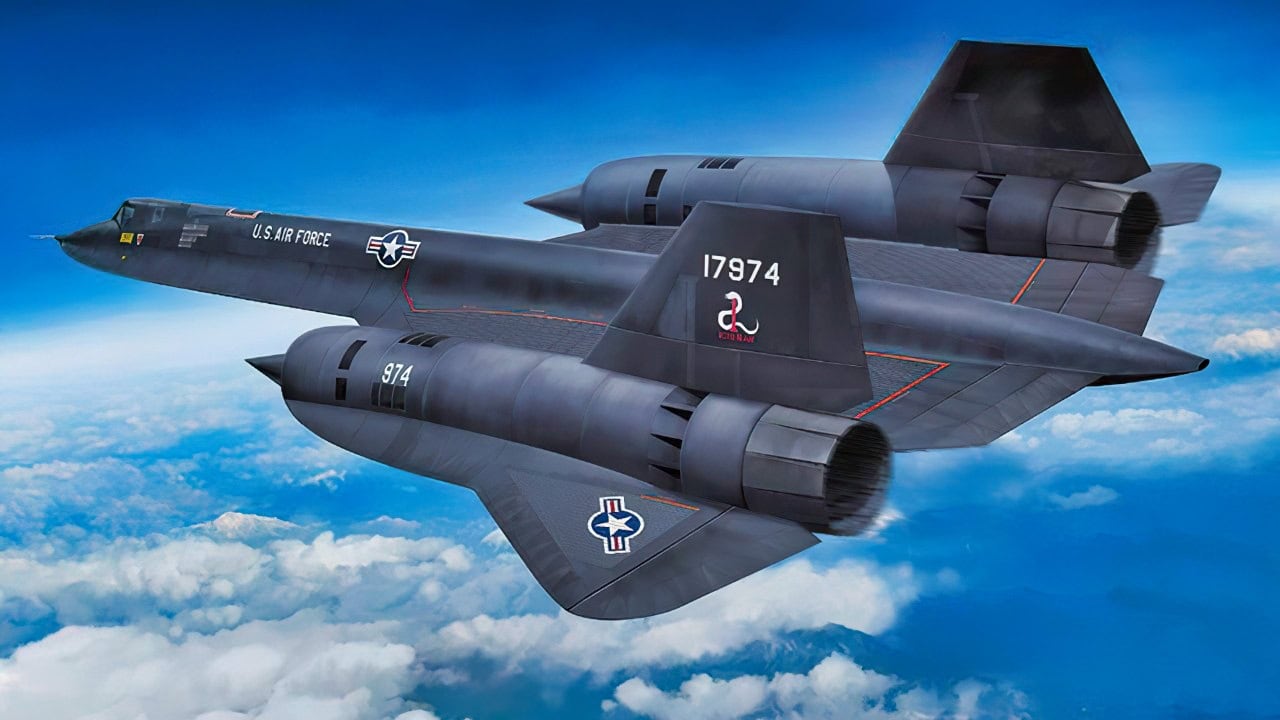
SR-71 Blackbird. Image Credit: Creative Commons.
The Q-model tankers were the only aircraft plumbed for JP-7, and they had to be choreographed along every Blackbird mission route around the world, a private aerial-refueling fleet dedicated to one airplane type.
The refueling itself was an involved procedure, with the tanker delivering not only fuel but also liquid nitrogen, and the two aircraft working together so that as JP-7 filled the SR-71’s tanks, the oxygen was purged from the space above the fuel to eliminate any chance of combustion.
The whole mission was flown as a series of high-speed dashes strung between tanker rendezvous, with a meaningful fraction of any sortie spent flying slowly behind a KC-135Q, taking on the fuel the next dash would consume.
What It Cost and Why It Was Hard to Make
None of this was cheap, and the fuel sat at the center of the expense that eventually helped ground the airplane. JP-7 was a specialty product with no other significant customer, hand-blended to exacting specifications, and it ran roughly three times the price of the fuel that airlines poured into their airliners. The difficulty went beyond price.
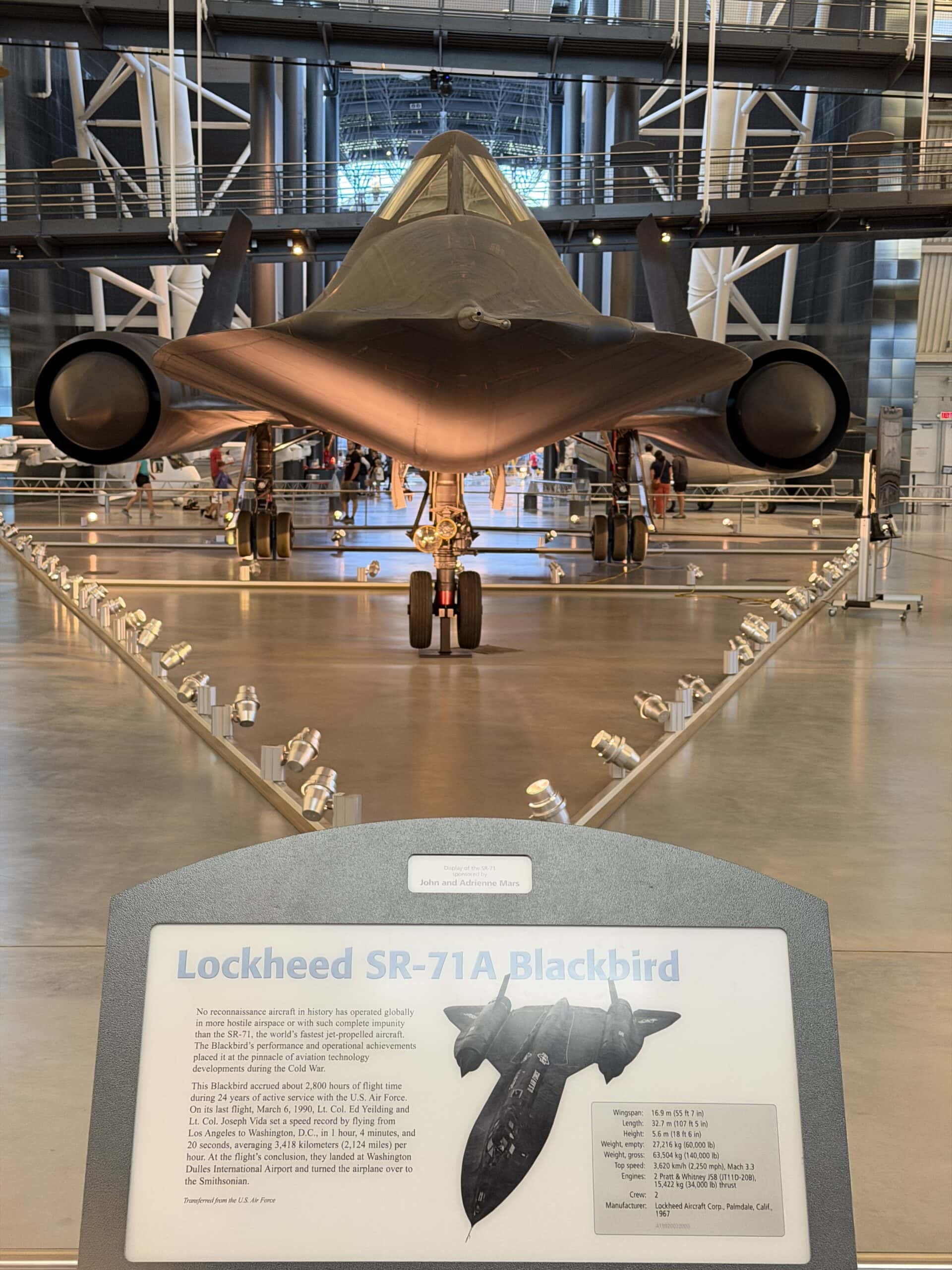
SR-71 Blackbird. Image taken at the Smithsonian on 6/30/2026 by 19FortyFive
The fuel was chemically aggressive toward the equipment meant to handle it, dissolving the linings inside hoses and the fuel tanks of ordinary fuel trucks, so those components had to be repeatedly flushed with JP-7 itself to dissolve the linings out and guarantee that the fuel loaded into a Blackbird was free of contamination. The TEB that lit the fuel added its own cost and hazard, an expensive pyrophoric chemical that had to be handled by crews in protective suits and that could clog its own injector nozzles with coking deposits, occasionally frustrating a restart.
All of it fed into an operating bill that was punishing by any measure, with estimates putting the cost of flying the Blackbird at around $200,000 per flight hour once fuel, dedicated tankers, and specialized maintenance were all counted.
When the Air Force weighed that expense against satellites and other reconnaissance systems, the fuel and its supporting apparatus were part of what made the Blackbird seem unaffordable, and the custom fuel logistics were cited as reasons the airplane was retired despite never being outrun.
How a Fuel Made a Speed Record
The temptation is to credit the Blackbird’s speed to its engines or its titanium skin, and both deserve their share, but the fuel is the piece that made the rest cohere. JP-7 did not make the airplane fast by carrying more energy than ordinary fuel, because it did not. It made the airplane fast by removing the reasons it otherwise could not have gone fast and stayed fast.
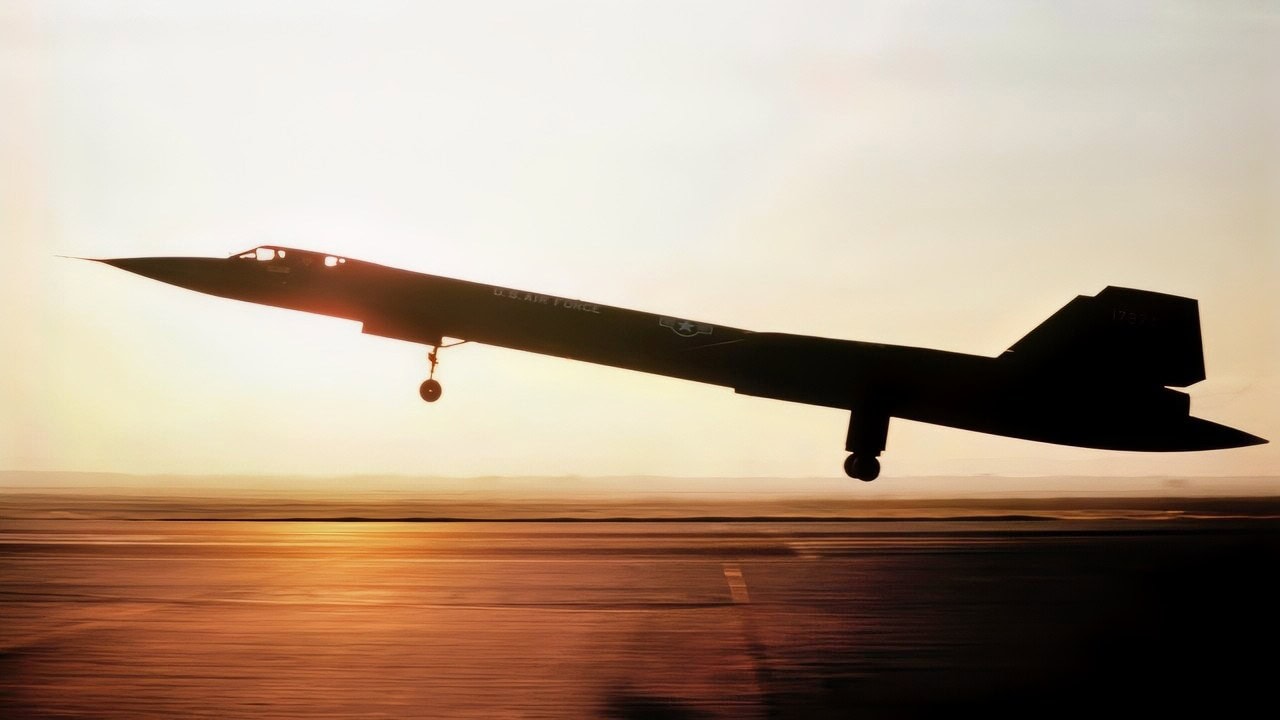
A left side view of an SR-71 aircraft from the 9th Strategic Reconnaissance Wing landing. The aircraft is silhouetted against the sunset.
A conventional fuel would have vaporized and threatened to explode in those searing uninsulated tanks, capping the airplane’s speed at whatever its fuel could survive. JP-7’s high flash point and thermal stability lifted that cap, letting the tanks run hot without danger.
A conventional fuel could not have absorbed the airframe’s heat load without breaking down, which would have left the airplane with no way to cool itself in sustained cruise; JP-7’s stability made it a heat sink that worked continuously, so the Blackbird could hold Mach 3 for as long as its dashes between tankers allowed rather than for seconds at a time.
The airplane’s documented performance, a sustained cruise above 80,000 feet at better than three times the speed of sound, existed inside a thermal envelope that the fuel defined and defended.
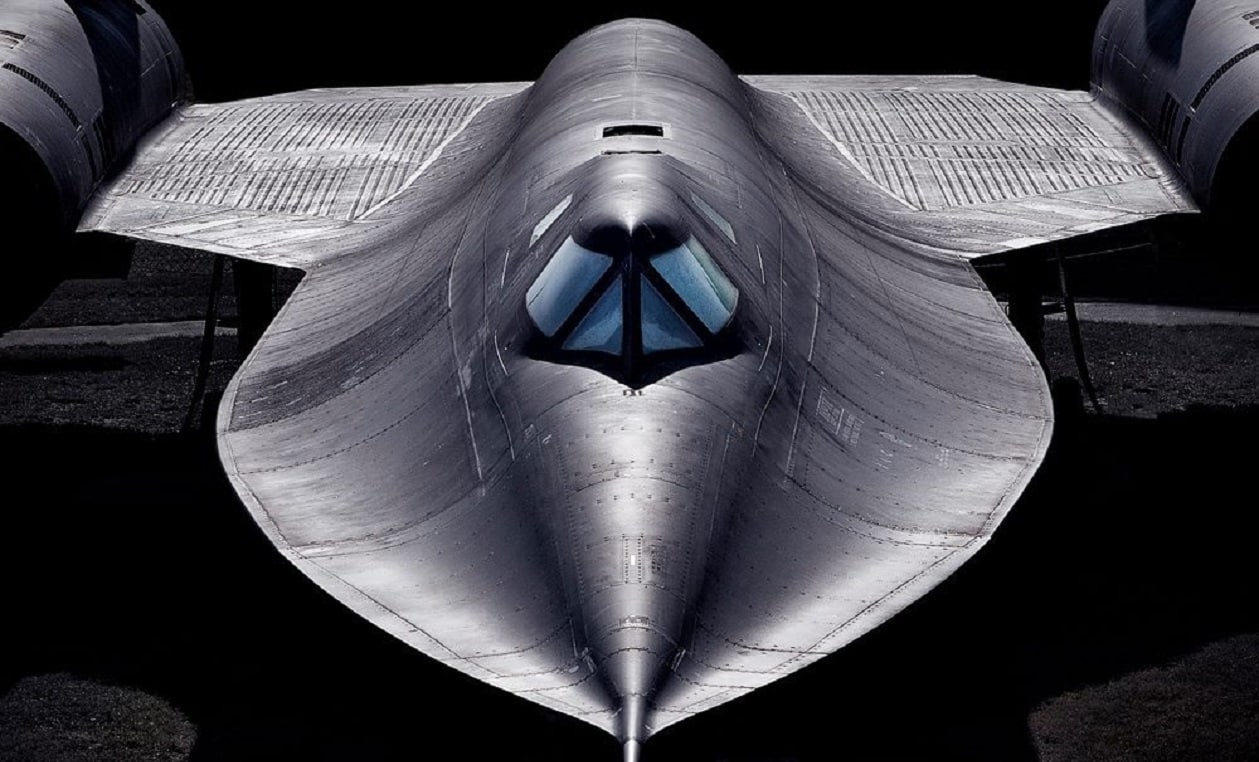
Up-close image of SR-71 Spy Plane. Image Credit: Creative Commons.
Every part of the SR-71 was an answer to the heat that speed generates, and the fuel was the answer that touched all the others, cooling the structure, feeding the engines, lubricating the controls, and refusing to burn until told.
Six decades on, no crewed air-breathing airplane has flown faster, and the machine that set that mark drank a fuel invented for it alone, a liquid engineered to do the one thing every other fuel would not: stay calm in the fire.
About the Author: Harry J. Kazianis
Harry J. Kazianis (@Grecianformula) was the former Senior Director of National Security Affairs at the Center for the National Interest (CFTNI), a foreign policy think tank founded by Richard Nixon based in Washington, DC. Harry has over a decade of experience in think tanks and national security publishing. His ideas have been published in the NY Times, The Washington Post, The Wall Street Journal, CNN, and many other outlets. He has held positions at CSIS, the Heritage Foundation, the University of Nottingham, and several other institutions related to national security research and studies. He is the former Executive Editor of the National Interest and the Diplomat. He holds a Master’s degree focusing on international affairs from Harvard University.

