
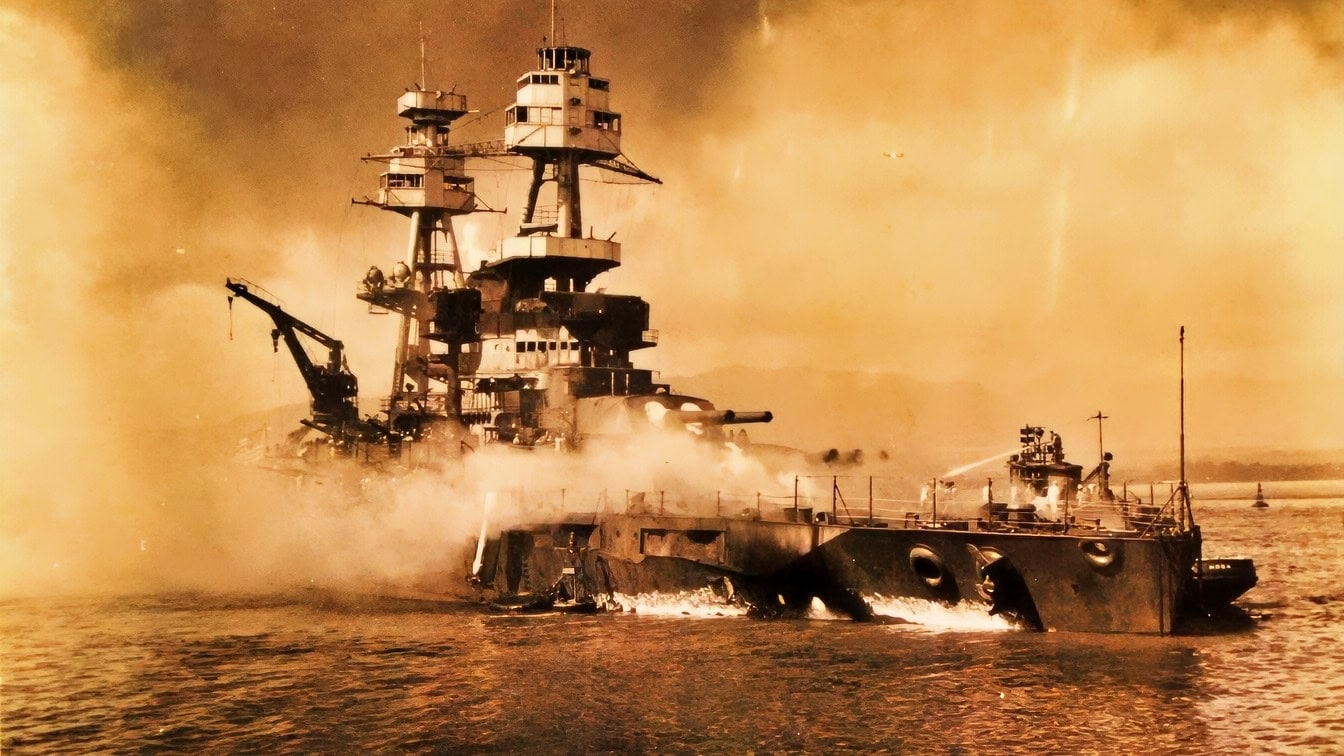
USS Nevada by the Numbers: The $5.9 Million Contract, Ten 14-Inch Guns and 27,500 Tons – Official Navy ship data listed USS Nevada’s contract price at $5,895,000. The figure was not a lifetime cost; it came before three decades of refits, repairs, and wartime changes. Nevada was commissioned on March 11, 1916, and remained in service until August 29, 1946.
Nevada displaced 27,500 tons when new. She measured 583 feet long, 95 feet 3 inches across the beam, and drew almost 30 feet of water at maximum load. Twelve oil-fired boilers supplied geared turbines rated at 26,500 shaft horsepower, which turned two propellers and drove the ship to about 20.5 knots.
Her main battery contained ten 14-inch/45-caliber guns in two twin and two triple turrets. The original armor-piercing shell weighed about 1,400 pounds, making a ten-gun broadside roughly 14,000 pounds. After modernization, Nevada used 1,500-pound armor-piercing projectiles, raising the broadside to 15,000 pounds, or 7.5 short tons.
The original complement was 864 officers and sailors. The ship also carried twenty-one 5-inch guns, submerged torpedo tubes, and a 13.5-inch armor belt. Those figures changed through repeated rebuilding, but the ten 14-inch guns remained the center of the ship’s fighting power from commissioning through World War II.
Nevada Introduced the Standard-Type Battleship
Fore River Shipbuilding laid Nevada down at Quincy, Massachusetts, on November 4, 1912. The design concentrated heavy armor around magazines, machinery and other vital spaces while leaving less important areas lightly protected. This “all-or-nothing” system, oil-fired propulsion, and the Navy’s first triple main-gun turrets made USS Nevada a major break from earlier American battleships.
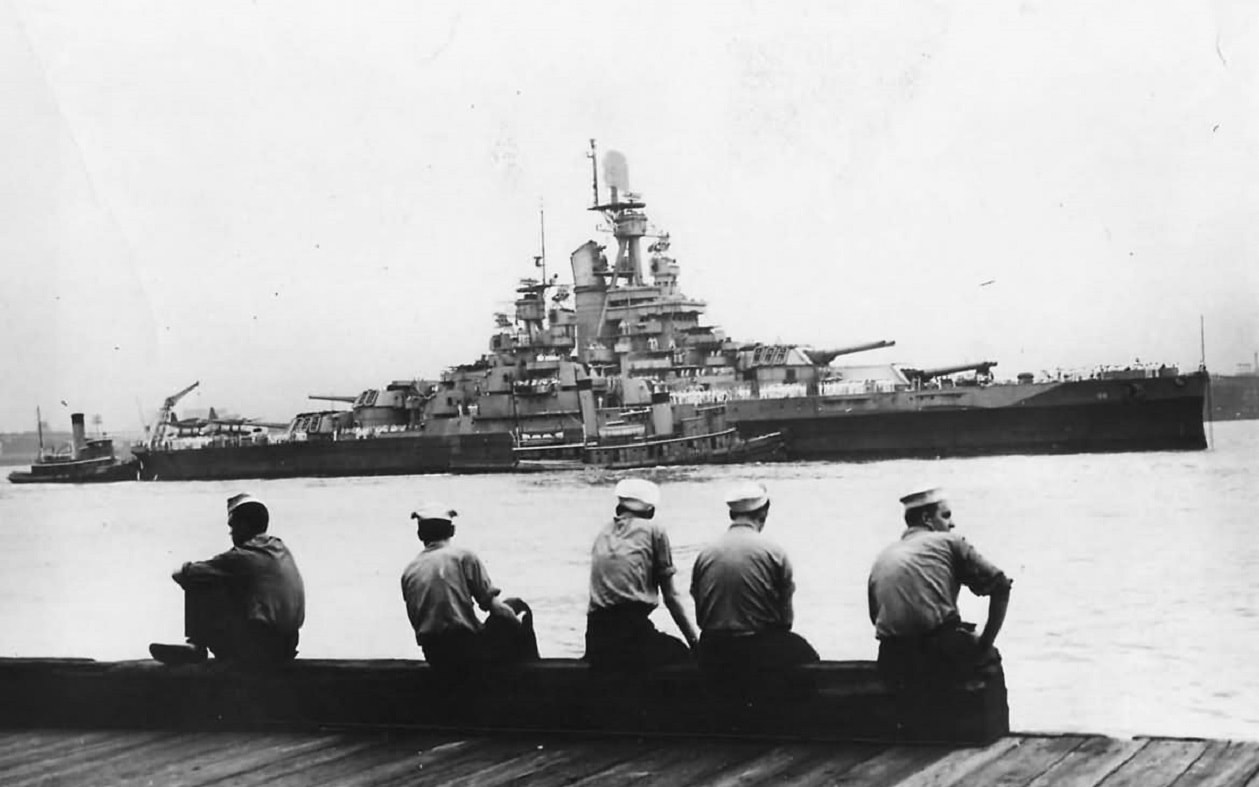
Battleship USS Nevada. Image: Creative Commons.
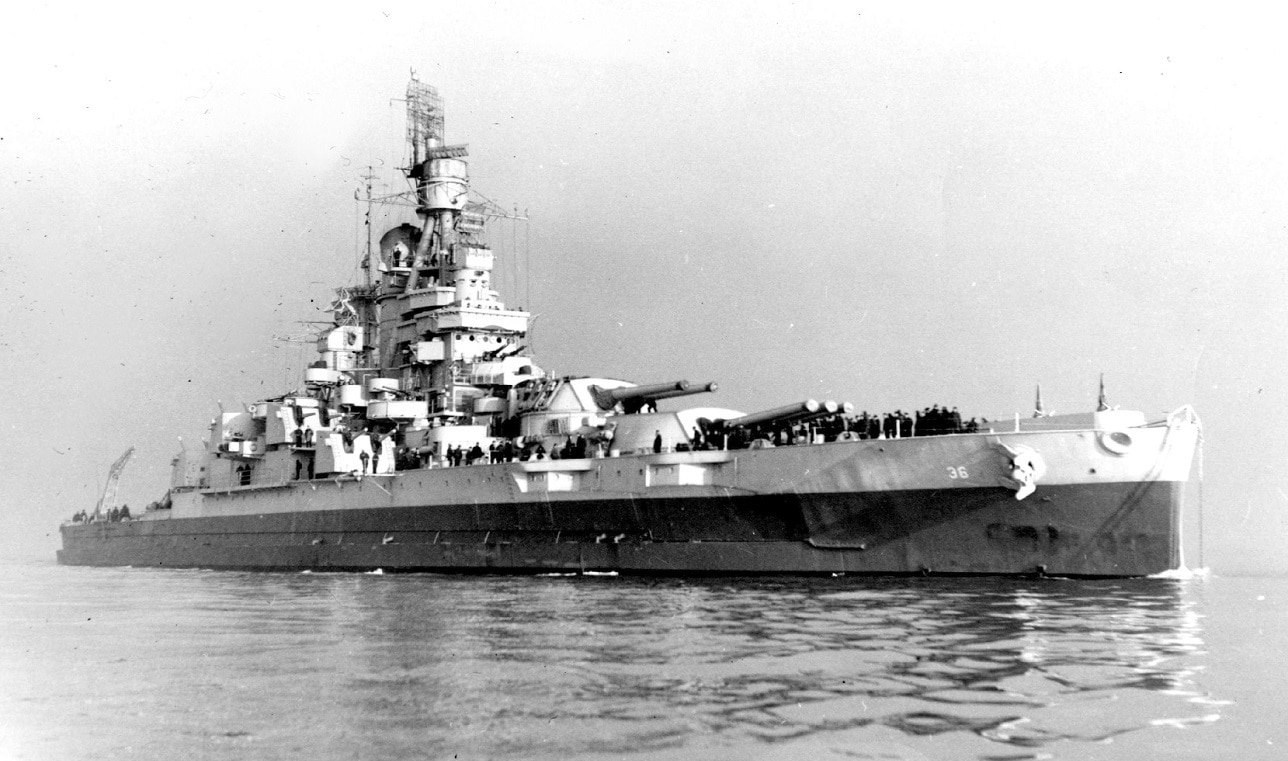
USS Nevada. Image Credit: Creative Commons.

Underway off the U.S. Atlantic coast, 17 September 1944. Photographed from a blimp of squadron ZP-12. Official U.S. Navy Photograph, now in the collections of the National Archives.
Oil reduced the labor and storage demands associated with coal. Triple turrets placed more guns on the centerline without adding a fifth turret, while the armored citadel used weight where a hit threatened the ship’s survival. The same choices defined the two-ship Nevada class and influenced the American standard-type battleships that followed.
World War I Sent Nevada to Ireland but Not Into Battle
Nevada spent most of America’s World War I involvement training and operating from the East Coast. She reached Bantry Bay, Ireland, on August 23, 1918, as part of Battleship Division Six. The force guarded Atlantic approaches and stood ready if German surface warships threatened Allied shipping.
The expected battle never came. After the armistice, Nevada helped escort the transport George Washington as President Woodrow Wilson traveled to France for the peace conference. Her first war, therefore, ended without the 14-inch battery firing at an enemy.
One Torpedo and at Least Six Bombs Stopped Nevada at Pearl Harbor
Nevada was moored near USS Arizona on Battleship Row when Japan attacked Pearl Harbor on December 7, 1941. Unlike most of the battleships, she was not trapped alongside another large ship. Her crew raised steam, backed clear, and got underway at about 8:40 a.m., making Nevada the only battleship to move under her own power during the attack.
The movement drew repeated air attacks. Nevada’s action report counted one torpedo hit and at least six bomb hits, with the possibility of several more. The official ship history records 50 killed and 109 wounded. Fires spread through the forward sections as flooding increased.
Harbor authorities feared the damaged battleship might sink in the narrow channel and block access to Pearl Harbor. Nevada was grounded near Hospital Point, later settling into shallow water. She was temporarily lost as an operational warship, but not beyond recovery. Salvage crews refloated her on February 12, 1942.
The Rebuilt Nevada Fired 337 Heavy Shells on D-Day
Repairs became a reconstruction. The Navy removed Nevada’s old secondary battery, rebuilt the superstructure, and installed sixteen 5-inch/38 dual-purpose guns, thirty-six 40 mm barrels, and dozens of 20 mm weapons. The altered ship returned to combat at Attu in 1943 before moving to Europe.
On June 6, 1944, Nevada supported the landings at Utah Beach. The Navy credits her with firing 337 rounds from the 14-inch battery and nearly 2,700 rounds from the 5-inch guns that day. The old battleship later bombarded Southern France, then returned to the Pacific for Iwo Jima and Okinawa, extending the useful life of a slow battleship through shore fire support.
At Okinawa, a kamikaze struck Nevada on March 27, 1945, and Japanese coastal fire hit her on April 5.
The ship remained on station. Her wartime battery even included 14-inch guns salvaged from Arizona and Oklahoma, allowing weapons recovered from Pearl Harbor’s wreckage to fire against Japanese positions.
Two Atomic Bombs Failed to Sink Nevada
After the war, the Navy selected Nevada for Operation Crossroads at Bikini Atoll.
Painted orange as the aiming point for the Able airburst, she survived when the bomb missed by roughly 1,700 yards. She also remained afloat after the Baker underwater explosion, although contamination made continued service impossible.
The tests showed why surviving a nuclear blast did not mean a ship remained usable.
Nevada was decommissioned in August 1946 and towed off Hawaii for a final weapons test on July 31, 1948.
Gunfire from warships failed to finish her, and an aircraft delivered the sinking torpedo.
SEARCH and Rescue and Ocean Infinity located the overturned hull in 2020, 65 nautical miles southwest of Pearl Harbor and more than 15,400 feet beneath the Pacific.
About the Author: Harry J. Kazianis
Harry J. Kazianis (@Grecianformula) was the former Senior Director of National Security Affairs at the Center for the National Interest (CFTNI), a foreign policy think tank founded by Richard Nixon based in Washington, DC. Harry has over a decade of experience in think tanks and national security publishing. His ideas have been published in the NY Times, The Washington Post, The Wall Street Journal, CNN, and many other outlets worldwide. He has held positions at CSIS, the Heritage Foundation, the University of Nottingham, and several other institutions related to national security research and studies. He is the former Executive Editor of the National Interest and the Diplomat. He holds a Master’s degree focusing on international affairs from Harvard University.