
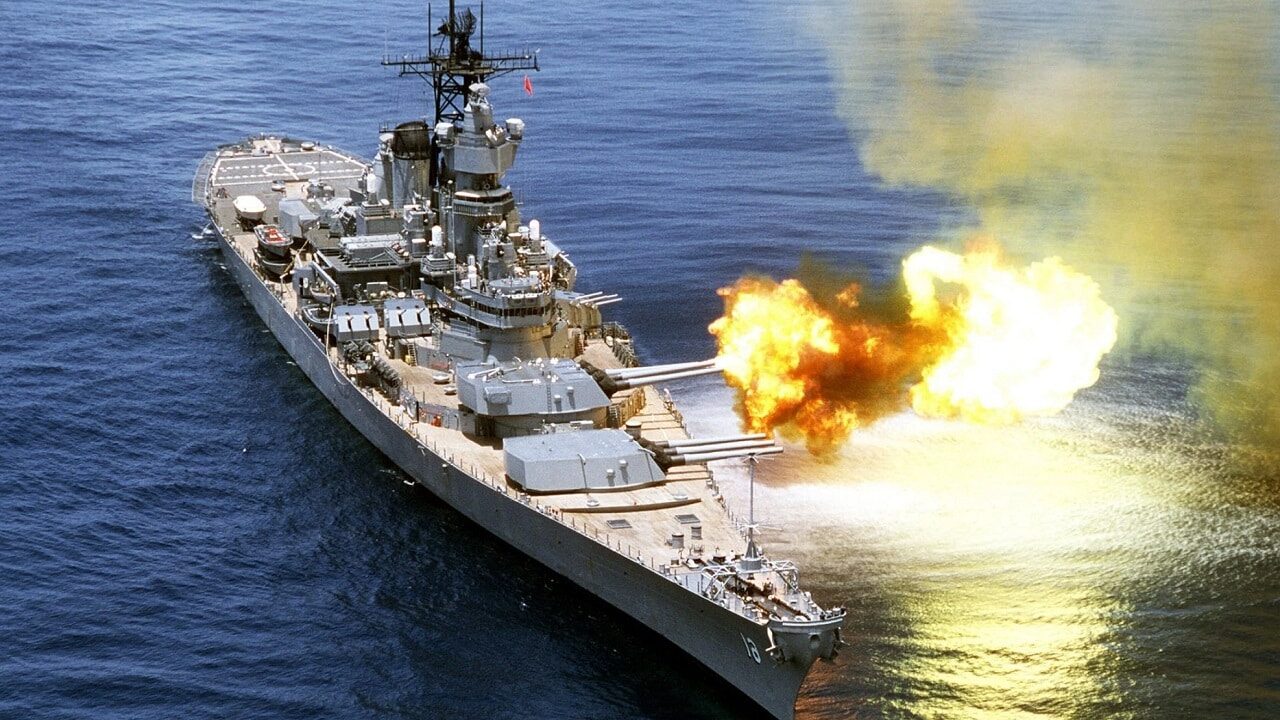
USS Wisconsin by the Numbers: 57,271 Tons, 212,000 Horsepower, and Nine 16-Inch Guns: The Philadelphia Navy Yard laid the keel for USS Wisconsin on January 25, 1941, and commissioned the battleship 1,177 days later on April 16, 1944. A Hampton Roads Naval Museum history placed the expected cost of each Iowa-class ship at about $125 million. That is a class estimate, not a surviving audited final bill unique to Wisconsin.
The completed ship measured 887 feet 3 inches from bow to stern, had a beam of 108 feet 2 inches, and displaced 57,271 tons at full load. Eight boilers and four geared turbine units produced 212,000 shaft horsepower, enough to drive four propellers and move the battleship at roughly 33 knots.
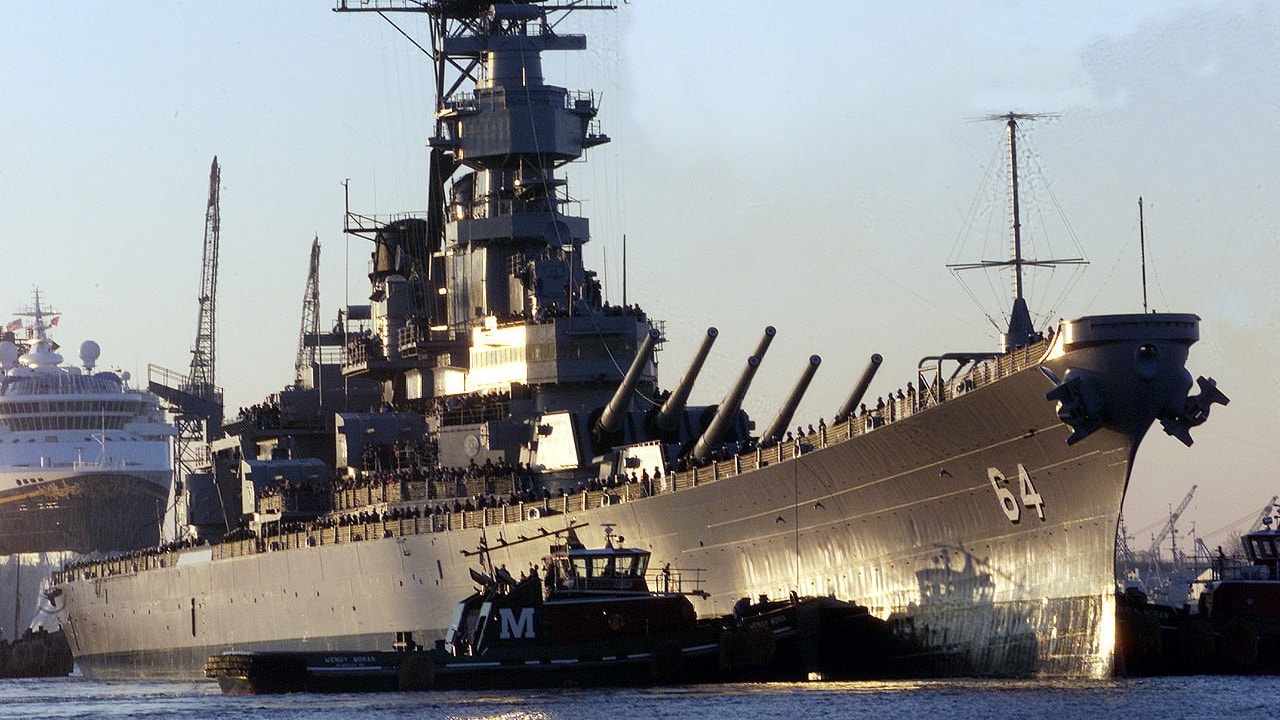
A tug boat nudges the bow of the battleship USS Wisconsin (BB 64) as the ship is pushed from the Norfolk Naval Shipyard to the Nauticus Museum in Norfolk, Va., on Dec. 7, 2000. The Wisconsin will be the centerpiece of a four-part exhibit on the battleship’s role in Naval history.
Wisconsin’s main battery contained nine 16-inch/50-caliber Mark 7 guns. One armor-piercing salvo placed 24,300 pounds of steel in the air. Twenty 5-inch guns and a dense anti-aircraft battery surrounded the main armament when the ship entered service.
“Big Whisky” was served in three wars across three commissions. She screened carriers and shelled Japan during World War II, fired 977 main-battery rounds in Korea, returned with 48 cruise and anti-ship missiles during the 1980s, and fired the final combat rounds ever discharged by an American battleship. She is now open to visitors at Nauticus in Norfolk, Virginia.
Philadelphia Built Wisconsin in 1,177 Days
Wisconsin launched on December 7, 1943, exactly two years after Pearl Harbor. Only 131 days separated the launch from commissioning.
The hull combined heavy protection with carrier-escort speed. Armor reached 17 inches on the thickest turret faces, while the main belt measured about 12.1 inches.
The design called for 117 officers and 1,804 enlisted sailors. Wartime requirements raised the total to 189 officers and 2,789 enlisted personnel. Galleys, machine shops, an operating room, a post office, and a passage known as Broadway made the battleship a self-contained naval base.
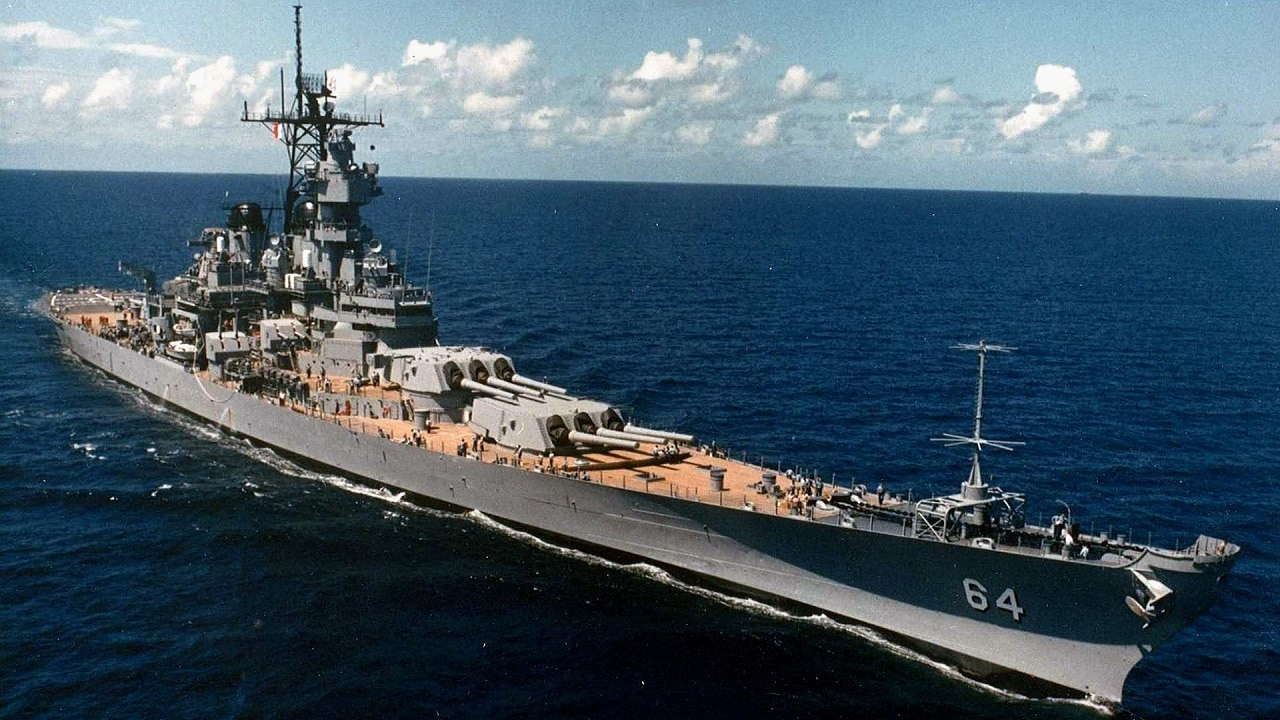
USS Wisconsin. Image Credit: Creative Commons.
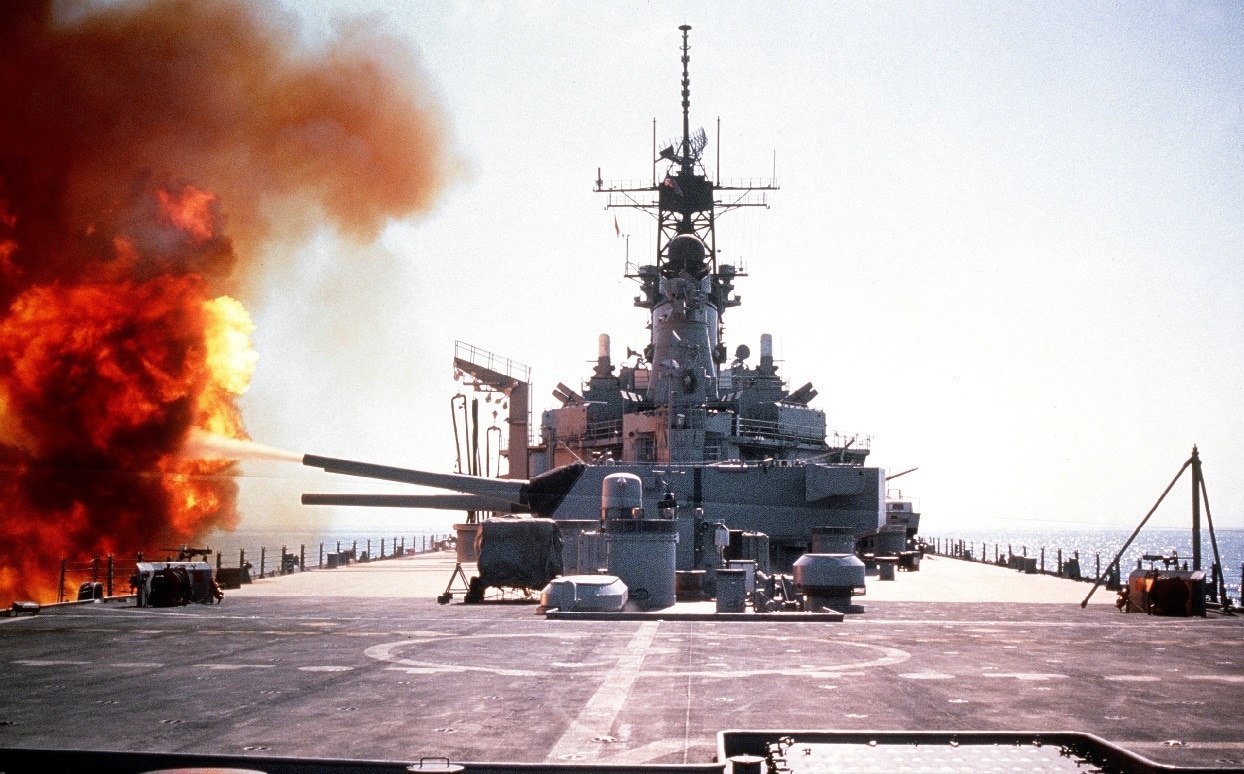
Image: Creative Commons.
Nine 16-Inch Guns Fired a 24,300-Pound Broadside
Each Mark 7 gun weighed 267,904 pounds with its breech and measured 68 feet long. The armor-piercing projectile weighed 2,700 pounds; the high-capacity shell used against shore targets weighed 1,900 pounds. The armor-piercing round left the muzzle at 2,500 feet per second and reached roughly 42,345 yards, or 24.1 miles.
The three triple turrets weighed between 1,701 and 1,708 tons apiece. At the rate of two rounds per minute, all nine guns theoretically sent 48,600 pounds of armor-piercing projectiles downrange in 60 seconds. Shell design, radar fire control, and barrel length made the Mark 7 battery more formidable than caliber alone suggests.
At commissioning, Wisconsin also carried ten twin 5-inch/38 mounts, twenty quadruple 40 mm Bofors mounts, forty-nine single 20 mm Oerlikons, and two twin 20 mm mounts. Counting every barrel produced 162 guns. Two catapults and Kingfisher floatplanes occupied the stern for reconnaissance, rescue, and gunfire spotting.
World War II Used Wisconsin as a Carrier Escort and Bombardment Ship
Wisconsin joined Adm. William Halsey’s Third Fleet at Ulithi in December 1944. Her speed let her screen fast carriers during strikes against the Philippines, Formosa, the South China Sea, Iwo Jima, Okinawa, and Japan. Typhoon Cobra sank three destroyers soon after she joined the fleet, but Wisconsin avoided serious structural damage.
During the final months of the war, she protected carriers, refueled screening destroyers and fired 16-inch shells at industrial targets at Muroran and Hitachi. Wisconsin never exchanged main-battery fire with a Japanese battleship. None of the four completed Iowas did, leaving the class’s intended gun duel unfought.
The Navy records 105,831 miles steamed from commissioning through the end of Wisconsin’s World War II service. The ship shot down three aircraft, received credit for four assists and refueled destroyers about 250 times. She earned five battle stars before decommissioning on July 1, 1948.
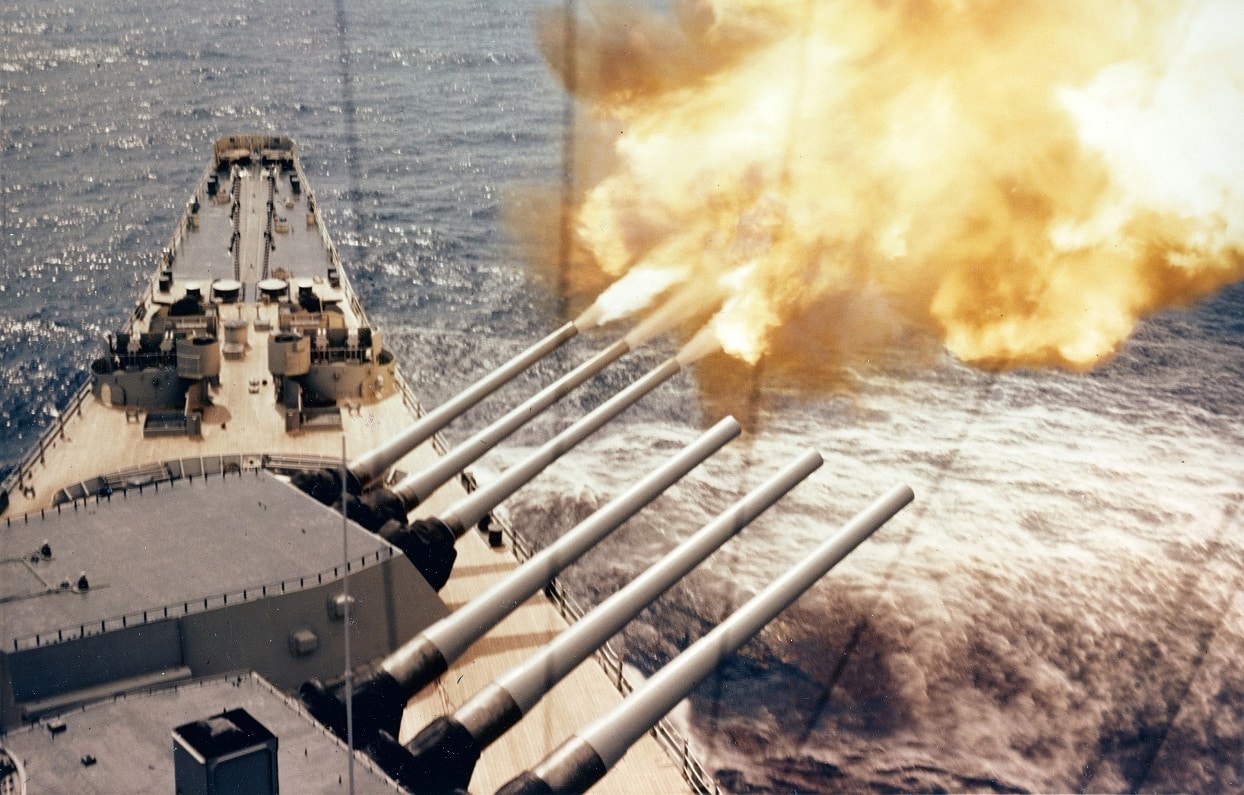
USS Wisconsin (BB-64) Fires a three-gun salvo from her forward 16/50 gun turret, during bombardment duty off Korea. Photograph is dated 30 January 1952. Official U.S. Navy Photograph, now in the collections of the National Archives.
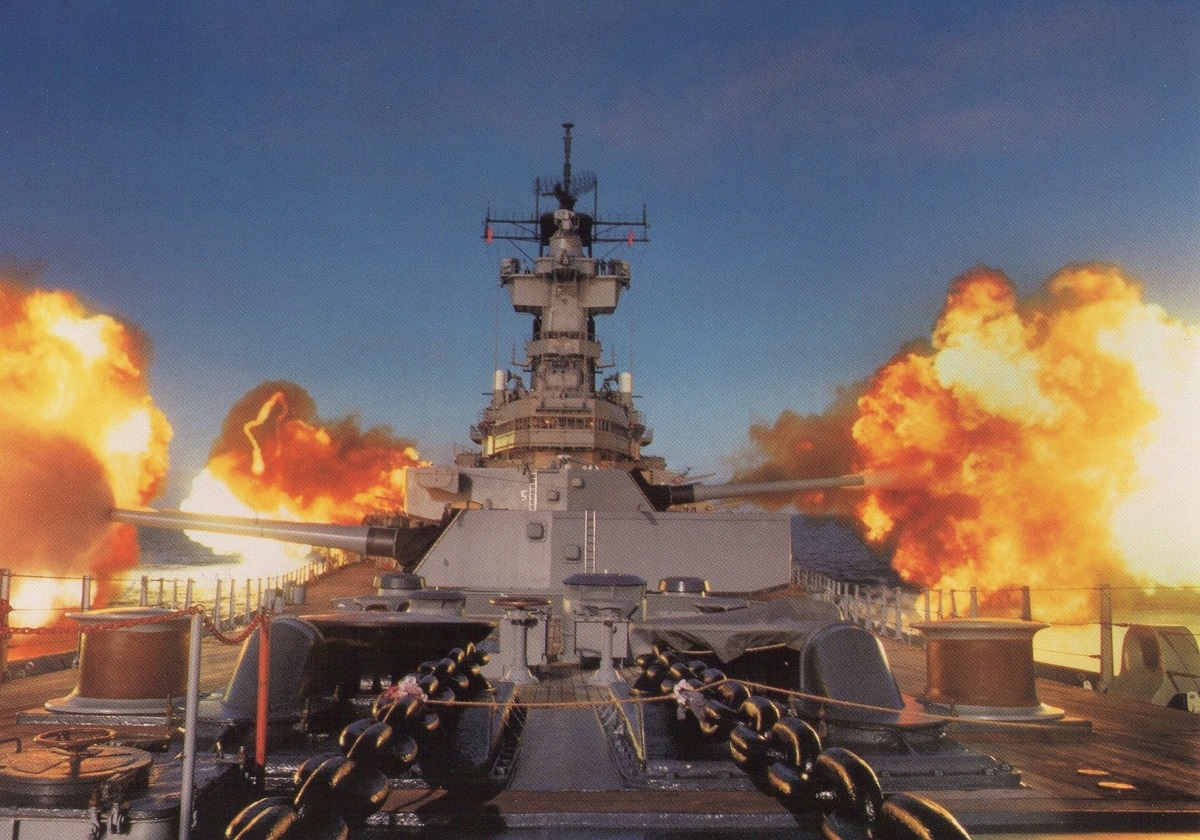
USS Wisconsin. Image: Creative Commons.
Korea Brought Back the Guns and Kentucky Supplied a New Bow
The Korean War returned Wisconsin to service on March 3, 1951. She supported South Korean and American ground forces, firing 977 main-battery rounds at an average distance of 16 miles against artillery, bunkers, rail lines, command posts and troop concentrations.
On March 15, 1952, a North Korean 155 mm shell struck Wisconsin near Songjin. Three sailors were injured, and the hit damaged a 40 mm mount, teak decking, cables and ventilation ducts. It was the only enemy fire to damage the ship during her career. Wisconsin answered with 16-inch gunfire, one of the best-known Iowa-class exchanges in Korea.
The Korean-era refit removed the floatplane catapults and converted the stern into a helicopter operating area. Radar and fire-control equipment improved, while the light antiaircraft battery declined as jets and guided weapons changed fleet defense.
A peacetime collision caused the ship’s largest physical repair. Wisconsin struck the destroyer USS Eaton in heavy fog off the Virginia Capes on May 6, 1956. The Navy transported a 120-ton, 68-foot bow section from the unfinished USS Kentucky and grafted it onto Wisconsin in 16 days. The ship returned to sea on June 28.
Wisconsin left active service again on March 8, 1958. Her decommissioning left the United States without an active battleship for the first time since 1896. She spent almost three decades in reserve before the Reagan administration’s naval expansion gave the hull another mission.
The 1980s Refit Added 48 Missiles and Modern Electronics
The Navy began Wisconsin’s major refit in 1986 and recommissioned her on October 22, 1988. The four-ship modernization and reactivation effort cost about $1.7 billion in total. The program retained the nine 16-inch guns while rebuilding communications, sensors, living spaces and defensive systems.
Engineers removed four twin 5-inch mounts and all remaining 40 mm guns. Eight armored box launchers held 32 Tomahawk land-attack missiles, while four quadruple launchers carried 16 Harpoon anti-ship missiles. Four Phalanx close-in weapon systems protected the ship. The refit turned a World War II gun platform into a long-range strike ship.
Wisconsin also received updated search radars, electronic-warfare equipment, chaff launchers, a towed torpedo decoy, data links and eight RQ-2 Pioneer unmanned aircraft. Automation and the removal of older weapons lowered the crew to 65 officers and 1,450 enlisted sailors.
Desert Storm Led From the Persian Gulf to Norfolk
Wisconsin reached the Persian Gulf in September 1990 after Iraq invaded Kuwait. During Operation Desert Storm, her commanding officer served as the Navy’s strike-warfare commander for the opening Tomahawk attacks. The National Register nomination credits the ship with 26 Tomahawk launches before she shifted to gunfire support.
The battleship fired on Iraqi positions in southern Kuwait, supported American and Saudi forces and used Pioneer drones to correct the fall of 16-inch shells. On February 28, 1991, Iraqi troops on Faylaka Island displayed white flags after seeing one of Wisconsin’s drones overhead, the first recorded surrender of soldiers to an unmanned aircraft.
Wisconsin fired her main battery for the final time on February 28. No American battleship has fired in combat since. The Navy decommissioned her on September 30, 1991, as the Soviet Union collapsed and the expense of maintaining a 1,500-person battleship became harder to justify.
The ship arrived beside Nauticus on December 7, 2000, and later passed into City of Norfolk ownership. Visitors now tour the decks at One Waterside Drive, with guided access to command spaces and the engine room. Nauticus lists daily hours of 9 a.m. to 5 p.m.
The bow visible from Norfolk’s waterfront is not the one launched in Philadelphia in 1943. It is the 68-foot section taken from Kentucky, the only surviving part of that unfinished battleship’s hull.
About the Author: Harry J. Kazianis
Harry J. Kazianis (@Grecianformula) was the former Senior Director of National Security Affairs at the Center for the National Interest (CFTNI), a foreign policy think tank founded by Richard Nixon based in Washington, DC. Harry has over a decade of experience in think tanks and national security publishing. His ideas have been published in the NY Times, The Washington Post, The Wall Street Journal, CNN, and many other outlets worldwide. He has held positions at CSIS, the Heritage Foundation, the University of Nottingham, and several other institutions related to national security research and studies. He is the former Executive Editor of the National Interest and the Diplomat. He holds a Master’s degree focusing on international affairs from Harvard University.

