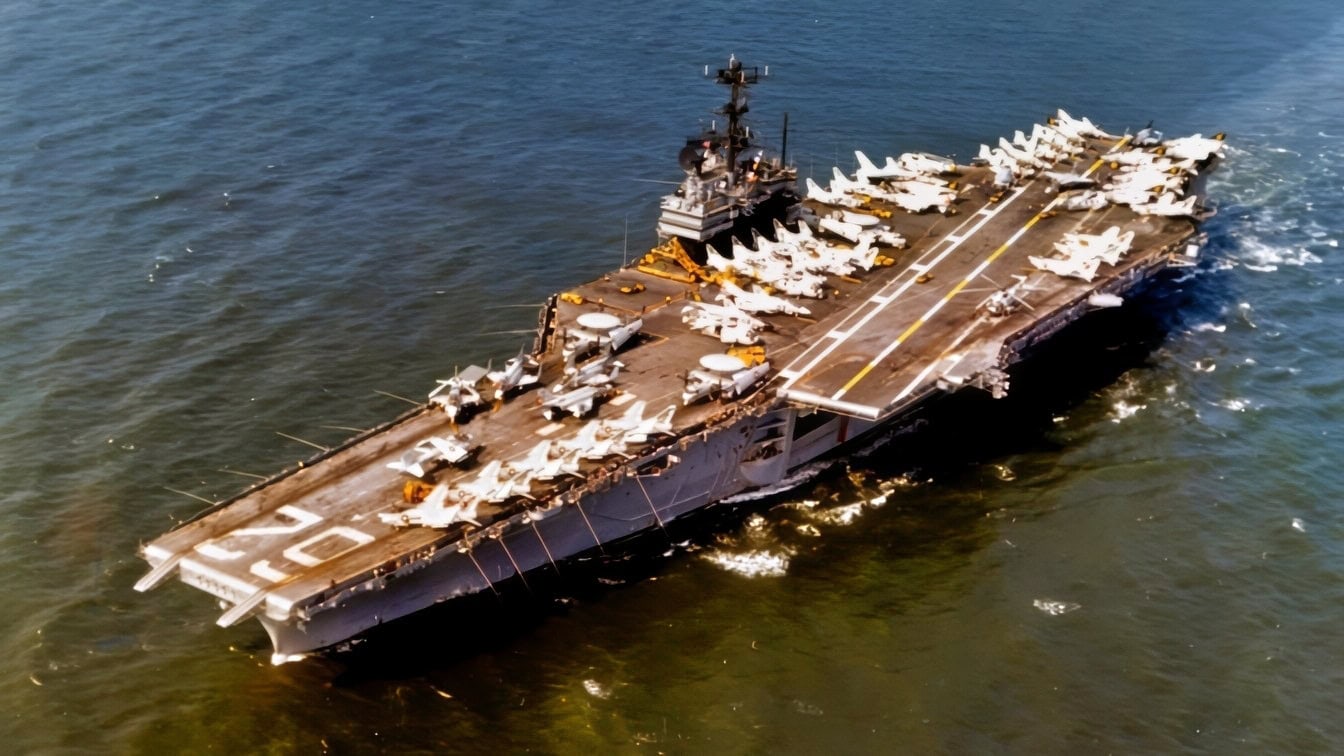
The fifth version of the United States Navy’s legendary Forrestal-class supercarrier, the USS Independence (CVA-62/CV-62), was a conventionally powered vessel that served for nearly 40 years, participating in the Cuban Missile Crisis, the Vietnam War, and beyond.
Throughout its long career, the carrier earned a reputation as one of the Navy’s most reliable and, therefore, most deployed capital ships.
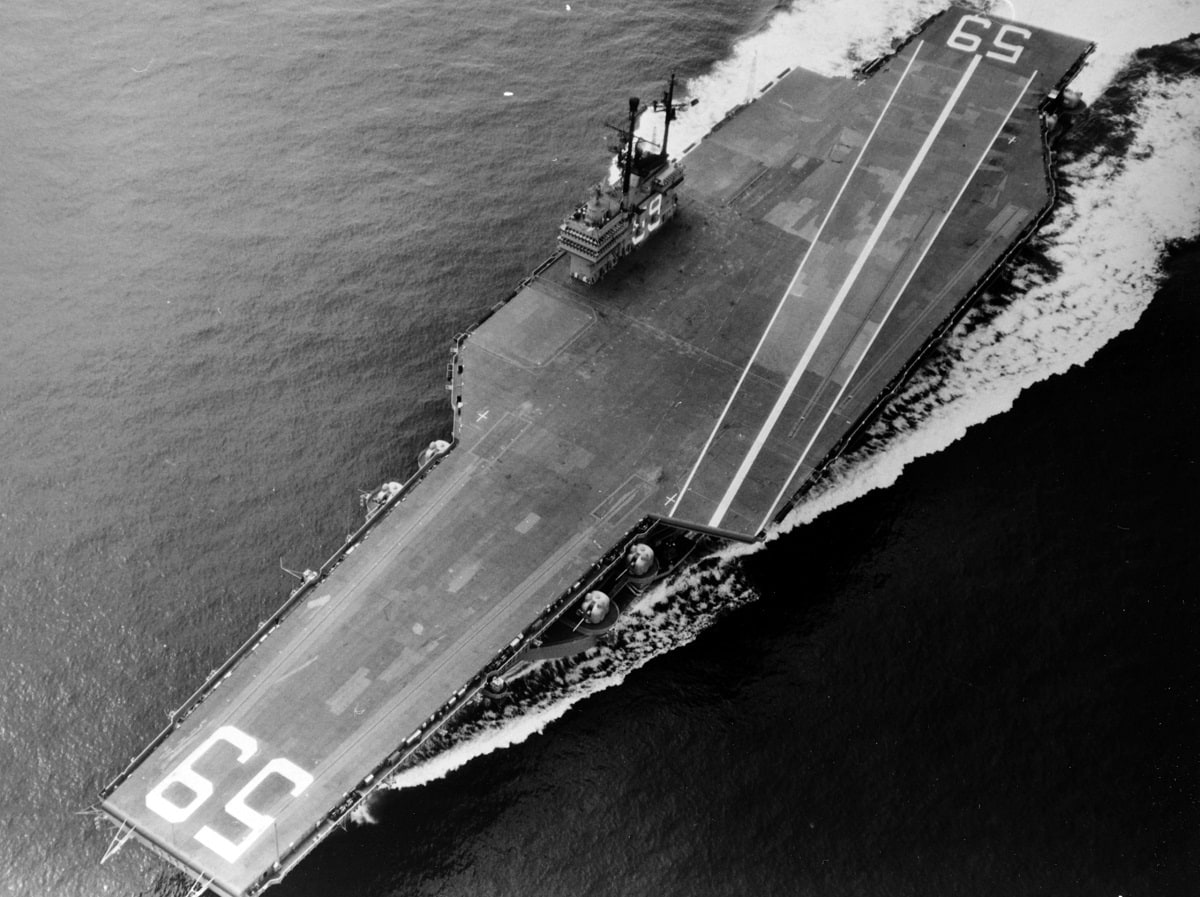
Forrestal undergoing sea trials, 29 September 1955
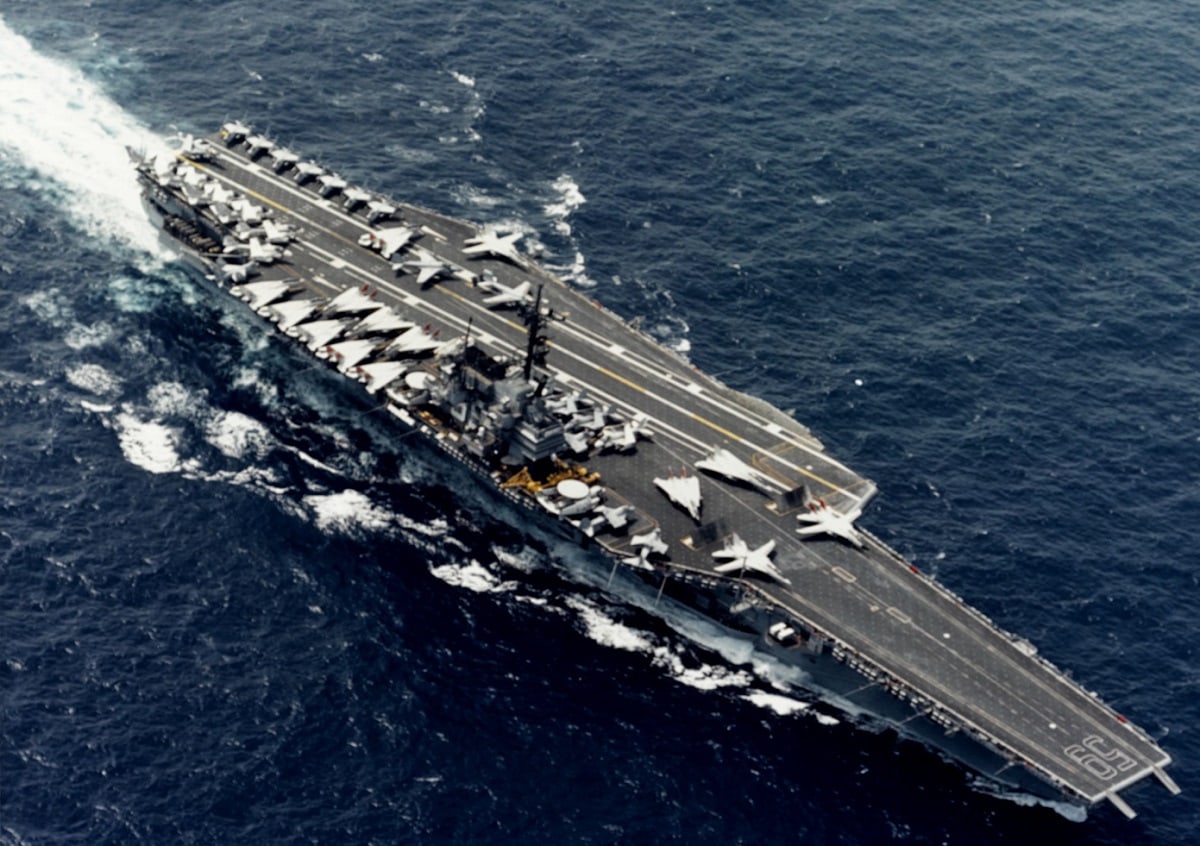
USS Forrestal in 1987. Image: Creative Commons.
Heroic Service
The long and heroic story of the Independence begins at the New York Naval Yard in Brooklyn after its keel was laid on July 1, 1955.
The carrier was launched on June 6, 1958.
At the time of her commissioning, the USS Independence represented one of the most advanced aircraft carriers in the world and was among the Navy’s largest conventionally powered warships.
Independence displaced around 56,400 tons (standard) and more than 80,000 tons (fully loaded). She measured over 1,046 feet long and carried up to 90 aircraft.
Four steam turbines produced 280,000 shaft horsepower, propelling the ship to speeds greater than 34 knots.
After her shakedown cruise in 1959, the Independence joined the Atlantic Fleet and quickly became a regular presence with the US Sixth Fleet in the Mediterranean.
Her first overseas deployment began in August 1960, as Cold War tensions escalated across Europe and the Middle East.
Independence served in her early career, conducting various NATO exercises meant to project US naval power at the height of the Cold War and deter any malign intentions the Soviet Navy may have had at the time.
The Independence cut her operational teeth during the infamous Cuban Missile Crisis.
Ordered into the Caribbean by then-President John F. Kennedy, the carrier participated in the naval quarantine surrounding Cuba after the discovery of Soviet nuclear missiles on the island.
Independence helped enforce the blockade that ultimately contributed to Moscow’s decision to withdraw its missiles, making the operation a success–and the Independence’s contribution to that successful operation was integral.
Her Finest Hours: The Vietnam War
After that, the carrier went to work in the Pacific, supporting US combat operations during the Vietnam War. During her first deployment to the combat theater in 1965, Carrier Air Wing Seven flew more than 7,000 combat sorties against North Vietnamese targets.
The carrier participated in the first coordinated strikes against North Vietnamese supply routes and against North Vietnam’s expanding surface-to-air missile (SAM) network.
Aviators from the Independence survived the first Soviet-made SAM barrages of the Vietnam War, too.
That deployment earned the Independence (and her embarked air wing) the Navy Unit Commendation for exceptionally meritorious service.
Throughout the 1960s and 1970s, the Independence bounced between Mediterranean deployments, NATO exercises, and readiness operations.
The carrier repeatedly responded to geopolitical crises in Cyprus and during the Arab-Israeli conflict. In fact, the carrier became one of the primary ships of the Sixth Fleet during that time.
She even saw combat during the Lebanon Crisis in the 1980s. Aircraft from her air wing supported multinational peacekeeping forces and later flew strike missions against Syrian positions after attacks on American personnel.
During these operations, two A-6 Intruder aircraft were lost to enemy anti-aircraft fire. Independence supported Operation Urgent Fury, the 1983 US-led invasion of Grenada.
In other words, this ship got around.
A New Lease on Life
Between 1985-88, the Independence underwent what is known as a “Service Life Extension Program (SLEP).” That’s basically an overhaul to completely modernize the combat systems, electronics, and flight operations so the Navy can squeeze additional years out of the ship without losing combat readiness (or relevance).
Once her refit was completed in 1988, the Independence transferred from Norfolk, Virginia to San Diego, California.
Inevitably, though, the carrier was permanently deployed to Yokosuka, Japan, replacing the USS Midway.
During both Operation Desert Shield and, later, Desert Storm, the USS Independence played a pivotal role supporting US forces in combat against Iraq.
The carrier also supported the post-Desert Storm containment missions against Saddam Hussein’s Iraq (Operation Southern Watch), which imposed continual No-Fly Zones in the southern part of Iraq and the northern part.
The Independence served 39 years of active duty before being decommissioned in 1998. She remained in reserve before being towed to Texas for scrapping, which concluded in 2019.
Her long career was defined by constant deployments during the most heightened parts of the Cold War–like the Cuban Missile Crisis–the Vietnam War, the Middle East, and Desert Storm.
She was one of the most active conventionally powered carriers in history.
MORE – Japan Tried to Take a Battleship and Morph It Into an Aircraft Carrier
About the Author: Brandon J. Weichert
Brandon J. Weichert is the Senior National Security Editor at 19FortyFive.com. He also manages The Weichert Brief on Substack. Weichert also hosts “National Security Talk” on Rumble. He is the author of four bestselling national security books, the most recent of which is A Disaster of Our Own Making: How the West Lost Ukraine (Encounter Books). Follow him via Twitter/X @WeTheBrandon.