
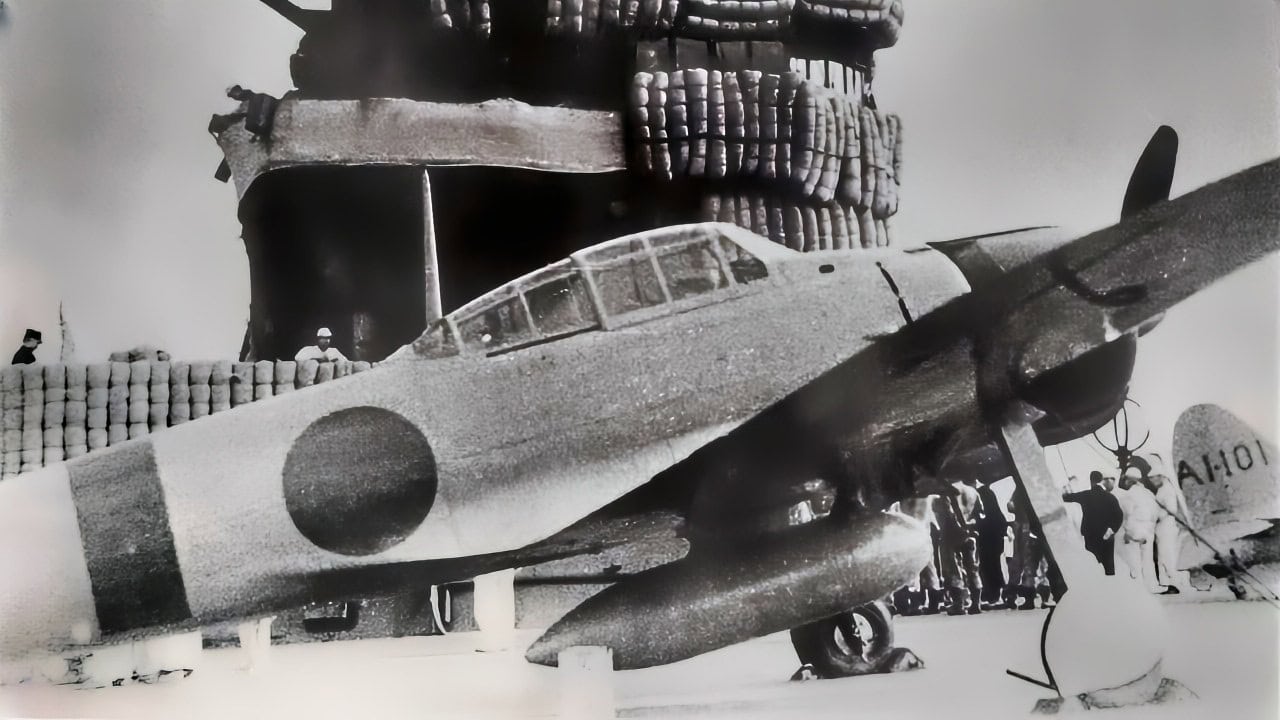
The story of December 7, 1941, is a story of annihilation: the battleships of the Pacific Fleet destroyed at their moorings in a single morning. The ledger tells it differently. Japan attacked eight American battleships at Pearl Harbor that day. Two never fought again. The other six were raised, rebuilt, and returned to the war, and on a black night three years later, five of them formed the line that annihilated a Japanese battleship force in the last battleship-against-battleship action ever fought. Judged by what it was meant to accomplish, the most famous surprise attack in history was a failure, and the arithmetic of the ships proves it.
Pearl Harbor: The US Navy Battleships Attacked
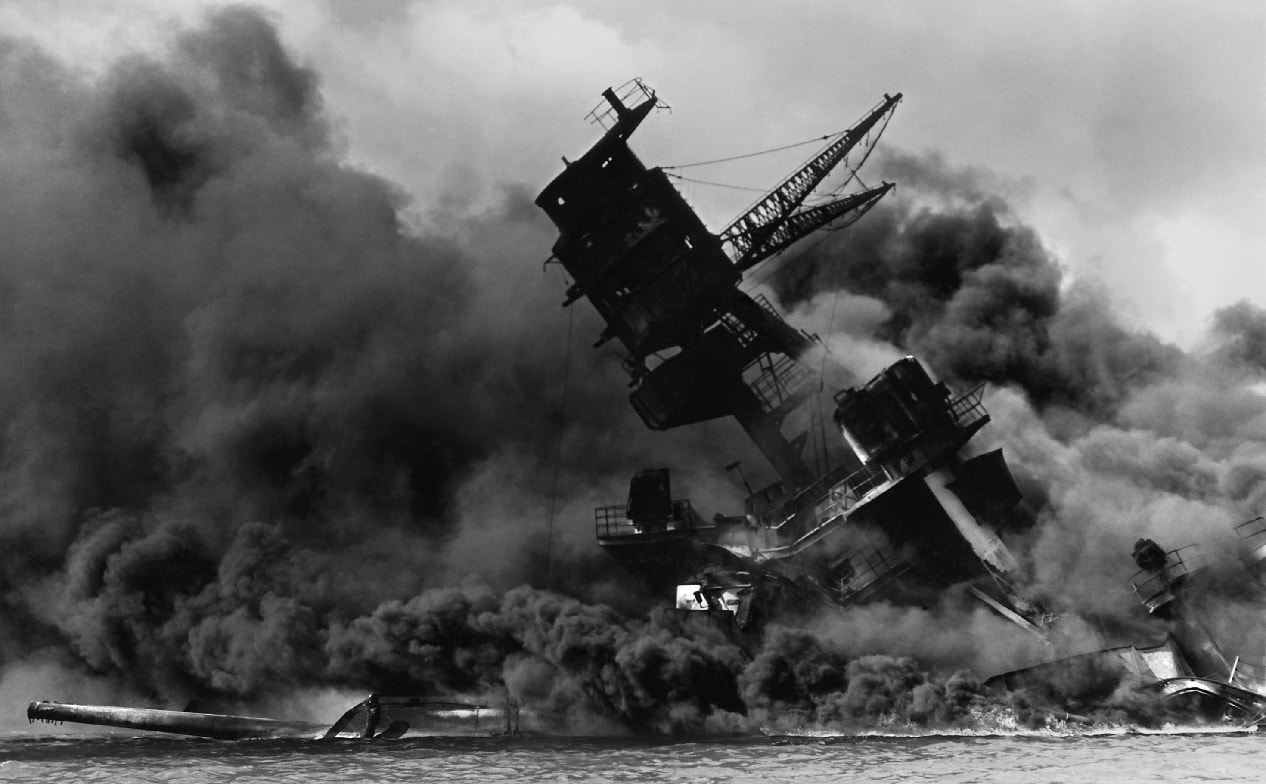
USS Arizona in the aftermath of Pearl Harbor. Image Credit: Creative Commons.
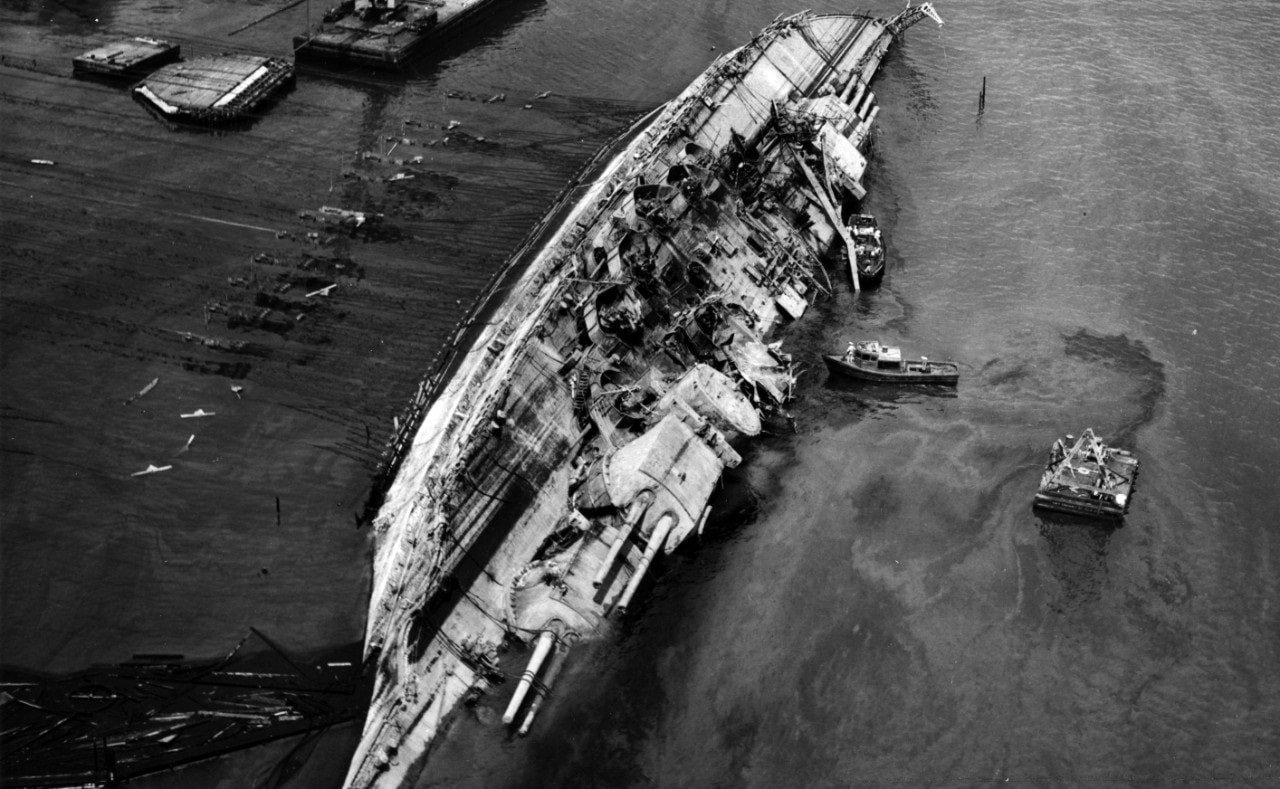
The USS Oklahoma, moored at Ford Island, Pearl Harbor, was sunk by Japanese aircraft during the attack on Pearl Harbor. A total of 429 crewmen aboard the USS Oklahoma were killed in the early morning hours of Dec. 7, 1941, after the ship quickly capsized from the numerous torpedo hits.
The morning itself was a catastrophe. Along Battleship Row, Arizona blew apart when a bomb detonated her forward magazines, killing 1,177 men. This was a tragedy woven into the fabric of America.
Oklahoma took at least six torpedoes in the opening minutes, rolled over, and trapped hundreds inside; 429 of her crew died.
West Virginia and California, torpedoed repeatedly, settled upright to the harbor bottom.
Nevada, the only battleship to get underway, steamed past the burning Arizona for the sea, took bomb after bomb, and was run aground to keep from sinking in the channel.
Pennsylvania sat in drydock and was hit; Maryland and Tennessee, moored inboard, were damaged where they lay.
In under two hours, 2,403 Americans were dead, and every battleship in the harbor was sunk or damaged.
What Happened After the Battle: Battleships Were Saved
What the morning could not do was make the damage permanent, because of where it happened.
Pearl Harbor is shallow. Ships that would have vanished into the deep ocean anywhere else settled a few feet into mud, upright, at their own home base, beside a navy yard the attackers left intact. The Navy’s salvage force went to work in the smoke, and the arithmetic began to reverse almost immediately.
Pennsylvania, Maryland, and Tennessee were patched and back in service, or steaming to West Coast yards for final repairs, by February 1942. Nevada was refloated and headed for rebuilding that spring.
California came off the bottom in March, West Virginia in June, and both were rebuilt from the keel up into the most modern battleships in the fleet. Only two of the eight were beyond saving. Arizona had been broken in half.
Oklahoma was righted in one of the great feats of marine salvage, then judged too old and too wrecked to be worth restoring; she gave up her guns and gear and was written off.
The Fleet That Was Not in the Harbor: The Aircraft Carriers Saved
The attack also missed the ships that mattered most, because they were not there: the aircraft carrier fleet.
The Pacific Fleet’s three aircraft carriers were all at sea or away on December 7. Enterprise had delivered Marine fighters to Wake Island and stood 215 miles west of Oahu at dawn, close enough that her scout planes flew into the middle of the raid. Lexington was ferrying aircraft to Midway.
Saratoga was on the West Coast, embarking her air group. Within six months, those absent flattops and their sisters had turned the Coral Sea and Midway into the graveyards of Japanese naval aviation, and the attack itself had settled an argument inside the US Navy: with the battle line on the bottom, the carrier was now the capital ship, whether the admirals liked it or not.
The Revenge of Battleship Row
The salvaged battleships got their answer in person. In the early hours of October 25, 1944, at the mouth of Surigao Strait in the Philippines, six American battleships waited in the dark for a Japanese force built around the battleships Yamashiro and Fuso. Five of the six, West Virginia, California, Tennessee, Maryland, and Pennsylvania, had been sunk or damaged at Pearl Harbor.
The American line crossed the enemy’s T, the textbook maneuver every admiral dreams of and almost none ever executes. West Virginia, tracking by radar in pitch blackness, opened fire at 22,800 yards and put her first salvo on Yamashiro, firing 93 rounds of 16-inch shells; Tennessee and California, similarly rebuilt with modern fire control, added 69 and 63.
Maryland ranged on the splashes and joined in. Pennsylvania, her older radar unable to find a target, never fired. Yamashiro went down with the fleet commander aboard. It was the last time battleships ever fought battleships, and the line that won it was crewed by ships Japan had already sunk once.
Nevada, the ship that tried to fight her way out of the harbor, took her own road back: she shelled the Normandy beachhead on D-Day, then Iwo Jima, then Okinawa, some of her guns replaced with barrels salvaged from Arizona and Oklahoma, so that even the two dead ships of Battleship Row fired on the enemy again.
What Japan Bought
We should look at Pearl Harbor differently after all these years. Japan spent 29 aircraft, five midget submarines, and 64 men, and bought the permanent loss of two elderly battleships, the temporary loss of six more, and one target ship.
It hit no aircraft carriers.
It never touched the submarine base, the repair shops that resurrected the fleet, or the tank farm holding fuel that, in the words of one account, “could not have been replaced for months.”
Every element of American power that would win the Pacific war, the carriers, the submarines, the yard, the oil, sailed out of December 7 untouched, and the ship type Japan did wreck was the one the war was about to make obsolete.
The United States commissioned no new battleship designs once the war made the lesson plain; the last battleships ever ordered were canceled outright while the salvaged veterans of Pearl Harbor did the fleet’s shore bombardment.
Pearl Harbor Will Never Be Forgotten
Eighty-four years on, the ledger still exists in physical form, and we should never forget what happened or honor those lives lost. Arizona lies where she sank, oil still rising from her fuel bunkers, and in September 2025, Navy divers spent weeks lifting hundred-ton concrete mooring platforms off her hull to protect the war grave beneath.
Oklahoma never reached the scrapyard that bought her: sold in 1946, she broke her tow in a Pacific storm in May 1947 and went down in deep water, five hundred miles out, the sea claiming her before the breakers could.
About the Author: Harry J. Kazianis
Harry J. Kazianis (@Grecianformula) was the former Senior Director of National Security Affairs at the Center for the National Interest (CFTNI), a foreign policy think tank founded by Richard Nixon based in Washington, DC. Harry has over a decade of experience in think tanks and national security publishing. His ideas have been published in the NY Times, The Washington Post, The Wall Street Journal, CNN, and many other outlets. He has held positions at CSIS, the Heritage Foundation, the University of Nottingham, and several other institutions related to national security research and studies. He is the former Executive Editor of the National Interest and the Diplomat. He holds a Master’s degree focusing on international affairs from Harvard University.

