
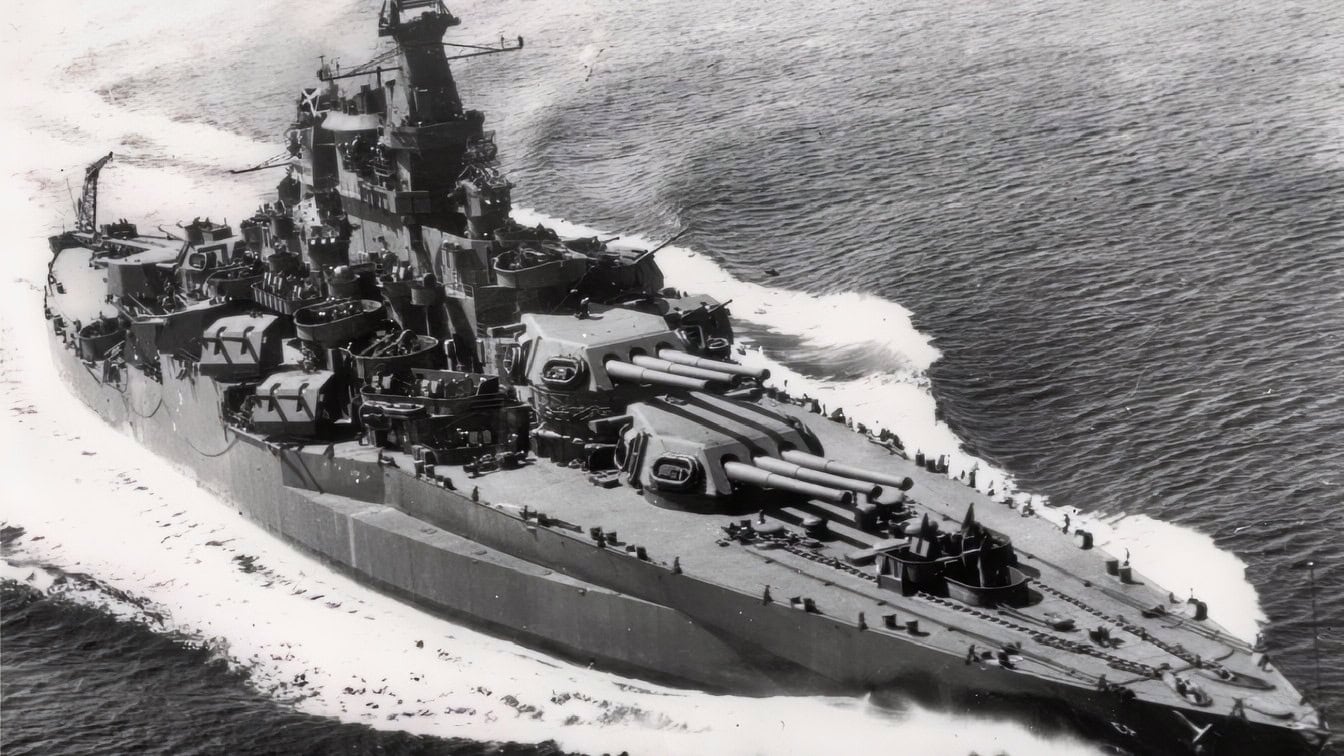
USS Tennessee by the Numbers: 40,345 Tons, 28,600 Horsepower, and 12 14-Inch Guns: USS Tennessee took two armor-piercing bomb hits at Pearl Harbor, endured fires spreading from USS Arizona, and remained trapped at Battleship Row for nine days. Less than three years later, the rebuilt battleship fired 69 14-inch shells at a Japanese battle line during the last battleship-versus-battleship engagement in history.
The New York Navy Yard in Brooklyn laid Tennessee’s keel on May 14, 1917, launched her on April 30, 1919, and commissioned her on June 3, 1920. A detailed historical ship-data compilation lists $7.8 million for the hull and machinery and $12.75 million overall. A contemporary newspaper account placed the completed ship above $22 million, reflecting a broader accounting of equipment, armor, and armament.
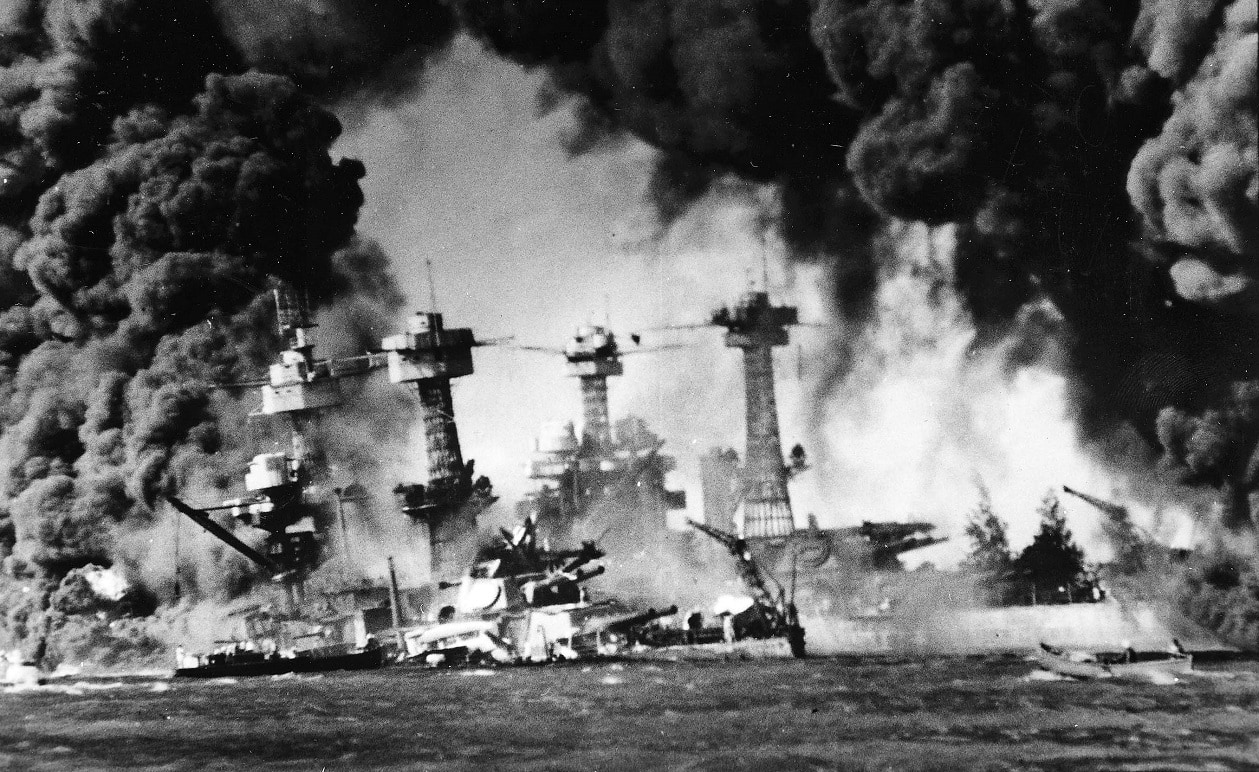
Battleship USS West Virginia sunk and burning at Pearl Harbor on Dec. 7, 1941. In background is the battleship USS Tennessee.
As built, Tennessee measured 624 feet overall, carried a beam of about 97 feet, and displaced roughly 32,300 long tons at normal load. Eight oil-fired Babcock & Wilcox boilers supplied steam to a Westinghouse turbo-electric propulsion system. The machinery generated approximately 28,600 shaft horsepower across four propeller shafts and pushed the battleship to about 21 knots.
Her main battery consisted of twelve 14-inch/50-caliber guns arranged in four triple turrets. The later Mark 11 weapons fired armor-piercing shells weighing as much as 1,500 pounds at roughly 2,700 feet per second. One projectile left the muzzle with around 230 megajoules of kinetic energy. A full 12-gun broadside placed 18,000 pounds, or nine tons, of projectiles into the air.
USS Tennessee Was Built Too Late for World War I
Construction began while the United States was fighting in World War I, but Tennessee entered service more than 18 months after the armistice. She became the lead ship of a two-battleship class completed by the USS California.
The Tennessee class represented an improved version of the New Mexico design. The ships retained the same main battery but introduced stronger underwater protection, improved fire control, and greater elevation for the 14-inch guns. The class belonged to the American “standard-type” battleship family designed to turn, maneuver, and fight together in a unified battle line.
Tennessee’s original secondary battery included fourteen 5-inch/51-caliber guns for use against surface targets, four 3-inch antiaircraft guns, and two submerged 21-inch torpedo tubes. Her armor belt reached roughly 13.5 inches over vital spaces. Turret faces carried as much as 18 inches of armor, while the conning tower had approximately 16 inches.
Each 14-inch gun weighed more than 81 tons and measured close to 60 feet. Maximum reach approached 36,800 yards, or almost 21 miles, after elevation increased to 30 degrees. The guns were individually mounted inside each turret, allowing one weapon to remain in action if another experienced mechanical trouble.
Tennessee spent most of the interwar years with the Pacific Fleet. She joined the annual Fleet Problems, trained in gunnery and engineering, visited Australia and New Zealand in 1925, and operated from California and Hawaii. She represented the generation of battleships designed for the decisive surface action American and Japanese planners expected somewhere in the Pacific.
By 1940, the Pacific Fleet had moved its main base from California to Pearl Harbor. Tennessee was there when Japan launched the attack that turned a planned knockout blow into a prolonged industrial war.
USS Tennessee Survived Pearl Harbor Because West Virginia Took the Torpedoes
On December 7, 1941, Tennessee was moored inboard of USS West Virginia along Battleship Row. West Virginia stood between Tennessee and the open harbor, placing the neighboring ship directly in the path of Japanese torpedo bombers.
West Virginia absorbed multiple torpedo hits and settled into the shallow water. Tennessee escaped the underwater weapons, but Japanese aircraft attacked her with heavy bombs made from modified naval armor-piercing shells.
At about 8:20 a.m., one bomb struck the center gun of Turret Two and exploded. Another partially penetrated the roof of Turret Three. The impacts damaged the main battery, sent fragments across the decks and started fires. Fragments from the Turret Two hit mortally wounded Capt. Mervyn Bennion aboard West Virginia.
The explosion of USS Arizona astern created another threat. Burning oil, steel fragments and debris struck Tennessee’s stern. Oil from the damaged battleships burned around the hull while Tennessee’s crew used hoses and propeller wash to keep flames away from ammunition spaces.
Sailors flooded magazines as a precaution and fought the fires while the ship’s anti-aircraft batteries remained in action. Tennessee received credit for destroying or helping destroy five Japanese aircraft. Five members of her crew were killed.
The concrete mooring quay stood on one side of Tennessee, and the sunken West Virginia blocked the other. Debris and the position of the damaged ships kept Tennessee trapped until workers demolished part of the quay. She finally moved on December 16 and departed Pearl Harbor on December 20.
Tennessee survived because West Virginia absorbed the torpedoes and because her crew stopped fire from reaching the magazines. West Virginia later returned to fight beside her, becoming one of the battleships raised and rebuilt after the attack. None of the battleships present at Pearl Harbor survive as a complete museum ship today.
The Navy Repaired USS Tennessee Twice
Tennessee reached Puget Sound Navy Yard on December 29, 1941. The first repair period replaced the damaged structure and electrical wiring, restored the main battery, and repaired the fire-damaged stern. Workers replaced the aft lattice mast, strengthened the anti-aircraft battery and installed additional 20mm and 1.1-inch weapons.
The battleship left Puget Sound on February 25, 1942. She spent several months training and patrolling along the West Coast while the Navy decided how extensively to modify the older battleships.
Tennessee returned to Puget Sound on August 27, 1942, for a far more ambitious reconstruction. She did not return to active operations until May 7, 1943. The transformation lasted a little more than eight months. From Pearl Harbor to the completion of the full rebuild, the process took roughly 17 months.
Workers stripped away the cage masts and much of the old superstructure. A modern tower bridge replaced the forward lattice mast; the funnels were trunked into one structure, and new radar and fire-control equipment appeared above the deck.
Large antitorpedo bulges increased the beam from about 97 feet to roughly 114 feet. Full-load displacement rose to approximately 40,345 long tons, more than 7,000 tons above the prewar figure. Deck armor and internal subdivision received additional protection.
The extra width made Tennessee too large for the original Panama Canal locks. When she returned to the East Coast after the war, the battleship had to travel through the Indian Ocean and around the Cape of Good Hope.
The original 5-inch weapons were replaced by sixteen 5-inch/38-caliber dual-purpose guns in eight twin mounts. Ten quadruple 40mm Bofors mounts added 40 medium antiaircraft barrels. Forty-three 20mm Oerlikons formed the inner defensive layer.
Crew size grew from roughly 1,083 officers and sailors before the war to more than 2,240 after reconstruction. The added personnel operated radar, antiaircraft weapons, communications equipment and the larger damage-control organization.
USS California received a similar transformation after being raised from Pearl Harbor. The rebuilt sisters looked so different from their 1941 appearance that photographs often resemble an entirely new class. California’s own return became another example of the Navy sending a Pearl Harbor survivor back against Japan.
The Rebuilt USS Tennessee Went From Alaska to Tarawa
Tennessee’s first combat operation after Reconstruction came in the Aleutians. In August 1943, she supported the landing on Kiska and fired 60 14-inch shells at positions around the abandoned Japanese submarine base. Japanese forces had secretly evacuated before the Americans arrived.
The battleship next moved into the Central Pacific campaign. At Tarawa in November 1943, Tennessee bombarded Japanese defenses before Marines landed on Betio. During one 17-minute period, she fired 70 14-inch shells and 322 rounds from the 5-inch battery.
Tennessee’s 5-inch guns later joined destroyers attacking the surfaced Japanese submarine I-35. USS Frazier rammed the damaged submarine and delivered the final blow.
At Kwajalein and Eniwetok in early 1944, Tennessee moved close to shore and fired at bunkers, artillery positions, buildings and beach defenses. Heavy naval shells could collapse concrete positions and create openings for troops moving inland, although the effects depended on accurate spotting and the quality of Japanese fortifications.
The battleship supported operations at Kavieng before joining the Marianas campaign. Off Saipan, Japanese shore batteries hit Tennessee three times. One shell disabled a secondary gun mount. Eight sailors were killed and 25 were wounded.
Repairs returned the ship to action for Guam and Tinian. Tennessee later supported landings at Angaur and Peleliu before moving toward the Philippines.
USS Tennessee Fought the Japanese Battleship Yamashiro
The Battle of Surigao Strait on October 25, 1944, finally placed Tennessee in the type of surface engagement for which she had been designed.
Vice Adm. Jesse Oldendorf deployed six American battleships across the northern end of the strait. Five had been present at Pearl Harbor. Tennessee stood in the battle line with West Virginia, California, Maryland, Mississippi, and Pennsylvania.
The Japanese Southern Force included the battleships Yamashiro and Fusō, the heavy cruiser Mogami, and several destroyers. American destroyer torpedo attacks shattered the formation before it reached Oldendorf’s guns. Fusō was crippled and dropped out of the advance.
West Virginia opened fire first at 3:53 a.m. Tennessee and California followed at 3:55. Tennessee used improved fire-control radar to track Yamashiro through the darkness and fired six-gun salvos to conserve her limited supply of armor-piercing ammunition.
Over approximately 12 minutes, Tennessee fired 69 14-inch armor-piercing shells. At 1,500 pounds each, those projectiles weighed a combined 51.75 tons. She also fired secondary rounds as Yamashiro and Mogami moved through the American line of fire.
Shell splashes, fires and simultaneous fire from several battleships made individual hits impossible to assign with confidence. Tennessee unquestionably fired on Yamashiro, but no reliable record identifies which holes came from her guns rather than West Virginia, California or Maryland.
Yamashiro sank after suffering torpedo and gunfire damage. Mogami escaped temporarily but was lost later. Surigao Strait became history’s last battleship-versus-battleship engagement.
Tennessee had finally fought a major enemy warship. The battle was not a clean duel between equal opponents. Radar-directed American gunfire struck a force already damaged and disorganized by torpedoes. It was still the surface action envisioned when Tennessee’s keel was laid 27 years earlier.
USS Tennessee Fired Nearly 1,400 Main-Battery Shells at Iwo Jima
After Leyte Gulf and repairs, Tennessee joined the bombardment of Iwo Jima in February 1945. The volcanic island’s tunnels, caves and reinforced positions demanded prolonged fire.
Tennessee fired nearly 1,400 14-inch shells and more than 6,000 rounds from her 5-inch guns during the operation. Some positions survived even direct bombardment because Japanese troops had dug deeply into volcanic rock.
The battleship remained offshore as Marines fought across the island. Spotters ashore and in aircraft directed fire onto caves, gun positions and suspected concentrations. The campaign showed both the destructive force and limitations of heavy naval artillery against deeply buried defenses.
A Kamikaze Hit USS Tennessee at Okinawa
Tennessee arrived off Okinawa in March 1945 and began bombarding the island before the April 1 landings. Her guns struck coastal positions, artillery, caves, and troop concentrations while Japanese aircraft attacked the invasion fleet.
On April 12, a burning Aichi D3A dive bomber approached the battleship and crashed into the signal bridge area. Its wreckage swept across anti-aircraft positions, and the aircraft’s 250-pound bomb penetrated the deck before exploding.
The attack killed or mortally wounded 22 sailors and injured 107, according to the Navy’s official ship history. It destroyed a 40mm mount, damaged lighter anti-aircraft positions, and started fires around the superstructure.
Emergency repairs allowed Tennessee to resume firing within two days. She remained off Okinawa until May, then received more extensive work at Ulithi. The battleship returned for the final stages of the campaign and later joined preparations for operations against the Japanese home islands.
Across World War II, Tennessee fired 9,347 rounds from her 14-inch guns, 46,341 rounds from the 5-inch battery, and more than 100,000 anti-aircraft rounds. She earned 10 battle stars.
USS Tennessee Was Decommissioned and Sold for Scrap
After Japan surrendered, Tennessee supported occupation operations at Wakayama and Yokosuka. She departed Japanese waters in October 1945 and returned to Philadelphia on December 7, exactly four years after Pearl Harbor.
The rebuilt beam forced the battleship to take the long route through the Indian Ocean and around southern Africa. She entered the Atlantic Reserve Fleet in 1946 and was decommissioned on February 14, 1947.
Tennessee remained in reserve for 12 years. The Navy struck her from the Naval Vessel Register on March 1, 1959, and sold her to Bethlehem Steel on July 10.
Tugs brought the battleship to Baltimore on July 26, 1959. Workers cut apart the armored hull, four triple turrets, and the reconstructed tower. Tennessee’s bell escaped the cutting torches and is displayed at the Museum of Scott County in Huntsville, Tennessee.
MORE – The ‘New’ B-52J Bomber Is in Trouble
About the Author: Harry J. Kazianis
Harry J. Kazianis (@Grecianformula) was the former Senior Director of National Security Affairs at the Center for the National Interest, a foreign policy think tank founded by Richard Nixon in Washington, D.C. Harry has more than a decade of experience in think tanks and national security publishing. His ideas have been published in The New York Times, The Washington Post, The Wall Street Journal, CNN and many other outlets worldwide. He has held positions at CSIS, the Heritage Foundation, the University of Nottingham and several other institutions related to national security research and studies. He is the former Executive Editor of The National Interest and The Diplomat. He holds a master’s degree focusing on international affairs from Harvard University.

