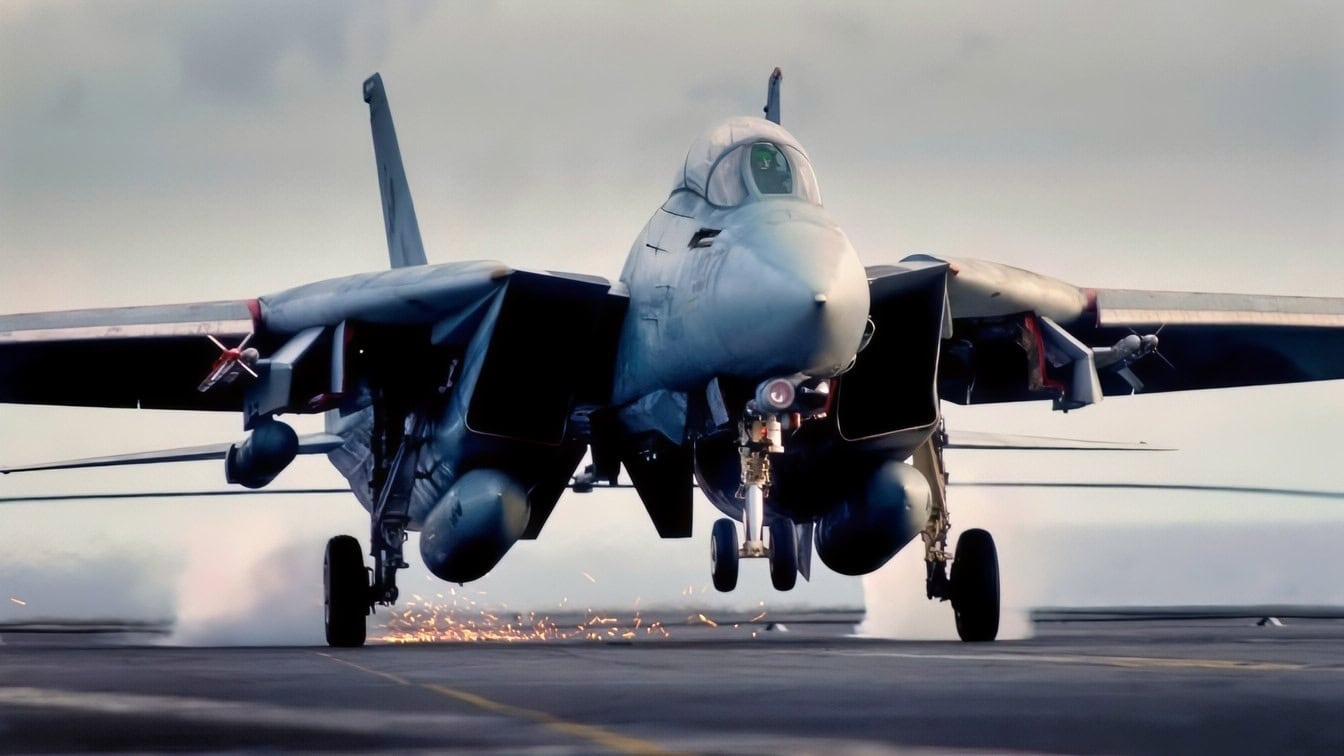
The origin of Iran’s F-14 Tomcats is one of the Cold War era’s stranger stories. But perhaps more remarkable is how long those warplanes continued to fly for Iran, despite sanctions, wars, and a lack of ammunition.
Under the Shah, Tehran purchased 79 Tomcats from the United States in 1974, along with AIM-54 Phoenix missiles (capable of reaching Mach 4) and associated spare parts and maintenance equipment.
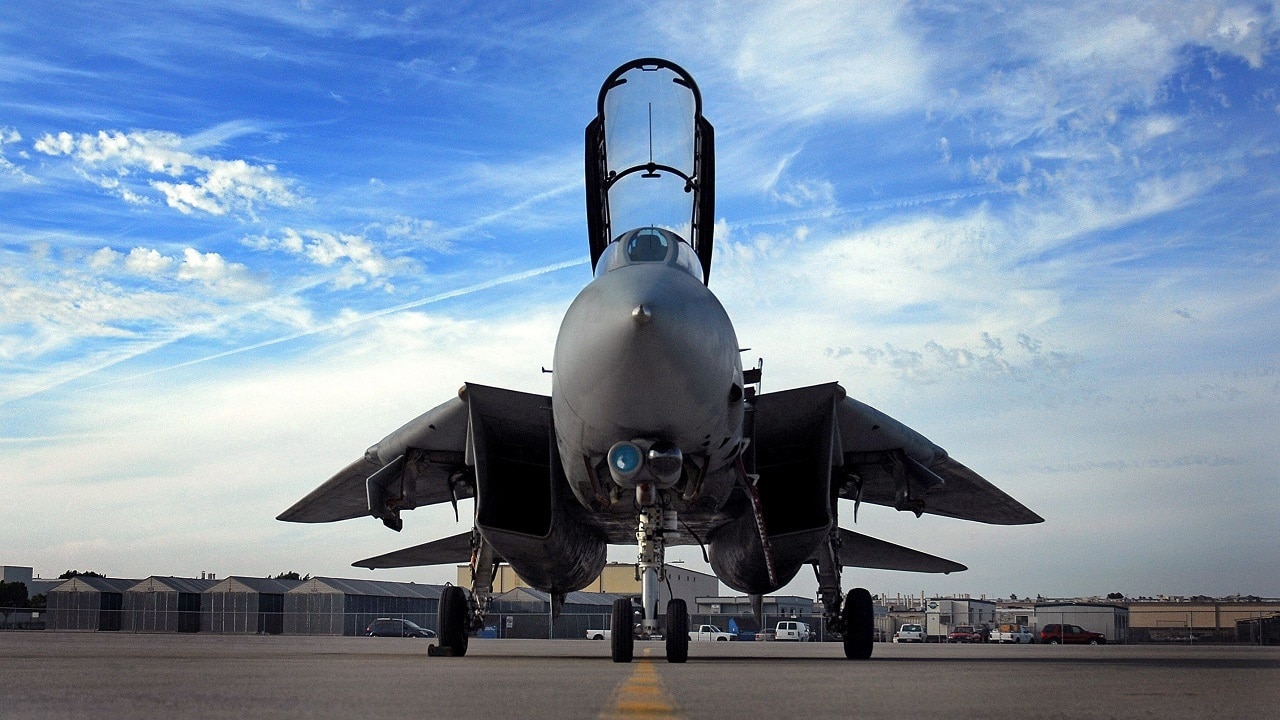
A U.S. Navy F-14D Tomcat aircraft from Fighter Squadron 31, sits on the flight line after completing its final flight at Naval Base North Island, San Diego, Calif., on Sept. 29, 2006. After 36 years of service, the Tomcat is being replaced by the F/A-18E/F Super Hornet aircraft.
F-14 Tomcat. Image Credit: Creative Commons.
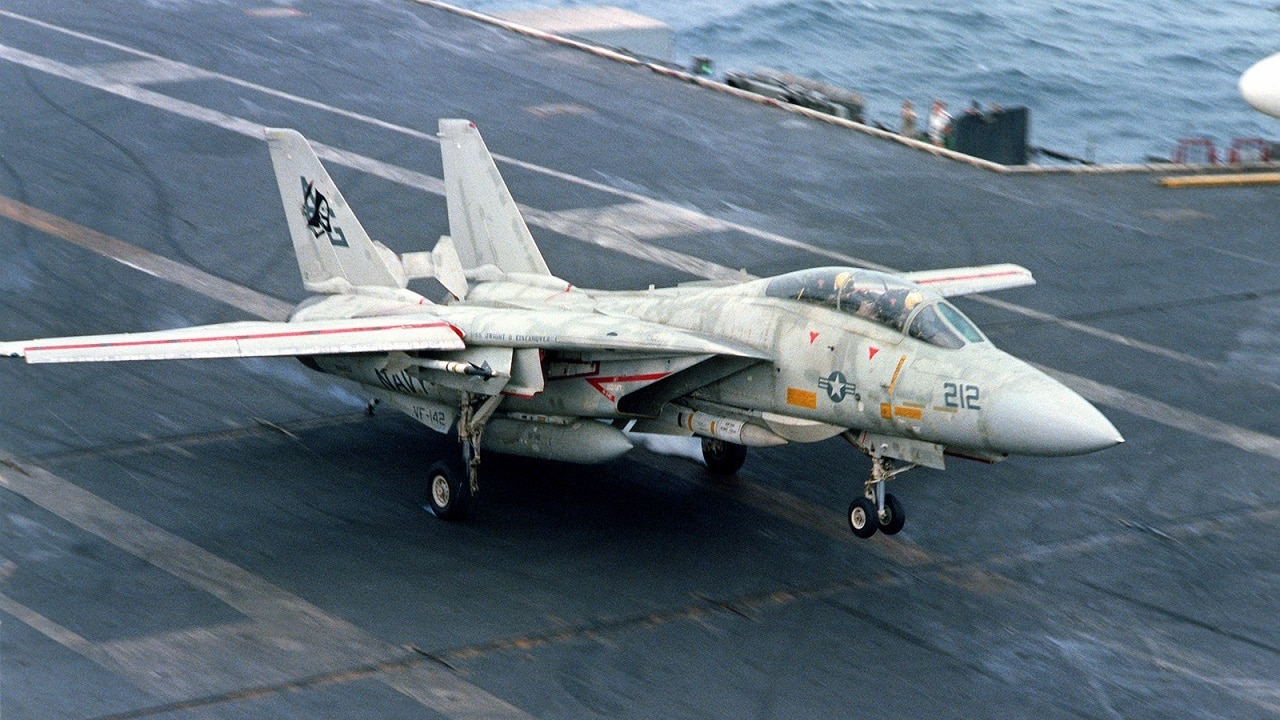
An F-14 Tomcat aircraft makes an arrested landing on the flight deck of the nuclear-powered aircraft carrier USS DWIGHT D. EISENHOWER (CVN-69). The F-14 is assigned to Fighter Squadron 142 (VF-142).
The rationale for buying the American warplanes was to protect the country from Soviet MiG-25 reconnaissance aircraft and bombers at very long ranges.
But after the 1979 revolution, the once-amicable relationship between Washington and Tehran evaporated.
Although the country — now an Islamic theocracy — retained the Shah’s F-14 fleet, access to the Tomcat’s supply chain, technical assistance, and access to new components and spare parts also disappeared.
Not all 79 of the original Iranian Tomcats were operationally retained. Instead, Iran turned that fleet into a pool of aircraft, engines, avionics, and components from which a much smaller number of usable aircraft could be assembled, a strategy that began almost immediately after the Iranian Revolution.
The strategy would continue for decades.
An F-14 that was no longer economical or possible to return to flight could become an extremely valuable source of parts for another aircraft.
Landing gear, hydraulic components, avionics, flight-control equipment, and countless other smaller items could be stripped and harvested from the pool for use on other aircraft.
As a result, the Iranian F-14 fleet nominally held dozens of aircraft, but only a fraction of these were actually capable of generating air sorties.
Spare Parts Sourcing
There was, however, not just one source of parts for Iran’s Tomcats. Instead, there were several supply lines, some of which were clandestine.
Initially, post-revolution Iran had an enormous stock of material inherited from the Shah’s era in the 1970s.
Along with the aircraft, Iran had purchased a substantial logistics and training infrastructure to support the jets.
Iran therefore began the post-revolution period with a significant inventory of spares, tools, documentation, and trained personnel.
But then came the aforementioned cannibalization, probably the single most important mechanism for keeping the aircraft alive over the long term.
So too was there an illicit international market for parts.
One report from the U.S. Government Accountability Office, a federal watchdog, found in 2008 that Iran was known to be seeking F-14 components and illustrated how easily sensitive military hardware could leak onto the commercial surplus market.
In their investigation, the GAO managed to purchase an entire F-14 antenna on eBay.
Iran also exploited intermediary deals and covert procurement networks, with some F-14 components reportedly moved via third countries and front companies.
During the Iran-Contra Affair, there were also clandestine transfers of U.S. equipment to Iran, though that pipeline for parts does not alone explain decades of Tomcat sustainment.
Perhaps the most remarkable aspect of the Tomcat’s longevity in Iran is how Iran managed to manufacture replacements itself domestically.
The Iranian aviation organization developed the ability to overhaul components, reproduce relatively straightforward mechanical parts, repair and modify avionics, and eventually manufacture increasingly sophisticated replacements.
While an F-14 production line was not recreated in its entirety, the Iranian approach stretched the Tomcat’s lifespan.
The F-14 was an extraordinarily complicated machine to maintain even when the United States Navy had an enormous industrial base behind it.
Iran was trying to sustain early-production F-14As with 1970s technology decades after production had ended while under international sanctions and without original support from the manufacturer.
Iran’s F-14 Tomcats
But time ultimately exacted a heavy toll on the Iranian F-14 fleet. Against an isolated aircraft or an opponent that underestimated it, a functioning Iranian F-14 could still be dangerous — it remained a large fighter with a powerful, albeit dated radar, long endurance, and long-range missiles.
But against the more modern air forces of the United States or Israel, the F-14 had little hope of victory.
Israel and the United States’ fleets are made up of newer, more capable fourth-generation aircraft such as F-15s and F-16s, and both countries increasingly rely on their highly capable fifth-generation F-35 stealth fighters, and, in the case of the United States Air Force, F-22 Raptors, arguably the most capable air-superiority fighter ever built.
Tomcats During the Present Day
Fast-forward to 2026, and the strikes against Iran by the United States and Israel appear to have brought the Iranian Tomcat story to a close.
Open-source evidence shows that several of the last remaining Iranian Tomcats were destroyed at Isfahan, adding to the losses Iran suffered in 2025. And while perhaps not every single Tomcat has been destroyed, there are likely very few remaining, if any.
But in any case, the combat effectiveness of Iran’s Tomcat fleet — even if a few aircraft remain in flightworthy condition — is practically zero, and brings a long and storied Cold War chapter to its definitive end.
About the Author: Caleb Larson
Caleb Larson is an American multiformat journalist based in Berlin, Germany. His work covers the intersection of conflict and society, focusing on American foreign policy and European security. He has reported from Germany, Russia, and the United States. Most recently, he covered the war in Ukraine, reporting extensively on the war’s shifting battle lines from Donbas and writing on the war’s civilian and humanitarian toll. Previously, he worked as a Defense Reporter for POLITICO Europe. You can follow his latest work on X.