
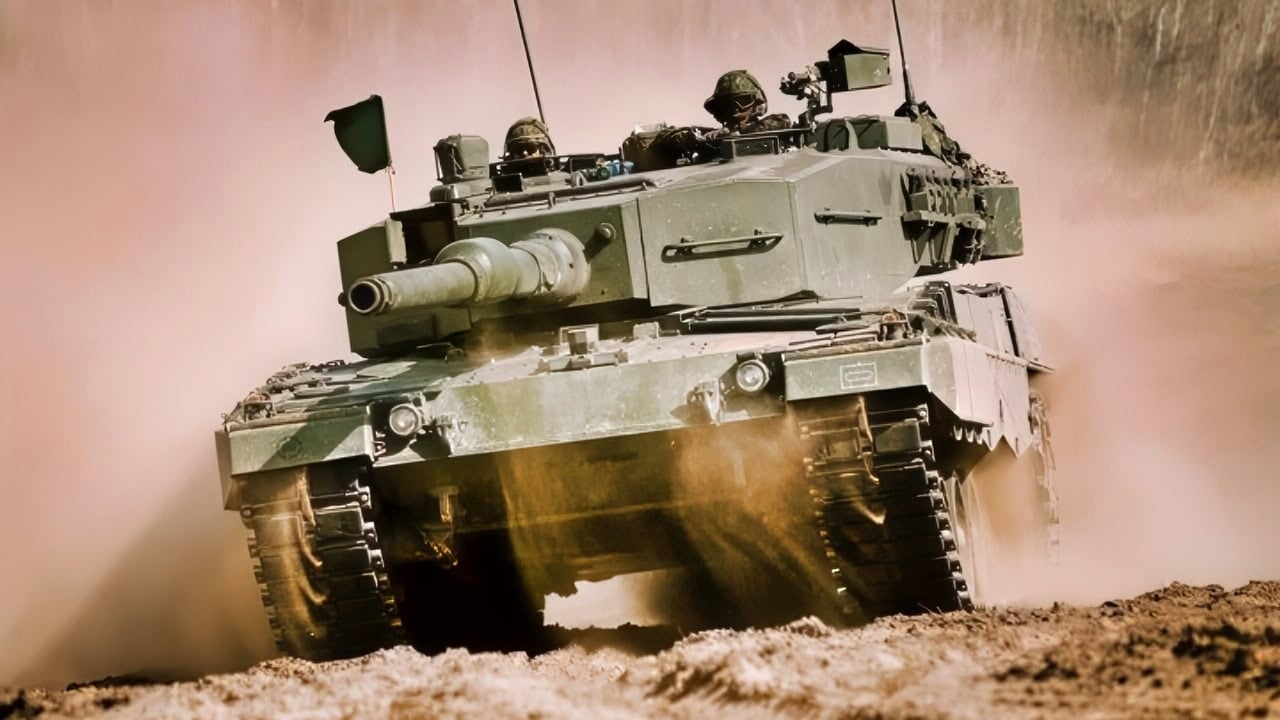
On July 13, the response period closed on a Department of National Defence request for information (RFI) covering the future of Canada’s tank fleet and a new medium cavalry vehicle. It drew little coverage.
The document is preliminary, but after years spent sustaining the Leopard 2 fleet without deciding what comes next, its appearance matters: the Army has begun formal work on a potential replacement.
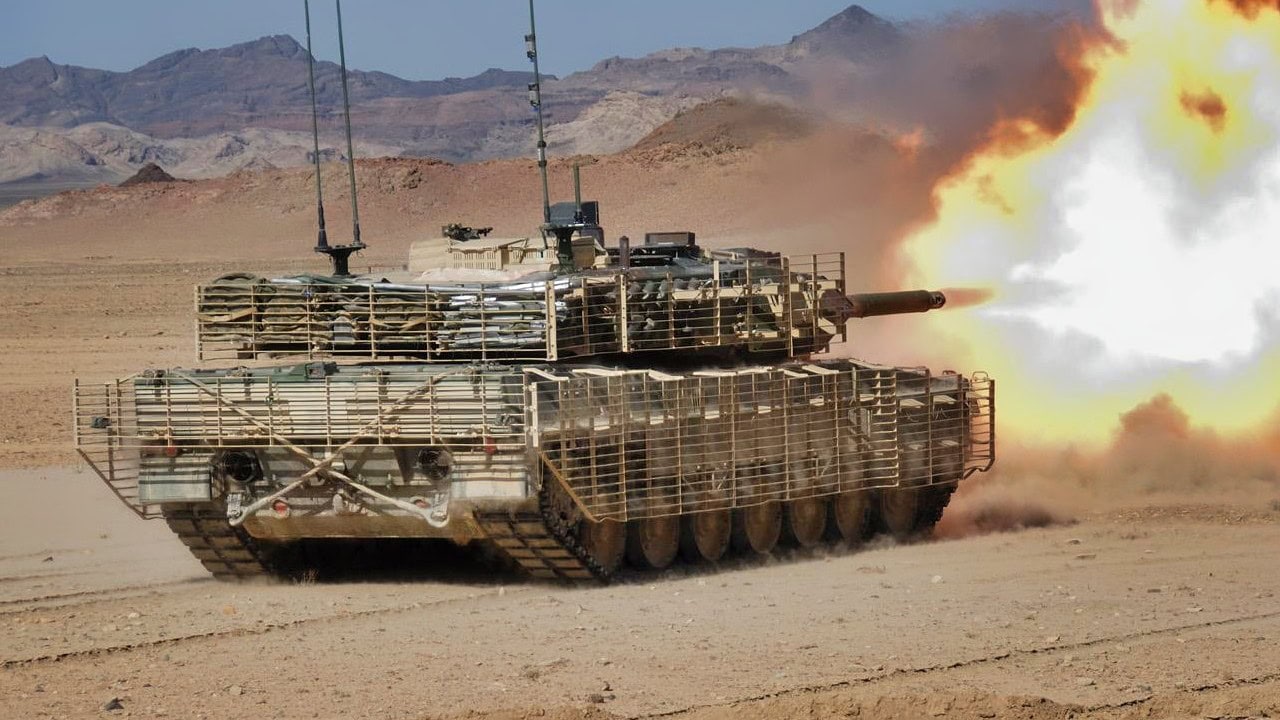
Canada Military Leopard C2 Tank.
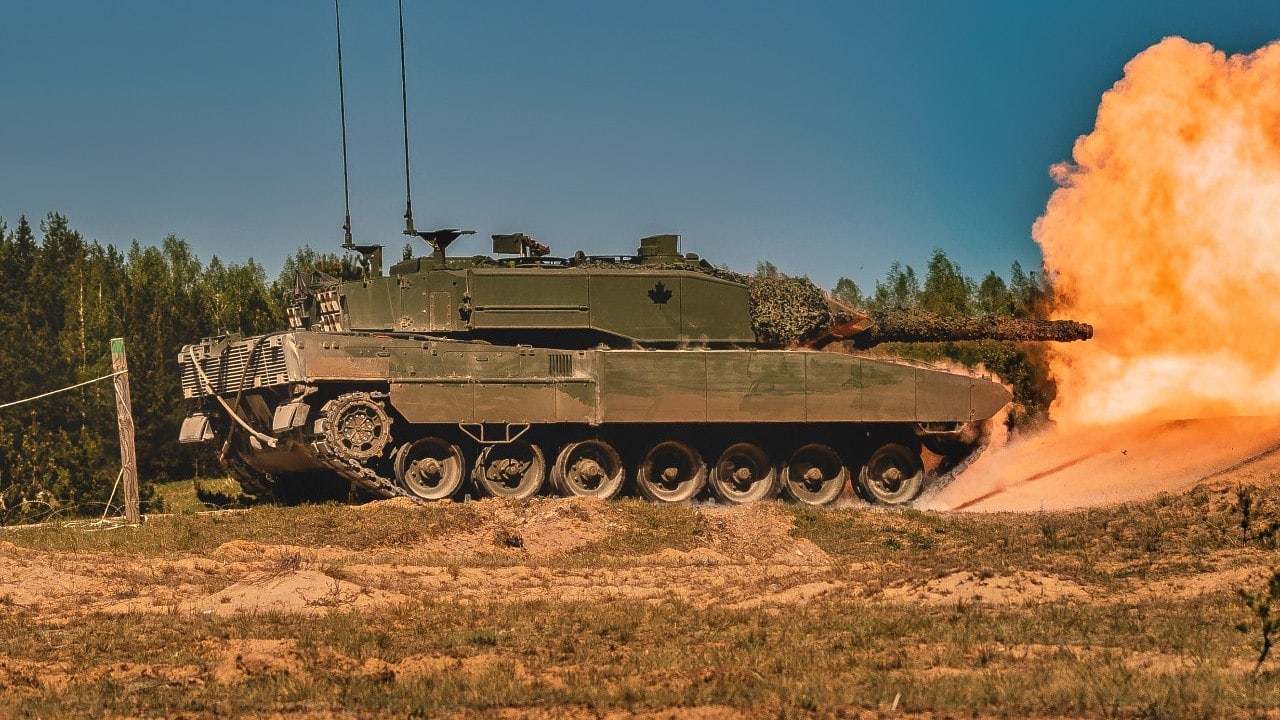
A Canadian Army Leopard 2A4M tank fires a round while taking part in the Canadian Army Trophy tank competition at Ādaži in Latvia.
The Canadian Army Trophy tank competition, held in May 2024, allowed participating nations to show off their gunnery skills while building camaraderie.
The starting point is not reassuring.
Canada’s own Army modernization strategy, Inflection Point 2025, says the Army’s sole remaining armored regiment has just a single squadron of tanks that are both serviceable and aging, a fleet already thinned by the eight Leopards Canada donated to Ukraine in 2023.
The immediate question is no longer simply whether heavy armor has a future.
It is what a successor force should look like, and whether the Army can keep today’s thin fleet viable long enough to get there, even as the brigade in Latvia asks more of it than it has in years.
What Closed on July 13
The notice is formally titled the “Heavy Direct Fire Modernization and Medium Cavalry Vehicle request for information.” Industry reporting describes HDFM as a rescoped version of an older project, once billed simply as a Leopard life-extension effort, widened after last year’s Inflection Point strategy into something closer to a full rethink of what heavy armour Canada should own.
Ottawa bundled it with the medium cavalry project on purpose, looking for commonality between a heavy fleet and a lighter, faster one.
It is neither a contract nor a decision about which new tank Canada is buying.
The Department of National Defence describes it as support for options analysis and preliminary project definition — procurement language for asking industry what exists before deciding what to buy.
Heavy Direct Fire Modernization, based on available reporting, covers more than a main battle tank.
It reaches into recovery vehicles, engineering vehicles, command vehicles and resupply vehicles: Ottawa is looking at the whole armored enterprise, not a one-for-one replacement for an aging German tank.
The companion project, Medium Cavalry Vehicle, is aimed at a tracked reconnaissance and direct-fire capability meant to work alongside the heavier fleet rather than instead of it.
Industry reporting has floated numbers as large as two heavy armored regiments and two medium cavalry regiments, which would be the largest reset of Canadian armor in a generation.
A month after the RFI closed, all of it is still just a request for information.
The Long Overlap
Canada’s public timeline keeps the existing Leopard fleet in service to roughly 2035. Identification and procurement of a successor platform is not expected to begin before 2030, and the resulting formations are not projected to be fully operational before 2038.
That leaves close to a decade between this year’s request for information and a working replacement force — not a decade of empty years, but one in which an aging fleet and an emerging one overlap, both relying on a training and maintenance system the Army itself says is already stretched thin.
The Army’s own modernization strategy is candid about the strain this creates.
It names insufficient spares and ammunition stocks and training capacity that have not kept pace with growth targets, and separately warns that aging equipment can go obsolete before its replacement arrives.
It even puts a number on part of the problem: National Procurement funding, the account that pays for keeping equipment serviceable, has run at roughly half of assessed requirements for most of the past decade. That sustainment shortfall is only one pressure point.
The Army separately lists HDFM and MCAV among forty-nine major capital projects it says it is running at once, describing the whole effort as its most comprehensive equipment modernization effort in twenty years. That is the Army’s own assessment of the risk, not an outside critique.
The Mission That Isn’t Waiting
Canada’s brigade in Latvia, the anchor of Operation Reassurance and the country’s largest overseas commitment, had its mandate renewed through 2029 last year.
The brigade includes troops from 14 NATO countries; Canada, the framework nation, currently has about 2,000 personnel in Latvia and plans a persistent presence of up to 2,200.
Colonel Kris Reeves, the brigade’s commander, said this spring that the mission has moved past the old tripwire concept toward something closer to genuine tactical credibility.
The force, he said, is now expected to hold ground, not simply signal that Canada showed up.
The Army is redesigning its future armored force at precisely the moment its current one is doing its most demanding job in decades.
The firm commitment runs through 2029; the fleet transition runs a decade beyond that.
If Canada extends the Latvia mission again, which is plausible given its record of renewing rather than shrinking the commitment, that extension will land directly in the hardest years of the transition, when the Leopards are oldest, and the successor still is not fully fielded.
What Comes Next
None of this ends with the RFI, or even with an eventual contract.
The Army has made clear it wants a heavier, better-organized force behind its NATO commitments; building one is a different, harder problem.
Over the next several years, Ottawa has to keep an aging Leopard fleet credible in Latvia, stand up a new medium cavalry capability, and fund and select whatever eventually replaces the tank, all while reorganizing the Army around Inflection Point’s new Maneuver Division.
All of that costs money, and the Army’s own accounting says funding has not reliably kept pace with the requirement even for equipment it already owns.
Canadian defence procurement has a long record of losing programs this way: not through formal cancellation, but through years spent waiting for money and political attention that never fully arrive, while the fleet the program was meant to replace keeps getting older regardless
About the Author: Dr. Andrew Latham
Andrew Latham is a professor of international relations and political theory at Macalester College in Saint Paul, MN. You can follow him on X: @aakatham.


James
August 14, 2026 at 11:25 am
Canada has consistently opposed war.
It led the opposition to the Suez Crisis in 1956.
Canada should have remained neutral during World War II, like Ireland.