
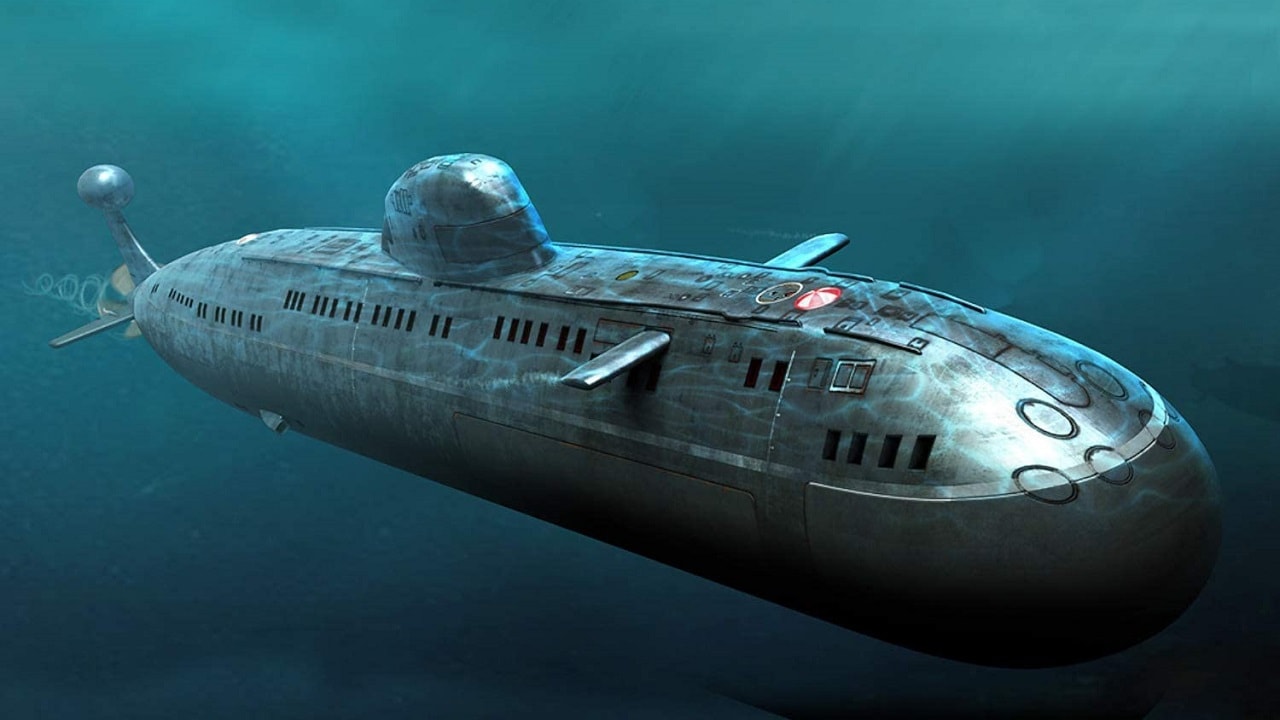
The 80,000-Ton USS Kitty Hawk Hit a Soviet Nuclear Submarine at 15 Knots in 1984 – At 10:07 p.m. on March 21, 1984, USS Kitty Hawk was steaming south through the Sea of Japan at about 15 knots when the 80,000-ton aircraft carrier collided with Soviet nuclear attack submarine K-314.
The impact sent a hard shudder through the American ship. Captain David N. Rogers and a starboard lookout saw the silhouette of a submarine’s sail slipping away in the darkness without running lights. No one aboard either vessel was reported injured.
This was not a deliberate Soviet ramming attack; no one wanted to start what could have been World War III. K-314, a roughly 5,200-ton Victor I-class boat, had spent days shadowing the American carrier group, lost its underwater picture, and surfaced into Kitty Hawk’s path. The carrier then struck the much smaller boat, damaging both warships and leaving the submarine without effective propulsion.
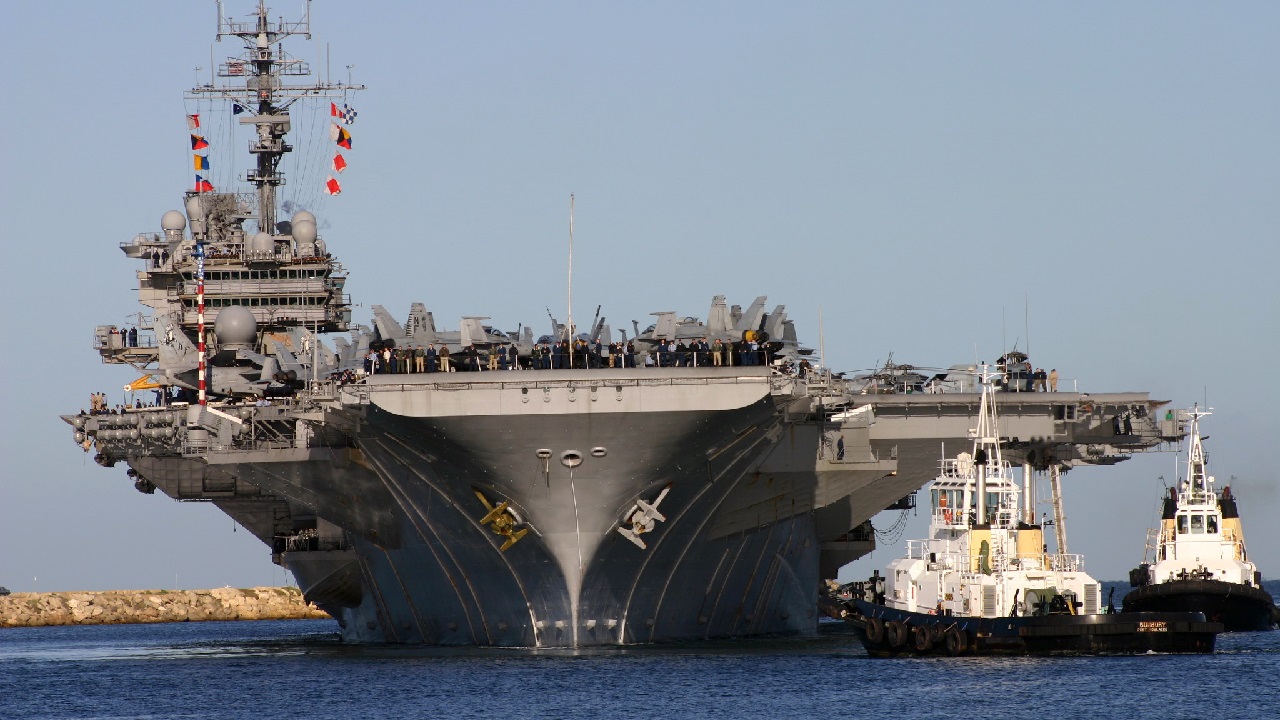
Fremantle Harbour, Australia (Apr. 22, 2004) – Tug boats escort USS Kitty Hawk (CV 63) and embarked Carrier Air Wing Five (CVW-5) into Fremantle Harbour, Australia where the crew will enjoy a five day port call. This was Kitty Hawk’s fifth visit to Fremantle and the ninth for CVW-5. Kitty Hawk is one two remaining conventionally powered aircraft carriers in the U.S. Navy, and is currently homeported in Yokosuka, Japan.
The Naval History and Heritage Command’s official history places the collision about 150 miles east of Pohang, South Korea, near 37 degrees 3 minutes north and 131 degrees 54 minutes east.
Battle Group Bravo was heading toward the Tsushima Strait during Team Spirit 84-1, a large American-South Korean exercise closely watched by the Soviet Pacific Fleet.
K-314 Was Tracking Team Spirit 84
USS Kitty Hawk had entered service in 1961 and represented the peak of the conventionally powered American supercarrier.
The 1,069-foot ship carried Carrier Air Wing Two and served as the flagship of Battle Group Bravo during its 1984 Western Pacific deployment.

At Sea (Aug. 9, 2004) -USS Kitty Hawk (CV 63) plows through the waters of the Pacific Ocean as it makes its approach to the oiler USNS Yukon (T-AO 202) before commencing a replenishment-at-sea (RAS) evolution. A RAS is the on- and off-loading of fuel and stores while ships are under way. Currently underway in the 7th Fleet area of responsibility (AOR), Kitty Hawk demonstrates power projection and sea control as the world’s only permanently forward-deployed aircraft carrier, operating from Yokosuka, Japan.
U.S. Navy photo by Photographer’s Mate 3rd Class Jason T. Poplin
A screen of cruisers, destroyers, and frigates protected the carrier, supported by anti-submarine aircraft and helicopters. Kitty Hawk itself had no hull-mounted sonar. Its escorts and aircraft had to find, classify, and track submarines moving around the formation.
K-314 was built for the opposite mission. The Project 671V boat, known to NATO as a Victor I-class submarine, was a fast nuclear-powered attack vessel designed to stalk surface forces and enemy submarines.
During Team Spirit, its job was to locate the carrier group, follow it, and report how the American force operated near the Soviet Far East.
Later Soviet accounts state K-314 found Kitty Hawk on March 14 and followed the group for roughly a week. The Americans also knew a Soviet submarine was nearby. According to a Washington Post report published after the collision, escort ships had tracked it before losing sonar contact.
Losing contact did not mean K-314 had left the area. It meant both sides no longer held an exact position on a nuclear attack submarine maneuvering close to an aircraft carrier.
The Soviet Captain Ordered an Emergency Dive
A detailed Soviet account emerged years later from K-314 commander Evseenko.
His recollections, quoted from Nikolay Cherkashin’s book in a 2024 reconstruction of the collision, describe poor weather, broken contact, and an attempt to relocate the American force.
Evseenko brought K-314 toward periscope depth. He then saw the ships of Battle Group Bravo only a few kilometers away on a converging course. He ordered an emergency dive, but the submarine had too little time and too little distance.
K-314 felt one heavy blow followed by a second strike against its starboard side. Evseenko first feared the sail had been destroyed and the pressure hull opened. Internal checks found no flooding, but the impact damaged the submarine’s outer hull, starboard stabilizer, and propulsion machinery.
The American bridge saw only the last moments. Rogers later described a “fairly violent shudder.” A contemporary UPI account reported Kitty Hawk was not conducting flight operations and was steering toward the Yellow Sea when the ships met.
The carrier’s size left little room for recovery after the submarine appeared ahead. A ship more than 1,000 feet long does not turn like a destroyer. At 15 knots, Kitty Hawk covered roughly 25 feet every second.
Kitty Hawk Kept Operating After the Collision
Initial reports understated the damage because neither crew had completed a full inspection. The Pentagon first described no apparent serious damage. By the next day, officials acknowledged damage to an aviation-fuel tank below the waterline near the starboard bow. The compartment was taking seawater, but Kitty Hawk retained propulsion and continued normal operations.
Later retellings often claim thousands of tons of jet fuel were poured into the sea. Contemporary Pentagon reporting carried by UPI did not support such a dramatic number. It described damage to the tank, seawater entering it and a carrier able to keep operating.
Kitty Hawk later entered Subic Bay in the Philippines for repairs. Later ship histories report that part of a Soviet propeller blade and pieces of anechoic coating were found lodged against the carrier’s underwater hull. The fragments gave American specialists an unintended look at the materials used to reduce a Soviet attack submarine’s acoustic signature.
The carrier had taken a hit in a vulnerable part of the ship, but no fire followed, and no propulsion space was disabled. The size difference between the two vessels shaped the outcome.
K-314 Lost Propulsion and Needed a Tow
K-314 suffered the more serious operational damage. Its light hull, sail fairing and starboard stabilizer were damaged. The collision also struck propulsion equipment, leaving the submarine dead in the water for a time and later moving at only a few knots on the surface.
A U.S. Naval Institute review of Soviet operations in 1984 described a crease in the submarine’s hull and said it limped toward Vladivostok at a crawl under escort by a Kara-class cruiser.
USS Harold E. Holt remained nearby and offered assistance. The Soviet crew refused. American helicopters flew over K-314 to inspect its condition, while Soviet surface ships moved in to take control of the recovery. A Soviet rescue vessel eventually took the submarine under tow and hauled it to Chazhma Bay near Vladivostok for emergency repairs.
Neither government reported reactor damage or a radiological release. The mechanical damage was serious enough to keep K-314 in repair from March through August 1984. A Russian submarine service chronology records its return to shipyard trials on August 21.
The Collision Exposed a Peacetime Anti-Submarine Gap
Pentagon officials rejected the idea of a wartime breakthrough. Peacetime rules allowed a Soviet vessel to shadow an American formation in ways no carrier commander would accept during combat. The escorts tracked and simulated attacks against K-314, but peacetime rules barred weapons fire or coercive action in international waters.
The distinction was real, though it did not erase the failure.
The carrier group lost sonar contact with a submarine already known to be nearby. Weather, ocean conditions, formation changes, and rules of engagement all shaped the result. None changed the fact that K-314 surfaced inside the carrier group and was close enough for a collision.
USS Kitty Hawk’s wider history explains why the incident still attracts attention.
The carrier served from Vietnam through Iraq and became the last active American conventionally powered supercarrier.
The same carrier figured in another undersea warning in 2006, when a Chinese Song-class submarine surfaced about five miles away.
Modern exercises have kept the warning alive. Submarines have penetrated carrier defenses in simulated engagements, feeding the continuing debate over the threat relatively inexpensive submarines pose to billion-dollar carriers.
Neither Side Turned the Collision Into a Crisis
The collision occurred during one of the colder phases of the Cold War, less than seven months after the Soviet Union shot down Korean Air Lines Flight 007. Neither government treated the accident as an armed attack.
A framework for restraint already existed. The United States and the Soviet Union had signed the Incidents at Sea Agreement in 1972 after years of unsafe maneuvering, simulated attacks, and close passes.
It directed both navies to follow international navigation rules, avoid interfering with formations, and use caution during surveillance.
The annual U.S.-Soviet naval-safety talks still went ahead two months after the collision. A Pentagon spokesman later described the session as “remarkably smooth.”
The incident carried a personal cost.
Later, Russian accounts say Soviet authorities removed Evseenko from submarine command and assigned him to shore duty.
He argued his crew saved K-314 and prevented loss of life, but the Soviet Pacific Fleet treated the collision as a command failure.
K-314 returned to operational service and completed a long Indian Ocean patrol in 1985.
It left active fleet service in 1989 and was eventually dismantled. Kitty Hawk returned to San Diego on August 1, 1984, and remained in commission until May 12, 2009.
MORE – Battleship USS New Jersey Was Out To Sea for Over 300 Days
About the Author: Harry J. Kazianis
Harry J. Kazianis (@Grecianformula) was the former Senior Director of National Security Affairs at the Center for the National Interest (CFTNI), a foreign policy think tank founded by Richard Nixon based in Washington, DC. Harry has over a decade of experience in think tanks and national security publishing. His ideas have been published in the NY Times, The Washington Post, The Wall Street Journal, CNN, and many other outlets worldwide. He has held positions at CSIS, the Heritage Foundation, the University of Nottingham, and several other institutions related to national security research and studies. He is the former Executive Editor of the National Interest and the Diplomat. He holds a Master’s degree focusing on international affairs from Harvard University.