
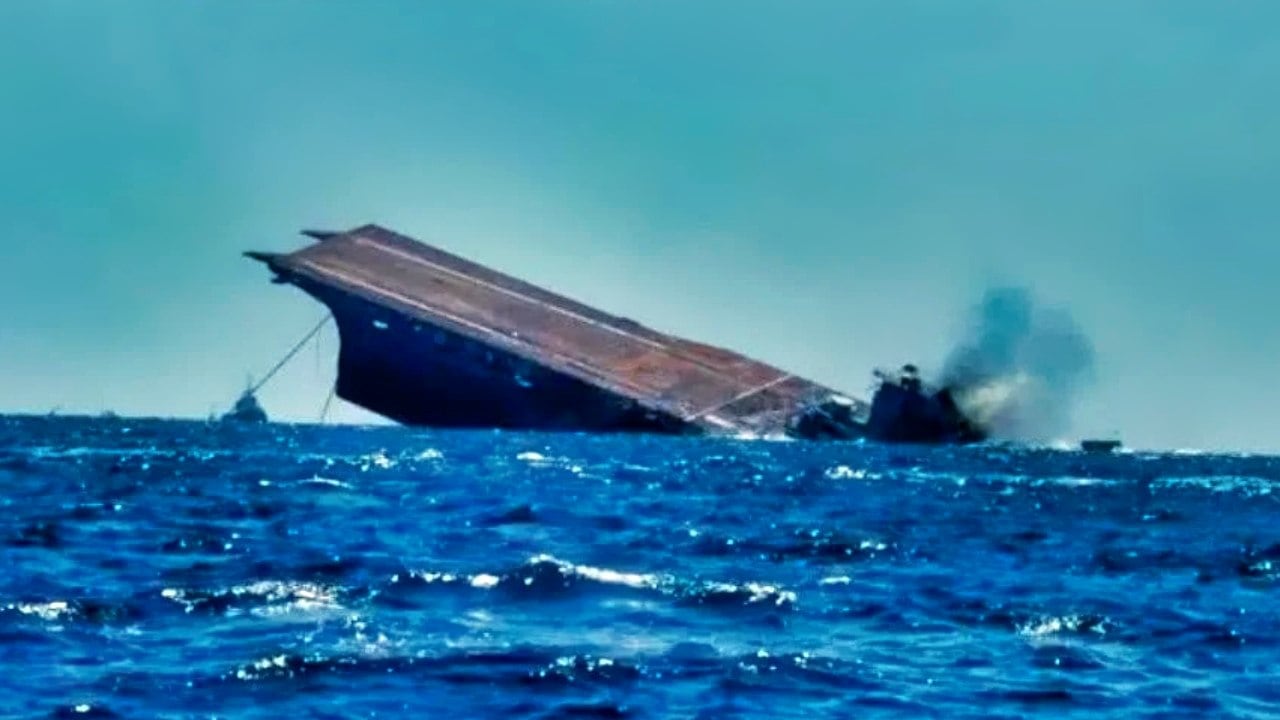
Brazil ended the 63-year life of the aircraft carrier São Paulo with explosives on February 3, 2023. The roughly 32,800-ton ship was sunk in Brazilian jurisdictional waters about 350 kilometers off the country’s northeastern coast, where the Atlantic is approximately 5,000 meters deep. The carrier had spent months under tow after Turkey refused to let it enter for dismantling.
The description of São Paulo as the carrier no port would accept is powerful, though not literal. Turkey withdrew its import consent after the voyage had begun. Once the damaged hull returned across the Atlantic, its Turkish owner failed to produce the liability insurance and signed repair-yard agreement required for entry into Brazilian internal waters. The Brazilian Maritime Authority said it had provided a list of domestic yards capable of performing repairs, but no compliant arrangement was secured.
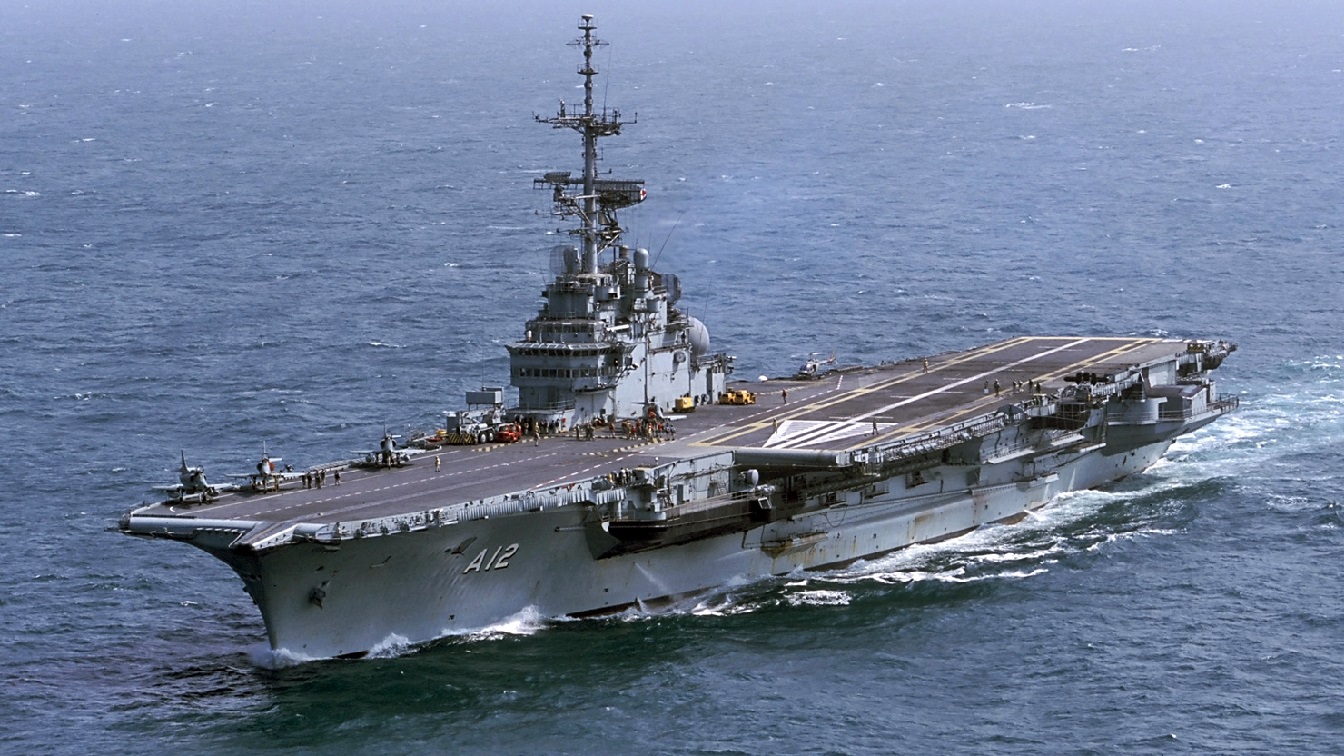
Sao Paulo at sea, seen from a Bell 206 Jet Ranger.
Brazil’s Navy said another inspection found severe deterioration in São Paulo’s buoyancy and stability. An uncontrolled sinking near the coast, inside a port approach, or while the ship was being moved had become an immediate danger.
Brazil’s environmental agency disagreed with the final solution. IBAMA argued that safe recycling at an accredited foreign yard was the only environmentally appropriate disposal route and warned that sinking would release risks already contained inside the hull.
The ship had once been a credible instrument of French military power. Laid down in November 1957, launched in July 1960, and commissioned on July 15, 1963, Foch was the second of France’s two Clemenceau-class carriers.
It measured 265 meters long, displaced nearly 33,000 tons at full load, and reached about 32 knots. Its angled flight deck, arresting gear, and two steam catapults supported an air group of roughly 40 aircraft.
Foch Spent 37 Years as a Front-Line French Aircraft Carrier
France built Foch and Clemenceau to restore independent carrier aviation after relying heavily on British- and American-built ships after World War II.
Their air wings changed with the decades, operating Étendard strike aircraft, F-8 Crusader fighters, Super Étendards, Alizé antisubmarine aircraft, and helicopters. Foch also helped test the Rafale before France’s new nuclear-powered Charles de Gaulle entered service.
The carrier supported France’s nuclear-testing campaign in the Pacific in 1966 and deployed to the Red Sea during the independence of Djibouti.
In 1983, Foch operated off Lebanon during Operation Olifant. Its Super Étendards flew strikes against positions threatening French forces while Crusaders provided fighter cover. The ship was later deployed off Libya during a period of tension with Muammar Gaddafi’s government.
Foch spent much of the 1990s supporting French and multinational operations over the former Yugoslavia. It operated in the Adriatic during missions connected to Bosnia and later participated in NATO’s 1999 air campaign over Yugoslavia. France’s post-Cold War expeditionary record depended heavily on carrier aviation before Charles de Gaulle was ready.
By 2000, Foch was old but still operational. France had a replacement entering service, while Brazil wanted to preserve fixed-wing naval aviation without paying for a newly built carrier. The two governments reached a deal reportedly worth about $12 million. Foch was transferred on November 15, 2000, renamed São Paulo, and commissioned into the Brazilian Navy on the same day.
Brazil Bought a $12 Million Shortcut to Aircraft Carrier Aviation
São Paulo replaced Minas Gerais, a World War II-era British carrier Brazil had operated since 1960. The newer ship was faster, larger, and equipped with catapults capable of launching Brazil’s recently acquired A-4 Skyhawks. The Navy had purchased 23 former Kuwaiti aircraft, designated AF-1 in Brazilian service, to give the fleet its own fixed-wing strike and air-defense force.
The acquisition offered prestige, training, and a foundation for future aircraft carrier aviation. São Paulo conducted exercises with Brazilian and foreign forces, qualified pilots, and supported operations involving Argentine naval aircraft. An early U.S. Navy account of the program presented the ship and its Skyhawks as a major expansion of Brazil’s maritime capabilities.
The $12 million purchase price concealed the cost of operating a steam-powered carrier already approaching 40 years old. Boilers, turbines, catapults, arresting gear, and thousands of auxiliary components required an experienced industrial base and steady funding. Brazil had acquired the ship cheaply because France no longer wanted to carry those costs.
Fires and Repair Bills Consumed São Paulo’s Brazilian Career
On May 17, 2005, a steam-pipe rupture caused an explosion in an engine room. Three sailors died, and the propulsion plant suffered serious damage. São Paulo underwent an extensive overhaul that lasted until 2010. Work covered boilers, turbines, electrical systems, catapults, pumps, tanks, sensors, and flight-deck equipment.
The carrier returned to sea, but not to reliable frontline service. Another major fire occurred in 2012 as the Navy prepared for a further return to operations.
Plans were followed for an ambitious modernization that might have extended the ship’s life into the 2030s, but the required structural, propulsion, and aviation work kept growing. Brazil would have needed to invest heavily in a hull designed during the 1950s while also rebuilding its small Skyhawk force.
In February 2017, the Navy abandoned the modernization plan, citing cost, technical uncertainty, and the lengthy work required.
São Paulo was formally decommissioned in November 2018. The carrier’s Brazilian career had lasted 18 years on paper, but prolonged repair periods kept it unavailable for much of that time. A later review of Brazil’s decision to sink São Paulo reflected how far the ship had fallen from the ambitions surrounding its purchase.
Turkey Withdrew Permission After São Paulo Had Crossed the Atlantic
Brazil sold the hull to Turkish recycling company SÖK Denizcilik in 2021 for R$10.55 million, then worth about $1.9 million. The disposal plan required towing São Paulo to an approved recycling yard at Aliağa, Turkey.
IBAMA authorized the export under the Basel Convention governing the transboundary movement of hazardous waste.
The tow began from Rio de Janeiro on August 4, 2022. Twenty-two days later, while the carrier was approaching the Strait of Gibraltar, Turkey withdrew its consent. The ship’s hazardous-material inventory had become the center of an international dispute.
The approved survey listed roughly 9.6 tons of asbestos-containing material. Environmental organizations argued that comparisons with Foch’s sister ship, Clemenceau, suggested the inspection had missed far larger quantities of asbestos and other dangerous substances.
The disagreement also covered polychlorinated biphenyls, toxic paints, heavy metals, and contaminated insulation found throughout ships of that generation. Campaigners demanded a more detailed inspection before the carrier entered Turkey. With Turkish authorization gone, Brazil suspended the export permit and ordered the hull back under the Basel Convention.
The return created a trap. Brazil had no ship-recycling yard accredited for the required work. Export depended on another country consenting to receive the hull. Yet another ocean crossing required a ship stable enough to survive it, an insurer willing to assume the risk, and a destination prepared to accept the hazardous materials.
São Paulo Returned Without Insurance or a Repair-Yard Contract
Brazilian authorities kept São Paulo more than 22 kilometers offshore near Pernambuco while surveyors examined the hull.
The Navy required the owner to maintain Protection and Indemnity insurance and present a signed contract with a capable yard before the carrier entered sheltered waters for repairs. SÖK did neither. On January 10, 2023, the company informed IBAMA and the Navy of its intention to abandon the vessel.
The government then faced the danger of a 265-meter-long hull sinking out of control, possibly near a harbor or in shallow water, where it could obstruct navigation. A further inspection found worsening stability and buoyancy. The Navy declared the hull lost under Brazilian law and assumed administrative control while maintaining that the private owner still held legal responsibility.
São Paulo was not physically impossible to dismantle. Clemenceau had faced its own international dispute after France tried to send it to India, but the sister ship was eventually accepted and recycled at Hartlepool in Britain. São Paulo’s disposal route failed because no financed, insured and legally approved alternative was secured before its hull deteriorated beyond safe movement.
Brazil Chose a Controlled Sinking Over a Port-Side Disaster
The Navy moved São Paulo to a site inside Brazil’s exclusive economic zone, outside protected environmental areas and clear of documented submarine cables and planned offshore construction. The water was more than 3,000 meters deep throughout the selected area and approximately 5,000 meters deep at the sinking point. Officials argued that distance and depth reduced the danger to fisheries, coastal ecosystems, shipping lanes, and port infrastructure.
Environmental authorities and campaigners saw the same decision as dumping rather than disposal. IBAMA had identified asbestos in the ship’s insulation and warned that paints and other materials would become dangerous if the hull sank. The Navy’s argument was narrower: once the hull began failing and no safe berth existed, a planned sinking at a selected location was less dangerous than an uncontrolled loss closer to shore.
The contrast with the deliberate sinking of USS Oriskany is stark. The United States spent about three years and $20 million removing fuel, oil, asbestos, batteries, wiring, and other contaminants before turning the carrier into an artificial reef. São Paulo was not cleaned to comparable reef standards and was sent into water far too deep for recreational access.
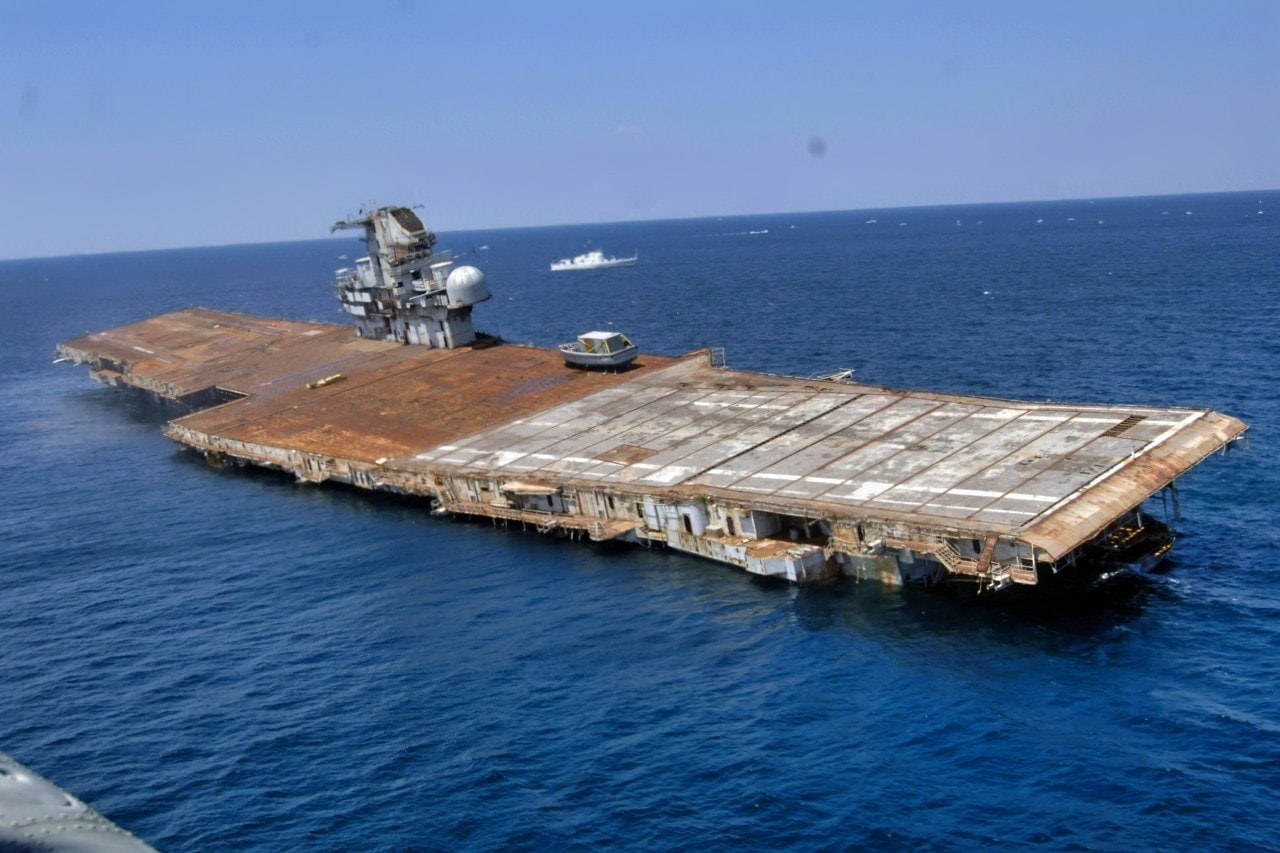
Aircraft Carrier Sinking from U.S. Navy in 2006. USS Oriskany. Creative Commons Photo.
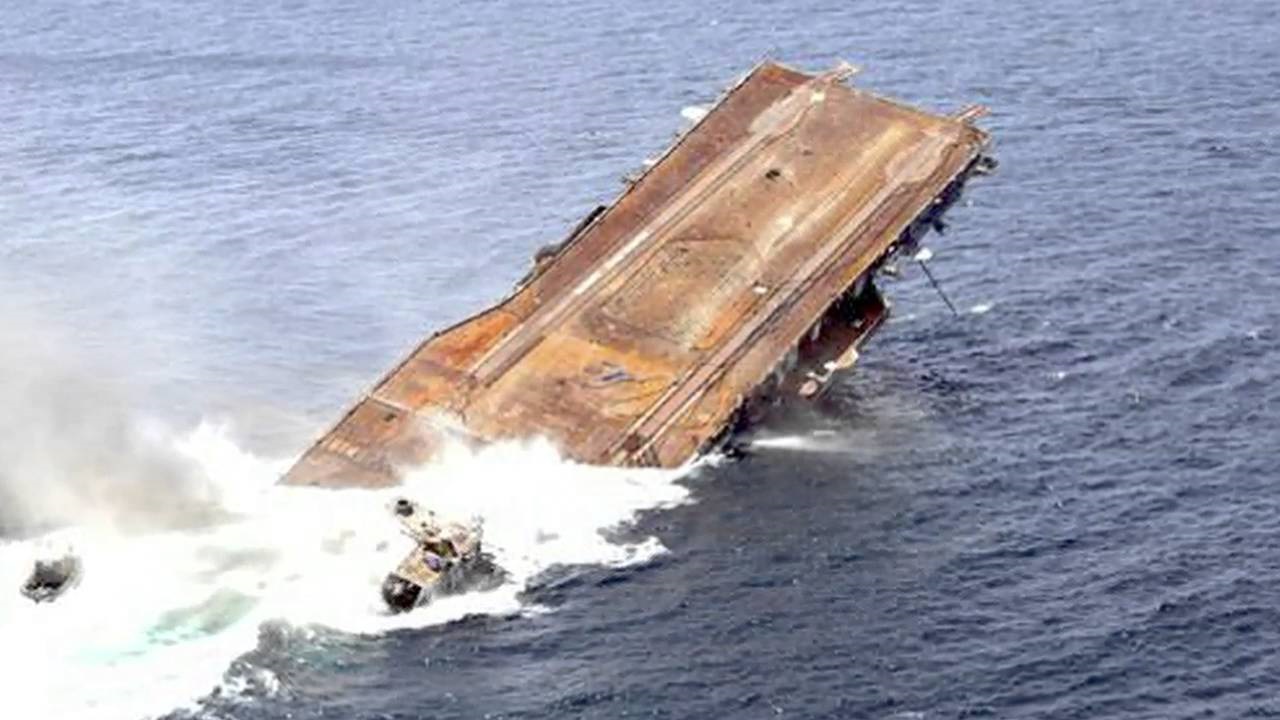
USS Oriskany Sinking in U.S. Navy Controlled Demolition. Image Credit: Creative Commons.
Other conventional American carriers were sold to commercial dismantlers for one cent because the scrap metal held value and the yards assumed the work. São Paulo demonstrated what happens when the estimated recycling value no longer covers towing, insurance, hazardous-material removal, and repairs needed merely to reach the cutting yard.
A later Brazilian access-to-information response placed Navy spending on the final operation at approximately R$37.2 million. Brazil therefore spent more than three times the R$10.55 million sale price dealing with the hull after the disposal plan collapsed.
On the afternoon of February 3, 2023, Brazilian Navy personnel detonated charges to open São Paulo’s hull. The former Foch sank about 350 kilometers off Pernambuco. Its 265-meter flight deck came to rest approximately 5,000 meters below the Atlantic surface.
MORE – A Navy Aircraft Carrier Hit a Russian Submarine
About the Author: Harry J. Kazianis
Harry J. Kazianis (@Grecianformula) was the former Senior Director of National Security Affairs at the Center for the National Interest (CFTNI), a foreign policy think tank founded by Richard Nixon based in Washington, DC. Harry has over a decade of experience in think tanks and national security publishing. His ideas have been published in the NY Times, The Washington Post, The Wall Street Journal, CNN, and many other outlets worldwide. He has held positions at CSIS, the Heritage Foundation, the University of Nottingham, and several other institutions related to national security research and studies. He is the former Executive Editor of the National Interest and the Diplomat. He holds a Master’s degree focusing on international affairs from Harvard University.

