
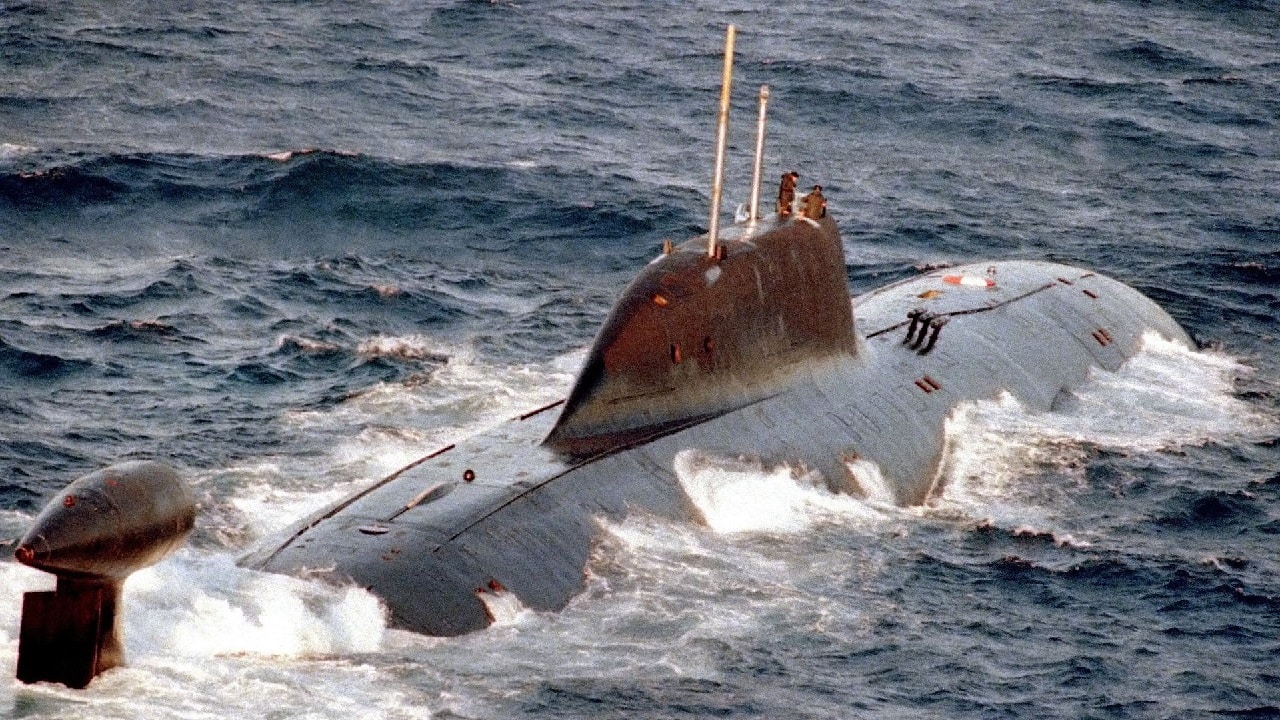
The Akula-Class Submarines Closed the Quieting Gap. The Soviet Collapse Left Russia Unable to Keep the Class at Sea – NATO calls them Akulas. The Soviet designation is Project 971 Shchuka-B — pike, not shark. The naming mix-up with Project 941, the Typhoon ballistic-missile submarine that Russians also named Akula, has followed the class for forty years. The boat itself is simpler to describe. It was the late-Cold War steel attack submarine, built to hunt U.S. Los Angeles-class boats at a price Moscow could actually afford to produce.
The first hull, K-284, was laid down at Komsomolsk-on-Amur in November 1983 and commissioned on December 30, 1984. Design work began in the mid-1970s because the titanium Project 945 Sierra was too expensive and too slow to build in large numbers. Project 971 used low-magnetic steel, a double hull, and a single OK-650-class reactor. Russian references list a submerged speed of about 33 knots, four 650-millimeter tubes, four 533-millimeter tubes, and a crew of roughly seventy. Later boats added external 533-millimeter tubes and, on the stretched Akula II, extra length for quieting gear.
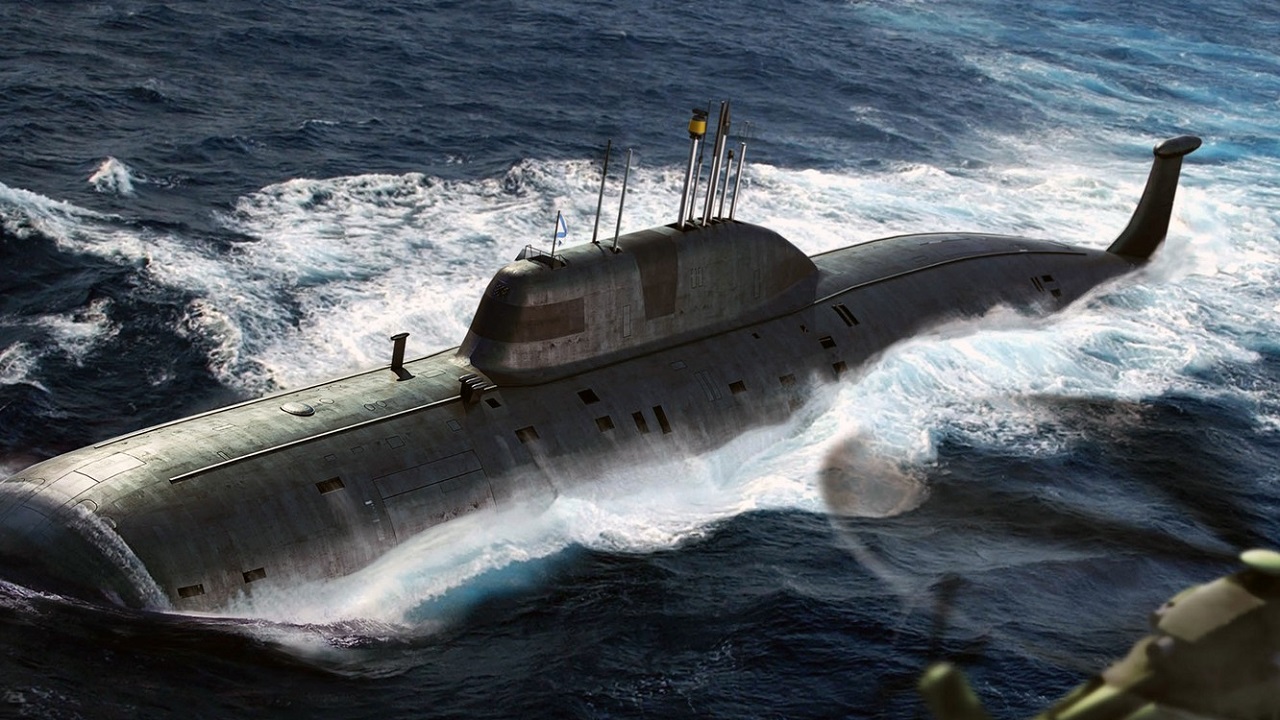
Akula-Class Submarine. Image Credit: Computer-Generated Image, Screenshot.
About twenty hulls were planned. Fifteen were completed. Several unfinished boats were broken up or cut apart so their sections could feed the Borei ballistic-missile program. As of mid-August 2026, a specialist order-of-battle in The Naval Review still counted nine Project 971 hulls in the Russian Navy’s combat cohort — seven in the Northern Fleet and two in the Pacific — and judged only a few of them deployable.
The Akula’s real achievement was acoustic. Its real failure was industrial.
The Soviet Union closed enough of the quantitative gap to scare the U.S. Navy in the late 1980s. Then the state that paid for the class disappeared, and Russia inherited a set of expensive hunters it had spent three decades struggling to keep in the water.
The Design Was a Steel Sierra, Built to Be Produced
Sierra’s titanium hull gave depth and quiet in theory, but a crazy price for sure. It also demanded a specialized industrial base that the Soviet Union could not scale. Project 971 was the production solution: a double-hulled steel boat divided into eight compartments, with enough reserve buoyancy to survive damage that would sink a tighter Western single-hull design. Builders split the work. The Lenin Komsomol yard in Komsomolsk-on-Amur (later Amur) produced Pacific boats. Sevmash at Severodvinsk built the Northern Fleet run.
The weapons fit was a late-Soviet mix. The large 650-millimeter tubes could fire heavyweight torpedoes and the Vodopad/Tsakra family of rocket-assisted weapons. The 533-millimeter tubes handled standard torpedoes and the RK-55 Granat land-attack cruise missile, later succeeded in Russian service by Kalibr variants. There is no U.S.-style vertical-launch battery on the early boats. The magazine is the torpedo room. That is why Western patrol reports treat an Akula in the open ocean as both a submarine hunter and a strike platform.
The class was not a one-design freeze, for sure. NATO’s labels — Akula I, Improved Akula, Akula II, Akula III — track successive quieting and combat-system inserts more than clean new classes. K-157 Vepr, commissioned in 1995, is the usual Akula II: a few meters longer, several hundred tons heavier, with more isolation around the plant. K-335 Gepard, commissioned in December 2001 after a ten-year build, is the lone boat NATO-tagged Akula III. K-152 Nerpa was finished to an export-leaning 971I standard for India.
Toshiba, Walker, and the 1989 Intelligence Shock
For most of the Cold War, U.S. attack submarines were expected to hear a Soviet boat first. Project 971 is the class that broke that assumption. Two transfers of Western knowledge sit in every serious account. In the early 1980s, Toshiba Machine and Norway’s Kongsberg sold numerically controlled propeller-milling machines that the Coordinating Committee for Multilateral Export Controls had tried to keep out of Soviet yards. King’s College London’s reconstruction of the case describes nine-axis machines installed at a Leningrad propeller plant, capable of cutting large, smooth screws that produce less broadband noise. The John Walker spy ring, running at the same time, had already told Moscow how U.S. sonar actually found Soviet boats.
In 1989, the U.S. Director of Naval Intelligence told Congress the Akula had reached quieting levels the United States had not projected the Soviets to achieve. A 1998 U.S. Naval Institute Proceedings essay used that testimony to argue that American planning had been too comfortable. Later Western assessments usually place the improved Akulas near a basic Los Angeles-class boat at low speed, and still behind an Improved 688 once the American boat begins turning. That is a narrower gap than the one the United States started the 1980s with. It is not a claim that Project 971 beat Seawolf or Virginia.
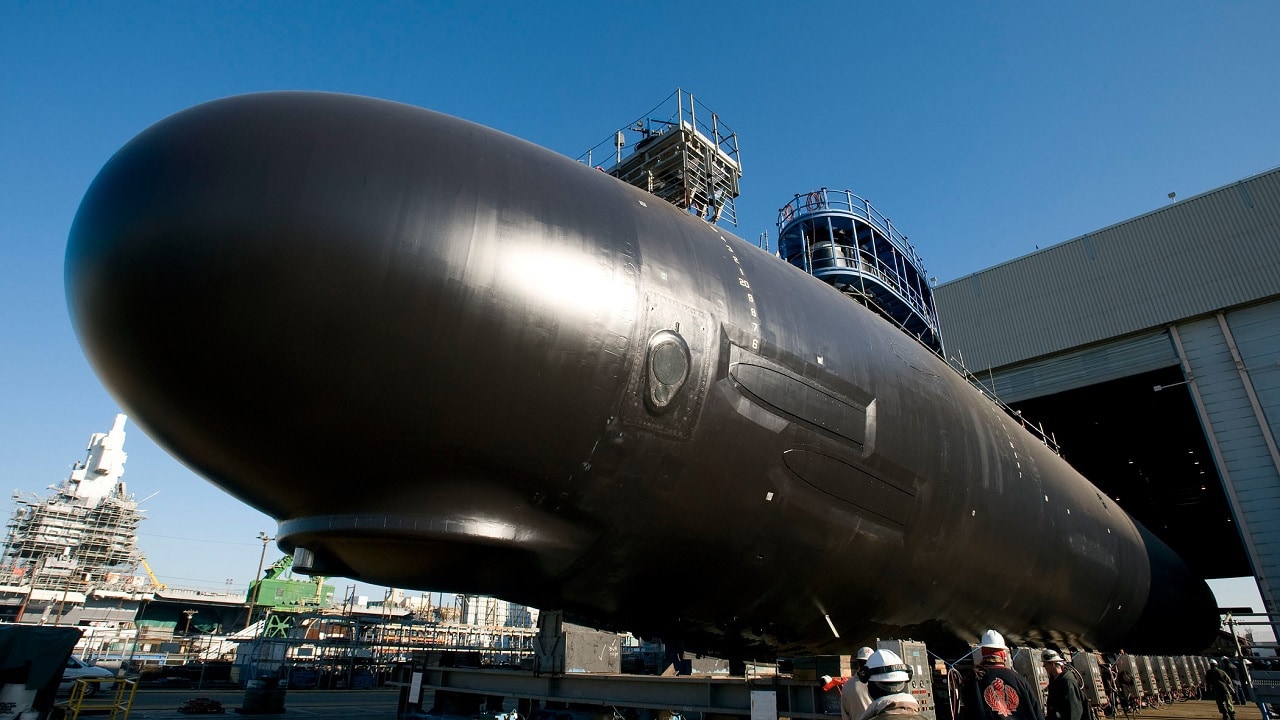
Virginia-Class. Image Credit: Creative Commons.
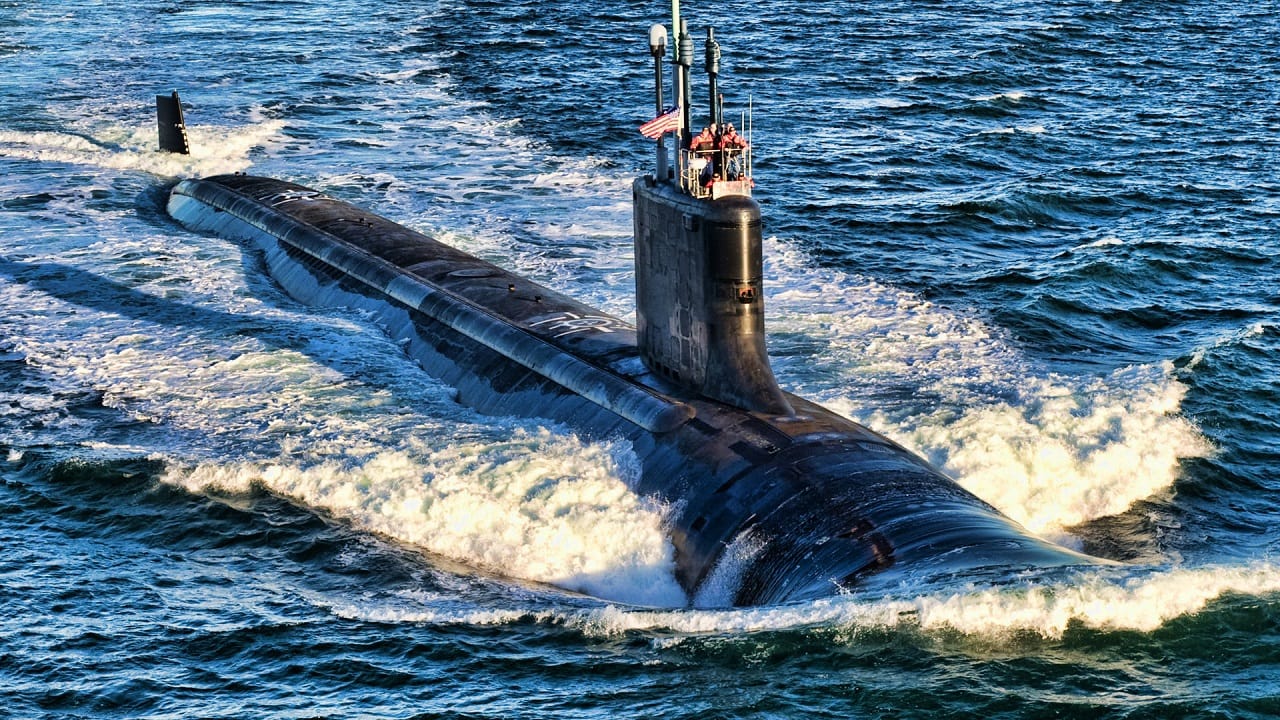
US Navy Attack Submarine. Image Credit: Creative Commons.
The 2012 Gulf of Mexico patrol — a Russian nuclear attack submarine operating for weeks before U.S. forces publicly acknowledged it — is the episode that fixed the Akula in American political memory. The boat was assessed as an Akula. The embarrassment was detection, not a missile shot. The class had been built for exactly that kind of quiet transit.
The Soviet Collapse Stopped the Class Mid-Hull
The production run did not survive the state that ordered it. Early Pacific boats commissioned on a Soviet drumbeat: K-284 in 1984, then a string of Amur hulls through 1992. After 1991, the calendar broke. Gepard was laid down in 1991 and not commissioned until 2001. Nerpa was laid down in 1993, launched in 2006, and accepted only at the end of 2009. Unfinished Sevmash hulls named Kuguar and Rys never went to sea. Their sections were used to start Borei-class ballistic-missile submarines. Amur left incomplete hulls on the ways.
That is the industrial lesson in one paragraph. A quiet breakthrough is a shipyard problem as much as a physics problem. When the orders stopped, the skilled welders, the propeller shop, and the combat-system vendors stopped with them. Russia kept the finished boats. It lost the ability to replace them at Soviet tempo. Two of the canceled hulls were used as parts for a different class. That is not modernization. It is cannibalization.
Money shortages also led to accidents and losses. On November 8, 2008, during Nerpa’s sea trials in the Sea of Japan, the chemical fire-suppression system dumped freon into the forward compartments. Reuters and later official accounts put the dead at twenty, most of them shipyard civilians on the acceptance team. The boat was repaired, commissioned, and leased to India. The Yasen-class that is supposed to replace the Akulas is the same story written forward: a high-end design, a thin industrial base, and a delivery rate that never matches the brochure.
India Paid Rent on a Capability Russia Could Not Use at Scale
New Delhi has treated the Akula as a training and bridge capability while it builds its own nuclear boats. K-152 served as INS Chakra from 2012 until it returned to Russia in 2021. Contemporary reporting put that ten-year lease near $650 million. In 2019, India signed a follow-on deal, widely reported to be worth about $3 billion, for another refurbished Akula to become INS Chakra III. Delivery was first described as 2025. By late 2025, Indian and trade-press accounts had slipped it to 2028. In January 2026, Indian defense reporting said New Delhi might drop the second lease and instead put the money into indigenous SSNs.
The lease was never a Russian force-structure solution. It was cash, a diplomatic tie, and a way to finish or refurbish a hull that the Russian Navy did not have the crew and yard time to run.
Bratsk was at one point discussed as an Indian boat and then left in a long, incomplete modernization at Zvezdochka. That pattern — announce a deep refit, miss the date, keep the hull on the books — is the Akula story after 1991.
August 2026: Nine Hulls, Few That Can Deploy
The Naval Review’s mid-August 2026 survey is the most careful public hull-by-hull snapshot available. It listed K-317 Pantera, K-461 Volk, K-328 Leopard, K-154 Tigr, K-157 Vepr, and K-335 Gepard in the Northern Fleet’s 24th Division at Gadzhiyevo, and K-419 Kuzbass and K-295 Samara with the Pacific Fleet. Older boats such as K-284, K-263, and K-322 are already out of service. The review judged Kuzbass, Vepr, and Gepard the most clearly deployable. Leopard had begun post-modernization sea trials in June 2026 and was not yet counted as operational. Volk, Tigr, and Samara were still in long repairs. On that accounting, Russia has a class, not a squadron.
That is the status that matters more than a brochure displacement figure. An Akula that is quiet in 1995 and then goes silent in 2026 is a maintenance problem. The Northern Fleet still uses the type for high-end work. The Pacific Fleet still puts Kuzbass to sea. Yasen-M boats are arriving slowly as the intended successor. Until those new hulls exist in numbers, Moscow keeps painting Project 971 numbers on boats that spend years at Zvezdochka and Sevmash.
Akula-Class Lessons Learned
The lessons stack in order following order: First, a steel production submarine can close an acoustic gap if the state is willing to steal, buy, and spend. Second, quieting without a working supplier base decays; anechoic coatings and rafted machinery do not maintain themselves. Third, a class designed for twenty boats and finished at fifteen, then left to rot through the 1990s, will not be a 66-boat problem for NATO in 2026. It will be a handful of dangerous hulls and a much larger list of names in refit. Fourth, leasing a boat to India does not replace a shipyard.
K-328 Leopard was still on trials in August 2026. The class that once forced a rewrite of U.S. quiet assumptions is now waiting, hull by hull, for yard time the Russian submarine force does not have to spare.
About the Author: Harry J. Kazianis
Harry J. Kazianis (@Grecianformula) was the former Senior Director of National Security Affairs at the Center for the National Interest (CFTNI), a foreign policy think tank founded by Richard Nixon based in Washington, DC. Harry has over a decade of experience in think tanks and national security publishing. His ideas have been published in the NY Times, The Washington Post, The Wall Street Journal, CNN, and many other outlets worldwide. He has held positions at CSIS, the Heritage Foundation, the University of Nottingham, and several other institutions related to national security research and studies. He is the former Executive Editor of the National Interest and the Diplomat. He holds a Master’s degree focusing on international affairs from Harvard University.

