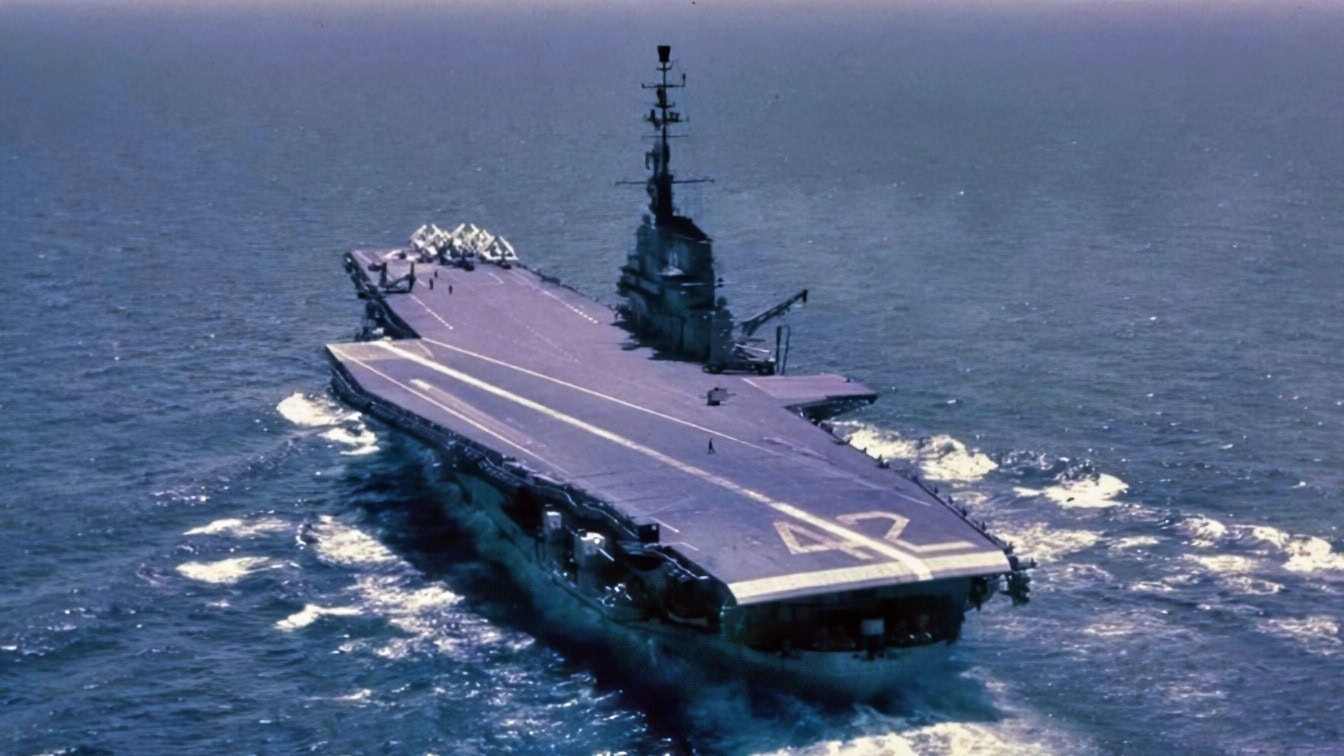
Summary and Key Points: USS Franklin D. Roosevelt was laid down in 1943 as USS Coral Sea and renamed 17 days after the president’s death, becoming the first American aircraft carrier named for a president. Across 32 years, she carried propeller aircraft, hosted the first planned US jet carrier landings, and finished her career flying Marine Corps Harriers — then went to the scrapyard in 1977 while both her sister ships served into the 1990s.
How USS Coral Sea Was Born
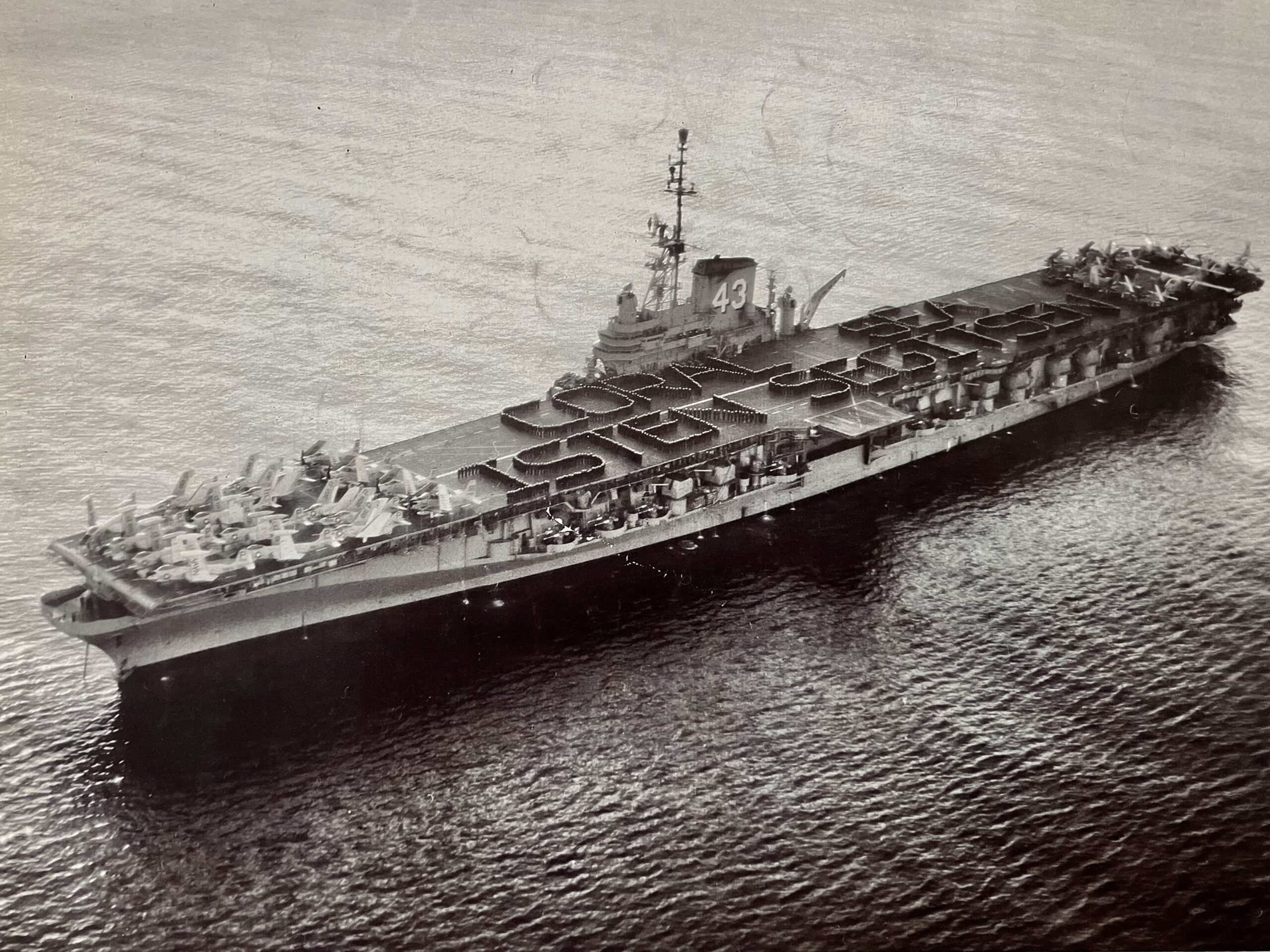
USS Coral Sea Creative Commons Photo.
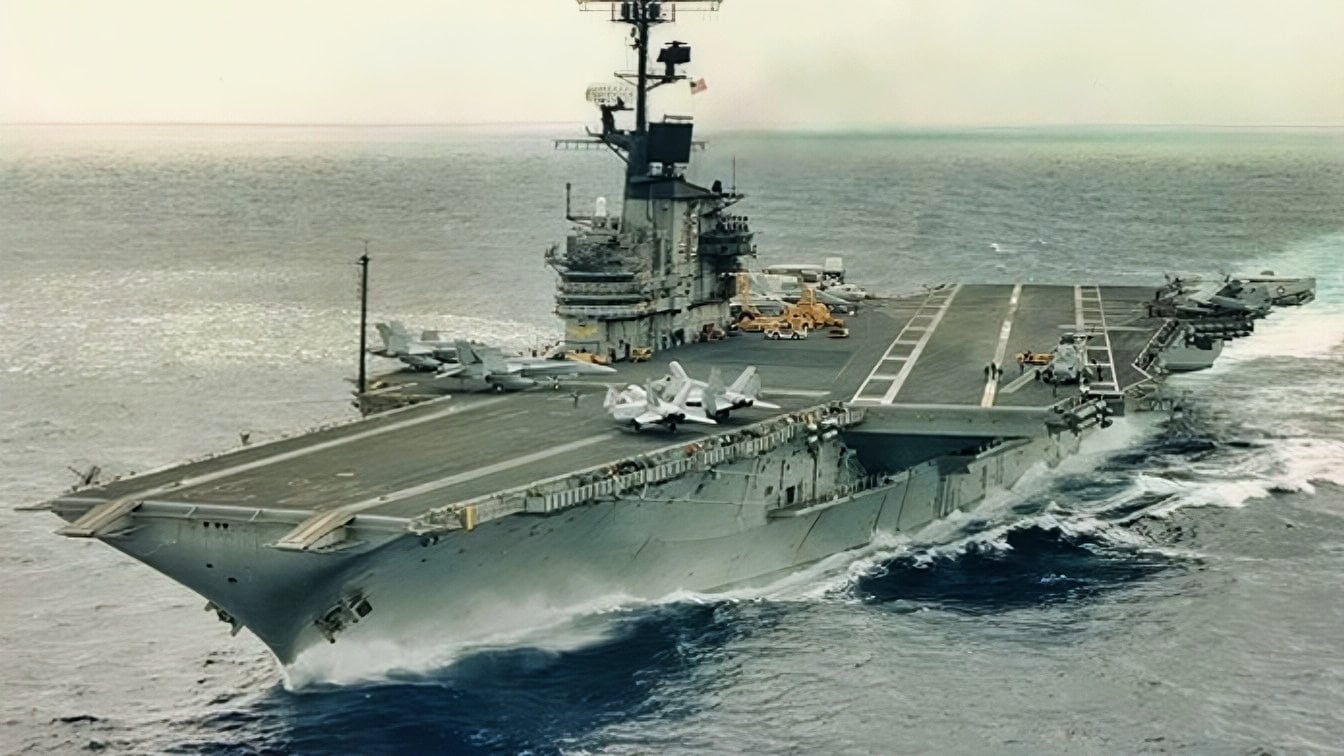
US Navy Aircraft Carrier USS Coral Sea Back in 1989 Creative Commons Image
The Second World War was one of the most gruesome conflicts in human history.
But some amazing technologies, warplanes, and warships helped the United States win that grand campaign.
One of the platforms that defined the United States Navy’s experience during this war was the aircraft carrier (which still forms the backbone of the US Navy today).
One carrier that stood out during that era was the USS Franklin D. Roosevelt.
Known to the sailors who served aboard her as either “Rosie,” “Swanky Franky,” or “Foo-De-Roo,” the great ship was the second of three Midway-class aircraft carriers constructed by the Navy.
In fact, the USS Franklin D. Roosevelt was laid down at the New York Naval Shipyard in Brooklyn back on December 1, 1943, at the height of America’s involvement in World War II.
She was originally named the USS Coral Sea, but because the carrier launched just 17 days after President Franklin D. Roosevelt had died, the Navy renamed the ship in his honor.
A US Navy Aircraft Carrier Made In 1943 Sailed Into the Cold War
Indeed, this was the first carrier named after an American president.
That set a precedent that continues today.
The newest US Navy carrier class is named after President Gerald R. Ford, and one of the carriers in that new class is named after President John F. Kennedy.
The FDR was commissioned on October 27, 1945.
By contemporary standards, the FDR was a massive carrier. She displaced around 45,000 tons (standard), measured 968 feet long, and could achieve speeds of 33 knots.
The FDR carried a crew of 4,000 sailors, while the design accommodated as many as 130 aircraft. One of the most important features of this carrier was its armored flight deck.
During the war, US naval designers watched as American ships were chewed up in the Pacific War by Japanese kamikaze attacks and aerial bombardment.
Lack of armor for the flight deck meant that a carrier could either be totally disabled or even sunk if enemy bombs or fully loaded planes hit the unprotected flight deck.
The British Royal Navy had long employed carriers with armored flight decks. The US Navy avoided armored flight decks because the added weight usually reduced a carrier’s aircraft capacity.
So, Uncle Sam decided to build a larger carrier.
The Midway-class flight deck was protected by 3.5 inches of armor while retaining the ability to operate a large air group. That combination made the ships massive for their era and marked a serious departure from the previous US Navy Essex-class carrier.
Despite the armored flight deck and larger size, the Midway-class ships sat lower in the water, were crowded onboard, and could be inundated by seawater in really rough seas.
Although the US Navy intended these carriers to carry 130 planes, that proved impractical while underway.
Ready for the Jet Age
The Roosevelt was also the canary in the proverbial coal mine when it came to the Navy’s embrace of jet aircraft. Specifically, the McDonnell XFD-1 Phantom in 1946.
At that time, the FDR became the site of the first planned carrier takeoffs and landings by US jet-powered aircraft.
But that incredible achievement presaged a major complication for the iconic carrier: adapting a WWII-era ship to handle larger, faster, and heavier Cold War jet planes proved difficult.
In 1954, the ship was decommissioned for an “SCB-110 modernization” at the Puget Sound Naval Shipyard.
During that modernization, workers installed an angled flight deck on the great ship.
They added steam catapults to launch the new jet planes, installed enhanced radar systems onboard, built an enclosed “hurricane bow” for the carrier, strengthened flight elevators to handle larger jet planes, and added a mirror landing system to make onboard landings safer.
Two years after beginning her modernization, the FDR returned to sea with an entirely new set of capabilities.
Most of her lifespan was spent with the Navy’s Sixth Fleet in the Mediterranean. She served during the Suez Canal Crisis in 1956.
Her major combat deployment, though, occurred during the Vietnam War.
Roosevelt deployed with Carrier Air Wing One in 1966 and operated in Southeast Asia for a year. After that deployment, the FDR returned to the Sixth Fleet in the Mediterranean.
In the 1960s, the FDR was scheduled for another modernization, similar to that of her sister ship, the USS Midway.
But rising costs significantly scaled back that modernization effort. Some of the changes involved moving the ship’s centerline elevator to the starboard deck edge.
Other modifications were made to better accommodate the Navy’s A-6 Intruder and A-7 Corsair II warplanes.
A Fateful Decision
Sadly, that scaling back during her planned 1968 modernization cut her life short. The Navy’s warplanes kept getting bigger and heavier.
Operational tempo kept increasing, placing greater strain on the carriers themselves. Once the F-14 Tomcat and S-3 Vikings came online, the limits of the FDR’s 1968 modernization were apparent. The Navy could not continue utilizing the carrier. Plans were implemented to retire her.
Still, the “Swanky Franky” got one last major notch under its belt.
From October 1976 to April 1977, the FDR embarked 14 Marine Corps AV-8A Harriers from VMA-231. That deployment marked the first overseas carrier deployment of the Marine Corps’ vertical/short takeoff and landing Harrier.
The Long Goodbye
On September 30, 1977, the USS Franklin D. Roosevelt was decommissioned. Multiple attempts were made to preserve the great ship as a museum.
But those efforts failed. She was sold for scrap.
The other Midway-class carriers, though, served much longer.
The USS Coral Sea remained operational until 1990, while the Midway flew in Desert Storm before retiring in 1992 (it is now a museum ship in San Diego, California).
The old “Rosie” was important, despite its relatively short lifespan for the US Navy.
It was a critical transition ship from the battles of the Pacific Theater of WWII to the jet age of the Cold War.
She served for more than 30 years and, during that time, went from launching propeller-driven WWII-era aircraft to Harrier jump jets.
Not too shabby for a carrier that was designed in 1943.
About the Author: Brandon J. Weichert
Brandon J. Weichert is the Senior National Security Editor at 19FortyFive.com. He also manages The Weichert Brief on Substack. Weichert also hosts “National Security Talk” on Rumble. He is the author of four bestselling national security books, the most recent of which is A Disaster of Our Own Making: How the West Lost Ukraine (Encounter Books). Follow him via Twitter/X @WeTheBrandon.