
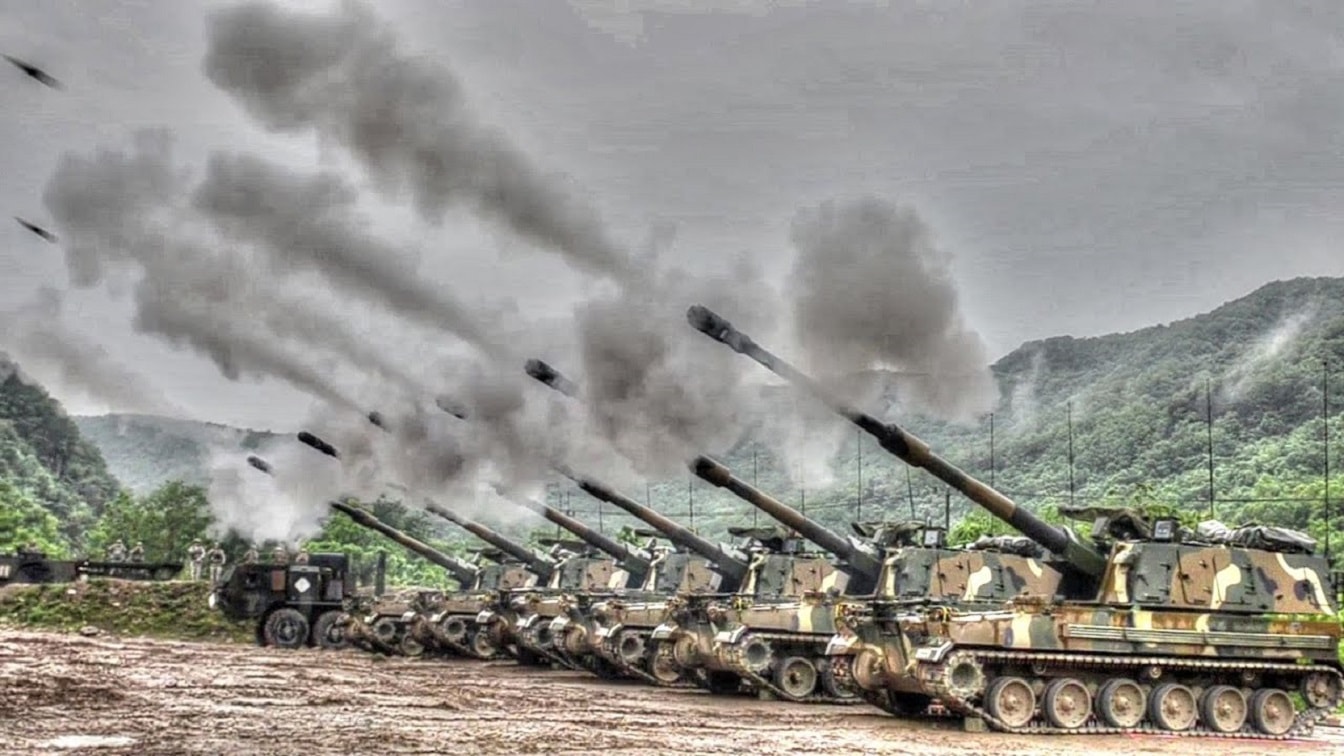
While Trump Feuds with South Korea, U.S. Army Plans to Try Out Seoul’s Long-Barrel K9MH Howitzer Truck – This Tuesday, the Army announced it had finally concluded its search for a longer-range self-propelled howitzer with roughly double the range of its towed M777 and tracked M109 howitzers.
The service’s Mobile Tactical Cannon program chose the Hanwha K9MH, a truck-based spinoff of the popular tracked K9 Thunder artillery system—a product which happens to come from South Korea, the same country the Trump administration announced it was downgrading its security relationship with two days earlier.
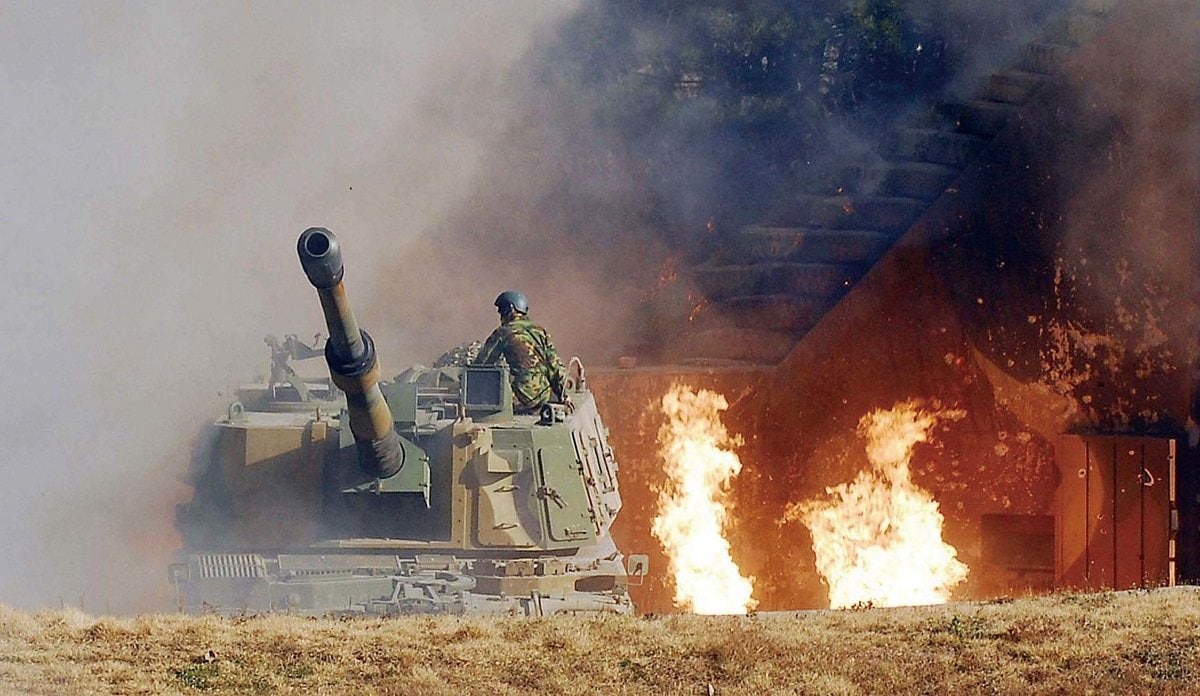
South Korean Marine Corps K9 self-propelled howitzer preparing counterattack right after the initial attack from North Korea in 2010.
Perhaps that’s why the Army announcement tactfully declined to mention such trifling details as the selected platform’s designation and country of origin, even if manufacturer Hanwha (technically, it’s a U.S.-based subsidiary headquartered in Arlington, Virginia) confirmed selection of the K9MH contract in its own press release.
The Army is initially spending $100.3 million in Other Transaction Authority funding to acquire six self-propelled Mobile Tactical Howitzer systems—enough to form one artillery battery for testing and evaluation. However, that contract’s maximum value of $262.9 million leaves open the option to order up to 18 systems to equip a full battalion.
The K9MH essentially plonks the boxy unmanned gun turret of the latest K9A2 tracked vehicle onto an 8×8 truck bed. The lighter resulting platforms retain the K9A2’s sophisticated new fire control system and automated dual-feed loading systems for shells and propellant charges, which enable surge firing rates of 9 rounds per minute.
Its CN98 rifled gun can furthermore achieve a maximum range exceeding 37 miles using rocket-assisted projectiles (RAPs)—double the 18.6-mile maximum range of the M109S firing RAPs. And it requires just three crew to operate, compared to 8 for an M777 and four for an M109A6/A7.
Regardless, Hanwha says the vehicle will be emplaced for ‘shoot-and-scoot’ fires in just 30 seconds. With the crew occupying an armored cab separated from the 40-round magazine in the crewless turret. Furthermore, the vehicle can be reloaded without human intervention in just 18 minutes by mating with a K10 resupply vehicle via an automated conveyor system. (It remains unclear whether ‘systems’ procured in the Army contract come bundled with K10s.)
It’s worth noting that K9MHs displayed by Hanwha use Tatra T815-7 truck chassis, though the company claims the system is “agnostic” to the underlying truck. Thus, the U.S. Army may attempt to mate the system with its prolific Oshkosh HEMTT 8×8 tactical truck to achieve maintenance commonality.
Following initial integration and testing at a Hanwha facility in Opelika, Alabama, the K9MH prototypes will be deployed with operational Army artillery units for soldier-centric testing evaluations. Only once that process concludes will the service decide whether to pursue large-scale procurement of a production model—with tweaks based on user feedback.
Or not—the last artillery system to reach such an evaluation stage, the U.S.-designed M1299, was canceled following unit-level evaluations of a prototype batch.
If the Army opts for mass fielding—possibly up to 500 systems—Hanwha would begin establishing U.S. production facilities. Delivered K9 would first begin replacing towed M777 howitzers in U.S. Stryker motorized brigades, and then, eventually, in light infantry brigades (Mobile Brigade Combat Teams, or MBCTs).
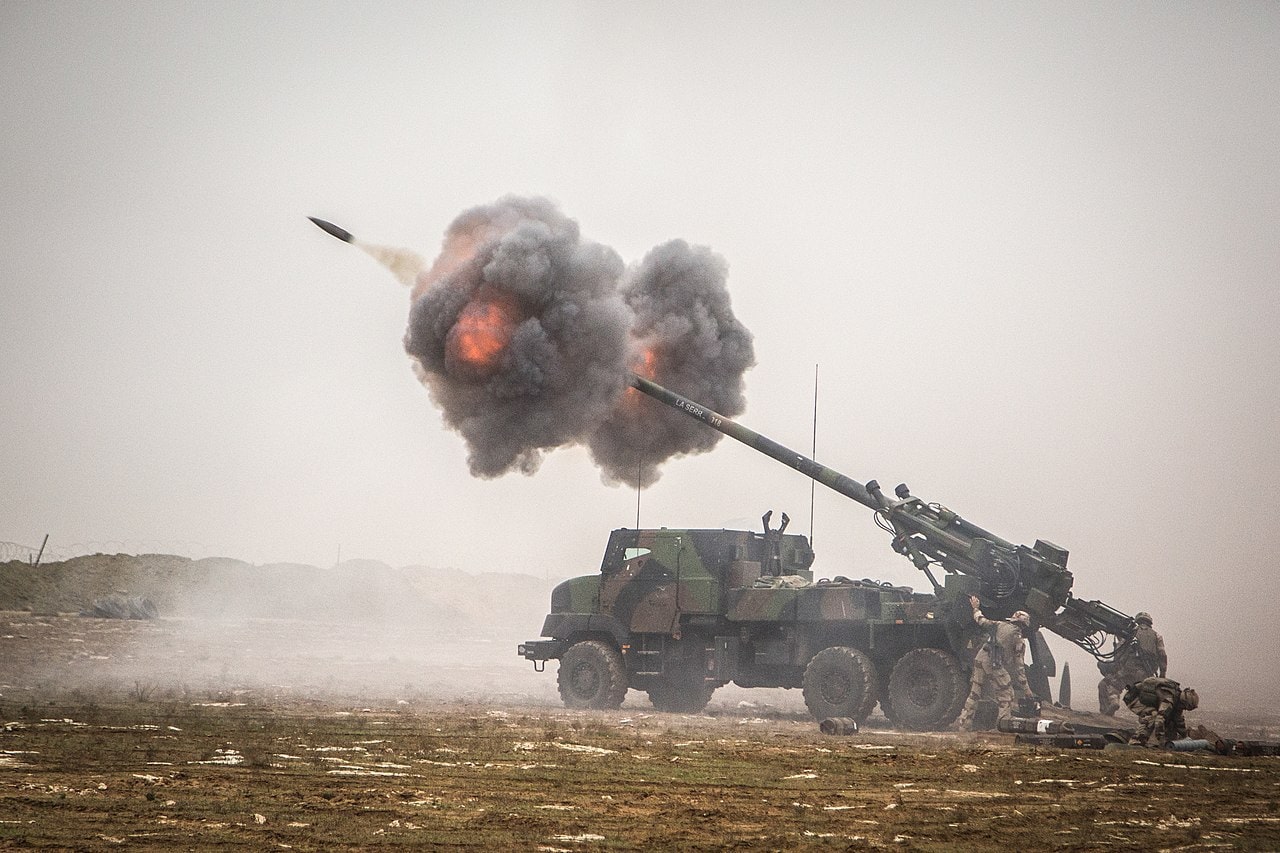
A French Caesar self-propelled howitzer fires into the Middle Euphrates River Valley in Southwest Asia, Dec. 2, 2018. As part of the Combined Joint Task Force – Operation Inherent Resolve, they are supporting the Syrian Democratic Forces as they clear the last remaining pockets of ISIS from the Middle Euphrates River Valley and pre-vent them from fleeing into Iraq. In conjunction with partner forces, Combined Joint Task Force – Operation Inherent Resolve defeats ISIS in designated areas of Iraq and Syria and sets conditions for follow-on operations to increase regional stability. (U.S. Army photo by Sgt. 1st Class Mikki L. Sprenkle)
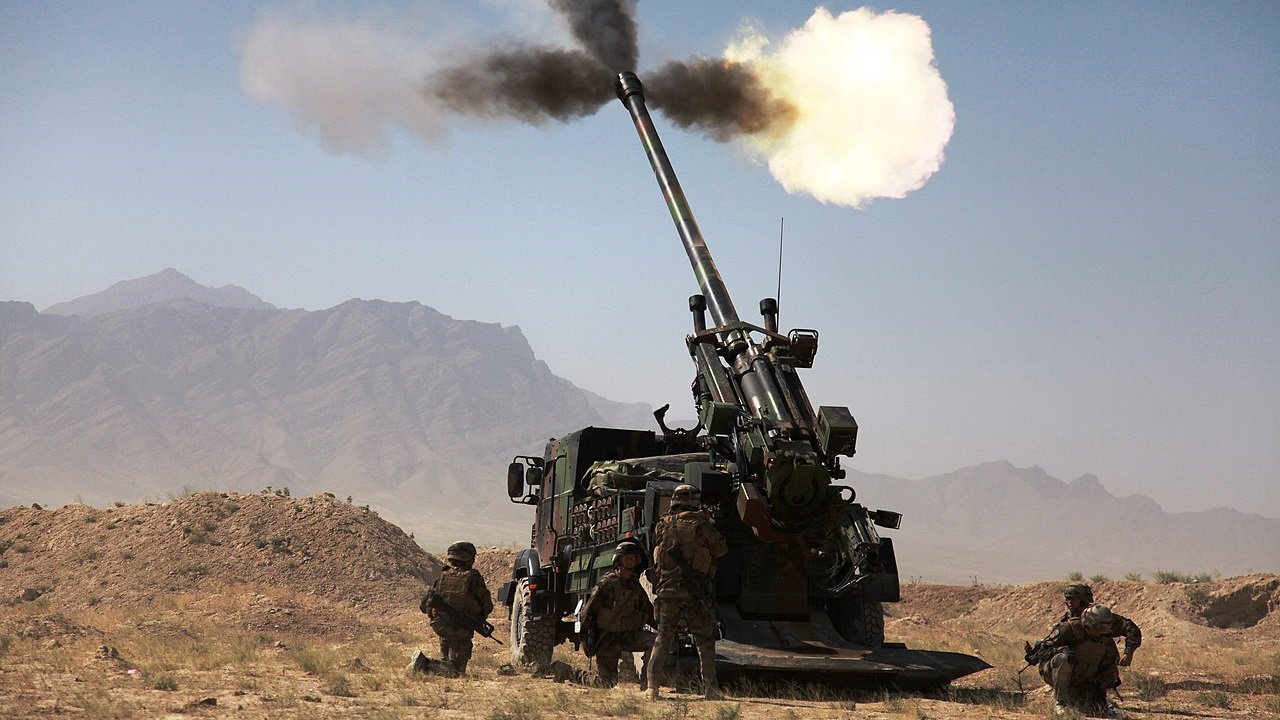
French soldiers conduct a live-fire exercise, with their Nexter Systems Caesar self-propelled wheeled armored vehicles, outside of Bagram Airfield, Afghanistan, Aug. 14, 2009. (U.S. Army photo by Sgt. Teddy Wade/Released)
The Army’s plan to eventually replace tracked M109A7 Paladins in armored and mechanized brigades awaits a separate decision by the service’s broader Self-Propelled Howitzer Modernization (SPH-M) program. Of course, should the Army embrace the K9MH in light infantry units, that might make it more appealing to adopt tracked or wheeled K9S in armored and mechanized units too.
It’s also worth noting that the U.S. Army and Hanwha began cooperating last December to develop a longer 58-caliber gun for K9, which might enable fires with ranges exceeding 43 miles. That means K9MHs could eventually upgrade to a longer gun of the kind the U.S. was unable to make work on the canceled M1299.
A new, untested spinoff of the tried-and-true K9 Thunder
The MTC program marks a break from the Army’s nearly 80-year preference for tracked artillery vehicles. The program is known to have evaluated K9s 2025 alongside competitors including the Swedish Archer offered by BAE Systems and Bofors, the German Rheinmetall RCH-155 on both Piranha 10×10 and Boxer 8×8 wheeled chassis, the 10×10 wheeled Israeli SIGMA 155 Ro’em (offered in partnership with U.S.-based Anduril), and a variant of the French CAESAR howitzer offered by Leonardo and KNDS.
Developed by South Korea’s ADD defense agency in cooperation with Samsung, Kia and other companies, the K9 has roughly a quarter-century of service under its belt and a substantial global footprint. The over 2,500 K9S built since 1999 serve multiple NATO countries on the ‘frontline’ near Russia (Estonia, Finland, Norway, Poland, Romania, Turkey), as well as U.S. allies including Australia, Egypt, India, and South Korea itself. Spain and Vietnam are currently next in line to stand up their own K9 fleets.
The K9’s user base reflects an attractive capability-for-cost proposition averaging $3 to 4.5 million per unit for a self-propelled vehicle featuring substantial automation, including Multiple Round Simultaneous Impact (MRSI) capability to quickly discharge several shells arced to land at the same time for maximal lethality (the initial rounds of artillery strikes are deadlier than subsequent ones because enemy personnel haven’t had time to take cover)
The K9’s global popularity has also created attractive regional supply chains, making it easier to sustain. Consider that, should U.S. ground forces ever battle Russian or North Korean troops, K9 howitzers could benefit from repair facilities and spare-parts depots conveniently located in Poland and South Korea.
But despite the maturity of the tracked K9 Thunder, the wheeled K9MH has yet to be fielded by any army, so it may still encounter teething and integration issues.
Why the U.S. Army needs longer-range artillery
Following the end of the Cold War, the Pentagon came to see beyond-frontline strikes as largely the province of jet fighters, drones, and attack helicopters; meanwhile, heavy artillery systems like the canceled XM2001 Crusader were spurned as too heavy to quickly deploy overseas.
However, by the 2010s, defense analysts warned of a growing gap in U.S. long-range artillery capabilities compared to systems fielded by China, Russia, and even NATO allies. The U.S.’s popular M109 Paladin family of 155-millimeter howitzers used medium-length 39-caliber barrels (6.04 meters long), compared to 47 to 52-caliber longer barrels on other Russian and European systems (around 8 meters).
Longer barrels allow for greater pressure, making it possible to lob shells to greater maximum ranges. And howitzers with greater range can assail more high-value enemy targets, while simultaneously remaining outside the range of more enemy counter-battery weapons.
Analysts also warned that airpower might not be readily available to meet the Army’s deep-strike needs in future wars against more formidable enemy air defense systems. Indeed, Russia’s invasion of Ukraine in 2022 provided ample evidence that missile-armed combat drones, attack helicopters and non-stealth jets would struggle to survive to penetrate significant distances beyond the frontline.
The Russia-Ukraine conflict thus reinforced the importance of various longer-range artillery systems, while also challenging conventional wisdom. Cold War-era armored artillery vehicles were designed to rapidly reposition on a fluid mechanized battlefield and to survive imprecise area attacks from artillery shrapnel and even tactical nuclear weapons. But in Ukraine, large-scale deployment of tactical kamikaze drones able to strike precisely with anti-tank warheads dramatically worsened survivability for artillery—particularly those compelled to deploy closer to the frontline.
Here, it’s worth comparing the performance of Ukraine’s donated M109 howitzers with its truck-based CAESAR and 2S22 systems. Well over half of Ukraine’s beefier M109S have been destroyed or damaged, compared to just 10-20% of Ukraine’s Caesars and 2S22s.
While circumstantial factors unavoidably distort such comparisons, the disparities still might indicate that longer maximum range contributes more to survivability than heavier armor and tracked mobility, making trucks with long-barreled guns a viable alternative.
|
Ukraine’s 155mm Self-Propelled Howitzer Fleet (Deliveries and Losses) c. 8/2026 |
||||||
|
Type |
Design origin |
Calibers |
Max range w/RAP |
Units delivered* |
Losses* (destroyed/ damaged) |
Fleet KO rate |
|
2S22 Bohdana |
Ukraine |
52 |
31-37 miles |
500-600 |
87 (80/7) |
14.5-17.5% |
|
Archer |
Sweden |
52 |
37 miles |
8 |
2 (1/1) |
25% |
|
AS-90 |
U.K. |
39 |
19 miles |
105 |
30 (22/8) |
28.57% |
|
Caesar 6×6 + 8×8 |
France |
52 |
34 miles |
254+ |
26 ( 22/4) |
10.2% |
|
Dita |
Czechia |
45 |
24.5 miles |
15 |
0 |
0% |
|
Krab |
Poland/UK |
52 |
25 miles |
54-108 |
45 (38/7) |
41.6-83% |
|
M109 (various) |
U.S. |
39 |
18.5 miles |
Over 175 (200?) |
139 (115/24) |
69.5-79.4% |
|
PzH-2000 |
Germany |
52 |
34 miles |
59 |
4 (3/1) |
7.7% |
|
Zuzana-2 |
Slovakia |
52 |
31 miles |
9-16 |
5 (4/1) |
|
|
* Figures derived from Oryx website’s ‘Answering the Call’ and ‘Attack on Ukraine’ articles in mid-August 2026 based on media reports and documented photo evidence respectively. |
||||||
The static Ukrainian battlefield also challenges ‘shoot-and-scoot’ tactics, as unarmored towed artillery began suffering fewer losses due to its superior ability to conceal towed guns from drones. Some reports also suggest that heavily automated systems like Germany’s PzH-2000 suffer from lower operational availability due to increased repair/maintenance complexity. In this regard, the K9MH’s crewless turret represents a more technically complex, low-manpower solution compared to the simpler, high-manpower formats of CAESAR and 2S22.
Going back to the late 2010s, the U.S. launched the Extended Range Cannon Artillery (ERCA) program to catch up with Russian long-barrel guns, resulting in an XM1299 prototype vehicle with a 58-caliber-long XM907 gun. Despite executing impressive long-range shots using XM113 rocket-assisted projectiles, the powerful shots wore down the barrel life too quickly, leading to XM1299’s cancellations in 2023.
The subsequent SPH-M program sought to evaluate multiple existing off-the-shelf long-range artillery solutions. Mobile Tactical Cannon represents a subset of SPH-M aimed at infantry units with towed M777S, while the Army’s plans for replacing M109S remain unclear.
Why South Korea’s burgeoning defense industry could win over ‘America First’ industrial nationalism
SPH-M sought a domestically built system, but explicitly didn’t rule out production of foreign designs on U.S. soil. Mindful of political headwinds, Hanwha’s marketing for K9MH emphasizes technology transfer, co-development of a K9 tailored to U.S. requirements, and localization of the production of systems, ammunition, and modular charges. Such may be easier for Hanwha to concede, given that Korea’s military may remain solely interested in tracked K9s given the mountainous, muddy terrain along the DMZ.
Still, the Trump administration’s belligerent stance towards longstanding U.S. partners has already disrupted several arms export deals. However, Trump’s personal antipathy toward Seoul is not widely shared in the U.S. military and defense industry, so K9 procurement might manage to skate by and avoid the higher-level political crossfire.
Regardless, the Army’s selection of K9 reflects the success of South Korea’s long-running program to develop a globally competitive arms industry, despite its historical dependence on the U.S. defense sector. That industry surged in 2022, when Poland—terrified of Russian aggression and frustrated by the inability of European and U.S. industries to deliver firepower cheaply and quickly—signed deals worth a staggering $14.5 billion for FA-50 jets, K2 Black Panther tanks, K239 rocket launchers, and hundreds of K9 Thundes.
These deals were divided between rapid deliveries directly from South Korean stocks, followed by plans for localized production of tailored subvariants in Poland—for example, South Korea initially delivered 212 K9A1s, to be followed by up to 624 ‘Polonized’ K9PLs based on the K9A2. Admittedly, South Korea has struggled to finalize “Polonized” platforms as quickly as planned due to teething issues.
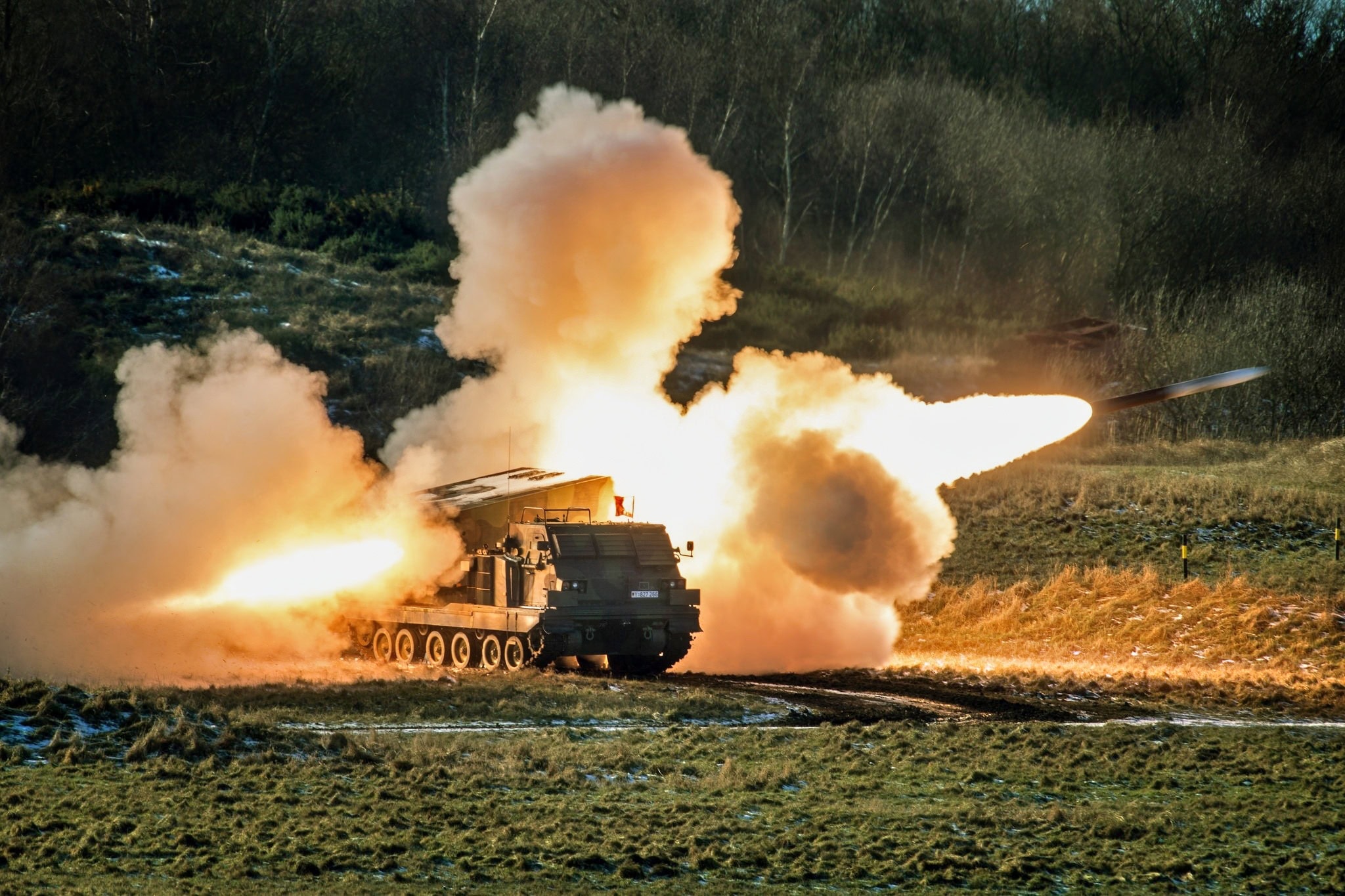
Artillery Attack. Image Credit: Creative Commons.
Hanwha’s press release notably describes “phased-in localization,” echoing its production strategy with Warsaw. Like Poland’s military, the U.S. Army will surely seek to customize the K9MH to its unique requirements, particularly communications and networking subsystems compatible with U.S. combat networks. Still, the Army must remain mindful that excessive tailoring risks causing undue added costs and delays.
Time will tell if the K9MH integration and evaluations proceed smoothly, given its status as a novel evolution of a proven system. But regardless of whether the K9 enters wider U.S. service, it arguably stands as a good example of the advantages the U.S. can gain by viewing the defense industries of its traditional allies as assets that complement its own defense industry, rather than strictly as economic rivals.
About the Author: Defense Expert Sebastien Roblin
Sebastien Roblin writes on the technical, historical, and political aspects of international security and conflict for publications including The National Interest, NBC News, Forbes.com, and War is Boring. He holds a Master’s degree from Georgetown University and served with the Peace Corps in China. Roblin is also a 19FortyFive.com Contributing Editor.