
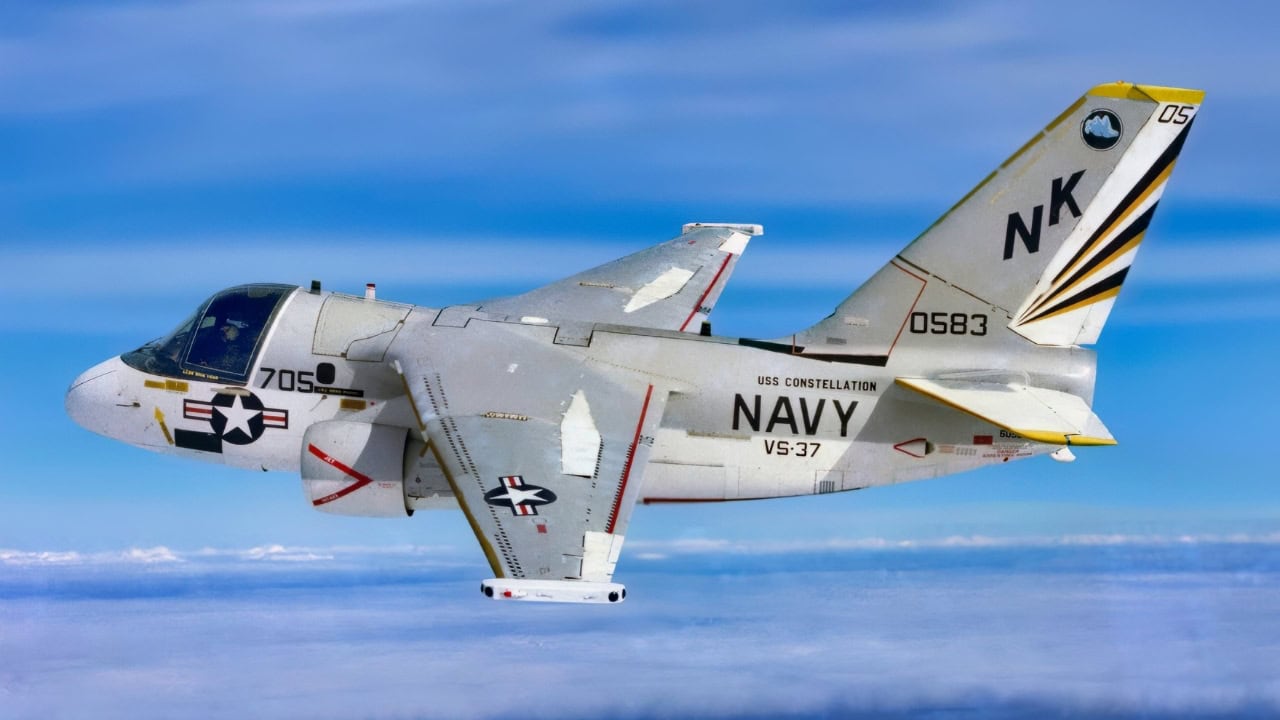
Summary and Key Points: The S-3 Viking was the answer to the question that mattered most in a NATO-Soviet war: whether carrier groups could kill the submarines hunting them. Lockheed built 187; the fleet flew them for 1.7 million hours, and they never fired a weapon at the enemy they were designed to fight. Instead, they bombed Iraq, refueled entire air wings, spied for the battle group, and carried a president. Retired from 2004 to 2009 with roughly half their airframe life unused, they left gaps in tanking and submarine hunting that the US Navy is still paying to fill.
The S-3 Viking Story
The S-3 Viking is the only jet aircraft any navy ever built specifically to hunt submarines from a carrier deck, and its career is a study in irony. Designed to counter the Soviet submarine fleet, it tracked that enemy for 15 years and never dropped a weapon on one.

A Lockheed S-3A Viking aircraft of anti-submarine squadron VS-31 in flight with an ASQ-81 Magnetic Anomaly Detection (MAD) boom extending from the tail section. The aircraft was assigned to Carrier Air Wing Seven (CVW-7) aboard the USS Dwight D. Eisenhower (CVN-69) in 1983.
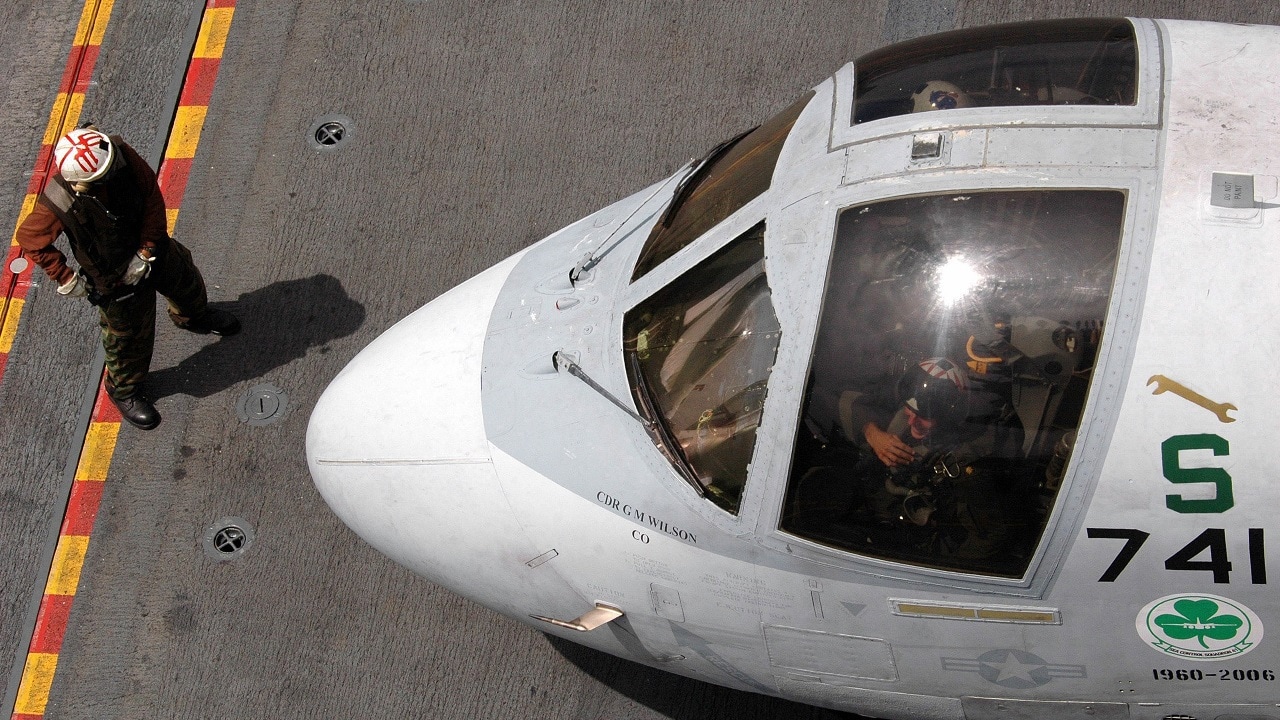
A U.S. Navy S-3B Viking aircraft assigned to the”Shamrocks”of Sea Control Squadron 41 prepares for launch from the U.S. Navy Aircraft Carrier USS NIMITZ (CVN 68).
It went to war instead against targets its designers never imagined, became the aircraft carrier’s flying gas station, carried a sitting president to a flight deck, and was retired to the desert with roughly half its certified airframe life unused. The Navy has spent the years since relearning, expensively, why the airplane mattered, and the last flying example did not stop working until 2021, seventeen years after the fleet began letting the type go.
The mission came first, and it was existential. In a NATO-Warsaw Pact war, Soviet ballistic missile submarines threatened American cities, and Soviet attack boats threatened the convoys that would reinforce Europe; the carrier battle group’s ability to find and kill them was not one mission among many but the precondition for everything else. The piston-engined S-2 Tracker that flew that mission from carrier decks was a 1950s design running out of margin against nuclear boats that were getting faster, deeper, and quieter.
The Navy’s VSX competition sought a jet-powered replacement, and in August 1969, the winning design came from Lockheed, teamed with Vought. Eight prototypes were ordered; the first YS-3A flew on January 21, 1972, and the S-3A entered service with squadron VS-41 on February 20, 1974.
The airplane that the requirement produced was strange and brilliant. Four crew, a pilot, a copilot, a tactical coordinator, and a sensor operator, sat on ejection seats around a digital nervous system: the Viking was among the first aircraft anywhere to fuse its sensors, radar, sixty sonobuoys, infrared, electronic surveillance gear, and a tail-mounted magnetic anomaly detector boom, into one central computer whose picture every station shared.
Two General Electric TF34 turbofans, the same engine family that powers the A-10, gave it 2,300 miles of range, ten-hour loiter endurance, and the vacuum-cleaner whine that named it: to every sailor who ever heard one taxi, the Viking was the “Hoover.” The wings folded for the deck; the internal bay carried homing torpedoes, depth charges, mines, or nuclear depth bombs; wing pylons carried more.
What It Cost, and How Many There Were
Lockheed built 187 Vikings, including the prototypes, between 1971 and 1978, enough to equip a squadron on every deployable carrier, 18 squadrons in all, split between Cecil Field in Florida and North Island in California.
Across four decades, those airframes flew nearly 1.7 million hours. On price, the honest answer is that no single reliable unit-cost figure survives in the public record the way the P-51’s or the F-14’s do; the S-3 was procured in 1970s dollars across shifting lots, and the money story the record does document runs through its middle age, when a government watchdog report pressed the Navy to raise the S-3A fleet’s readiness to justify further investment in it.
The decisive cost argument came at the other end of its life: by the 2000s, keeping a small, unique fleet of jets with bespoke parts and its own training pipeline had become, in the Navy’s accounting, more expensive than folding its jobs into aircraft already on deck. The Viking was not retired because it was worn out. It was retired because it was singular.
The Upgrades That Kept Remaking It
The S-3B rebuild defined the type’s second decade. Under the Weapon System Improvement Program, conversions from 1987 through 1994 gave the fleet a new inverse synthetic aperture radar, expanded electronic surveillance, a modern acoustic processor, and the Harpoon anti-ship missile, and more than a hundred aircraft were rebuilt to the standard. Sixteen more airframes became ES-3A Shadows in the early 1990s, crammed with receivers and more than sixty antennas as the carrier’s electronic-intelligence ears. A handful served as carrier-onboard-delivery haulers.
Then the Cold War ended and took the mission with it: in 1999 the Navy pulled the acoustic suite out of the S-3B entirely, re-roled the squadrons for sea control and surface attack with Maverick and SLAM-ER, and, when the KA-6D tanker retired, handed the Viking the job that would quietly define its last decade: the carrier’s primary overhead tanker, the aircraft that kept everyone else flying.
The Wars It Found Instead
The Viking’s combat record is everything except the war it was built for. Through the late Cold War, S-3s tracked Soviet boats across the Atlantic and Pacific, with work measured in contacts held rather than weapons released, and never fired a shot at the fleet they were designed to kill. In Desert Storm in 1991, S-3Bs flew tankers, listened with the new Shadows, launched decoys, and bombed targets including an Iraqi Silkworm missile site.
They patrolled through the Balkans and over the Arabian Sea after September 11. In Iraq in 2003, the type had its busiest hour: every available Viking crowded the carrier decks, squadrons flew up to thirty sorties a day, and on March 25, 2003, an S-3B of VS-38 fired a laser-guided Maverick into a naval target on the Tigris near Basra, the type’s first and only offensive missile launch in combat.
During the Iraq War, the Vikings passed roughly eight million pounds of fuel to other aircraft. And on May 1, 2003, an S-3B of VS-35, callsign Navy One, carried President George W. Bush in the co-pilot’s seat to an arrested landing aboard USS Abraham Lincoln at the end of her ten-month deployment, the only time a sitting president has trapped aboard a carrier, minutes before the speech remembered for its “Mission Accomplished” banner; that airframe stands in the National Naval Aviation Museum at Pensacola.
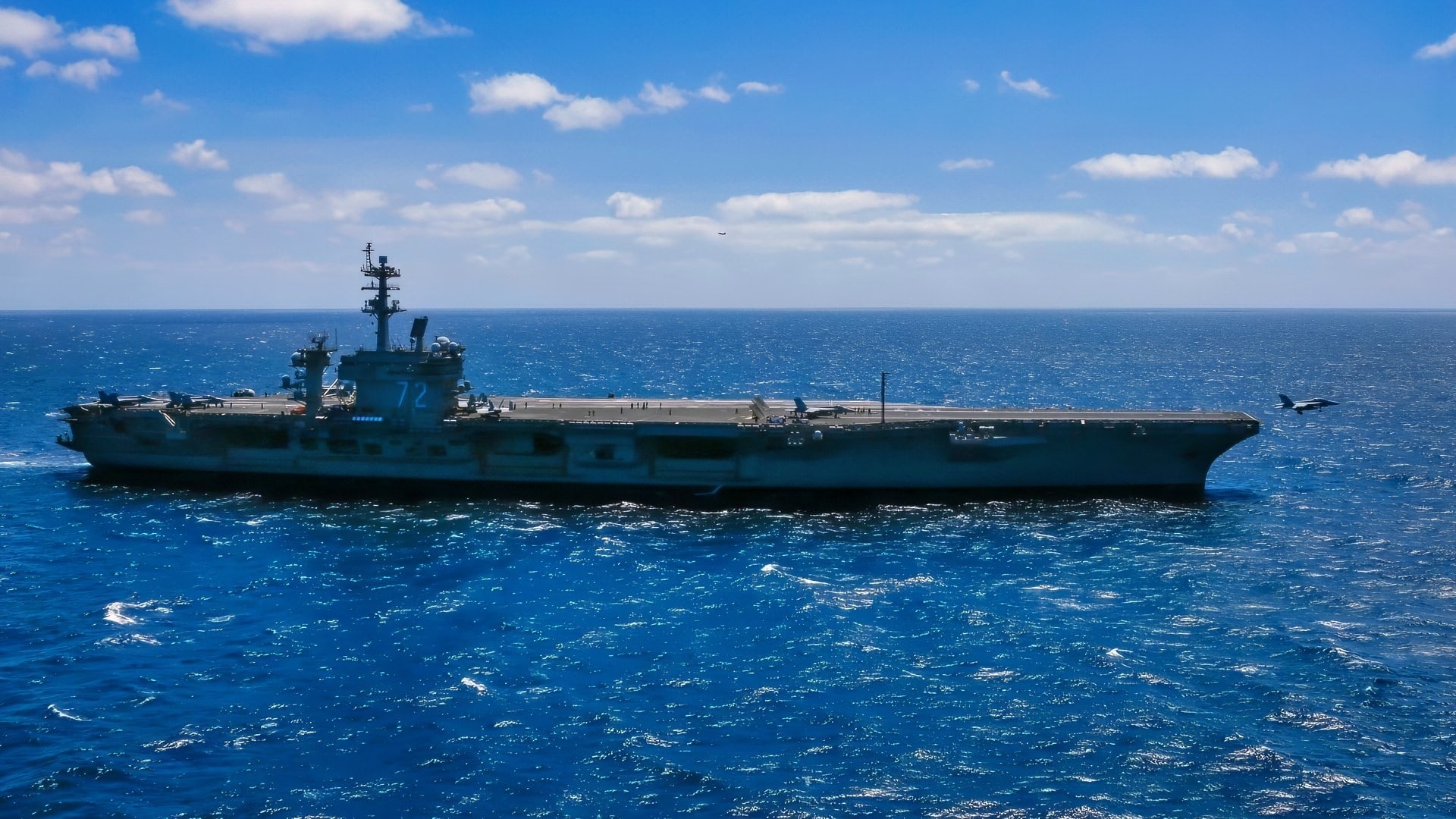
(May 13, 2020) An F/A-18E Super Hornet assigned to the “Flying Eagles” of Strike Fighter Squadron (VFA) 122 launches from the flight deck of the aircraft carrier USS Abraham Lincoln (CVN 72). Abraham Lincoln is underway conducting routine operations in the U.S. 3rd Fleet area of operations. (U.S. Navy photo by Mass Communication Specialist 2nd Class Amber Smalley/Released)
The Retirement the Navy Still Argues About
The Sundown Plan began drawing down the fleet in 2004, and the last front-line squadron stood down in January 2009. The reasons were a stack of assumptions that made sense in 2004: the peer submarine threat was judged gone, land-based P-3s and shipboard helicopters could cover what remained, the deck spots and money were needed for strike fighters, and a unique type’s overhead was the easiest bill to cut. A proposed Common Support Aircraft that would have replaced the S-3, E-2, and C-2 together never materialized.
The counter-evidence went to the desert with the airplanes. Fleet Vikings averaged around ten thousand flight hours against an airframe life that Lockheed fatigue testing had extended by eleven thousand hours and cleared to 18,750 and beyond, and the last three flying at Point Mugu kept clearing missile ranges until 2016, retired not for wear but because depot maintenance for so few jets no longer penciled out.
The bills came due elsewhere. The tanking mission passed to Super Hornets, burning the fleet’s frontline fighters on gas runs and helping drive the Navy to develop the MQ-25 drone tanker to do what the Hoover once did. Lockheed offered refurbished Vikings for the cargo role in the 2010s and lost to the V-22; South Korea studied reviving stored S-3s as submarine hunters and canceled the plan in 2017; even aerial firefighting outfits looked the airframes over.

MQ-25 Boeing Drone U.S. Navy Aircraft Carriers. Image Credit: Boeing.
Meanwhile, Russian and Chinese submarine fleets grew, and the argument that the Navy retired its dedicated sub-hunter a decade before it needed one again moved from hangar-deck grumbling into print, along with the counterpoint that the airplane’s upgrade margin, not its airframe, was the real limit against modern threats.
The S-3 Viking Legacy: Museum Time
The type’s last working years belonged to NASA. The Glenn Research Center acquired an S-3B in 2004 and flew it almost daily for sixteen years on communications research and environmental monitoring over the Great Lakes, retiring it in 2021 to the San Diego Air and Space Museum, the last Viking anywhere still flying.
A sister airframe that had been kept airborne as a parts donor was trucked in 2024 to the aviation museum in Jacksonville, on the grounds of the old Cecil Field, where the East Coast Viking squadrons once lived. The last of 187 came home to a parking spot on its own former flight line, and several dozen more sit preserved in the Arizona desert, where the periodic proposals to bring them back can still find them.
About the Author: Harry J. Kazianis
Harry J. Kazianis (@Grecianformula) was the former Senior Director of National Security Affairs at the Center for the National Interest (CFTNI), a foreign policy think tank founded by Richard Nixon based in Washington, DC. Harry has over a decade of experience in think tanks and national security publishing. His ideas have been published in the NY Times, The Washington Post, The Wall Street Journal, CNN, and many other outlets. He has held positions at CSIS, the Heritage Foundation, the University of Nottingham, and several other institutions related to national security research and studies. He is the former Executive Editor of the National Interest and the Diplomat. He holds a Master’s degree focusing on international affairs from Harvard University.

