
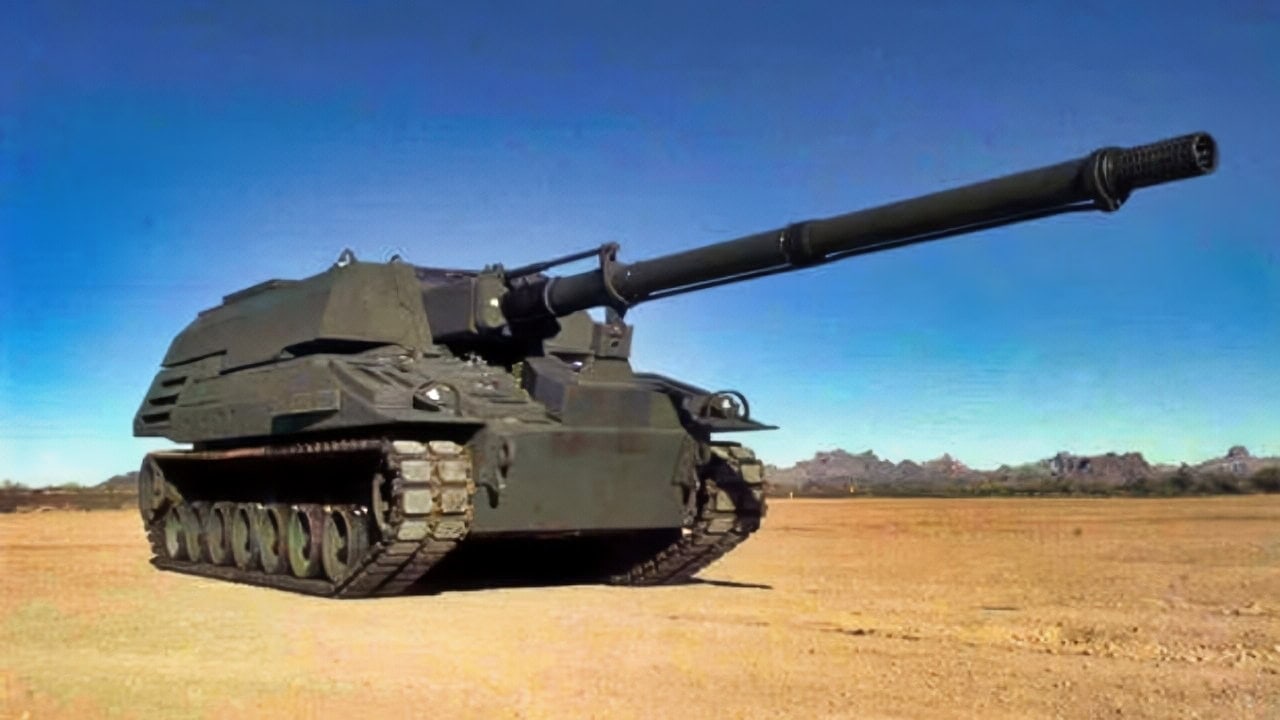
Summary and Key Points: The Crusader was designed to out-shoot every gun on Earth: a fully automated 155mm howitzer firing 12 rounds per minute, landing 8 shells on a single target simultaneously, and keeping pace with an armored corps. The US Army spent two billion dollars and built exactly one before Donald Rumsfeld terminated the eleven-billion-dollar program in May 2002, a fight that led to an inspector general’s investigation and a resignation. Three successor programs have since died in turn; Ukraine reopened every argument, and the Paladin, the Crusader, was meant to retire but still serves.
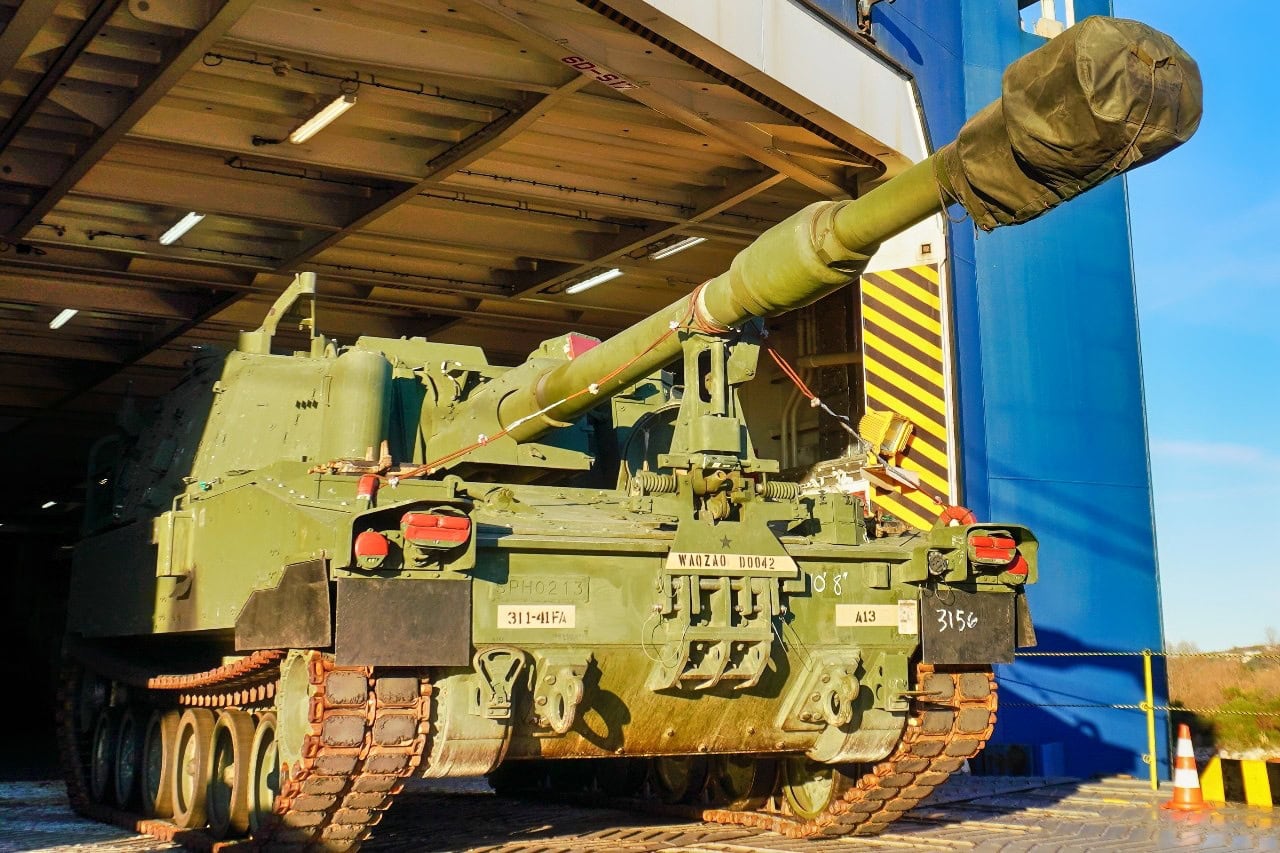
A U.S. M109 Paladin howitzer drives off the vessel Liberty Peace during offloading operations at the port of Koper, Slovenia on December 28, 2024. This Reception, Staging, and Onward Movement (RSOM) operation in the port of Koper is bringing in 1-3ID, the next Regionally Aligned Force (RAF), into the European Theater. These forces will be then transported by the 21st Theater Sustainment Command to their forward operating sites across NATO where they will conduct interoperability training with Allies and partners. The intent of these RAFs is to assure our allies and deter all adversaries.
XM2001 Crusader
Exactly one XM2001 Crusader was ever built, and it sits in the cannon park of the Army Field Artillery Museum at Fort Sill, Oklahoma, a few hundred yards from where the Army trains every artillery officer it has.
The vehicle standing there consumed about two billion dollars, was designed to be the most advanced self-propelled gun on Earth, and died in May 2002 in the loudest weapons cancellation of its generation, a fight that triggered an inspector general’s investigation, cost an Army official his job, and nearly took the Secretary of the Army with him.
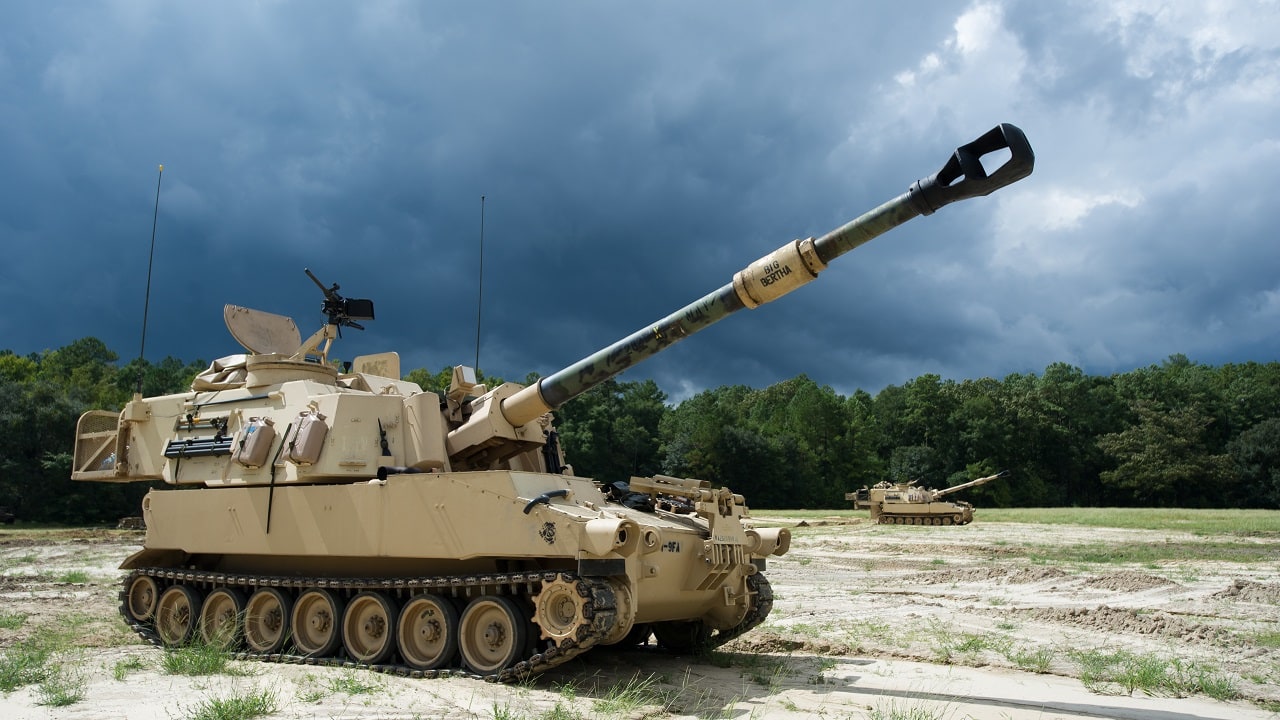
M109A6 Paladins from Battery B, 1st Battalion, 9th Field Artillery Regiment “Battlekings”, 2nd Armored Brigade Combat Team, 3rd Infantry Division, sit ready to fire their Gunnery Table VI here, Sept. 11. The Battlekings’ B Battery just completed Paladin GT VI crew qualifications. Unique to this gunnery is the fact that it this will be the last rounds fired by the Battlekings for the foreseeable future as they are slated to inactivate in the very near future. (U.S. Army Photo by Staff Sgt. Richard Wrigley 2nd ABCT, 3rd ID, Public Affairs NCO)
The Army has since tried twice more to replace the howitzer the Crusader was meant to replace, failed both times, and is now on its fourth attempt. The gun the Crusader was built to retire is still the Army’s gun.
Why the US Army Wanted It
The requirement predated the program’s name.
The Army had been trying to improve its self-propelled 155-millimeter artillery since the late 1970s, and from 1987 the effort took shape as the Advanced Field Artillery System, conceived, in the words of the Congressional Research Service, to match the mobility and firepower of Soviet artillery. The gun it would replace, the M109, was a design of the early 1960s; by the 1991 Gulf War, American gunners knew that several export artillery systems in Iraqi hands could outrange them, and the M109A6 Paladin upgrade, capable as it was, sat at the end of the old chassis’s growth.
The AFAS answer was radical: a regenerative liquid-propellant cannon, injecting fluid propellant into the chamber between moving pistons, promising longer range and cheaper rounds, wrapped in an automated turret no crewman would ride in.
The liquid gun failed its schedule with nearly a billion dollars already invested; the House Armed Services Committee flagged the risk as unacceptable in 1994, the year the program was renamed Crusader, and in 1996, the exotic propellant gave way to conventional solid modular charges. A government audit in 1997 suggested the Army consider a humbler path, upgrading the Paladin again or buying Germany’s Panzerhaubitze 2000 outright.
The US Army pressed on, even as Pentagon meetings as early as 2001 were listing the Crusader alongside the Comanche helicopter and the F-22 as programs that might be cut to fund the future.
What the Crusader Could Do
What the program produced was, on paper and in early testing, the most capable tube-artillery system ever designed. The Army’s own museum marker at Fort Sill states the essentials: a three-man crew sealed in the armored hull, operating a fully automated, unmanned turret whose actively cooled 155-millimeter gun could sustain ten to twelve rounds per minute to 30 kilometers, with the fire-control sophistication to land as many as eight shells from the same gun on one target at the same instant, an artillery trick called multiple-round simultaneous impact that turns a single vehicle into a battery.
A 1,500-horsepower gas turbine drove it at 42 miles per hour, fast enough to keep formation with Abrams tanks and Bradleys, and its companion XM2002 resupply vehicle could pump 48 rounds and fresh fuel into it automatically, under armor, in minutes.
Its advocates put the promise in homely terms: a gun parked on the Capital Beltway, they told reporters, could drop a hundred-pound shell on a precise target across the Washington region.
The uses followed from the specifications: counterbattery fire that could mass and displace before enemy radar-directed guns could answer, continuous fire for an armored corps on the move, and a volume that precision aircraft could not match in weather or in quantity.
The vice was weight, and the program spent years dieting. The original design came in at around 61 tons; a late-1990s redesign drove the requirement down to roughly 41, but the gun still needed its resupply vehicle, and the pair together exceeded 110 tons, an airlift problem no redesign could solve for an Army newly obsessed with flying brigades to distant wars in days.
What It Cost
The Congressional Research Service put the accounting plainly in the cancellation’s aftermath: roughly two billion dollars spent through fiscal 2002, against a total program estimated at 11 billion or more.
The scale had already shrunk once; a 1999 restructuring cut the planned buy from 1,138 vehicles to 480, with the first deliveries due in 2008, and the fiscal 2003 budget then pending before Congress carried 475 million dollars for the program’s next year. Measured against what followed, the money was not the remarkable part. The remarkable part was how the program ended.
Why It Died
Donald Rumsfeld came to the Pentagon promising, at President Bush’s direction, to skip a generation of weaponry, and after September 11 the argument sharpened: Afghanistan was being fought with precision munitions dropped from aircraft, not massed tube artillery, and the future Army was to be light, fast, and deployable. A 40-ton howitzer chained to an armored ammunition carrier nearly as heavy as itself failed every test in that sentence.
Inside the building, Deputy Secretary Paul Wolfowitz and policy chief Stephen Cambone drove the case; the Army, from Secretary Thomas White down, fought for the gun as the thing that keeps soldiers alive in close combat. On May 8, 2002, Rumsfeld ended it at a Pentagon podium: “After a good deal of consideration, I have decided to terminate the Crusader program.” It was the first major weapon system he had killed, and he made the stakes explicit by making an example of it, defending the decision before the Senate a week later.
The Army made it easy for him. Days earlier, after Wolfowitz privately informed White of the decision, talking points attacking the cancellation were faxed from the Army to friendly members of Congress, an act of service lobbying against the elected administration’s own budget decision. Rumsfeld was furious, an inspector general’s investigation followed, and the official identified as the distributor, Kenneth Steadman of the Army’s legislative liaison office, resigned. White was cleared of ordering the contacts, with Rumsfeld observing that someone on his staff had been “way in the dickens out of line,” but the episode fatally wounded the secretary’s standing and turned the Crusader into a case study, still taught, in civilian control of the military.
White pledged in public to support the president’s amended budget as religiously as he had supported the original, and said the Army would study alternatives, including the Excalibur guided shell, precision replacing the platform. Congress grumbled, the House briefly moved to keep the program alive into 2003, and by late June the appropriators reluctantly let it go. The savings were redirected toward the Future Combat Systems vision of lighter, networked vehicles.
Three More Funerals and a Fourth Attempt
The redirect is where the story turns bitter. The Crusader’s automation technology went into the Future Combat Systems’ own howitzer, the NLOS-C, which Secretary Robert Gates killed along with the rest of that program in 2009; its electric rammer survived into the M109A7, the newest Paladin, which is to say that pieces of the Crusader are in service in 2026 aboard the chassis line it was designed to retire.
All the while, a simpler option had come and gone: BAE had built a longer-barreled M109 International prototype years earlier, while the Army’s money rode on Crusader.
The next attempt, the Extended Range Cannon Artillery program, put a 58-caliber barrel on the Paladin and hit a target at 70 kilometers in testing, then died in April 2024 when the gun tubes wore out after too few rounds. Within months the Army opened what the Congressional Research Service calls its fourth attempt, a Self-Propelled Howitzer Modernization effort that solicited mature, fieldable systems, foreign guns included, and has since put demonstration contracts on a slate of American and allied manufacturers; in one arrangement announced in December 2025, the dead ERCA program’s own barrel is being fitted to South Korea’s K9 for testing.
Behind all of it stands Ukraine, where massed tube artillery has fired millions of rounds and turned the 2002 assumption that precision airpower had retired the howitzer into one of the most re-litigated judgments of the transformation era, argued in the same breath as the canceled aircraft of the same years. The M109A7 Paladin remains the Army’s self-propelled howitzer a quarter century after the Crusader was supposed to replace its grandfather.
And the one Crusader ever assembled still sits in the Oklahoma grass at Fort Sill, where every new artillery lieutenant can walk past the future that was terminated at a podium in 2002.
MORE – The X-30 Is the Mach 25 Space Plane You Never Heard Of
About the Author: Harry J. Kazianis
Harry J. Kazianis (@Grecianformula) was the former Senior Director of National Security Affairs at the Center for the National Interest (CFTNI), a foreign policy think tank founded by Richard Nixon based in Washington, DC. Harry has over a decade of experience in think tanks and national security publishing. His ideas have been published in the NY Times, The Washington Post, The Wall Street Journal, CNN, and many other outlets. He has held positions at CSIS, the Heritage Foundation, the University of Nottingham, and several other institutions related to national security research and studies. He is the former Executive Editor of the National Interest and the Diplomat. He holds a Master’s degree focusing on international affairs from Harvard University.

