

On March 16, 1945, the Pacific Fleet’s headquarters issued Communique No. 300, announcing that the battle for a sulfur island most Americans could not find on a map had been won. Admiral Chester Nimitz’s announcement closed with a passage that has outlived every other official document of the Pacific War:
“By their victory, the Third, Fourth and Fifth Marine Divisions and other units of the Fifth Amphibious Corps have made an accounting to their country which only history will be able to value fully. Among the Americans serving on Iwo Island, uncommon valor was a common virtue.”
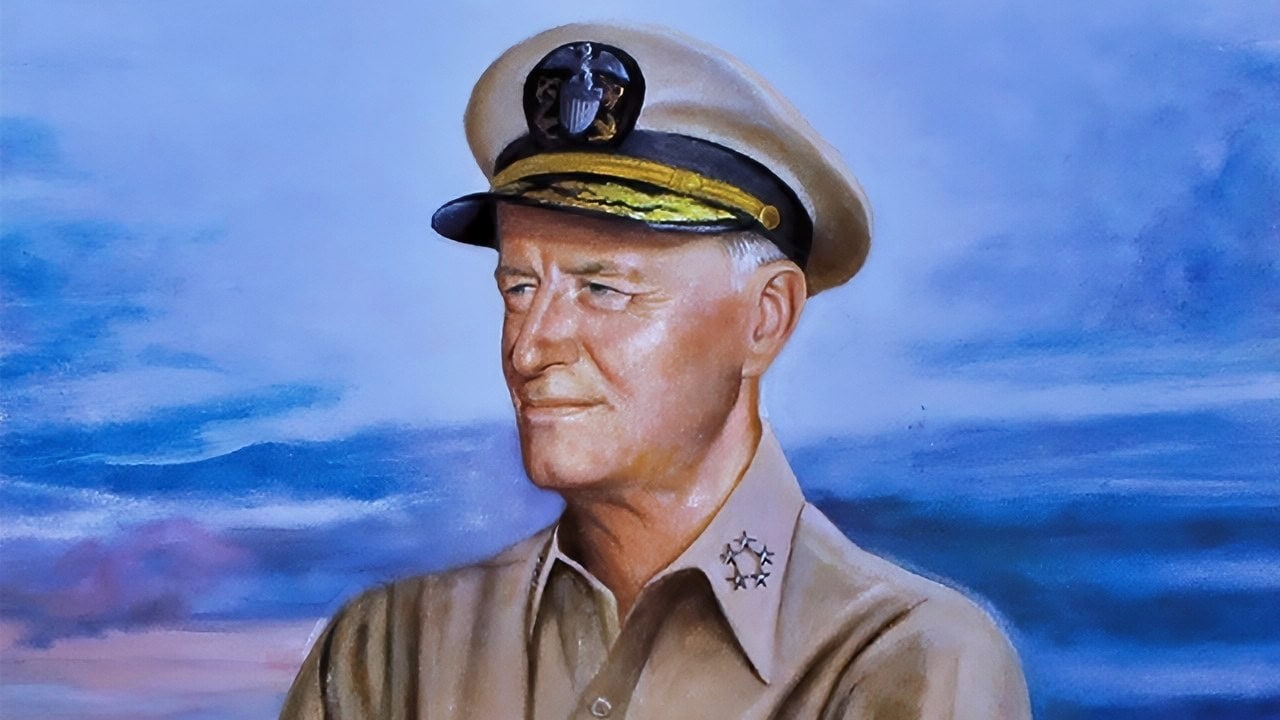
Chester Nimitz Navy Admiral. Image Credit: Creative Commons.
Eighty-one years later, the final sentence is carved into the Marine Corps War Memorial above Arlington, and it remains the finest thing anyone has written about United States Marines.
This is a plain accounting of what they did to earn it.
The Island and the Need
Iwo Jima is eight square miles of volcanic rock and black ash roughly 660 miles from Tokyo, and by late 1944, it sat directly in the path of the air war.
Japanese radar on the island gave the home islands early warning of every B-29 raid flying from the Marianas, its fighters harassed the bomber streams, and crippled Superfortresses limping home had nowhere to land but the ocean.
Operation Detachment was built to fix all three problems: silence the warning station, take the airfields, and turn the island into an emergency runway and fighter-escort base. Planners expected the job to take days.
What the Marines Faced
The Japanese had read the same map and had their own plans for sure.
Lieutenant General Tadamichi Kuribayashi spent the better part of a year converting the island into something no amphibious force had ever confronted, sinking his garrison of some 21,000 men into miles of tunnels connecting hundreds of concealed guns, blockhouses, and firing ports, with underground barracks and hospitals blasted from the rock.
He forbade the wasteful banzai charges of earlier campaigns; his men would fight from beneath the island, each ordered to kill ten Americans before dying.
Nearly every yard of the surface lay inside overlapping fields of fire.
On the morning of February 19, 1945, the largest force of Marines ever committed to a single battle, some 70,000 in the V Amphibious Corps’ three divisions, began landing at 9 a.m.
The first waves met soft, cascading volcanic ash that swallowed boots and bogged vehicles, and an eerie quiet.
Kuribayashi waited until the beaches were packed, then opened fire on everything.
By nightfall, more than 500 Americans were dead, and the survivors had learned a brutal lesson: Marines would burn out a pillbox with flamethrowers and grenades, move on, and take fire from the same pillbox minutes later as fresh defenders refilled it through the tunnels.
On February 23, four days in, a patrol from the 28th Marines fought to the crest of 550-foot Mount Suribachi and raised a small flag from the transport USS Missoula at 10:20 a.m. while the island cheered.
Hours later,a second patrol raised a larger ensign, and Joe Rosenthal of the Associated Press caught the instant in the most reproduced war photograph ever taken, a Pulitzer winner the same year.
The image’s serenity deceived a nation: three of the six flag-raisers never left the island alive, and the worst of the battle waited in the north, in ground the Marines named for what it did to them, the Meat Grinder, where nearly 850 died taking a single strongpoint complex, and the advance was measured in yards per day for five weeks.
The Cost, and the Sentence
When the island was declared secured on March 26, after 36 days, the arithmetic stood alone in the Pacific War.
American forces counted 6,821 dead and 19,217 wounded; of Kuribayashi’s roughly 21,000 defenders, only about 200 were taken alive during the battle, and the general’s own body was never identified.
Iwo Jima became the only major Pacific battle in which total American casualties exceeded Japanese, and it produced 27 Medals of Honor, more than any single battle in American history, nearly half posthumous, among them 17-year-old Jack Lucas, who smothered two grenades and lived, and Hershel “Woody” Williams, who worked alone with a flamethrower for four hours.
Nimitz’s communique, it should be said plainly, was issued while men were still dying: ten days after the sentence was written, in the pre-dawn dark of March 26, hundreds of remaining defenders mounted a final attack on a bivouac of sleeping airmen and support troops, killing or wounding more than 100 Americans in the battle’s last hours.
The Aftermath
The island began paying its debt before the battle ended. On March 4, a fuel-starved B-29 named Dinah Might made the first emergency landing on a captured airfield, and by the war’s end, more than 2,200 Superfortresses carrying some 24,000 airmen had done the same, while P-51s flew escort from the island’s strips; historians still debate how many of those landings were true emergencies, and whether the island was worth its price.
Rosenthal’s photograph became the bronze colossus of the Marine Corps War Memorial in 1954, with Nimitz’s sentence in gold around its base.
The island went back to Japan in 1968, officially reclaimed its older name, Iwo To, in 2007, and each year veterans’ families from both nations meet on the black sand for the Reunion of Honor.
The sentence, meanwhile, entered the Corps’ bloodstream, the most honored line in a service that collects them, because it did something official language almost never does: it told the exact truth.
On an eight-square-mile island where every man ashore was in range of something, courage could not be exceptional, because exceptional was the minimum required to stand up and move.
Uncommon valor, common virtue: eleven words, carved in gold, under a bronze flag that never comes down.
About the Author: Harry J. Kazianis
Harry J. Kazianis (@Grecianformula) was the former Senior Director of National Security Affairs at the Center for the National Interest (CFTNI), a foreign policy think tank founded by Richard Nixon based in Washington, DC. Harry has over a decade of experience in think tanks and national security publishing. His ideas have been published in the NY Times, The Washington Post, The Wall Street Journal, CNN, and many other outlets. He has held positions at CSIS, the Heritage Foundation, the University of Nottingham, and several other institutions related to national security research and studies. He is the former Executive Editor of the National Interest and the Diplomat. He holds a Master’s degree focusing on international affairs from Harvard University.

