
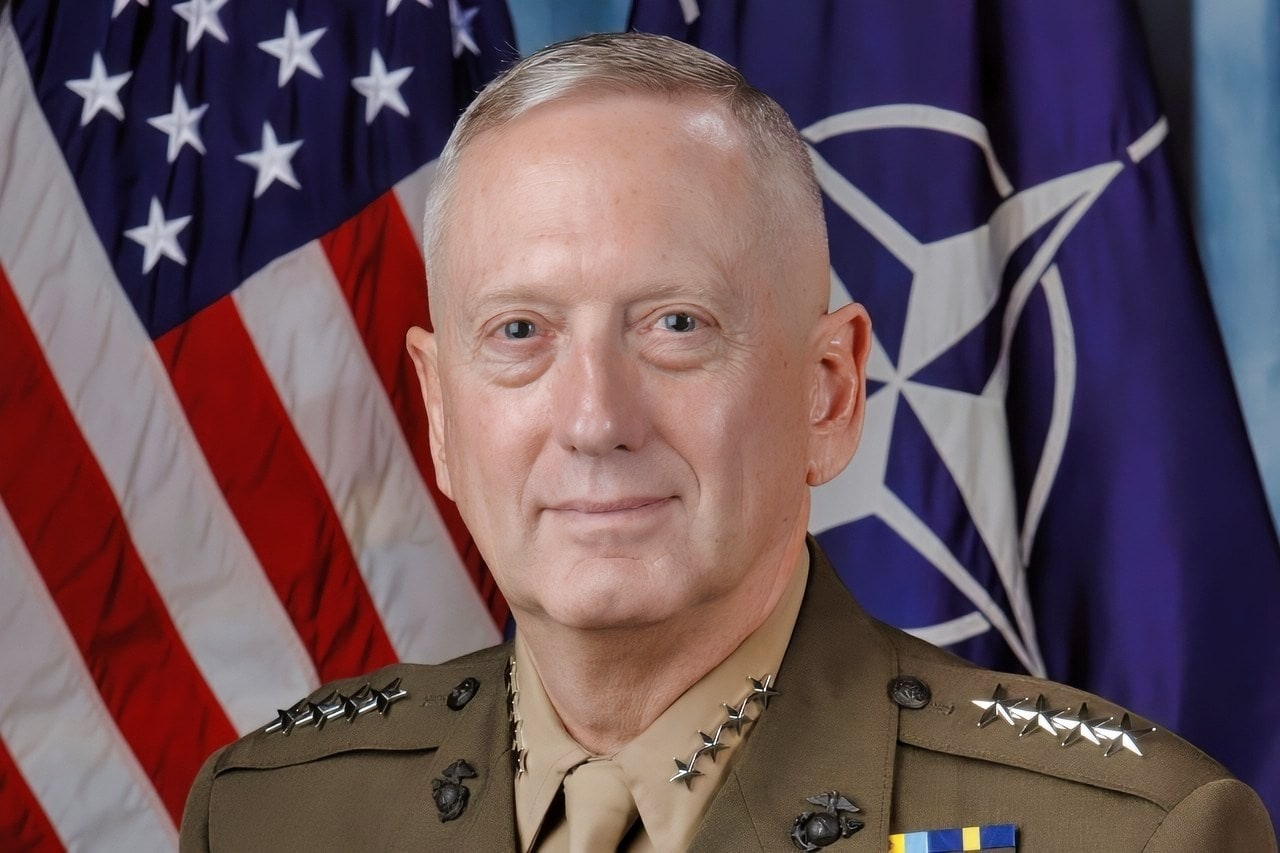
Key Points and Summary – James “Mad Dog” Mattis built his reputation on discipline, battlefield presence, and a leadership style that prioritized credibility with Marines over comfort or ceremony.
-After an early career that included infantry command and Desert Storm with Task Force Ripper, Mattis became a defining GWOT commander—leading Task Force 58 in Afghanistan and the 1st Marine Division into Iraq.
-Along the way, he earned a near-mythic status for being visible at the point of friction, demanding standards, and treating war as a profession requiring study.
-After four-star assignments and CENTCOM, he became Secretary of Defense, then a prominent voice on strategy and leadership.
From “Chaos” to SECDEF: How Mattis Became the Marine Corps’ Most Famous General
“There are hunters and there are victims. By your discipline…you will decide if you are a hunter or a victim.”—That quote belongs to James “Mad Dog” (AKA “Chaos [Colonel Has Another Outstanding Solution],” “Warrior Monk”) Mattis, retired U.S. Marine Corps four-star general and former Secretary of Defense (SECDEF) during the first Donald Trump Administration.
Admittedly, not as well-known or wickedly witty as his saying “Be polite, be professional, but have a plan to kill everybody you meet,” but still plenty profound, as it evokes the truism that “One must either be the hammer or the anvil” (which I first read as a teenager in Massad F. Ayoob’s 1983 book “The Truth About Self-Protection”).
Jim Mattis is arguably the most beloved USMC general officer since Chesty Puller and Smedley Butler.
We now examine his remarkable career, with particular focus on his leadership and service during the Global War on Terror (GWOT).
Early Life of James Mattis
James Norman Mattis was born on September 8, 1950 in Pullman, Washington (which college football buffs will recognize as the home of the Washington State University Cougars) to Lucille (Proulx) Mattis—who had immigrated from Canada as an infant from and had worked in U.S. Army Intelligence in South Africa during World War II—and John West Mattis, a merchant mariner who at one time worked at a plant supplying fissile material to the Manhattan Project.
After graduating from Richland (WA) High School in 1968, Jim began life as a college student at Central Washington University.
Initial Military Career
A year after starting college, Jim enlisted in the U.S. Marine Corps Reserve. Shortly thereafter, he entered the Naval Reserve Officers Training Corps (NROTC) Marine Option program, enabling him to earn a commission as a Marine second lieutenant upon graduating from CWU with a Bachelor of Arts in history in 1972.
The newly minted “butter bar” was assigned to the 3rd Marine Division as a rifle and weapons platoon commander. Upon his promotion to Captain, he transferred to the 1st Marine Brigade, where he commanded a rifle company and a weapons company. As a major, he commanded Recruiting Station Portland.
It was as a lieutenant colonel that Mattis was first “blooded” in the crucible of combat, as he commanded 1st Battalion, 7th Marines, one of Task Force Ripper’s assault battalions during the 1991 Persian Gulf War, AKA Operation Desert Storm.
Three years later, he was a full-bird colonel, commanding the 7th Marine Regiment.
GWOT
It was during the GWOT that Gen. Mattis truly cemented his status as a living legend in the military community (especially in the Corps). By the time Operation Enduring Freedom kicked off in Afghanistan, “Chaos” had pinned on his first star, and accordingly, he commanded the 1st Marine Expeditionary Brigade and Task Force 58; the latter made Brog. Gen. Mattis was the first Marine to command a Naval Task Force in combat.
His objective upon arriving in-country was to “make sure that the enemy didn’t feel like they had any safe haven, to destroy their sense of security in southern Afghanistan, to isolate Kandahar from its lines of communication, and to move against Kandahar.”
Fast-forward to Operation Iraqi Freedom, the 2003 Iraq War theater of GWOT, and Mattis was already a major general, commanding the 1st Marine Division during the initial invasion of Iraq and subsequent stability operations.
Maj. Gen. Mattis played a key role in the First Battle of Fallujah in April 2004, Operation Vigilant Resolve, by negotiating with the insurgent command inside of the city, as well as playing an important part in planning the Second Battle of Fallujah, AKA Operation Al-Fajr or Operation Phantom Fury, that November.
To junior officers and enlisted Marines, he became beloved for engaging his troops with genuine concern, compassion, and “real leadership.” As former Marine Recon captain and future diplomat Nathaniel C. Fick put it, “No one would have questioned Mattis if he’d slept eight hours each night in a private room, to be woken each morning by an aide who ironed his uniforms and heated his MREs. But there he was, in the middle of a freezing night, out on the lines with his Marines.”
Gen. Mattis pinned on his fourth star on November 9, 2007, taking charge of U.S. Joint Forces Command (JFCOM) and Supreme Allied Commander Transformation (SACT).
On August 5, 2010, he was confirmed by the Senate Armed Services Committee as Commander of U.S. Central Command (CENTCOM).
Military Retiree and SECDEF James Mattis
Gen. Mattis retired from the USMC on March 22, 2013. On December 1, 2016, then-President-elect Donald Trump announced that he would nominate the retired general to be his SECDEF.
Mattis ended up serving at the 26th Secretary of Defense from January 20, 2017, to January 1, 2019.
During this stint, among other things, SECDEF Mattis reaffirmed America’s commitment to defending longtime ally South Korea in the wake of the 2017 North Korea crisis, and opposed proposed collaboration with China and Russia, stressing what he saw as their “threat to the American-led world order.”
Lasting Legacy: Where Is He Now?
In a refreshing contrast to all the other “quotable” military leaders I’ve profiled in my recent biographical articles, Jim Mattis is thankfully still very much alive and kicking.
He’s currently the Davies Family Distinguished Fellow at the Hoover Institution (that enclave of conservatism in otherwise leftist Stanford University).
Although I myself wussed out on a chance to attend USMC Officer Candidates School (OCS), I still find Gen. Mattis relatable insofar as I, too, was a “mustang,” i.e., someone who starts their military career as an enlisted troop before transitioning to the commissioned ranks.
And amongst my buddies who are Marine Corps veterans and had the privilege of serving under Gen. Mattis, they all have nothing but great things to say about him (even the ex-grunts who usually aren’t fond of officers).
If you want further firsthand insights into Gen. (Ret.)/Sec’y Mattis’s personality and leadership philosophy, you can read his book “Call Sign Chaos: Learning to Lead.”
About the Author: Christian D. Orr, Defense Expert
Christian D. Orr is a Senior Defense Editor. He is a former Air Force Security Forces officer, Federal law enforcement officer, and private military contractor (with assignments worked in Iraq, the United Arab Emirates, Kosovo, Japan, Germany, and the Pentagon). Chris holds a B.A. in International Relations from the University of Southern California (USC) and an M.A. in Intelligence Studies (concentration in Terrorism Studies) from American Military University (AMU). He is also the author of the newly published book “Five Decades of a Fabulous Firearm: Celebrating the 50th Anniversary of the Beretta 92 Pistol Series.”