
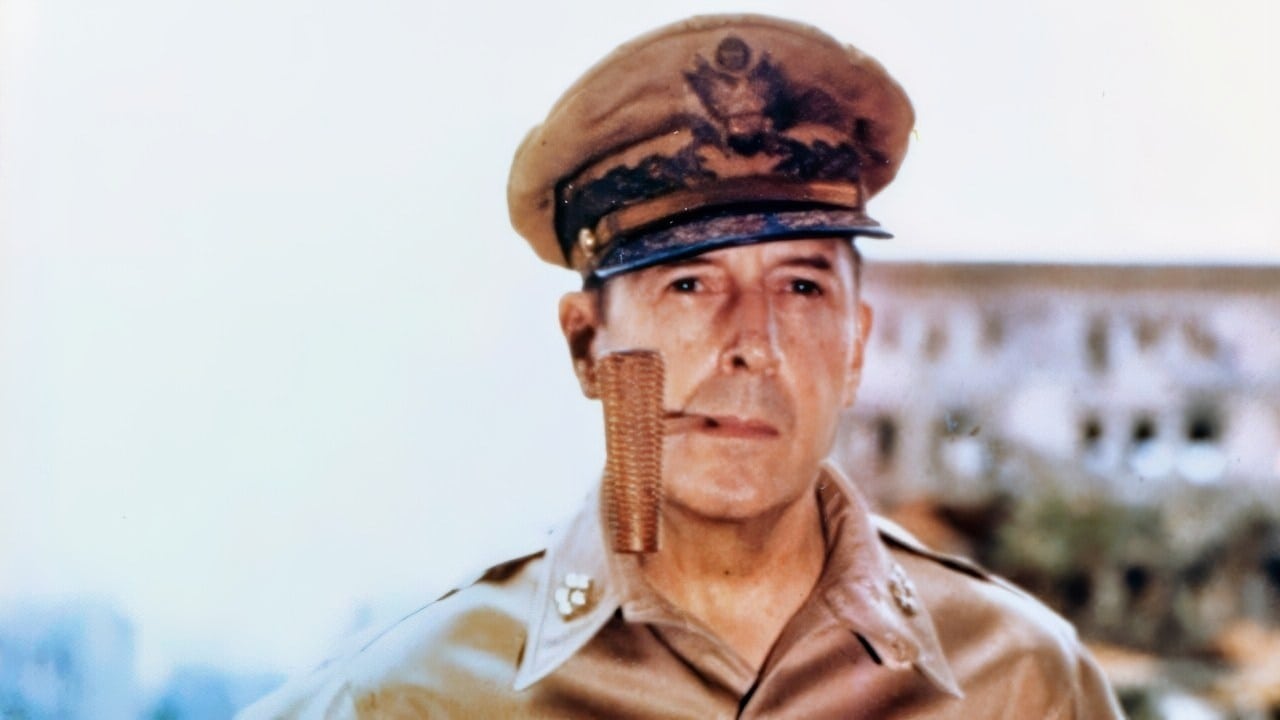
On May 12, 1962, an 82-year-old man in a dark civilian suit stood before the Corps of Cadets at West Point to accept the Sylvanus Thayer Award and delivered, without notes, the address against which every other definition of soldiering is still measured. He opened with a joke about a hotel doorman who had asked whether he had ever been to West Point before. Then he took the three words of the Academy’s own motto, “Duty, Honor, Country,” and spent half an hour handing them back transfigured, telling the cadets those hallowed words dictated what they ought to be, what they could be, what they would be, and closing with a farewell no one present ever forgot: it was his final roll call, he told them, and when he crossed the river, his last conscious thoughts would be of the Corps, and the Corps, and the Corps.
The cadets stood in a silence that graduates still describe six decades later.
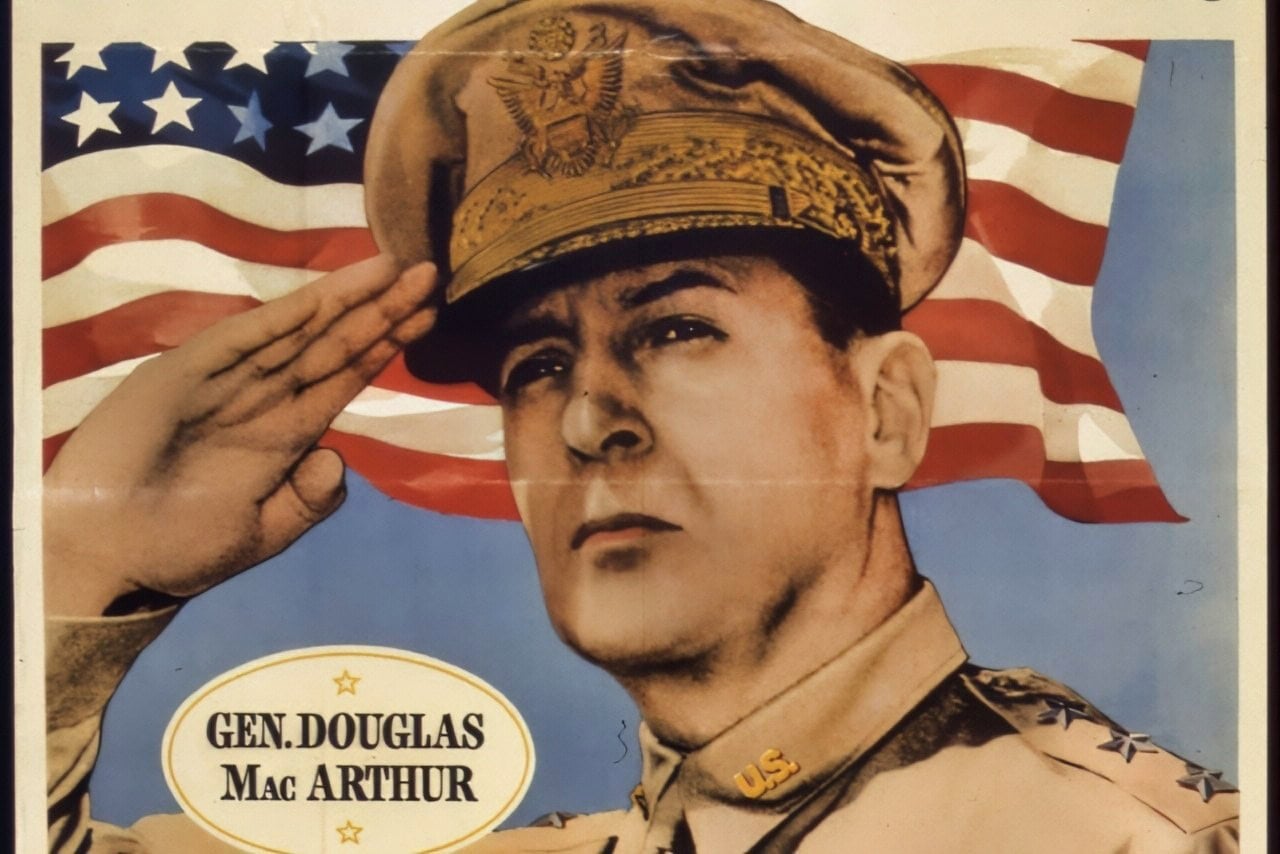
Douglas MacArthur. Image Credit: Creative Commons.
It was, as the monument on the Plain now inscribed with its lines attests, his last great public address; he had 23 months to live.
The three words were not his invention, and that is the point this piece exists to make at 64 years’ distance: the motto had waited on the Academy’s crest for every cadet since before his own arrival in 1899.
What Douglas MacArthur brought to it, and the reason the speech cannot be separated from the speaker, was the most spectacular, most decorated, most controversial American military life of the twentieth century, offered at its end as proof of the motto.
Born to the US Army
He was, almost uniquely among great commanders, born on a military post: January 26, 1880, at the Little Rock Barracks in Arkansas, son of Arthur MacArthur Jr., a Civil War hero who had won the Medal of Honor as a teenage officer on Missionary Ridge and would rise to govern the occupied Philippines.
Douglas absorbed the destiny whole, writing in his memoirs that he learned to ride and shoot almost before he could walk and talk.
At West Point, he made the inheritance his own, graduating first in the class of 1903 with one of the highest academic records ever compiled at the Academy, while serving as First Captain of the Corps, the cadet command’s summit.
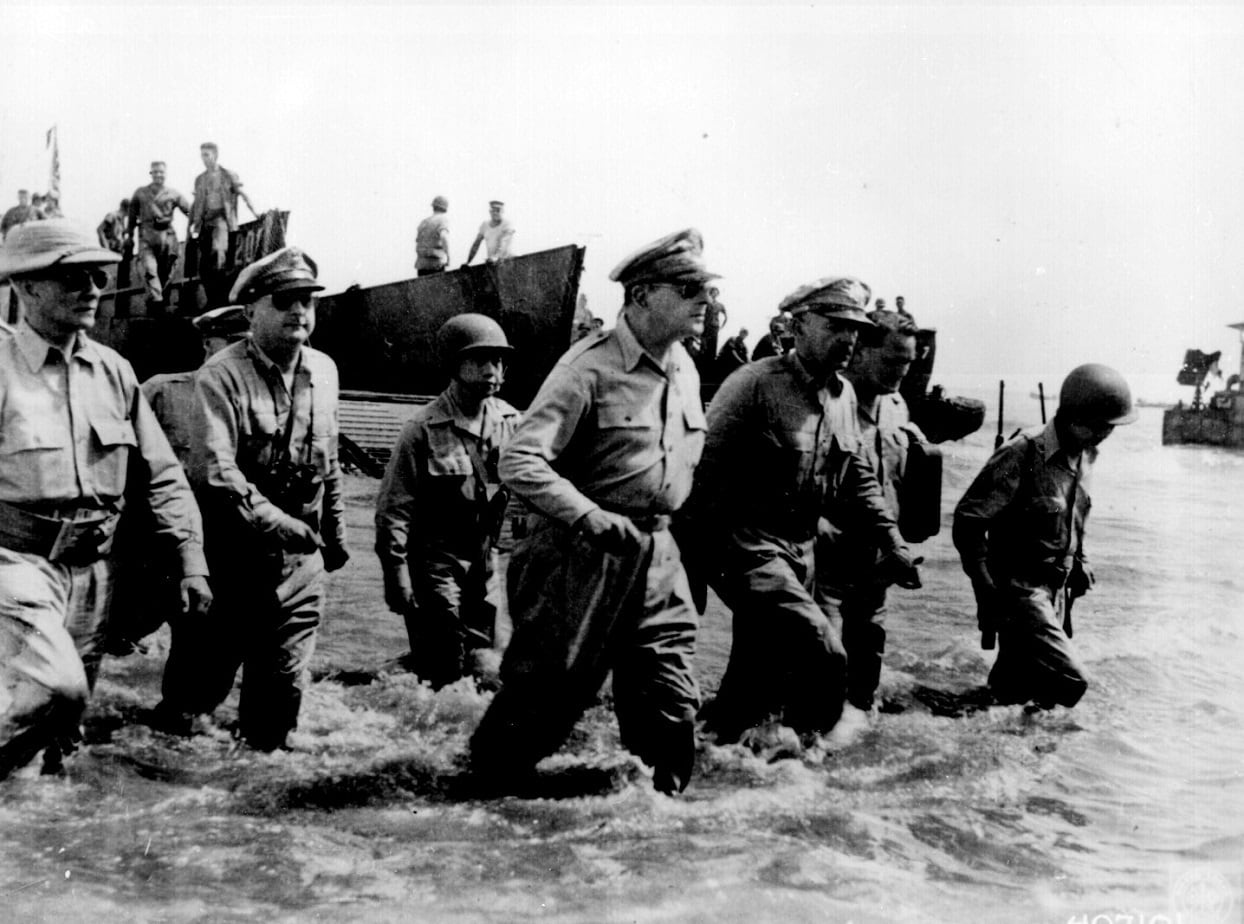
“General Douglas MacArthur wades ashore during initial landings at Leyte, P.I.” October 1944.
The Army he entered would spend the next six decades failing to contain him.
The Fastest Rise
He was nominated for the Medal of Honor for a reconnaissance at Veracruz in 1914.
In World War I, as chief of staff and then a brigade commander of the 42nd “Rainbow” Division, he fought in the trenches in a soft cap and muffler, disdaining the helmet and sometimes the gas mask, and emerged among the most decorated Americans of the war and one of its youngest generals.
At 39, he became the youngest superintendent in West Point’s history, modernizing the curriculum and writing the athletics credo still carved above the gymnasium door. At 50, he was Army Chief of Staff.
And it was in that office, in 1932, that he acquired the stain his critics never let fade, personally overseeing the troops who cleared the Bonus Army’s veteran encampment in Washington with cavalry and tear gas, an episode that remains part of any honest accounting of him.
In 1936, he accepted a rank no other American has held, Field Marshal of the Philippine Army, retired from the U.S. Army in 1937, and was recalled to its rolls in July 1941, with war weeks away.
The Promise
The war began for him in catastrophe. Hours after Pearl Harbor, much of his Far East air force was caught and destroyed on the ground, a failure historians still debate, and an honest biography must record, and the outgunned defense of the Philippines collapsed backward into Bataan and Corregidor.
Ordered out by President Roosevelt in March 1942, MacArthur reached Australia and uttered the three words that became a national promise: I shall return.
That year, he received the Medal of Honor for the defense of the Philippines, making the MacArthurs the first father and son ever to hold the nation’s highest decoration.
What followed was the long, brilliant grind back: the New Guinea campaigns and the leapfrogging advance that bypassed Japanese strongholds to wither, until October 20, 1944, when he waded ashore at Leyte through the surf and the newsreels and announced that he had returned.
Five-star rank, General of the Army, came that December, and on September 2, 1945, he presided on the deck of the USS Missouri as the Japanese Empire signed its surrender.
Shogun and Seoul for Douglas MacArthur
Then came the strangest and perhaps greatest chapter: absolute ruler of a defeated Japan.
As Supreme Commander for the Allied Powers, he governed with a forbearance his enemies never expected, sparing the emperor, imposing a democratic constitution, enfranchising women, and breaking up the feudal land system, an occupation so successful, and so improbably gentle from the man who ran it, that the Japanese themselves nicknamed him the foreign shogun.
War found him once more in June 1950, when North Korea overran the South, and at 70 he answered with the masterstroke of his career, the amphibious landing at Inchon on September 15, 1950, which unhinged the entire North Korean position in a stroke.
The drive to the Yalu that followed carried the seeds of his fall: China’s massive intervention threw the UN armies back in the war’s bitterest winter, and MacArthur’s increasingly public defiance of Washington’s limited-war policy forced the constitutional question he had spent a career skirting.
On April 11, 1951, President Truman relieved him of command, the most famous assertion of civilian control over the American military since Washington faced down his officers at Newburgh.
MacArthur came home to ticker tape, told a joint session of Congress that in war there is no substitute for victory, and closed with the ballad line that named the speech: “Old soldiers never die; they just fade away.”
The Last Roll Call
He did not entirely fade. He chaired a corporation, counseled Presidents Kennedy and Johnson, famously warning both against ever committing American ground forces to a land war in Asia, and, in 1962, came back up the Hudson one last time.
The speech he gave that May morning was preserved almost by accident, recorded because the cadet brigade commander of the Class of 1962 insisted on it, and the graduates’ accounts agree on the detail that matters: the Plain’s absolute, pin-drop stillness while the old man spoke.
He died on April 5, 1964, not two years later, and lies in the rotunda of the MacArthur Memorial in Norfolk, Virginia.
The motto he borrowed for his farewell had belonged to every cadet since 1898 and belongs to every one since.
About the Author: Harry J. Kazianis
Harry J. Kazianis (@Grecianformula) was the former Senior Director of National Security Affairs at the Center for the National Interest (CFTNI), a foreign policy think tank founded by Richard Nixon based in Washington, DC. Harry has over a decade of experience in think tanks and national security publishing. His ideas have been published in the NY Times, The Washington Post, The Wall Street Journal, CNN, and many other outlets. He has held positions at CSIS, the Heritage Foundation, the University of Nottingham, and several other institutions related to national security research and studies. He is the former Executive Editor of the National Interest and the Diplomat. He holds a Master’s degree focusing on international affairs from Harvard University.

