
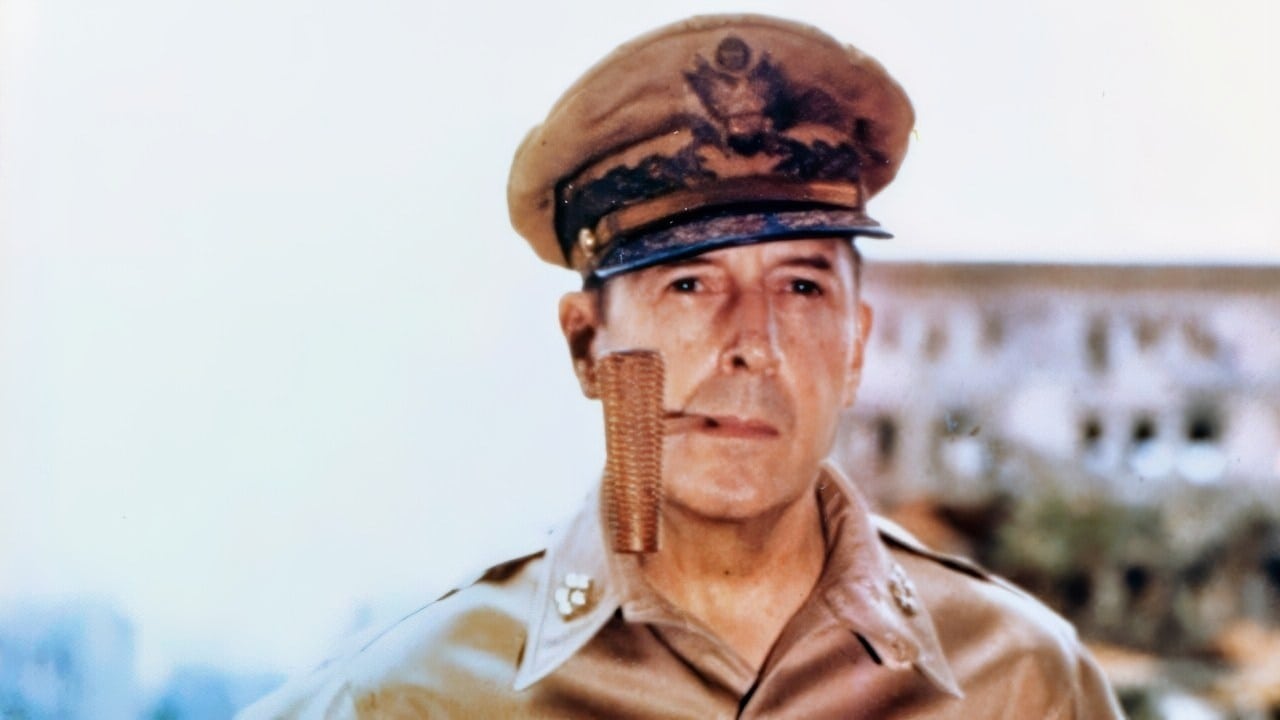
Summary and Key Points: General Douglas MacArthur, one of only five five-star generals in U.S. history, is defined by his legendary “Duty, Honor, Country” speech at West Point.
-As the son of a Civil War hero, MacArthur’s path from valedictorian to Supreme Allied Commander was marked by unrivaled bravery and significant controversy.
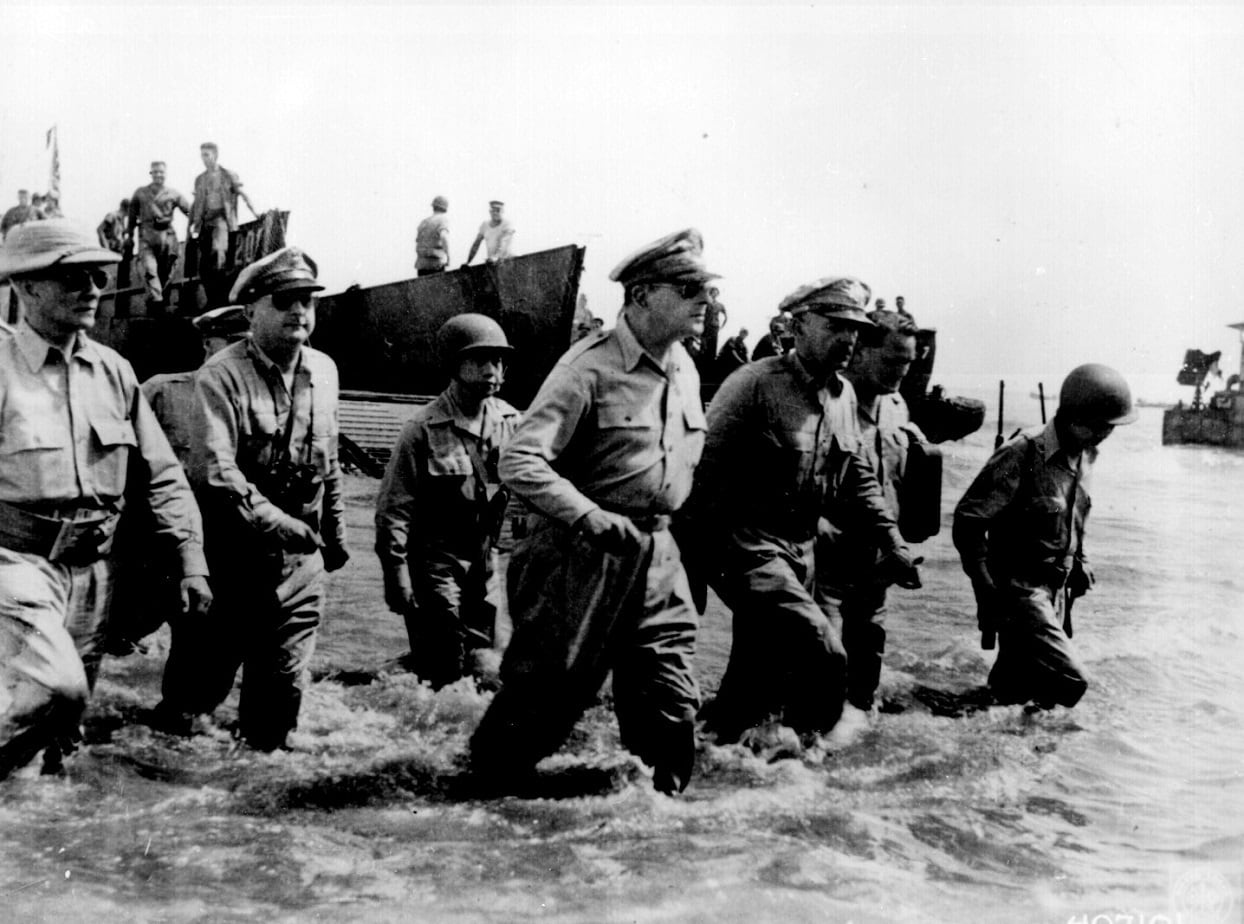
“General Douglas MacArthur wades ashore during initial landings at Leyte, P.I.” October 1944.
-His famous quote, emphasizing that soldiers pray for peace because they bear the deepest scars of war, remains a cornerstone of the American military ethos.
-This legacy of service, spanning World War I, World War II, and Korea, continues to inspire the “Long Gray Line” and generations of American leaders.
Army Quote of the Day: Douglas MacArthur’s Emotional Plea for Peace
“The soldier above all others prays for peace, for it is the soldier who must suffer and bear the deepest wounds and scars of war.” – Gen. Douglas MacArthur
Gen. Douglas MacArthur was one of just five five-star Army generals in U.S. history, the others being George C. Marshall, Dwight D. Eisenhower, Henry H. Arnold, and Omar N. Bradley.
All five served during World War II, which is not a coincidence.
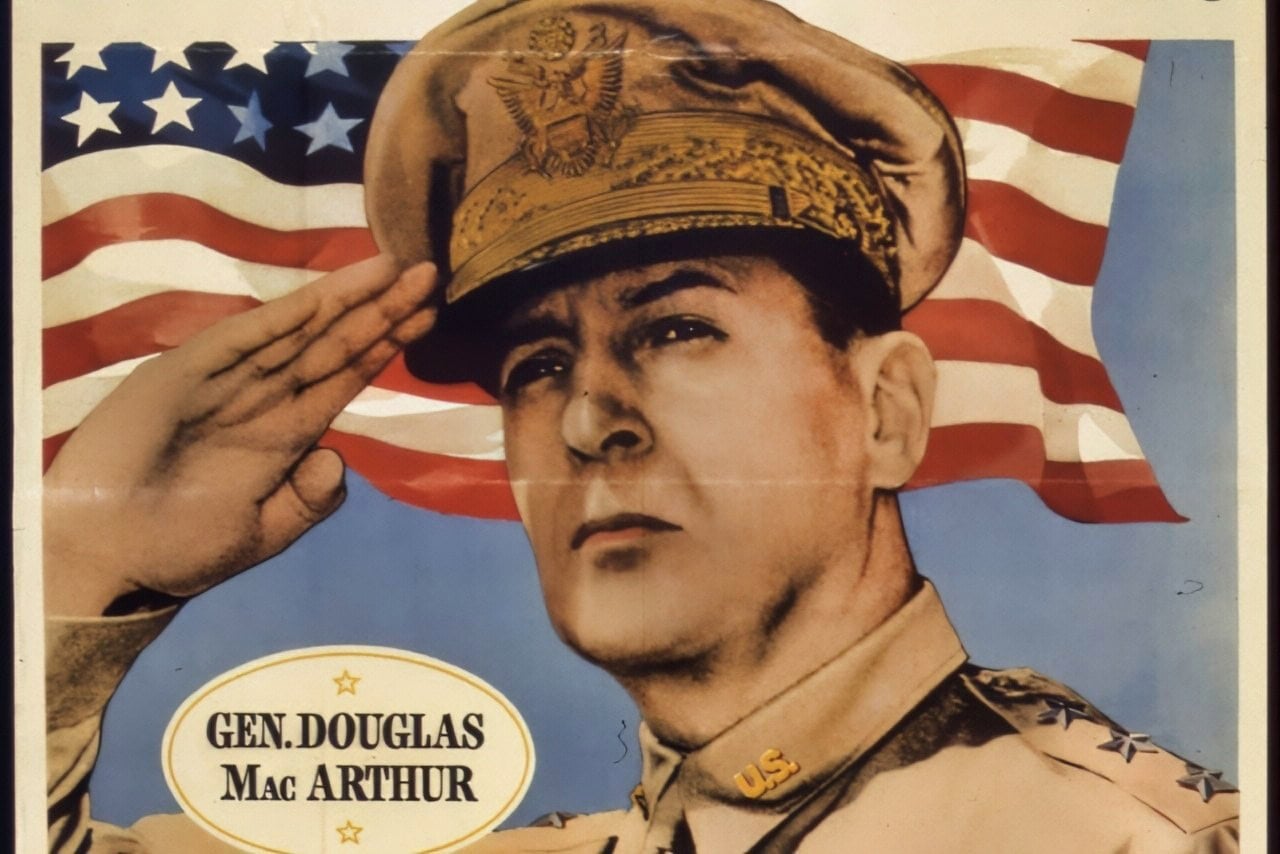
Per the U.S. Army Center of Military History, the “temporary grade of ‘General of the Army’(five-star)” was created in 1944, although no one since Omar Bradley has received a fifth star. Presidents retain the power to award four-star Army generals a fifth star, but it has not happened.
Doing so has been proposed on various occasions, including for Gen. Colin Powell after the Persian Gulf War, although that never happened. There was a minor push in 2011 to award a fifth star to Gen. David Petraeus, but such an award also never happened.
The co-author of the Wall Street Journal op-ed in 2011 calling for a fifth star for Petraeus was Pete Hegseth, then the head of Veterans for Freedom and now the Secretary of Defense.
How Douglas MacArthur Got To Five Stars
Per a bio on the website of the National Museum of the United States Army, MacArthur spent much of his life pursuing a career in military service.
“MacArthur’s involvement with the Army began as soon as he was born. The son of Lt. Gen. Arthur MacArthur Jr., a Civil War veteran and governor-general of the Philippines, MacArthur felt that it was his calling to honor his father’s legacy,” the bio said.
“His parents encouraged him to follow Arthur’s footsteps into the Army. After a childhood on the frontier and in Washington, D.C., MacArthur graduated first in his class from the U.S. Military Academy at West Point on June 11, 1903. MacArthur served as an engineering officer in the Philippines and aide-de-camp to his father, the commander of the Pacific Division.”
MacArthur participated in the Veracruz Expedition in 1912, which led to his nomination for the Medal of Honor. Pretty soon, it was time for World War I.
“With the entry of the United States into World War I, MacArthur deployed to France as the 42d’s chief of staff. During World War I, MacArthur attracted attention as a talented and courageous field commander. He led raids on German trenches and helped organize resistance to enemy assaults,” the National Museum bio said.
“He gained a reputation as a fearless leader and regularly exposed himself to danger. On June 29, 1918, the Army promoted MacArthur to brigadier general, and he soon commanded the 84th Infantry Brigade. MacArthur successfully led the 84th during the Battle of Saint-Mihiel and the Meuse-Argonne offensive. Throughout World War I, MacArthur earned seven Silver Stars, two Croix de Guerres, two Distinguished Service Crosses, and the Army Distinguished Service Medal.”
After the war, MacArthur did a stint as superintendent at West Point. Later, he became chief of staff of the U.S. Army, during which he presided over Depression-era budget cuts.
In 1941, the Japanese attacked Pearl Harbor.
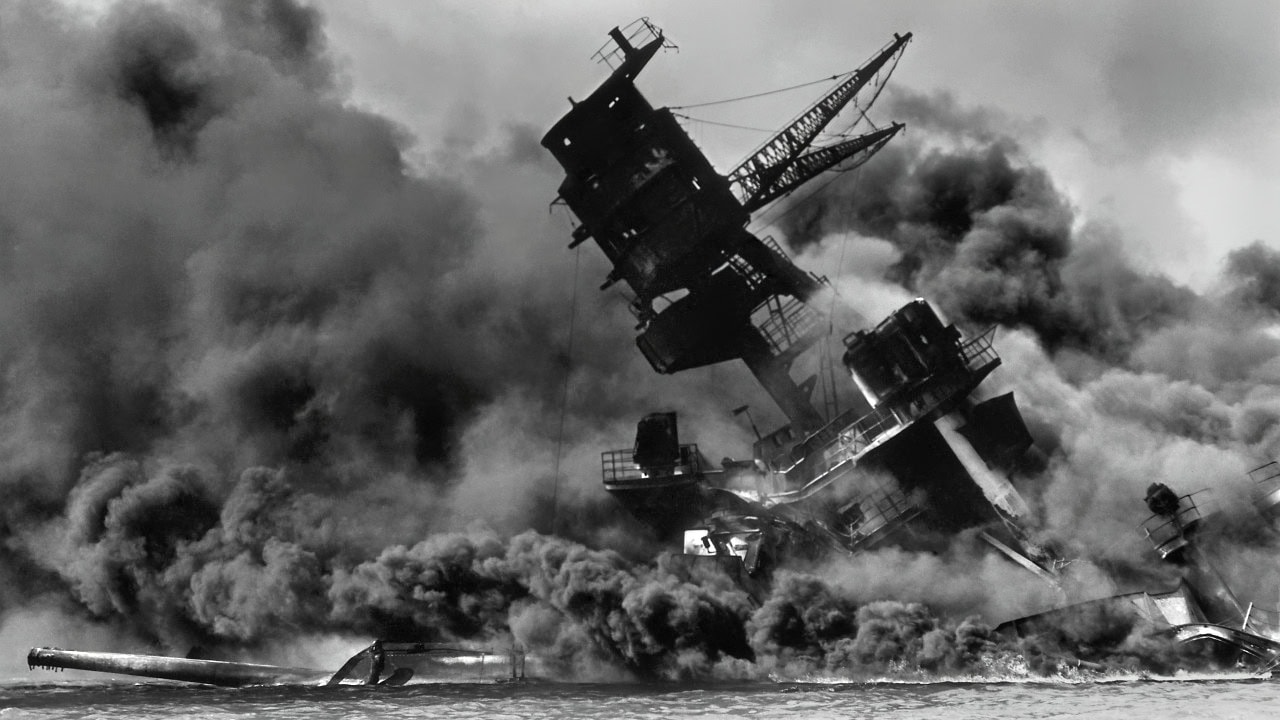
The USS Arizona (BB-39) burning after the Japanese attack on Pearl Harbor, 7 December 1941.
“With half of MacArthur’s air force destroyed on the ground, Japanese forces invaded and conquered the Philippines,” the bio said. “MacArthur was awarded the Medal of Honor for his defense of the Philippines and, before he evacuated, he declared, ‘I shall return.’”
Three years later, in 1944, MacArthur arrived in the Philippines with an invasion force, declaring, “I have returned.”
Two months after that, on December 14, 1944, MacArthur was promoted to general of the army and granted that fifth star. He kept that rank for the rest of his career, including his famed service in Korea.
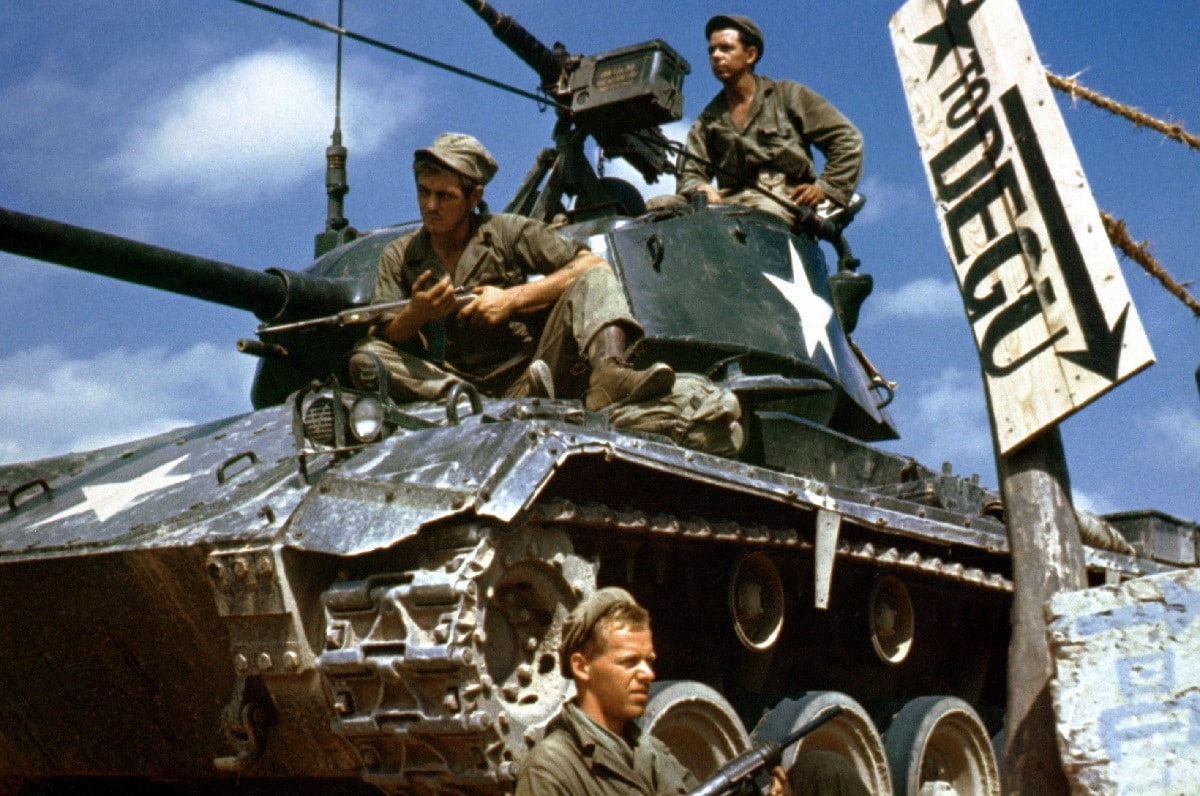
Crew of an M-24 tank along the Naktong River front. On the ground is Pfc. Rudolph Dotts, Egg Harbor City, N.J. gunner (center); Pvt. Maynard Linaweaver, Lundsburg, Kansas, cannoner; and on top is Pfc. Hugh Goodwin, Decature, Miss., tank commander. All are members of the 24th Reconnaissance, 24th Division.
NARA FILE#: 111-C-6061
The Quote
One quote often attributed to General MacArthur is, “The soldier above all others prays for peace, for it is the soldier who must suffer and bear the deepest wounds and scars of war.”
The implication is that soldiers, for all their readiness for war, are aware of the costs of what fighting wars does.
The statement comes from MacArthur’s famous “Duty, Honor, Country” speech, which marked his farewell address on May 12, 1962. The address came at West Point, when MacArthur was awarded the Sylvanus Thayer Award, at a time when he was clearly ailing.
This is not to be confused with the “other” farewell address MacArthur had delivered, in 1951, upon his return to the United States after his removal from command by President Truman.
“You are the leaven which binds together the entire fabric of our national system of defense. From your ranks come the great captains who hold the nation’s destiny in their hands the moment the war tocsin sounds. The Long Gray Line has never failed us. Were you to do so, a million ghosts in olive drab, in brown khaki, in blue and gray, would rise from their white crosses thundering those magic words: Duty, Honor, Country,” MacArthur said in the West Point speech, immediately before the famous quote. “This does not mean that you are war mongers.”
“The shadows are lengthening for me. The twilight is here. My days of old have vanished, tone and tint. They have gone glimmering through the dreams of things that were. Their memory is one of wondrous beauty, watered by tears, and coaxed and caressed by the smiles of yesterday,” MacArthur said at the end of the speech. “Today marks my final roll call with you, but I want you to know that when I cross the river my last conscious thoughts will be of The Corps, and The Corps, and The Corps. I bid you farewell.”
Douglas MacArthur died on April 5, 1964, just under two years after the West Point farewell address. President John F. Kennedy had authorized a state funeral in 1963, before his own death, and one indeed took place the following month, and MacArthur’s body lay in state in the U.S. Capitol.
About the Author: Stephen Silver
Stephen Silver is an award-winning journalist, essayist, and film critic, and contributor to the Philadelphia Inquirer, the Jewish Telegraphic Agency, Broad Street Review, and Splice Today. The co-founder of the Philadelphia Film Critics Circle, Stephen lives in suburban Philadelphia with his wife and two sons. For over a decade, Stephen has authored thousands of articles that focus on politics, national security, technology, and the economy. Follow him on X (formerly Twitter) at @StephenSilver, and subscribe to his Substack newsletter.