
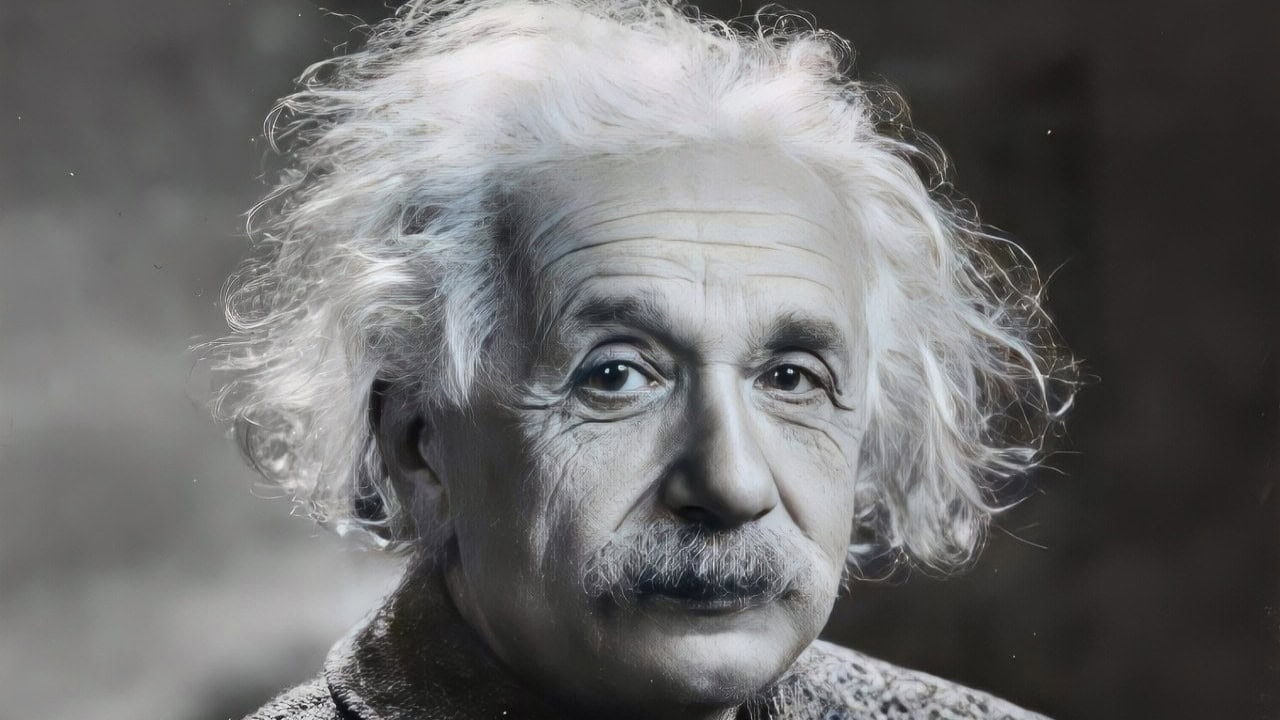
In December 1926, the most famous scientist alive sat down to answer a letter from his friend Max Born, one of the architects of the newborn quantum mechanics, and produced the most quoted objection in the history of science. The world remembers it as “God does not play dice.” As this series has learned to expect, that is the polish, not the sentence. What Einstein wrote, on December 4, 1926, was subtler and stranger: quantum mechanics was imposing, he conceded, but an inner voice told him it was not yet the real thing; the theory delivered much but brought no one closer to the secret of the Old One, and he was at any rate convinced that “He does not play dice.” The Old One, der Alte, was Einstein’s teasing name for whatever wrote the universe’s rules, and the letter’s target was the man reading it, since it was Born himself who had given the quantum wave function its probabilistic meaning.
Ninety-nine years later, with the centennial arriving this December, the sentence remains the best three-second summary of the deepest argument physics has ever had, an argument its author, by the verdict of a Nobel Prize awarded 96 years after he wrote it, lost. This is the story of the man who could be that wrong and remain the greatest scientist of his century.
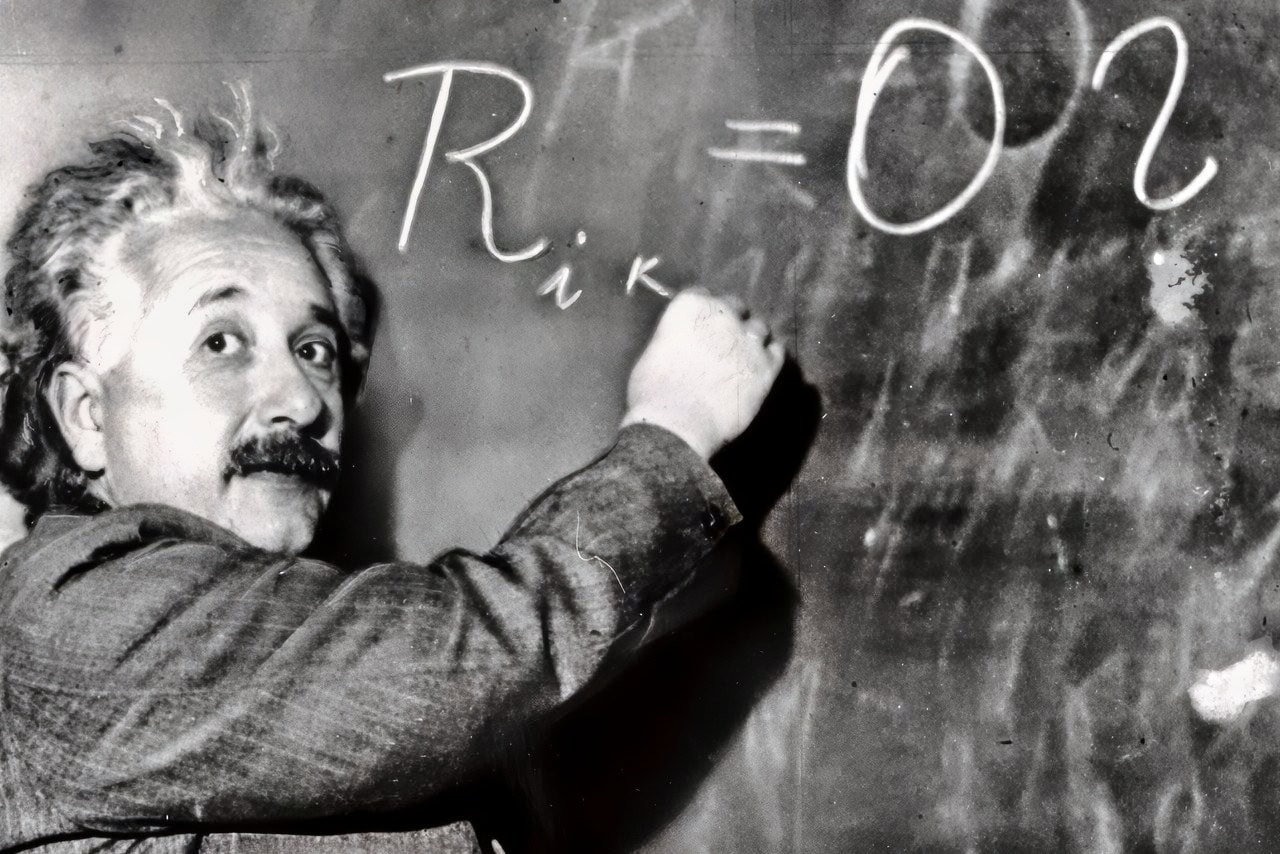
Albert Einstein and Atomic Bomb. Image Credit: Creative Commons.
Albert Einstein: The Clerk
Albert Einstein was born on March 14, 1879, in Ulm, Germany, and the most famous fact about his schooling is false: he never failed mathematics, and, by his own later account, he had mastered calculus by age 15.
The true version is better. At sixteen, he failed the entrance examination for the Zurich Polytechnic, excelling in the mathematics and physics sections and falling short in the rest.
He spent a year at a Swiss secondary school and got in. After graduating in 1900, he could not land an academic post, and so the century’s greatest theoretical physicist began his working life as a third-class technical examiner at the Swiss patent office in Bern, reviewing inventions by day and doing physics in the margins.
From that desk, in 1905, at age 26, came the annus mirabilis, the miracle year: four papers, any one of which would have made a career. One explained the photoelectric effect by proposing that light itself comes in discrete quanta, the founding document, ironically, of the quantum theory he would spend his last three decades resisting.
One proved the physical reality of atoms through Brownian motion. One introduced special relativity, reshaping our understanding of space and time. And a short follow-up derived the equivalence of mass and energy, the relation the world knows as E=mc².
The Summit
The rise carried him through professorships in Zurich and Prague to Berlin in 1914, where, in November 1915, he completed the general theory of relativity, recasting gravity itself as the curvature of space and time.
When a British eclipse expedition under Arthur Eddington confirmed in 1919 that starlight bent around the sun by the amount the theory predicted, Einstein woke to a fame no scientist had known before or would know since; the wild hair and the violin became global property.
The Nobel Prize followed in 1921, and here sits one of history’s great trivia corrections: it was awarded not for relativity, which the committee still considered unproven, but for the photoelectric effect, the quantum paper.
The founder of relativity won a Nobel for founding quantum theory, which makes what happened next one of science’s richest ironies.
The Argument
Through the mid-1920s, Born, Werner Heisenberg, Niels Bohr, and a brilliant generation built quantum mechanics into a complete machinery, and at its heart sat probability: the theory would tell you the odds of an outcome, and no deeper gears determined which outcome occurred.
It worked spectacularly. Einstein never disputed that it worked; his 1926 letter concedes the theory’s power in its first breath.
What he could not accept was that it was finished, that chance sat at the bottom of the world with nothing beneath it, and for the rest of his life, he probed for the missing floor.
At the Solvay conferences of 1927 and 1930, he dueled Bohr with ingenious thought experiments, each patiently dismantled, and their exchange hardened into legend, including the famous retort, reportedly delivered in some form by an exasperated Bohr, that Einstein should stop telling God what to do; the scholarly record notes the actual exchange was less theatrical than the anecdote.
In 1935, Einstein sharpened his objection in the EPR paper, arguing that quantum mechanics implied that linked particles influence each other instantly across any distance, which he later mocked in a letter to Born as “spooky action at a distance,” an absurdity that proved the theory incomplete.
The mockery backfired magnificently. John Bell showed in 1964 how to test it, the experimenters tested it for decades, and the 2022 Nobel Prize in Physics went to three of them for demonstrating that the spooky action is real, that entanglement is a fact of nature, and that the hidden gears Einstein hoped for, in any local form, do not exist.
He lost the argument, and the loss was the most productive in scientific history: the entanglement he had dismissed as an absurdity now powers quantum computing, quantum cryptography, and an entire field of information science, fields that exist because his objections forced the question. Born, for his part, received his own Nobel in 1954, for the probabilistic interpretation his friend’s letter had attacked, and the two argued warmly, by mail, to the end.
The Refugee and the Letter He Regretted
History gave the abstract argument a terrible sequel.
When Hitler took power in 1933, Einstein, a Jew whose books were burned, renounced his German citizenship and settled at the Institute for Advanced Study in Princeton for the rest of his life. In August 1939, at the urging of the physicist Leo Szilard, he signed the letter to President Roosevelt warning that Germany might build an atomic bomb, the letter that set in motion what became the Manhattan Project.

Fat Man Nuclear Bomb from National Museum of the U.S. Air Force. 19FortyFive.com Image.

Mark-17 Nuclear Bomb 19FortyFive.com Image

Nuclear Bomber Image Taken at National Museum of the Air Force by 19FortyFive.com
Precision matters, and the record is clear: Einstein was deeply involved in the letter itself, but he knew little about weapons physics, was never granted the security clearance to work on the bomb, and contributed nothing to its design.
When the war ended, and no German bomb had ever been close, he was blunt, saying that had he known the Germans would not succeed, he would never have lifted a finger.
He spent his final decade campaigning against the weapons his equation haunted, warning, in words this publication has traced before in their own polished-variant way, that a fourth world war would be fought with sticks and stones.
He declined the presidency of Israel in 1952, worked at his unified field theory to the last, and died at Princeton on April 18, 1955, having refused the surgery that might have bought him time, with pages of equations at his bedside. He was cremated and his ashes scattered at an undisclosed place, at his own wish: no grave, no shrine.
The Sentence at 99
The dice sentence endures because it distills a great scientist wagering his authority on how deep the world’s orderliness goes, and being wrong in the most honorable way available: in public, with reasons, against friends, for thirty years.
The polish into “God does not play dice” cost it its warmth; the original, with its teasing Old One and its inner voice, is a friend needling a friend, not a prophet thundering. And the argument it opened is the rare one where losing built more than winning would have, since every quantum computer that runs today is, in a sense, the trophy of the debate Einstein started and lost.
Ninety-nine years on, with the hundredth anniversary due this December, the dice keep rolling, exactly as he insisted they could not, and the science that proved it stands on the shoulders of his refusal to believe it.
About the Author: Harry J. Kazianis
Harry J. Kazianis (@Grecianformula) was the former Senior Director of National Security Affairs at the Center for the National Interest (CFTNI), a foreign policy think tank founded by Richard Nixon based in Washington, DC. Harry has over a decade of experience in think tanks and national security publishing. His ideas have been published in the NY Times, The Washington Post, The Wall Street Journal, CNN, and many other outlets. He has held positions at CSIS, the Heritage Foundation, the University of Nottingham, and several other institutions related to national security research and studies. He is the former Executive Editor of the National Interest and the Diplomat. He holds a Master’s degree focusing on international affairs from Harvard University.

