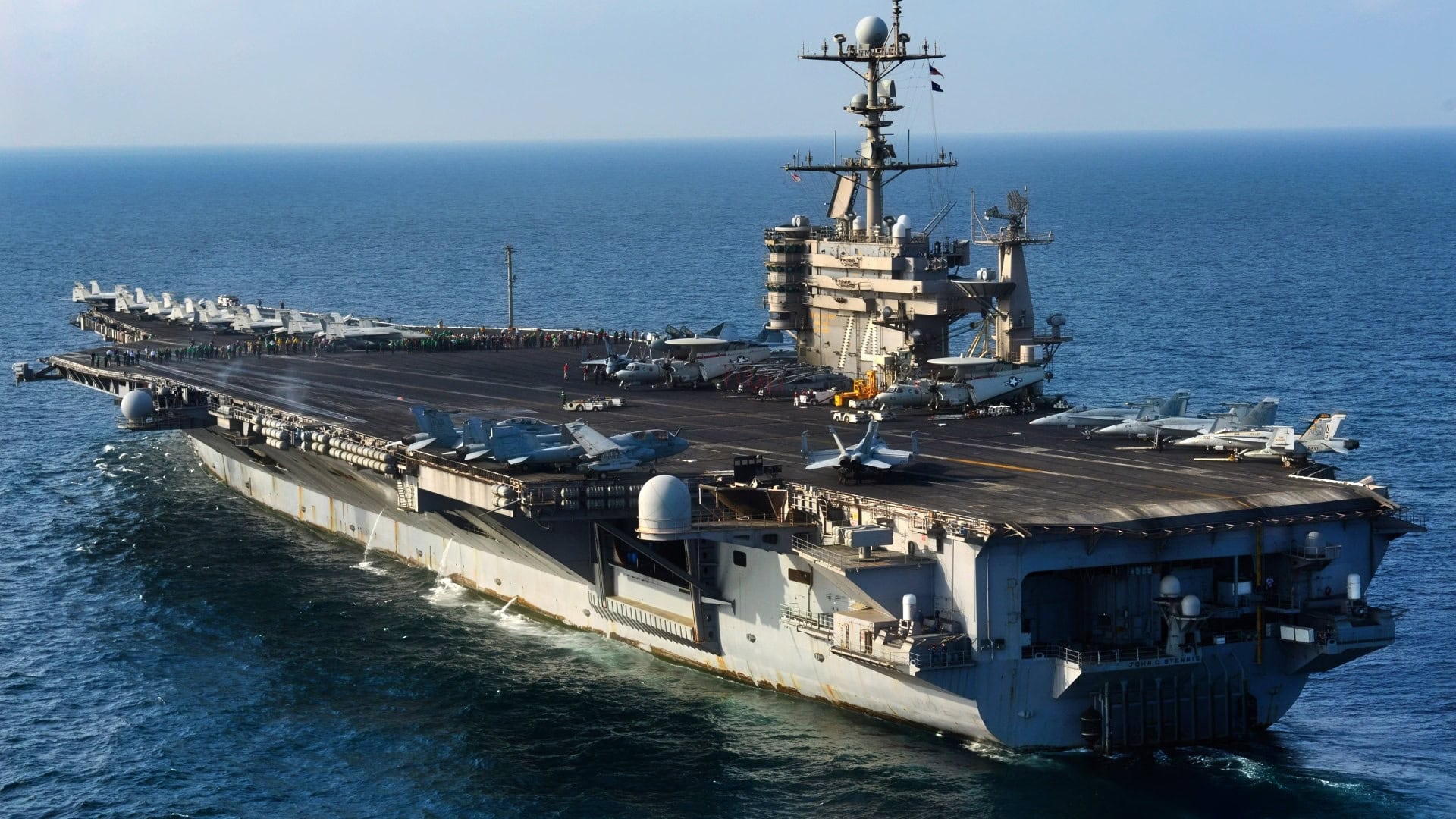
We’ve all come to take America’s vaunted 11-ship-strong aircraft carrier fleet for granted. But the recent round of warfare in the Middle East between the United States and the Islamic Republic of Iran has demonstrated how precarious managing an aircraft carrier — especially in combat conditions — is. We all see the end-user side of the carrier force. But what does it take to keep a nuclear aircraft carrier going at sea?
Supporting a Floating City
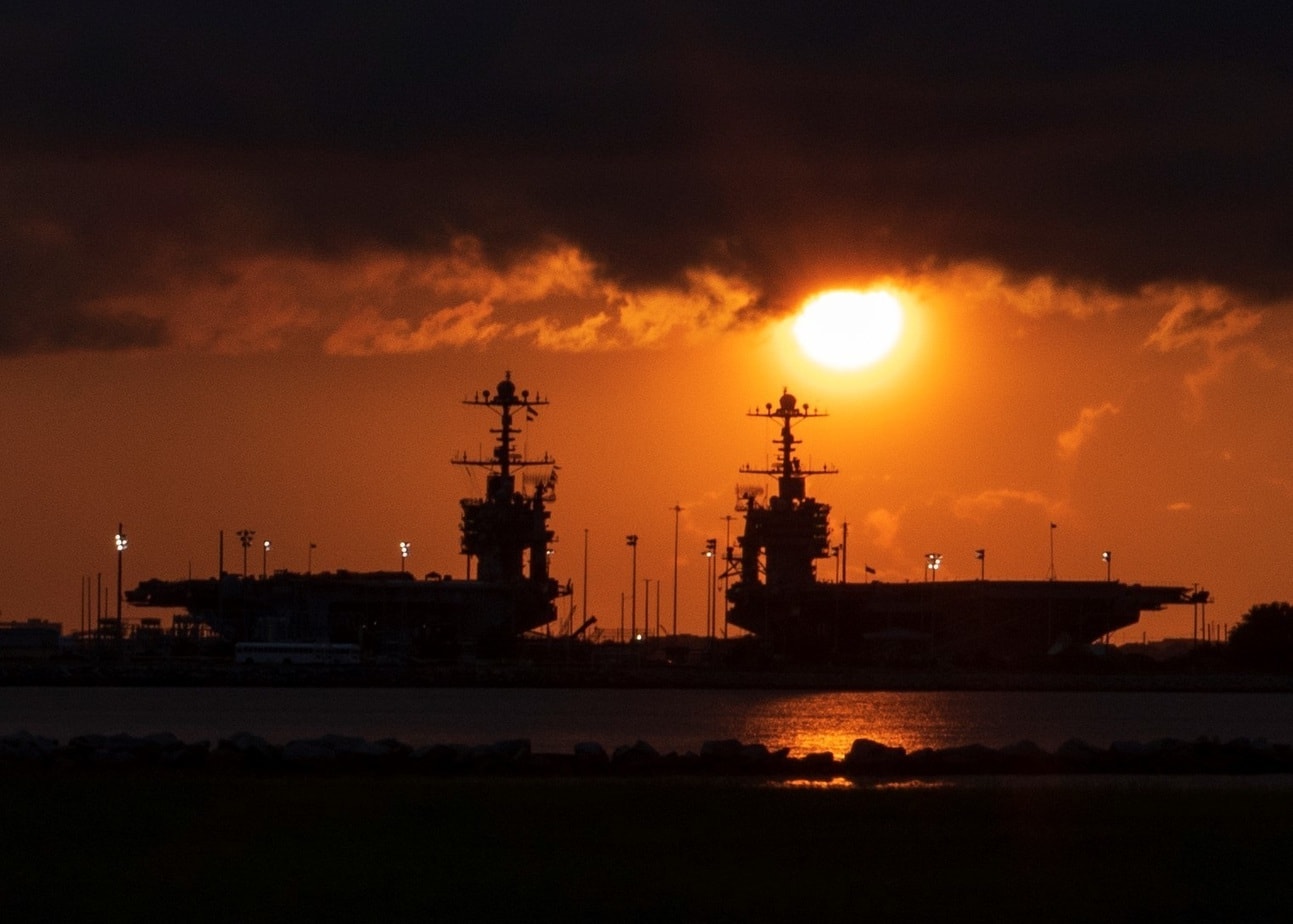
NORFOLK (Aug. 16, 2019) The Nimitz-class aircraft carriers USS Dwight D. Eisenhower (CVN 69), left, and USS John C. Stennis (CVN 74) moored at Naval station Norfolk. Making port at Naval station Norfolk is a routine activity for aircraft carriers.
That’s the carrier and its impressive air wing.
We don’t appreciate (nor do many civilian leaders and pundits) how complex and extensive the processes for maintaining those carriers at sea are.
The slightest change or complication to that logistical underpinning of the carrier fleet, as we’ve already seen, could end in disaster.
Keeping a 100,000-ton nuclear-powered aircraft carrier moving is a herculean feat.
No, it’s not a fuel problem.
The two onboard nuclear reactors on either a Nimitz-class or a newer Gerald R. Ford-class aircraft carrier can sustain a carrier for decades (roughly 25 years).
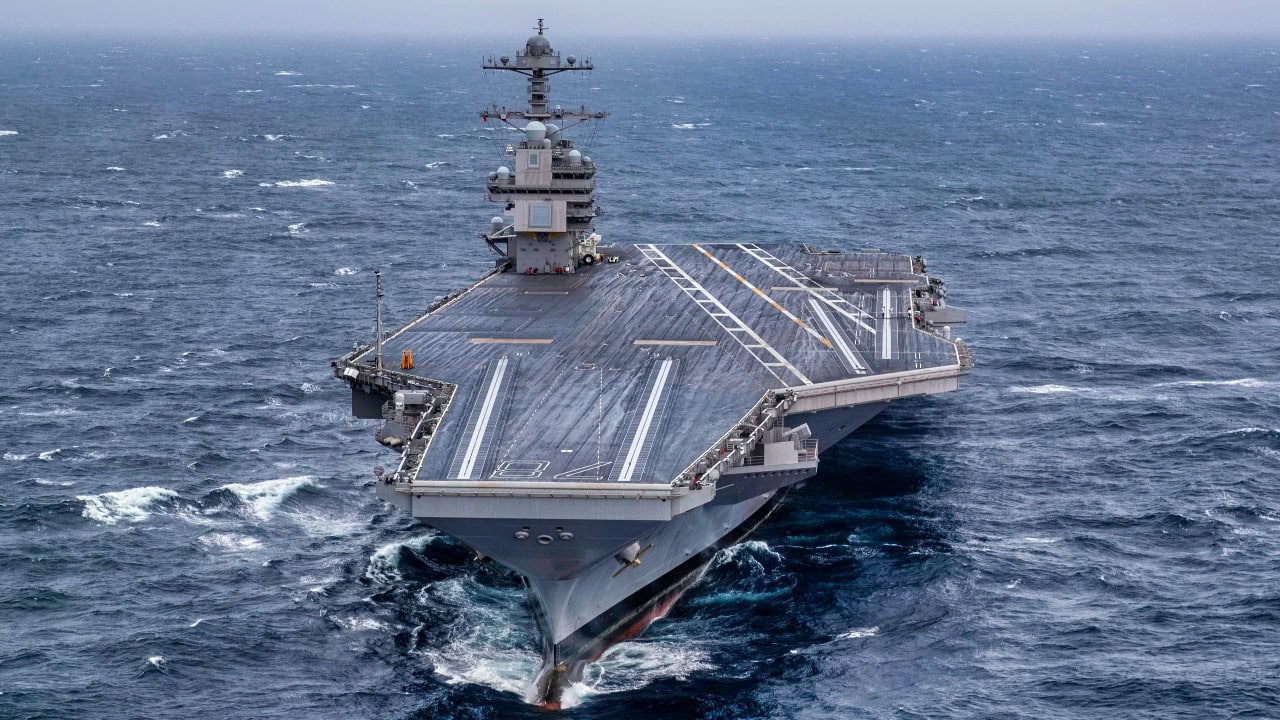
ATLANTIC OCEAN (Oct. 27, 2019) USS Gerald R. Ford (CVN 78) steams in the Atlantic Ocean for the first time since July 2018. Ford is conducting sea trials following its 15 month post-shakedown availability. (U.S. Navy photo by Mass Communication Specialist 3rd Class Connor Loessin)
But sustaining the crew and the parts for the ship, as well as the fixed- and rotor-wing aircraft that comprise the carrier’s air wing, is another matter entirely.
The carrier’s nuclear reactors provide 700,000 total horsepower.
These twin reactors use weapons-grade highly enriched uranium (HEU) to power the ship for up to 25 years.
The core has enormous power; it produces cleanly and uses only 8.8 pounds of HEU per week.
That’s astonishing when you consider the size and complex operations–as well as the duration of an average deployment–involved in carrier operations.
At that 25-year mark, the Navy sends the carrier back to port, where it receives a complex overhaul, including midlife refueling of the ship’s potent reactors.
The reactors are opened, and the depleted nuclear modules are replaced with new ones.
The Crew’s Needs
Just look at the crew’s needs.
The ship carries a crew of around 5,000 people.
The Navy has to feed all those mouths, three squares a day.
One YouTube video highlights the staggering amount required to sustain the caloric needs of 5,000 people deployed at sea for more than seven months.
Navy cooks prepare upwards of 18,000 meals every day the carrier is on deployment.
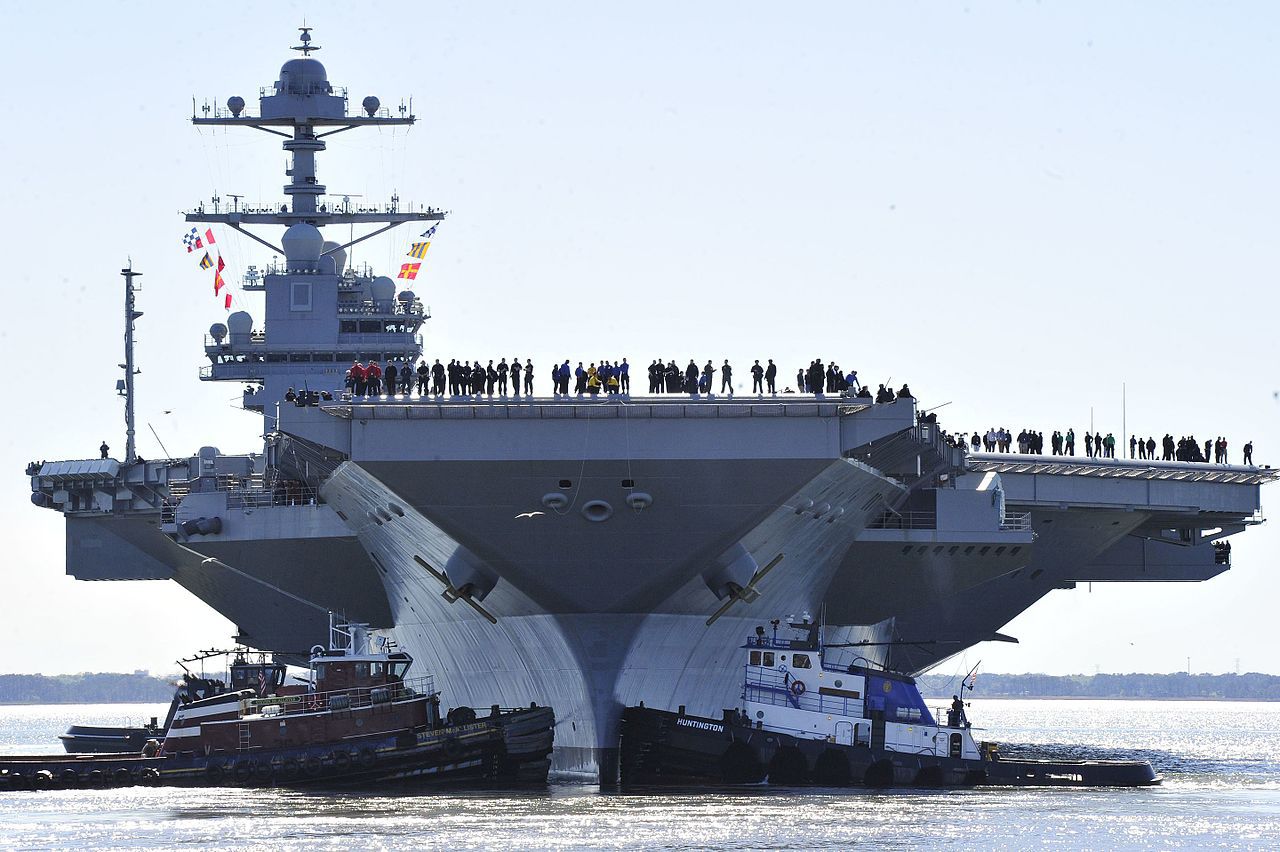
NEWPORT NEWS, Va. (April 8, 2017) – Pre-Commissioning Unit Gerald R. Ford (CVN 78) Sailors man the rails as the ship departs Huntington Ingalls Industries Newport News Shipbuilding for builder’s sea trials off the coast. The first- of-class ship—the first new U.S. aircraft carrier design in 40 years—will spend several days conducting builder’s sea trials, a comprehensive test of many of the ship’s key systems and technologies. (U.S. Navy photo by Chief Mass Communication Specialist Christopher Delano).
Some estimates place the monthly cost of feeding 5,000 humans under stressful conditions at around $1.5 million.
The daily cost is upwards of $65,000.
Your average carrier requires 1,600 pounds of meat consumed by 5,000 people over 24 hours.
The order is to chop 350 pounds of lettuce per day.
The Navy wants the crew to drink 160 gallons of milk every day.
Thirty cases–not boxes–of cereal gets poured every morning on one of these leviathans.
Coffee, the lifeblood of any crew, fills at least 20,000 cups for 12-hour shifts on the carrier.
Meanwhile, the Navy has installed at least 87 vending machines, averaging 8,000 retail transactions per day.
That’s 15,000 individual snack items served during the course of those 12-hour shifts, often under harsh conditions.
Turning Saltwater Into Drinking Water
Desalination plants on the carrier draw heat from the two onboard nuclear reactors and distill seawater into 400,000 gallons of freshwater daily.
Of course, the ocean’s saltwater may be abundant, but converting it into potable water via desalination makes it a finite commodity onboard.
Crews are often restricted to 10-liter quick showers daily to conserve onboard supplies.
Carrying Jet Fuel
Then there’s the matter of maintaining the air wing.
Aviation fuel is not cheap and must always be in abundance.
The carrier may run on nuclear power.
Airplanes and helicopters, however, do not.
So, the carrier stores as much as six million gallons of JP-5 aviation fuel inside massive internal tanks.
That’s to say nothing of the refueling that can occur at sea, in which the carrier receives up to 1.3 million gallons of fuel via tensioned hoses–all while moving at a clip of about 20 knots.
Oh, and let us not forget that the carrier acts as a sort of mothership for the smaller vessels that comprise the carrier strike group.
Those escorts are not nuclear-powered.
These smaller ships must sometimes be refueled by the carrier itself, which is carrying fuel for the smaller vessels of the carrier strike group.
Even under the best of circumstances, maintaining an aircraft carrier at sea is a difficult task.
Under the degraded conditions in the Middle East, is it any wonder that America’s carriers are struggling to stay supplied, or that living conditions on these great ships are deteriorating?
About the Author: Brandon J. Weichert
Brandon J. Weichert is the Senior National Security Editor at 19FortyFive.com. He also manages The Weichert Brief on Substack. Weichert also hosts “National Security Talk” on Rumble. He is the author of four bestselling national security books, the most recent of which is A Disaster of Our Own Making: How the West Lost Ukraine (Encounter Books). Follow him via Twitter/X @WeTheBrandon.