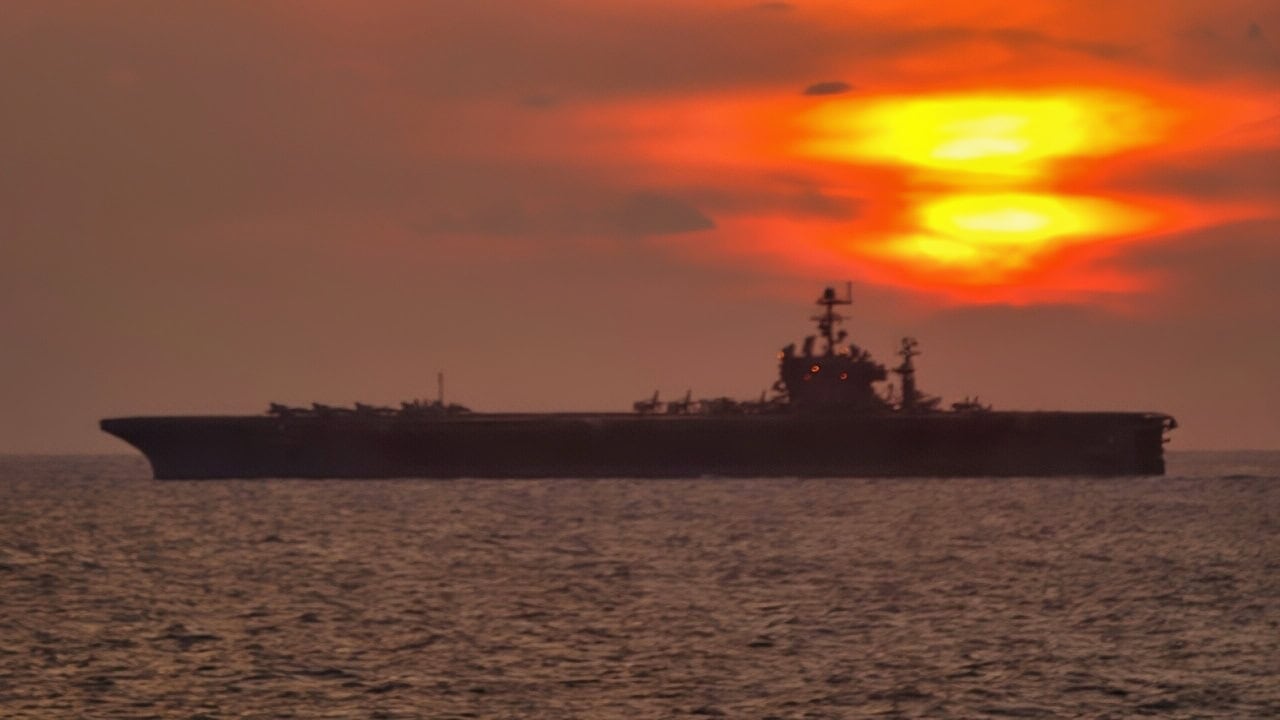
In December 2005, off the coast of California, a $100 million Swedish submarine sank a $6.2 billion American aircraft carrier. It did it more than once. HSwMS Gotland slipped through a screen of destroyers, guided-missile cruisers, attack submarines, and anti-submarine helicopters, entered the exclusion zone no enemy is supposed to reach, and put simulated torpedoes into USS Ronald Reagan. The US Navy was not ambushed. It was renting the submarine and its crew from Sweden for $17.5 million a year, specifically to find out whether this could happen. Twenty years later, the problem has not been solved.
How the US Navy ‘Lost’ An Aircraft Carrier and Never Learned the Lesson
America’s vaunted aircraft carriers have long been the source of prestige and power for the United States Navy.
It’s just too bad the rest of the world hasn’t remained in awe of these leviathans.
America’s many rivals have not only formulated counterattacks and ways to threaten the carriers that US naval planners never anticipated, but some allies have also warned Washington about how vulnerable the country’s carrier force is, especially to submarines.
The Event
During one such exercise in 2005, the Swedish Gotland-class diesel-electric submarine highlighted how dangerously exposed modern aircraft carriers were to submarine threats.
The USS Ronald Reagan was a newly constructed Nimitz-class aircraft carrier commissioned in 2005, costing American taxpayers $6.2 billion.
The Swedish diesel-electric submarine HSwMS Gotland cost a fraction of that and was manned by a smaller, more competent crew.
Few believed that the impressive nuclear-powered aircraft carrier, with its modern sensors and attendant carrier battle group, could be threatened the way it was during those 2005 exercises.
The Swedish submarine cost around $100 million to build, by the way.
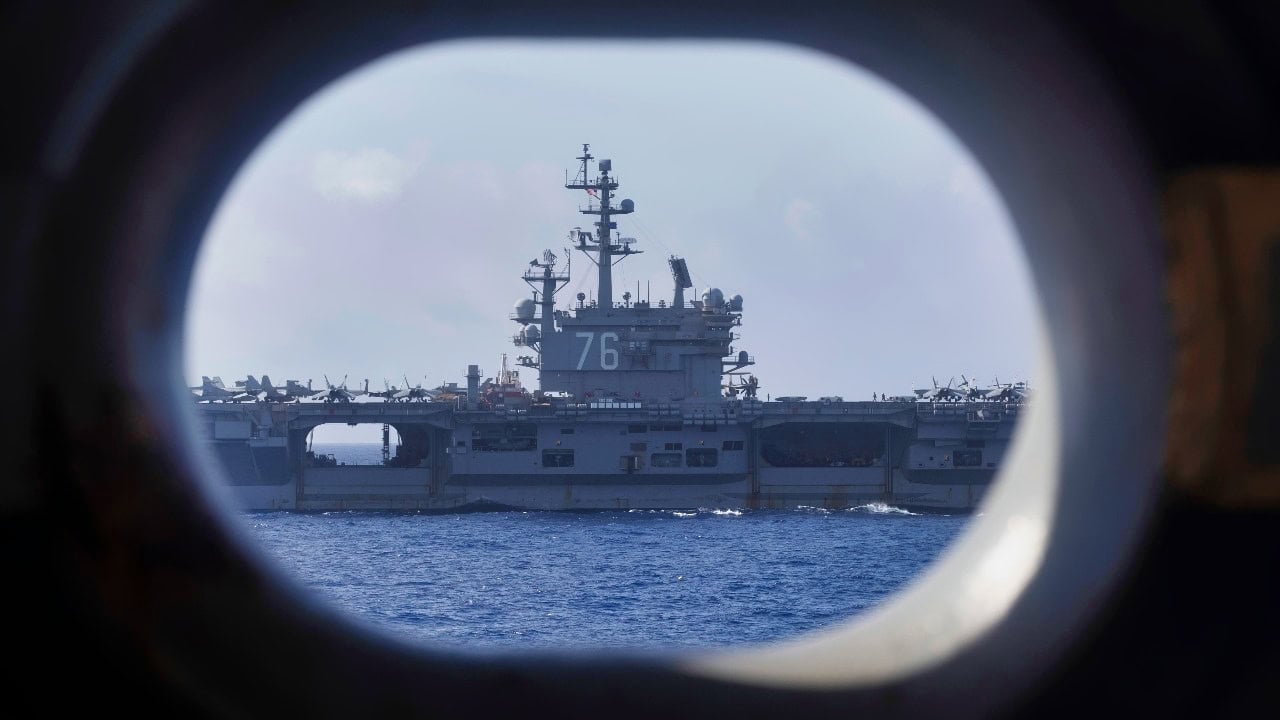
The aircraft carrier USS Ronald Reagan (CVN 76) sails alongside amphibious assault carrier USS Tripoli (LHA 7) during a photo exercise for Valiant Shield 2022, June 12, 2022. Exercises like VS22 allow forces across the Indo-Pacific the opportunity to integrate Navy, Marine Corps, Army, Air Force and Space Force to train in precise, lethal, and overwhelming multi-axis, multi-domain effects that demonstrate the strength and versatility of the Joint Force. Tripoli is operating in the U.S. 7th Fleet area of operations to enhance interoperability with allies and partners and serve as a ready response force to defend peace and maintain stability in the Indo-Pacific region. (U.S. Navy photo by Mass Communication Specialist 1st Class Peter Burghart)
The joint naval wargames in December 2005 off the coast of California showed how a diesel-electric submarine could maneuver cleanly through layers of destroyers, guided-missile cruisers, attack submarines, and anti-submarine helicopters–going so far as entering the so-called “red zone,” the area around an aircraft carrier that no enemy is supposed to get near, and hit the carrier multiple times with simulated torpedo strikes.
After the jarring results of the war game, US Navy planners studied the Swedish attacks on the Ronald Reagan.
They believed that the use of air-independent propulsion (AIP), which is different from what standard diesel submarines use, was a key element for the submarine passing unnoticed through the carrier’s extensive defensive perimeter.
The Stirling engine AIP system uses liquid oxygen and diesel fuel in a closed loop, allowing the submarine to remain submerged much longer than traditional diesel engines allow.
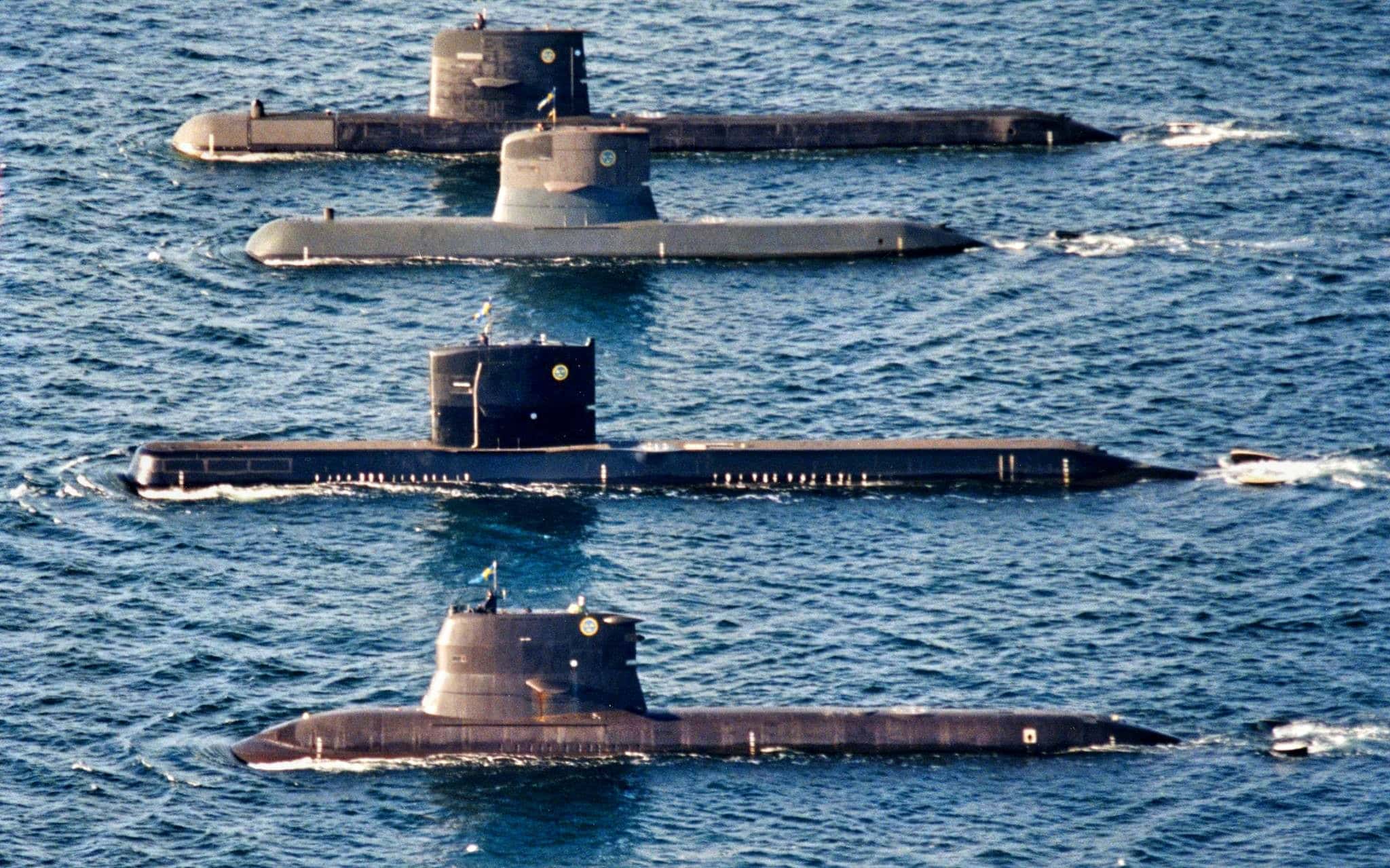
Gotland-Class Submarines and more from Sweden. Image Credit: Swedish Navy.
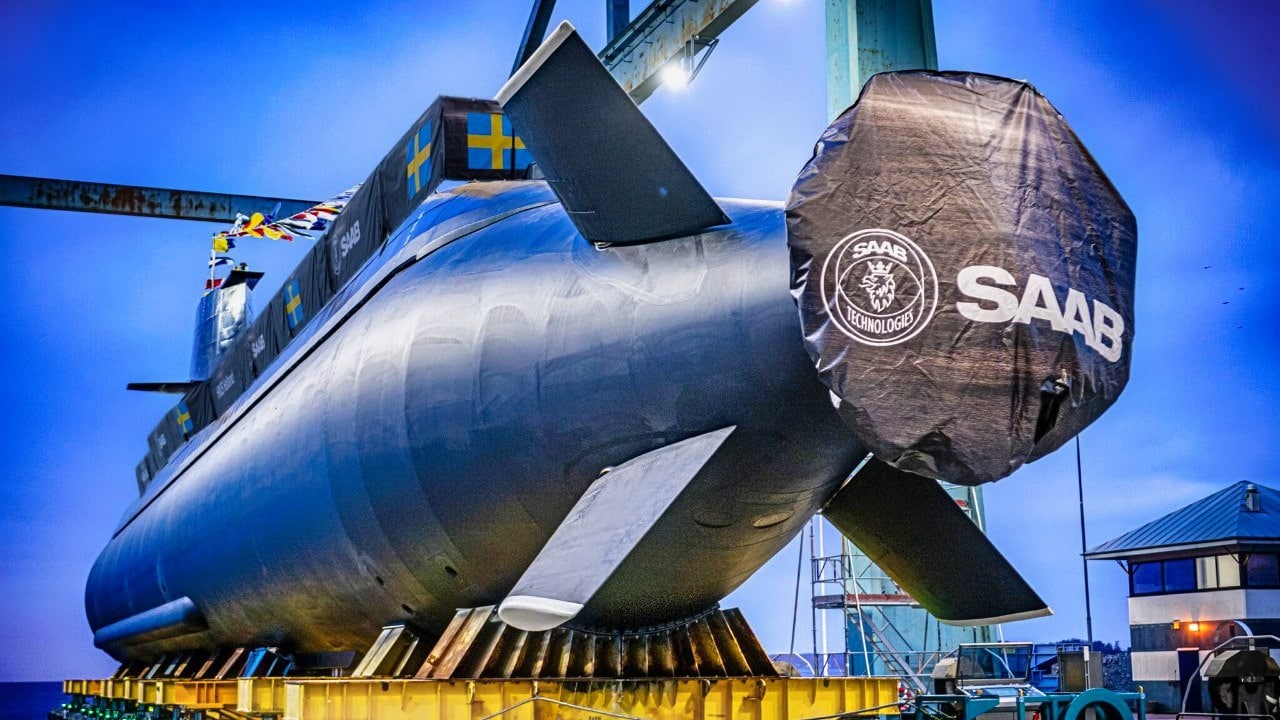
Gotland-Class. Image Credit: Saab.
What’s more, these AIP engines are significantly quieter than other forms of propulsion–even quieter than nuclear-powered engines.
AIP is quieter than nuclear-powered submarines because nuclear submarines must run coolant pumps to prevent their reactors from melting down.
That creates a hum that sonar operators on other ships and submarines can detect.
But the AIP produces no such hum.
Therefore, the Gotland in 2005 was quieter than even the ambient ocean background noise.
And the Gotland was designed to operate in shallow, or “cluttered,” maritime environments, such as the busy Baltic Sea.
Swedish engineers also designed their submarine with radar-absorbent coatings to make it harder to detect.
Of course, the 2005 exercises were not incidental.

USS KITTY HAWK, At Sea (May 17, 2005) – While departing Yokosuka’s harbor, USS Kitty Hawk (CV 63) steams past a small group of Japanese fishing vessels and steams toward Sagami Bay to conduct precision anchor checks. Currently underway in the 7th Fleet area of responsibility, Kitty Hawk demonstrates power, projection and sea control as the U.S. Navy’s only permanently, forward-deployed aircraft carrier, operating from Yokosuka, Japan..U.S. Navy photo by Photographer’s Mate 2ND Class William H. Ramsey.
The Navy knew the new ultra-quiet AIP technology could threaten US carriers.
So, they leased the Gotland (and its crew) from Sweden for $17.5 million annually to use the submarine in war games.
The Navy wanted to test how their systems–and how the carrier battle groups–would fare against such ultra-quiet submarines.
Still, it was a stunning moment when a $100 million non-nuclear submarine effectively destroyed a $6.2 billion, nearly irreplaceable nuclear-powered aircraft carrier that was heavily defended by the top-of-the-line US Navy defensive systems.
Not Learning the Hard Lessons
A year thereafter, the Navy was again surprised when a Chinese Song-class diesel-electric submarine came within range of the USS Kitty Hawk while she was underway in the Indo-Pacific.
That submarine, like the Gotland, had gone undetected before it came within torpedo range of the American carrier.
USS KITTY HAWK, At Sea (May 17, 2005) – While departing Yokosuka’s harbor, USS Kitty Hawk (CV 63) steams past a small group of Japanese fishing vessels and steams toward Sagami Bay to conduct precision anchor checks. Currently underway in the 7th Fleet area of responsibility, Kitty Hawk demonstrates power, projection and sea control as the U.S. Navy’s only permanently, forward-deployed aircraft carrier, operating from Yokosuka, Japan..U.S. Navy photo by Photographer’s Mate 2ND Class William H. Ramsey.
Somehow, the lessons from a year earlier in the exercises with Ronald Reagan had not been applied to the mission of the Kitty Hawk as it traversed the Pacific.
These incidents occurred 20 years ago.
The Navy has therefore had 20 years to prepare its vaunted carrier force for the kind of threat that diesel submarines obviously pose to American carriers.
Yet today, the US carrier force remains highly vulnerable to these submarines — despite more advanced systems being installed on the carriers and even an entirely new class of carrier being constructed.
China Can Sink an American Aircraft Carrier
Still, fears of diesel-electric–notably AIP–submarines persist.
These fears today are so pronounced that many naval planners plan for contingencies in which carriers cannot even be deployed to combat because the threat of AIP submarines is so severe.
How did the Navy let things get this way?
Why did the Navy keep spending gobs of tax dollars on building carriers that remain as vulnerable to increasingly advanced AIP engine submarines as they were back in 2005 and 2006?
About the Author: Brandon J. Weichert
Brandon J. Weichert is the Senior National Security Editor at 19FortyFive.com. He also manages The Weichert Brief on Substack. Weichert also hosts “National Security Talk” on Rumble. He is the author of four bestselling national security books, the most recent of which is A Disaster of Our Own Making: How the West Lost Ukraine (Encounter Books). Follow him via Twitter/X @WeTheBrandon.