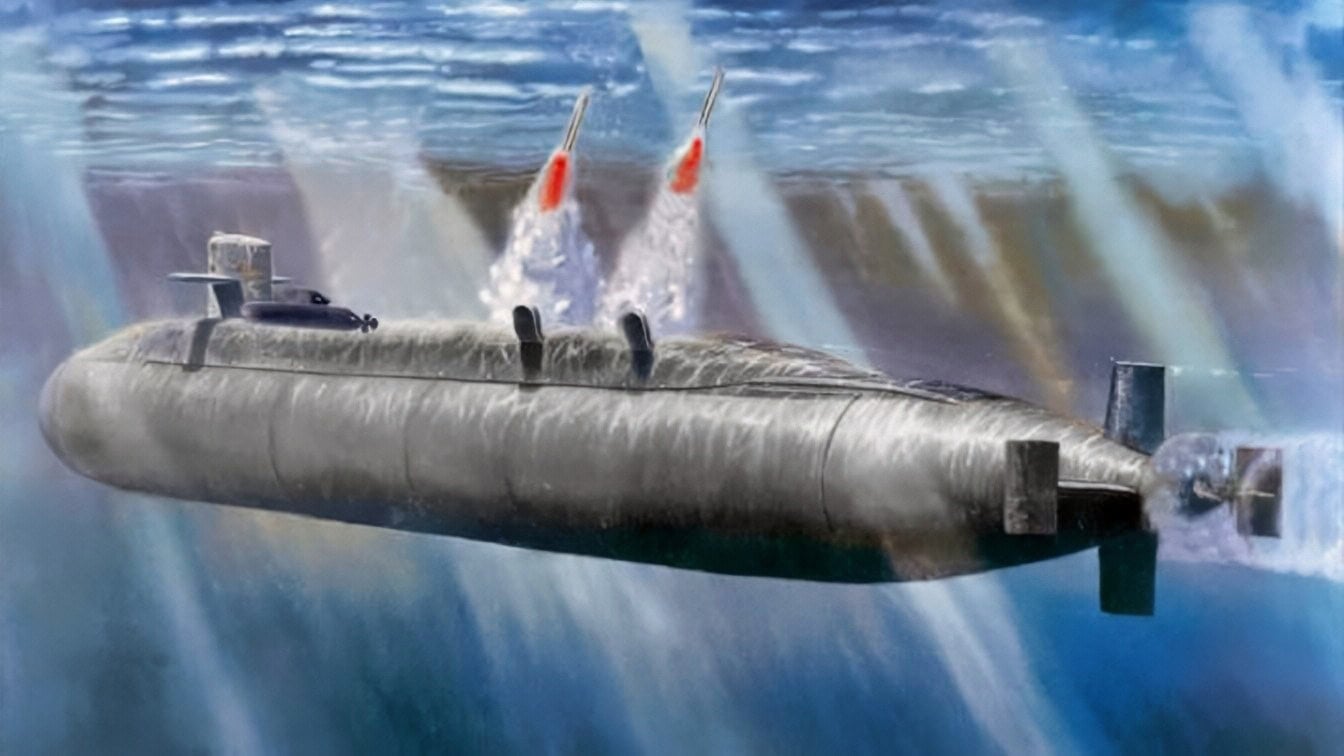
There was a time when America’s nuclear submarine force instilled fear in the hearts and minds of America’s adversaries. One such incident occurred in 2010 when the United States Navy demonstrated its undersea firepower across the Indo-Pacific in a rare example of power. In 2010, three Ohio-class guided-missile submarines surfaced simultaneously in three separate locations across what is today known as the Indo-Pacific.
Once-In-a-Lifetime Event
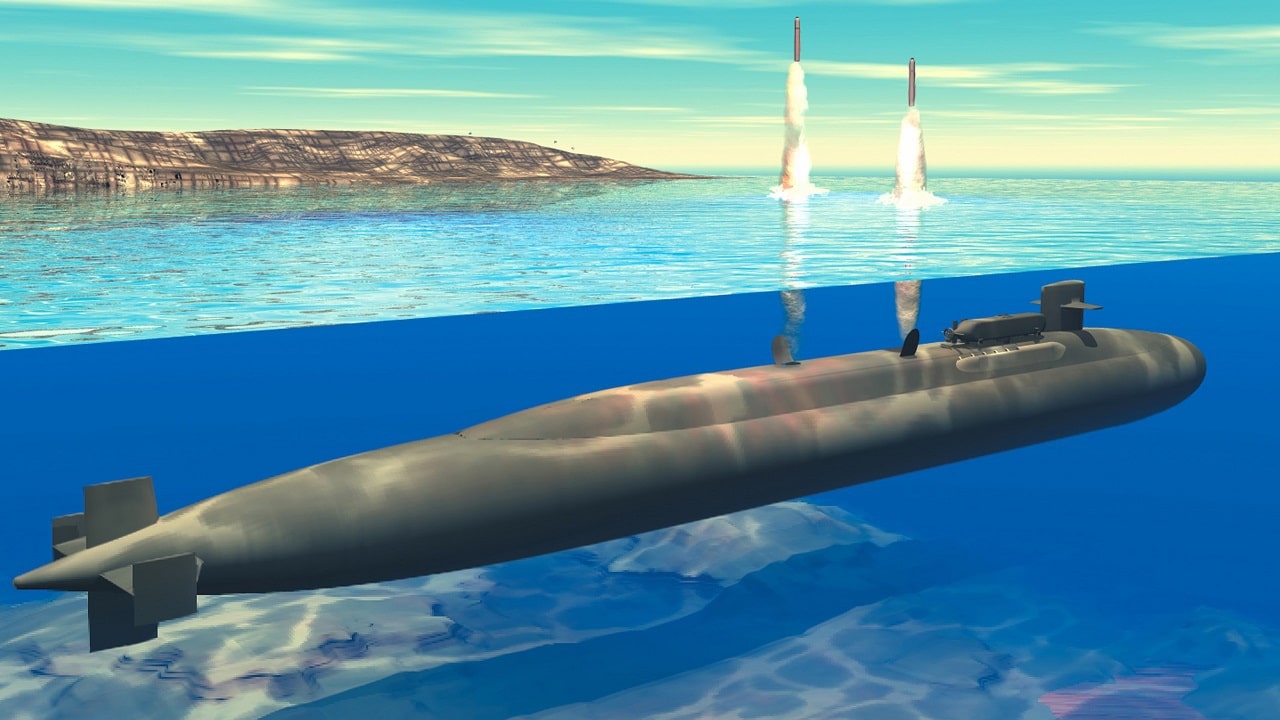
Artist’s concept of an Ohio-class SSGN launching Tomahawk Land Attack Missiles.
At the time, the USS Ohio surfaced at Subic Bay in the Philippines, the USS Michigan surfaced at Busan, South Korea, and the USS Florida surfaced at Diego Garcia in the Indian Ocean.
The three subs carried upwards of 462 Tomahawk land-attack cruise missiles.
That incident, while not officially directed at any particular nation, was believed to be aimed squarely at Beijing.
At that time, China was undergoing a significant military buildup and was expanding its missile forces (while engaging in increasingly aggressive behavior in its own region).
Sixteen years later, the United States finds itself in the most untenable strategic position it has been in since the interwar years of the twentieth century.
China’s military is growing not only in size but in capability.
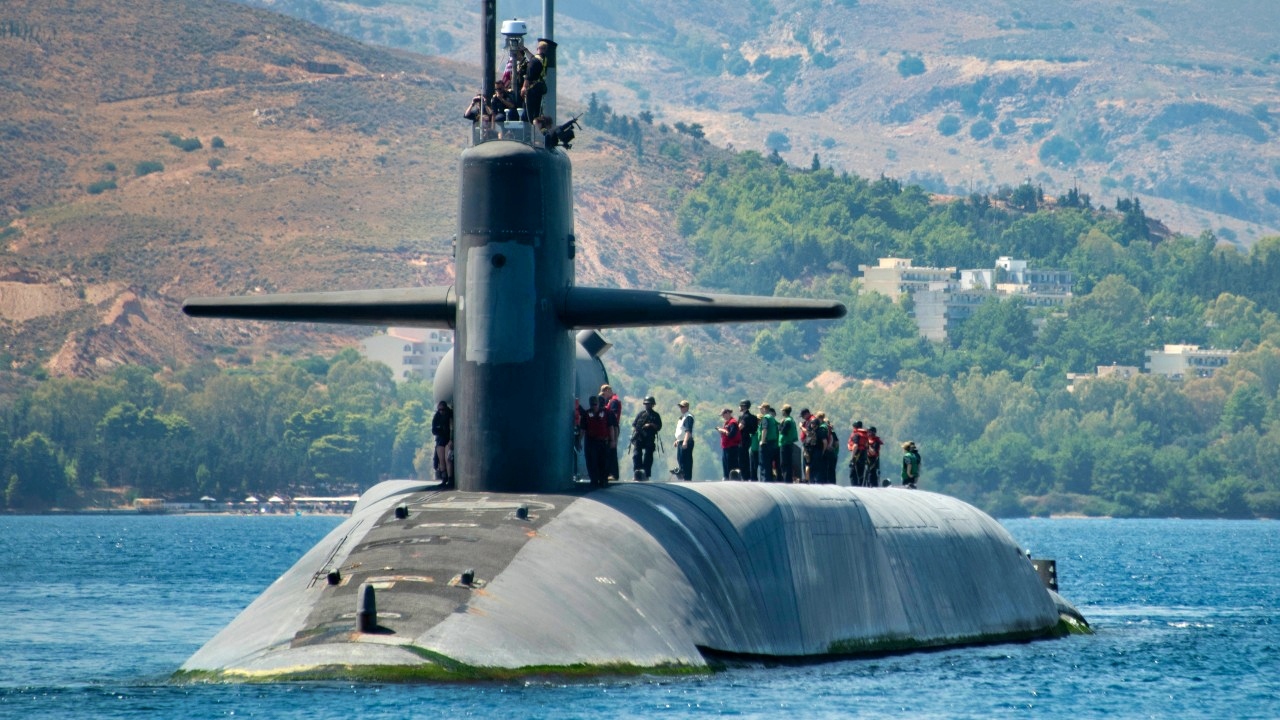
190907-N-UR565-0660NAVAL SUPPORT ACTIVITY SOUDA BAY, Greece (Sept. 7, 2019) The Ohio-class cruise missile submarine USS Florida (SSGN 728) arrives in Souda Bay, Greece, for a scheduled port visit, Sept. 7, 2019. NSA Souda Bay is an operational ashore base that enables U.S., allied, and partner nation forces to be where they are needed and when they are needed to ensure security and stability in Europe, Africa, and Southwest Asia. (Photo by Joel Diller/Released)
Meanwhile, the United States is trying to keep up with China’s expansion.
Unfortunately, the American industrial base is unable to keep up, and the number of platforms the United States military is retiring exceeds the number of new platforms — notably submarines — coming online today.
Beyond that, the 2010 incident was a unique moment in history. In many respects, 2010 was the apex of America’s post-Cold War “unipolar moment” in the Pacific. Since then, the region has decisively shifted toward China.
The United States also relies on conventional forms of power projection, such as submarines, believing these platforms remain the most dominant and effective means of projecting naval power.
But in the age of drones and anti-access/area-denial (A2/AD), the Americans are completely outmatched.
Still, the firepower that America’s four Ohio-class SSGNs brought into any fight in the post-Cold War era was something to marvel at–and something to lament, considering that such firepower is not available today for America’s submarine force without the Ohio-class SSGNs.
And those are going away.
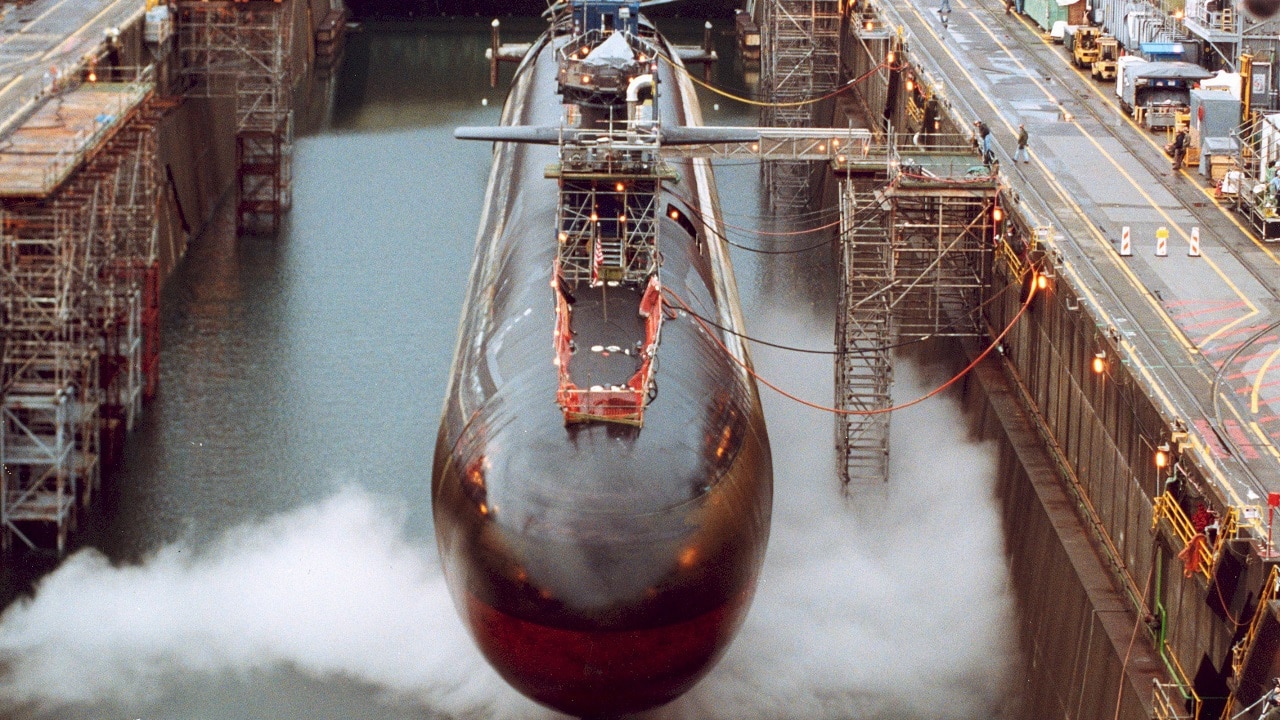
Puget Sound Naval Shipyard, Wash. (Aug. 14, 2003) — USS Ohio (SSGN 726) is in dry dock undergoing a conversion from a Ballistic Missile Submarine (SSBN) to a Guided Missile Submarine (SSGN) designation. Ohio has been out of service since Oct. 29, 2002 for conversion to SSGN at Puget Sound Naval Shipyard. Four Ohio-class strategic missile submarines, USS Ohio (SSBN 726), USS Michigan (SSBN 727) USS Florida (SSBN 728), and USS Georgia (SSBN 729) have been selected for transformation into a new platform, designated SSGN. The SSGNs will have the capability to support and launch up to 154 Tomahawk missiles, a significant increase in capacity compared to other platforms. The 22 missile tubes also will provide the capability to carry other payloads, such as unmanned underwater vehicles (UUVs), unmanned aerial vehicles (UAVs) and Special Forces equipment. This new platform will also have the capability to carry and support more than 66 Navy SEALs (Sea, Air and Land) and insert them clandestinely into potential conflict areas. U.S. Navy file photo. (RELEASED)
The Ohio-Class SSGN
Anyway, the Ohio-class SSGNs have a unique history. Originally designed as another cluster of Ohio-class ballistic missile submarines during the Cold War, the Ohio, Michigan, Florida, and Georgia were converted into guided-missile submarines, with 22 of their 24 large missile tubes capable of carrying canisters with seven Tomahawk cruise missiles each.
Each sub could theoretically carry 154 Tomahawks. The remaining two silos were converted into chambers capable of carrying special operations elements.
The 2010 experience was an amazing example of the United States’ virtually unparalleled military power. Washington cannot do something like that in the current strategic environment.
With the Ohio-class SSGNs set to be decommissioned by 2029, the Navy will not have a comparable replacement.
Yes, the Navy is building Virginia-class submarines that the service claims will be guided-missile submarines. But that’s just a designation on paper.
No Virginia-class submarine has the kind of individual carrying capacity for Tomahawks that those four Ohio-class SSGNs did.
They cannot bring that kind of firepower to bear–at least they won’t be able to without many more Virginia-class SSGNs being built, which won’t happen for many years to come.
China’s Rising Capacity
And as America’s SSGN capacity rapidly decreases over the next three years, China continues building its own capabilities.
Indeed, China’s Type 093B, the Shang III-class, appears to be Beijing’s first major attempt at building a dedicated nuclear-powered guided-missile submarine.
China completed the first Type 093B in 2022. American intelligence sources believe that five more of these submarines were launched at the end of 2024.
Another two were deployed in 2025, and one more unit may have been built and deployed this year.
At the same time, some analysts are skeptical that the Type 093B is directly akin to the Ohio-class SSGN. The missile capacity of the Type 093B’s missile capacity appears smaller.
What’s more, the Type 093B has not (yet) demonstrated it can successfully launch the kind of massive salvos of land-attack cruise missiles that the Ohio-class SSGNs have repeatedly demonstrated over the years.
China Builds Its Force
Although the primary mission of the Type 093B might be different than that of the old, retiring Ohio-class SSGNs. It appears as though the Type 093B might be packing some of China’s new high-speed anti-ship ballistic missiles (ASBMs), which are not about hitting land-based targets.
They’re about obliterating American surface warships — notably aircraft carriers, which remain the primary form of US Navy power projection.
What’s more, China’s mass production capabilities mean that it can simultaneously expand its current fleet while creating newer, bigger, and more capable submarines at a time when the Americans are struggling to do anything comparable.
Given this reality, the 2010 experience in which three Ohio-class SSGNs surfaced nearly simultaneously across the Pacific Ocean, thereby sending a clear–and powerful–signal of deterrence to Beijing.
The United States cannot do that again today.
In fact, by the end of the decade, it won’t be able to rely upon any of its Ohio-class SSGNs, as they are being retired with no truly comparable replacement.
About the Author: Brandon J. Weichert
Brandon J. Weichert is the Senior National Security Editor at 19FortyFive.com. He also manages The Weichert Brief on Substack. Weichert also hosts “National Security Talk” on Rumble. He is the author of four bestselling national security books, the most recent of which is A Disaster of Our Own Making: How the West Lost Ukraine (Encounter Books). Follow him via Twitter/X @WeTheBrandon.