
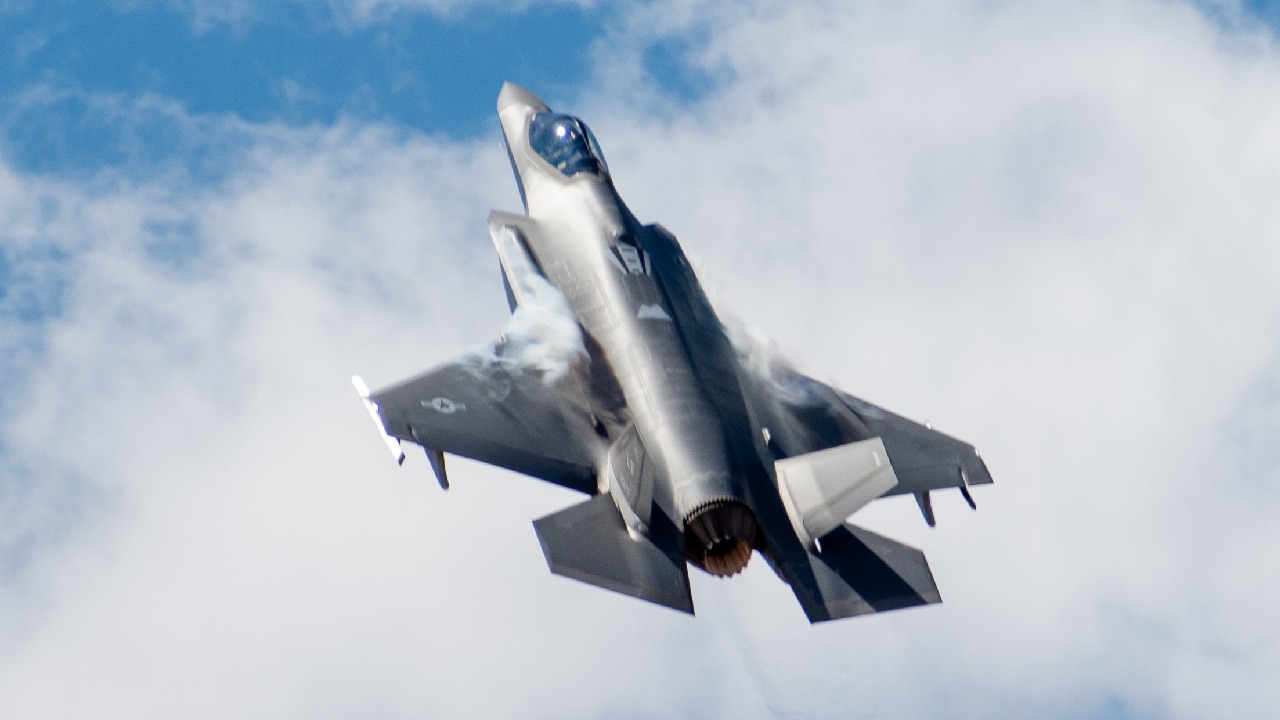
Summary and Key Points: An F-35 flying as designed carries 5,700 pounds of weapons, all of it inside the aircraft, and is very difficult to detect on radar. An F-35 in what Lockheed Martin’s marketing department christened “beast mode” carries 22,000 pounds — nearly four times as much — with most of it hanging off the wings where every hard edge throws a return. The stealth the aircraft exists for is gone. Pilots train for it anyway. “Even though the F-35 is an incredibly powerful aircraft, when you strap on six heavy-weight laser-guided bombs and missiles, it flies dramatically different,” said Lieutenant Colonel Peter Cossette of the 63rd Fighter Squadron. And Israeli F-35Is used the configuration in combat in 2025.
The F-35 Can Go Beast Mode
In the aviation world, when an aircraft flies in “beast mode,” that means that the aircraft is carrying its maximum ordnance load on its external and internal hardpoints, depending on the aircraft.
The term first arose from a Lockheed Martin graphic advertising the F-35’s maximum payload capacity, though it has since been applied to several other aircraft as well.
In training missions, pilots are often taught to fly the F-35 in its beast-mode configurations, with weapons stationed on all its internal and external hardpoints.
But why?
Why does one of the most advanced stealth fighters operate in a configuration that compromises its stealth characteristics?
Why Fly an F-35 in “Beast Mode?”
The Lockheed Martin F-35 Lightning II is a fifth-generation multi-role fighter. In its typical stealth-oriented configuration, the aircraft can carry up to 5,700 lbs in its internal weapons bays.
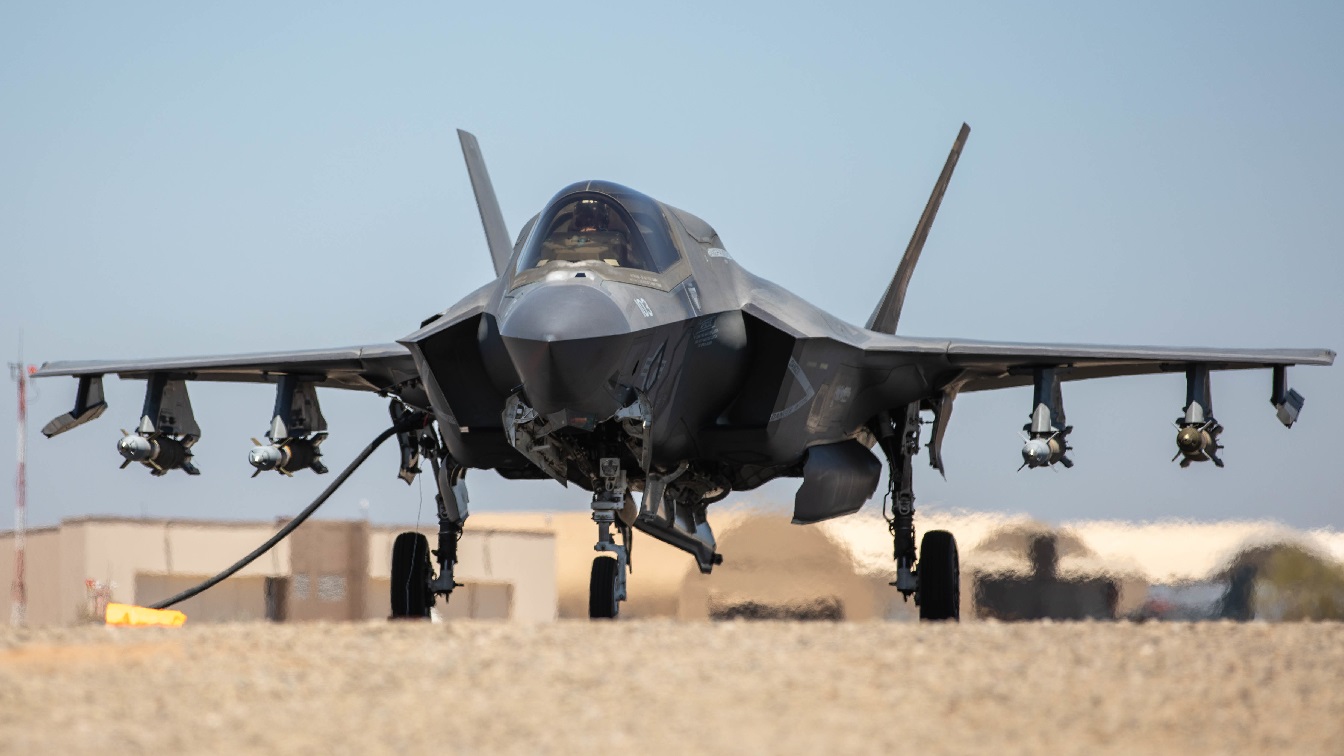
U.S. Marines with Marine Wing Support Squadron 371 , Marine Air Control Group 38, 3rd Marine Aircraft Wing (MAW), refuel a U.S. Marine Corps F-35B Lightning II with Marine Fighter Attack Squadron 225, Marine Aircraft Group (MAG) 13, 3rd MAW, on a Forward Arming and Refueling Point at U.S. Army Yuma Proving Grounds, Yuma, Arizona, May 23, 2022. The weapons configuration consists of six inert guided bombs, four mounted onto the wings and two loaded into the weapons bay, as well as an Air Intercept Missile 9X. Marine Aircraft Group 13 forces are capable of conducting offensive air support, anti-aircraft warfare, and aviation reconnaissance from expeditionary sites in any clime and place. (U.S. Marine Corps photo by Sgt. Samuel Ruiz)

NAS PATUXENT RIVER, Md. — An F-35 Lightning II test pilot conducts the first flight test to certify the F-35B short takeoff and vertical landing variant of the fighter aircraft for carrying the AGM-158C Long-Range Anti-Ship Missile (LRASM). As part of ongoing weapon integration efforts, the Pax River F-35 Integrated Test Force (Pax ITF) team for the first time flew test flights Jan. 14 with two AGM-158 loaded on external stations. LRASM is a defined near-term solution for the Offensive Anti-Surface Warfare (OASuW) air-launch capability gap that will provide flexible, long-range, advanced, anti-surface capability against high-threat maritime targets. The Pax River ITF’s mission is to effectively plan, coordinate, and conduct safe, secure, and efficient flight test for F-35B and C variants, and provide necessary and timely data to support program verification / certification and fleet operational requirements.
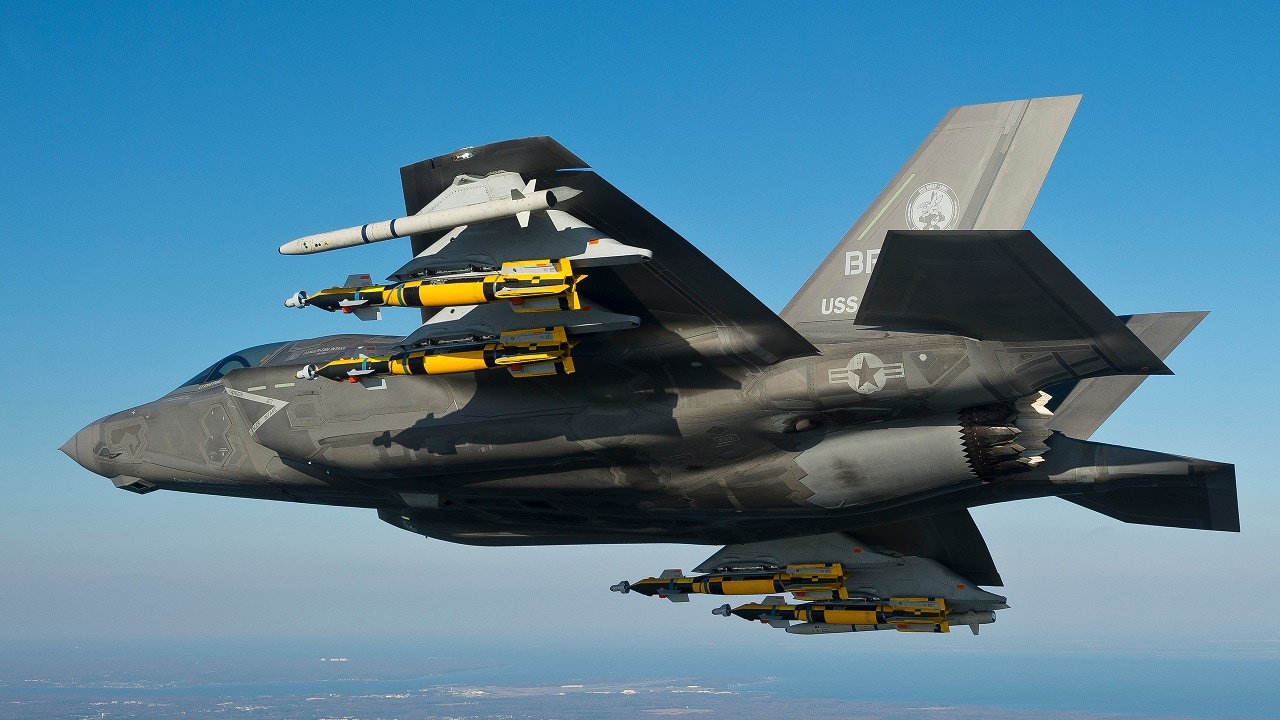
F-35 Joint Strike Fighter. Image Credit: Lockheed Martin.
In beast mode, however, that number rises to 22,000 lbs. This configuration is useful in training, as it helps to acquaint pilots with the F-35’s flight characteristics with heavy loads.
As Lieutenant Colonel Peter Cossette, Director of Operations at the USAF’s 63rd Fighter Squadron, explained, “Even though the F-35 is an incredibly powerful aircraft, when you strap on six heavy-weight laser-guided bombs and missiles, it flies dramatically different,” he said. “When our student pilots are given that responsibility, it provides a unique opportunity for growth.”
Beyond training, the F-35 may need to fly in its beast-mode configuration. As said earlier, the F-35 is a multi-role aircraft.
It was designed to fly a multitude of missions, including close air support.
While the USAF has the A-10 Warthog for CAS missions, allied nations that purchase the F-35 do not have it.
For several foreign nations, the F-35 is their only strike aircraft, meaning it sometimes must carry heavy payloads on strike missions.
In this context, its beast mode configuration can be quite helpful.
The Israelis notably used their F-35Is in beast mode during the Twelve Day War in 2025.
The aircraft’s external hardpoints can also be used to fit extra air-to-air missiles for air superiority missions.
Stealth Trade-Offs
The beast mode configuration obviously has certain trade-offs.
The F-35 is an incredibly stealthy platform.
According to some radar simulations, the aircraft has an estimated radar cross-section of around 0.06 square meters even without RAM coatings, thanks to its masterful stealth shaping.
Adding external munitions, however, changes that equation.
While some missiles are designed for low observability, most munitions definitely aren’t.
With six extra bombs strapped to its wings, the F-35’s RCS is bound to spike dramatically when flying in beast mode.
How high its RCS spikes is likely dependent on its loadout, but needless to say, the aircraft will definitely be spotted on enemy radars in this configuration.
Flying with full ordnance is typically relegated to niche missions once air superiority has been established.
As Mathew Harper, Commanding Officer of the Royal Australian Air Force’s No. 35 Squadron, explained, “This design feature allows Australian F-35As to be adapted to suit the threat environment and operational requirements.
This [beast] mode would most likely be used in less contested environments where rapid employment of ordnance is prioritized over maximizing the F-35A’s stealth capabilities.” Once enemy air defenses have been adequately suppressed, the F-35, flying with maximum ordnance load, can carry out strike missions against enemy positions or other sensitive targets.
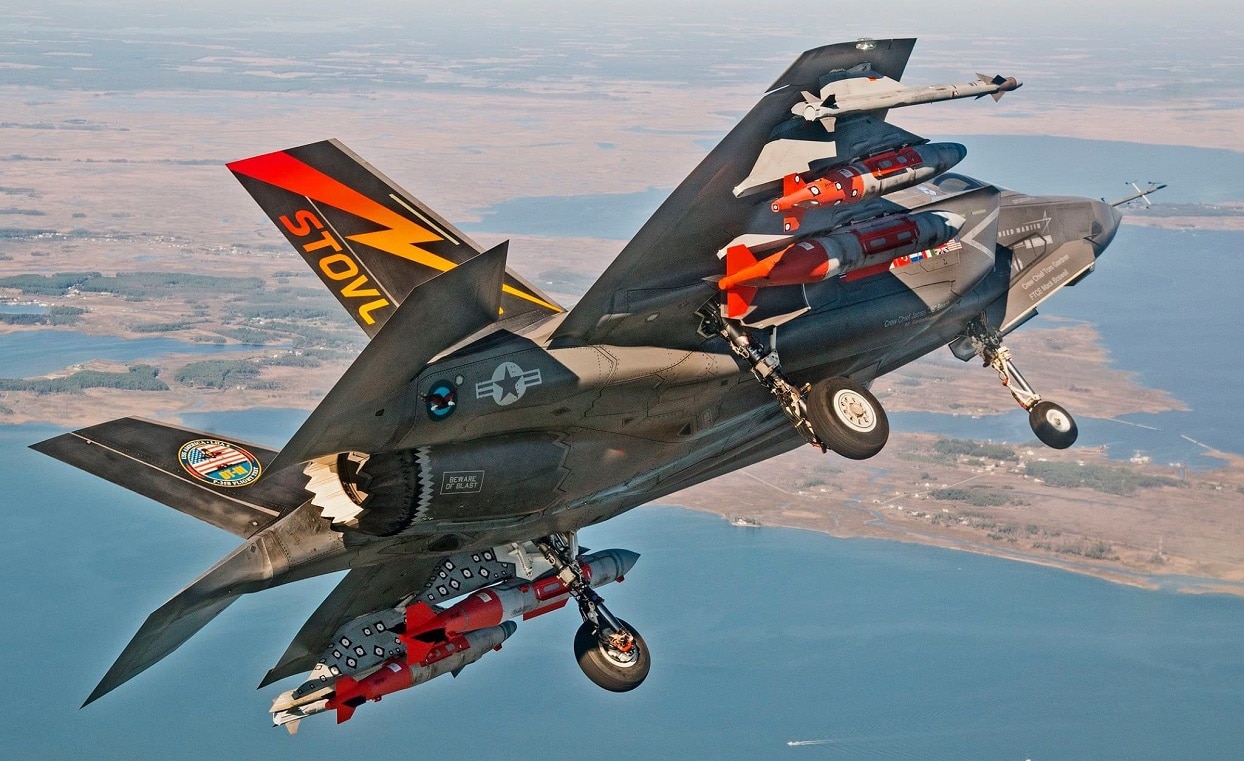
F-35 Image: Creative Commons.
These scenarios are rare, since air superiority is difficult to achieve in near-peer warfare, but this capability makes the aircraft more versatile.
The Joint Strike Fighter
The F-35 was originally born from the Joint Strike Fighter (JSF) program.
The JSF project sought to develop a new fifth-generation stealth fighter that was more versatile than the F-22.
The F-35 was designed to undertake a variety of missions, including SEAD/DEAD, air superiority, close air support, electronic warfare, and intelligence/surveilance missions.
Unlike the F-22, the F-35 program was designed from the ground up for export and allied cooperation. This would enable allied partners to acquire the advanced aircraft and help cover the program’s immense costs.
The F-35 took its first flight in 2006, nearly 20 years ago at this point, and beat out Boeing’s X-32 in the JSF competition. The F-35A was officially accepted into USAF service in 2016, ten years ago.
In terms of stealth and sensor fusion, no aircraft is on equal footing with the F-35.
Fitted with an AN/APG-81 AESA radar and a complex suite of advanced avionics, the aircraft’s onboard computers can receive data from multiple sources and translate that information into a comprehensive view of the battlefield for the pilot.
The F-35’s advanced communications architecture lets it seamlessly transmit data to other battlefield sources, ensuring coordination between air and ground units in combined arms operations.
The aircraft is available in three configurations depending on the customer’s needs: a typical ground variant (F-35A), a V/STOL variant (F-35B), and a navalized version for catapult-assisted takeoff and recovery (F-35C).
About the Author: Isaac Seitz
Isaac Seitz, a Defense Columnist, graduated from Patrick Henry College’s Strategic Intelligence and National Security program. He has also studied Russian at Middlebury Language Schools and has worked as an intelligence Analyst in the private sector.