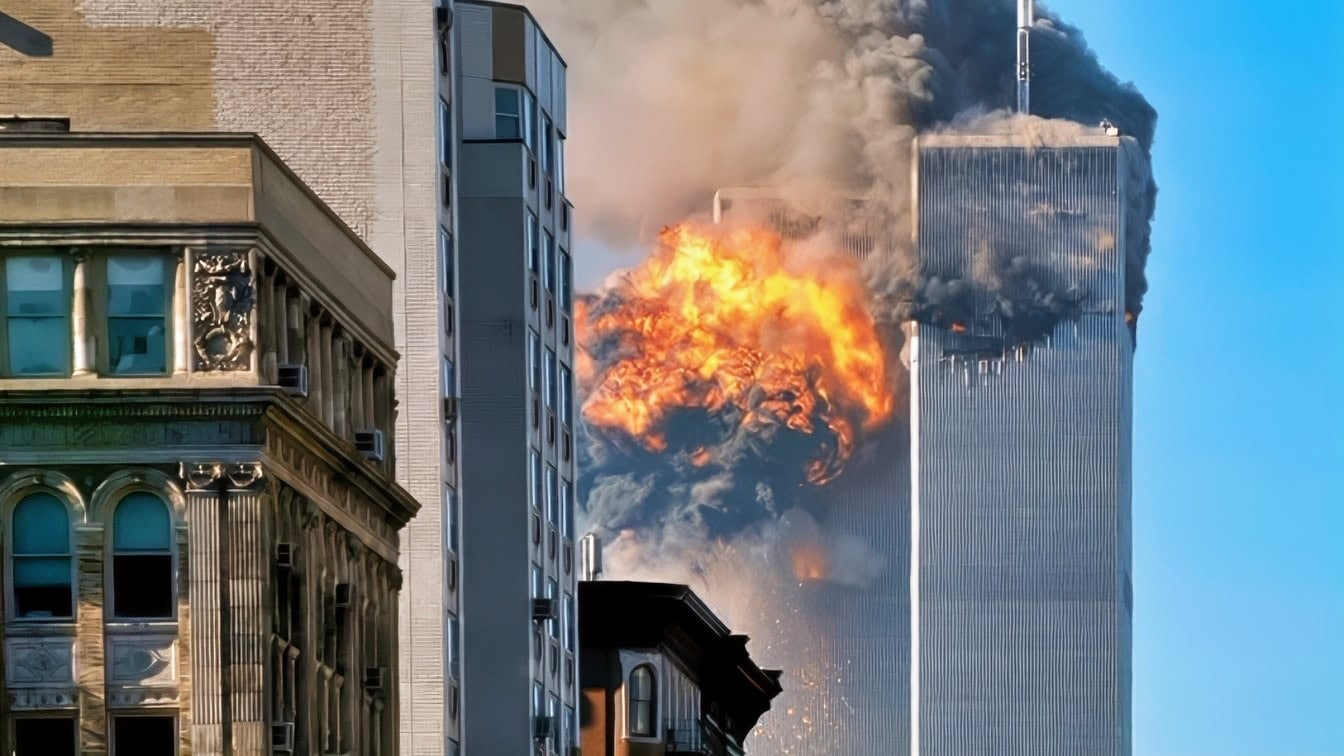
Remembering 9/11 – This year marks the 25th year since the devastating attacks by two hijacked airplanes on the World Trade Center in New York City; a third attacked the Pentagon in the National Capital Region, and the fourth hijacked aircraft crashed in Shanksville, Pennsylvania, thanks to the resistance of the flight’s passengers who literally went down fighting. “Let’s roll!” — the words that triggered the successful passenger counterattack on the hijackers — became an evocative phrase. They successfully terminated Flight 93. Their collective ultimate sacrifice saved their countrymen.
Honoring the Victims and First Responders
Conjecture still governs Flight 93’s intended target. Potentially our heroes spared us a mass killing on Capitol Hill. The conversion of U.S. civil air carriers into weapons of mass destruction adds to the bitterness of these attacks. It is right and proper that we honor the victims, those in the buildings doing their daily tasks. We also rightly honor the legion of our first responders. Many first responders ran to the carnage and perished in the immediate aftermath of the attack as buildings collapsed. Many more suffered debilitating effects from injuries and the pernicious effects of massive pollution in the immediate areas of the attacks, hastening early disability and death.
An apt description was coined: “all gave some, some gave all, and some gave all on the installment plan.”
The End of the Unipolar Moment
This attack shocked us to our foundations. America and our allies had rightly celebrated the fall of the Berlin Wall, and the collapse of the Soviet Union. It had been a long Cold War with many hot campaigns underneath it to limit the advances of communist ideology in Europe, Asia, Africa, Latin America, and elsewhere. Our second “Unipolar Moment” lasted only a short time. 9/11 taught us that America’s two oceans did not protect us from attacks, and that warfare had changed yet again while we were celebrating our Cold War triumph.
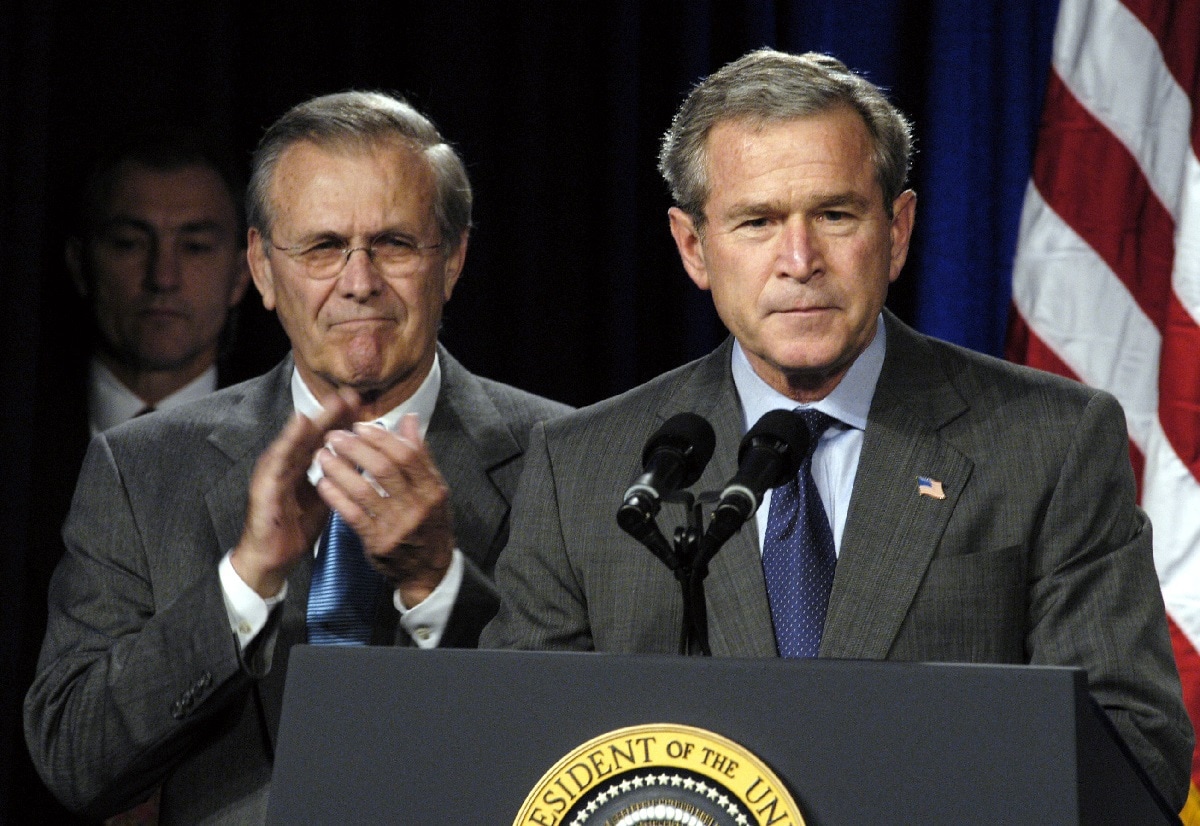
Secretary of Defense Rumsfeld and President Bush 2003 by Helene C. Stikkel
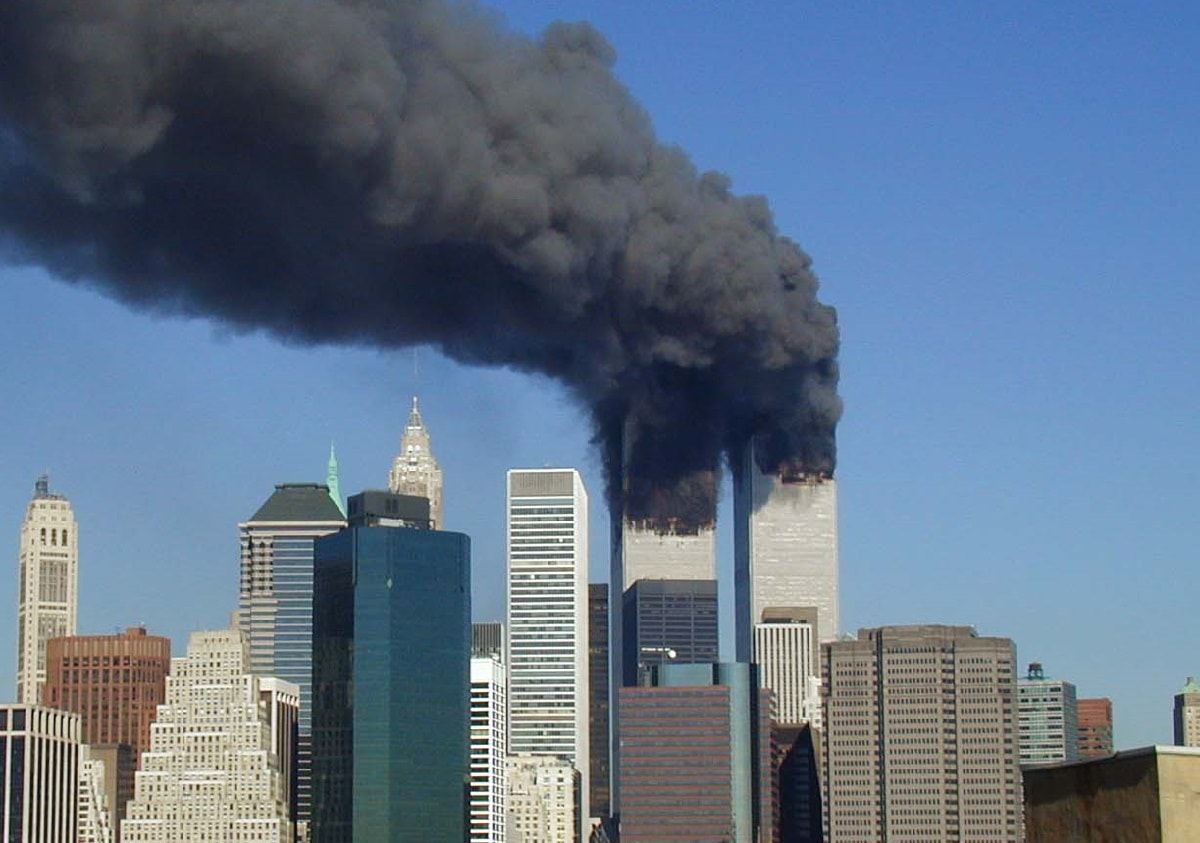
9/11 Image: Creative Commons.
A Failure of Intelligence, Not the Intelligence Agencies
In the early days of our 9/11 recovery, many observers alleged that our intelligence agencies failed to warn us of terrorist plans and our vulnerabilities. It may have been an “intelligence” failure, but it was not a failure of the intelligence agencies. The failure lay in the intelligence of all of us, including our elected representatives. Violent aircraft hijackings had been going on since the Reagan Administration. Yet no cry arose, in public or in our legislature, to even lock the doors to the cockpit, let alone impose any screening of passengers.
We were not the only nation afflicted with a failure to recognize the obvious. An exception was Israel. As one learned when departing there in the early 80s, every bit of luggage was publicly rummaged through and inspected. Personal searches were unapologetically thorough, despite presumed status.
More Bureaucracy to Fix the Bureaucracy
We created the Office of the Director of National Intelligence in 2005 following recommendations by Congress and the 9/11 Commission. The assumption was that all the necessary facts were known but were kept in separate silos by the individual agencies. The “ODNI” was to ensure that the “dots were connected” in the future. An assumed failure of the bureaucracy led to more bureaucracy.
The Response: Allies and the Long Campaigns
We responded immediately to the attack. The great Middle East campaigns began with the determined pursuit of Osama Bin Laden deep in South Asia. This was an exceptional operation conducted at the far reaches of our power projection capability. We were aided by our network of alliances. Our NATO allies, on their own initiative, declared this an Article 5 event, and provided substantial aid and forces to the U.S. Direct engagement by our diplomats with those at the top of other countries cleared the way for our deployments at the far end of our reach.

010915-N-3995K-015.New York, N.Y. (Sept. 15, 2001) — A New York City fireman calls for 10 more rescue workers to make their way into the rubble of the World Trade Center. U.S. Navy Photo by Journalist 1st Class Preston Keres. (RELEASED)
As is well known, the successful hunt for Osama Bin Laden led to extended national commitments in Afghanistan and eventually Iraq.
The Question We Owe Them Now
As we commemorate the impact of the 9/11 attacks, we should honor the memory of all our heroes involved in our immediate response and recovery.
We must also honor those who served in the campaigns in Afghanistan, Iraq, and elsewhere as we recovered.
The most appropriate honor we can render now is to ensure that our governmental and security institutions are fit for purpose in our all-too-visible emerging struggle.
What are we missing now, and what changes need to be made?
About the Author: Lieutenant General (Retired) Wallace “Chip” Gregson
Lieutenant General Wallace “Chip” Gregson joined The Roosevelt Group as a Senior Advisor after over 30 years of service in the U.S. Marine Corps. Prior to retirement, Chip served as the Assistant Secretary of Defense, Asian and Pacific Security Affairs. He also served as Commanding General of Marine Corps Forces Pacific and Marine Corps Forces Central Command, where he led and managed over 70,000 Marines and Sailors in the Middle East, Afghanistan, East Africa, Asia and the United States. From 2001 to 2003 he served as Commanding General of III Marine Expeditionary Force in Japan. He received the Japanese Order of the Rising Sun – Gold and Silver Star, the Korean Order of National Security Merit Gukseon Medal, and the Republic of China Order of the Resplendent Banner with Yellow Sash for his active duty service in Asia. Just prior to his service in Japan he was Director of Asia-Pacific Policy in the Office of the Secretary of Defense from 1998 to 2000. A combat veteran of the Vietnam conflict, he earned the Bronze Star with Combat “V” device for valor and heroism, and the Purple Heart.