
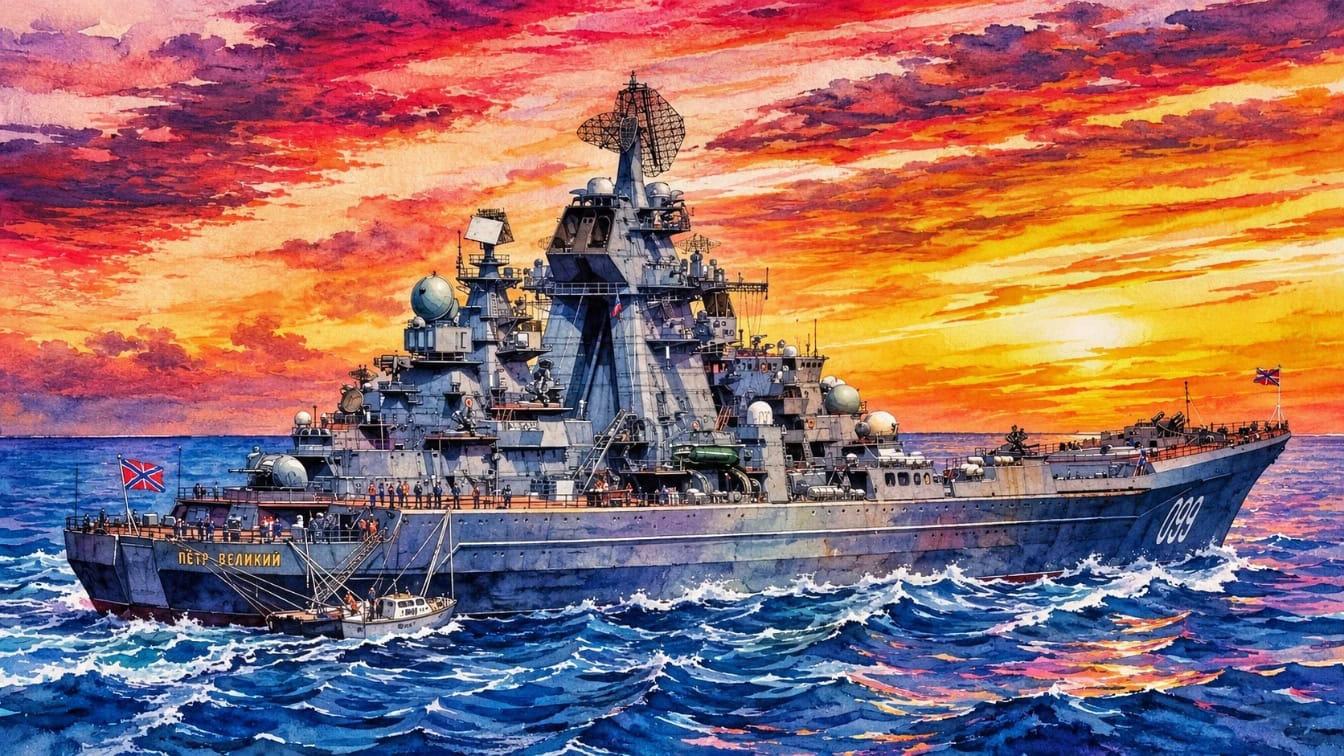
Summary and Key Points: The Soviet Union laid down the nuclear battlecruiser Kalinin in 1983 and commissioned her in 1986. She served about thirteen years in the Northern and Pacific Fleets before going into the yard at Severodvinsk in 1999 under her new name, Admiral Nakhimov. She came out in 2025. Twenty-six years in dock against thirteen at sea, at a cost reported around $5,000,000,000 — for one ship, by a navy that has not laid down anything larger than a frigate since 1991, apart from the Ivan Rogov-class amphibious ships. Russia originally intended to modernize three Kirovs. It could not afford to, so it scrapped two of them and put the money into this one.
Admiral Nakhimov Is One Powerhouse Russian Navy Warship
Russia has struggled to meet its naval needs since the collapse of the Soviet Union.
Since 1991, Russia has not laid down any new ships larger than a frigate, except of the Ivan Rogov-class amphibious assault ships.
Despite multiple setbacks in the shipbuilding industry and comparatively low funds, the Russians have remained committed to refurbishing and modernizing Admiral Nakhimov, a Cold War-era Project 1144 Orlan (Kirov-class) nuclear battlecruiser.
The Kirov-class was originally designed in the 1970s as a response to American carrier strike groups.
Although the ships are very imposing, many critics, even in Russia, remain skeptical about whether the Kirov-class is still relevant in the age of modern anti-ship missiles and naval drones.
Reviving a Cold War Leviathan
Admiral Nakhimov was originally laid down in 1983 as Kaliin (after Bolshevik statesman Mikhail Kalinin). She was commissioned in 1986 and served in both the Northern and Pacific fleets.
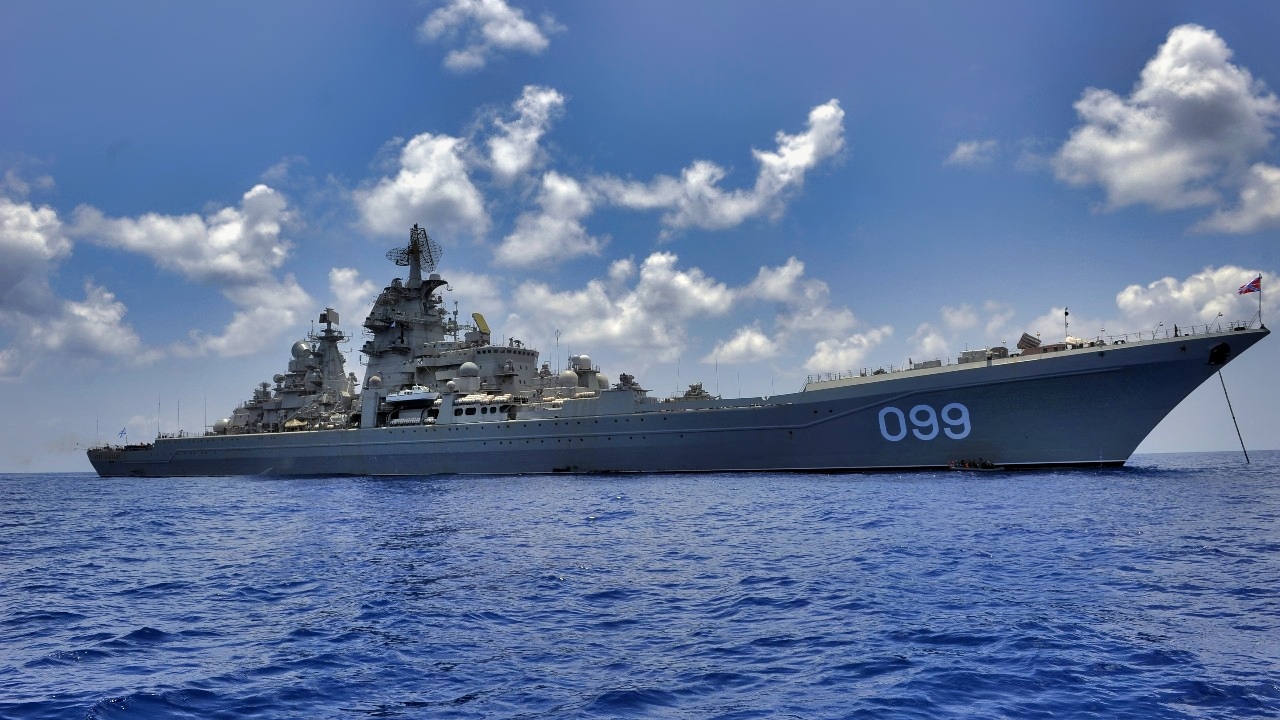
Kirov-Class Russian Navy. Image Credit: Creative Commons.
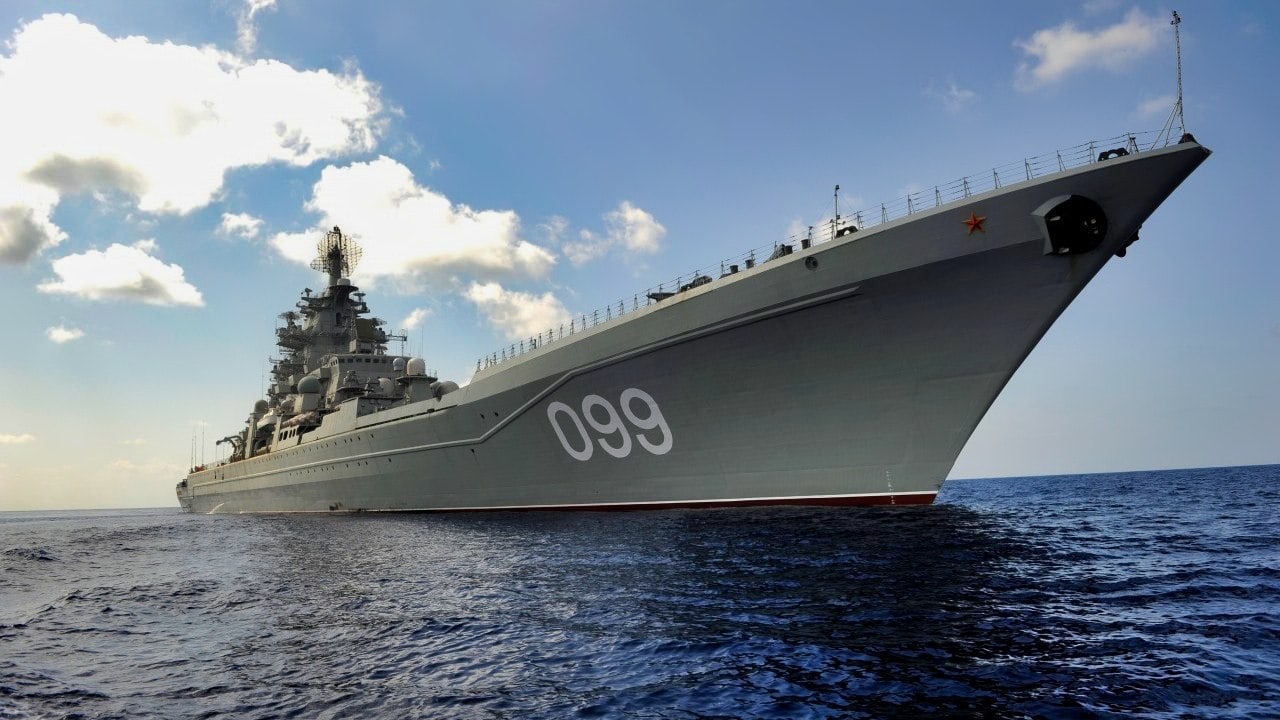
Kirov-Class Battlecruiser Russian Navy
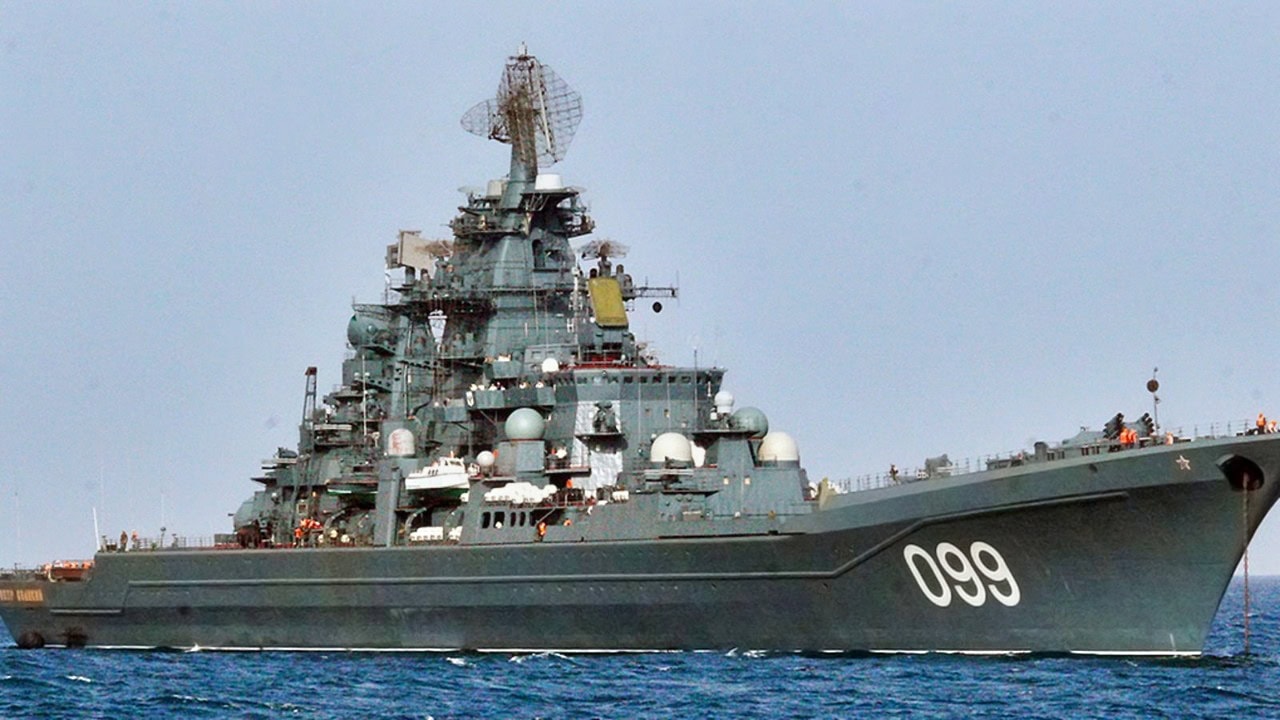
Kirov-Class Battlecruiser Russian Navy. Image Credit: Creative Commons.
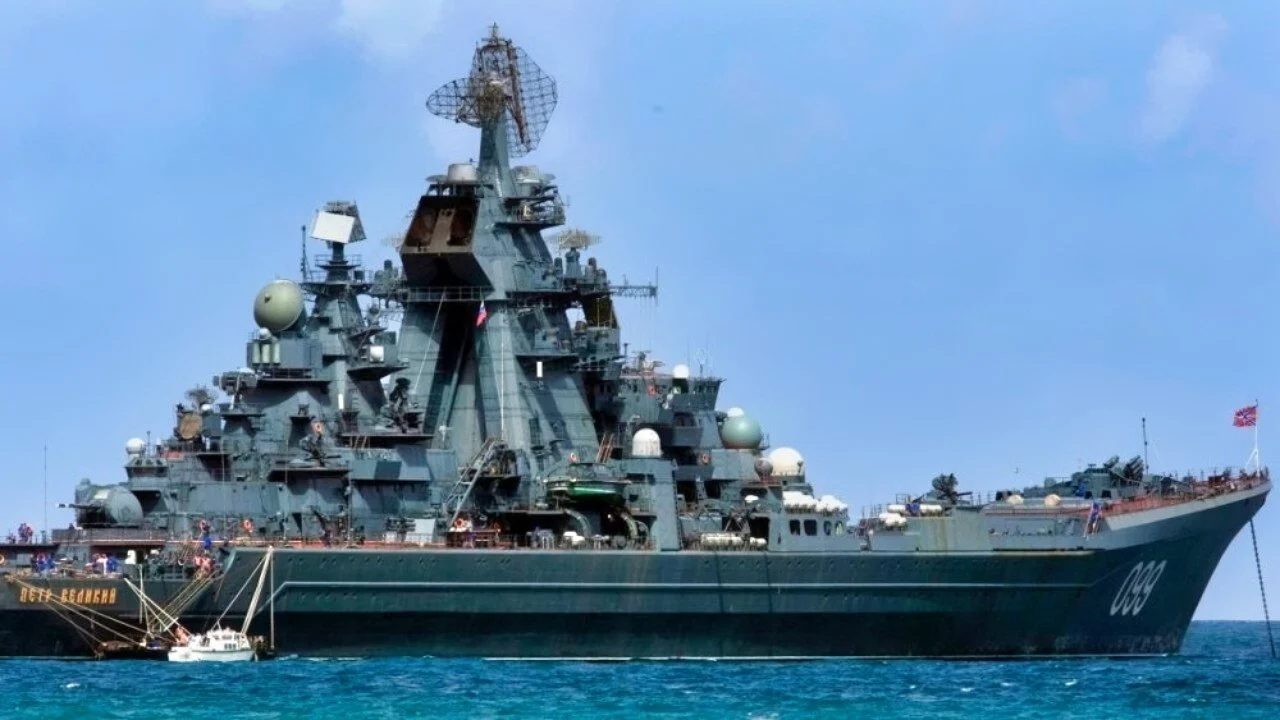
Kirov-Class Battlecruiser. Creative Commons Image.
After the collapse of the USSR, the newly renamed Nakhimov rarely went to sea and was instead hauled to Severodvinsk in 1999 for repairs.
From there, the ship entered into a strange limbo state as the Russian Ministry of Defense (MoD) decided what to do with its Soviet-era fleet. This was a crucial time period in Russian naval history.
Many upcoming projects, like the aircraft carrier Ulyanovsk, were canceled, while many other surface ships were subsequently decommissioned.
Many prominent shipbuilders either went under after privatization or shifted away from military shipbuilding toward civilian projects.
Many of the Russian Navy’s current problems originated from the 90s and early 2000s.
Despite all these issues and an overall lack of funding, the Russians still had a fully functional Kirov-class cruiser on their hands.
In 2006, the MoD decided to modernize Admiral Nakhimov, along with her sister ships Admiral Ushakov (ex Kirov) and Admiral Lazarev (ex Frunze).
However, the Navy lacked the funds to modernize all three ships and subsequently scrapped the latter two.
Throughout the 2010s, Nakhimov’s modernization program faced numerous delays, partly due to funding constraints and partly to the sheer scale of the work.
Originally planned to rejoin the fleet in 2012, the program was paused as the MoD finalized the design of the “new” ship.
Work resumed in 2014, but further delays prevented the ship from rejoining the fleet.
Finally, in 2025, Nakhimov’s modernization was completed, and her sea trials began.
She is expected to finish her trials later this year, when she will finally rejoin the Northern Fleet after more than 20 years.
What Does the “New Admiral Nakhimov” Offer?
Admiral Nakhimov’s sensor and communication suites have been completely overhauled.
While little information is currently available about these systems, the ship has received new radars and communication systems that enable it to detect and engage enemy ships from greater distances.
At a glance, one can spot numerous changes to the ship’s radar and sensor architecture, with the topmost radar replaced by what is likely a new, modern phased-array radar.
Speaking at “Fleet 2026,” General Director of the United Shipbuilding Corporation (USC), the company responsible for Nakhimov’s modernization, Andrei Puchkov stated that “today the cruiser is superior to modern foreign ships in a number of tactical, technical and operational characteristics.”
The new and improved cruiser’s real value comes from its overhauled weapons loadout.
Prior to its modernization, a typical Kirov-class cruiser carried a salvo of 20 P-700 Granit missiles. Today, Admiral Nakhimov carries up to 80 anti-ship missiles.
Its new VLS cells are compatible with the P-800 Oniks, the Kalibre cruise missile, and the 3M22 Zircon hypersonic cruise missile.
These new weapon systems allow the cruiser to engage enemy targets, whether sea- or land-based, at ranges of around 600 km.
Its defenses have also been improved with the inclusion of 96 S-400 surface-to-air missiles, the Pantsir-M CIWS, and 2 modified Osa-M surface-to-air missile launchers.
The Kirov-class in the Modern Age
The Russians have spent around 20 years and roughly $5 billion refurbishing Admiral Nakhimov.
The question on everyone’s mind is why?
Let us get the positives out of the way.
Nakhimov is but one part of Russia’s plans to reestablish itself as a blue-water naval power.
In an interview with Russian state-media channel Zvezda, Admiral Aleksander Moiseyev, Commander in Chief of the Russian Navy, discussed the need to build larger surface ships capable of operating independently at long ranges for extended periods. “Russia needs such ships,” he said in the interview. In this framework, Admiral Nakhimov, a nuclear-powered cruiser with an 80-missile magazine, slots in quite easily.
However, there is no getting around the fact that the ship is large and expensive.
In the era of unmanned naval systems and advanced anti-ship missiles, is Nakhimov really the best investment in this new era of naval warfare?
The cruiser’s main advantage over naval drones and smaller ships is its range.
As a nuclear-powered cruiser, Nakhimov’s range is theoretically limited only by its crew and food supplies.
This ship can operate in remote areas of the Arctic, far beyond the ranges of current unmanned systems. Russia currently needs such ships, considering its limited inventory of blue-ocean ships, especially after the unofficial decommissioning of Admiral Kuznetsov.
At the same time, however, operating and maintaining a ship of Nakhimov’s size is expensive, and for a cash-strapped Russian Navy, the investment may not be worth it, considering the fact that one or two anti-ship missiles can send the Cold War-era titan to its watery grave.
About the Author: Isaac Seitz
Isaac Seitz, a Defense Columnist, graduated from Patrick Henry College’s Strategic Intelligence and National Security program. He has also studied Russian at Middlebury Language Schools and has worked as an intelligence Analyst in the private sector.