
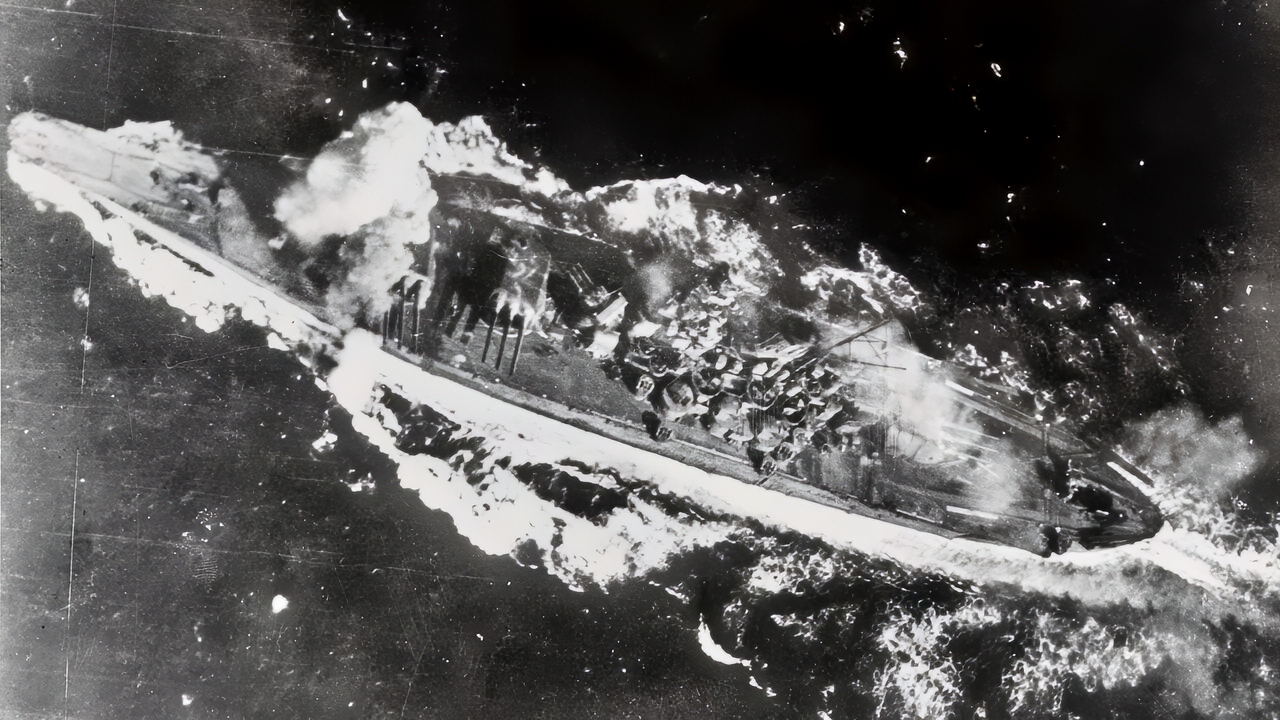
What Happened to Musashi, a Powerful Yamato-class battleship Displacing 72,000 Tons: Japan’s most famous battleship is back in the spotlight more than 80 years after it sank during World War II. The Yamato Museum in Kure, Hiroshima Prefecture, reopened in April following a major renovation, with exhibits examining the story of the enormous warship that gave the museum its name.
Yamato’s story ended dramatically in April 1945, when hundreds of American carrier aircraft attacked the massive battleship as it attempted to reach Okinawa on a one-way mission — but Yamato wasn’t the only battleship of its kind.
In fact, its sister ship had already suffered a similar and dramatic fate before Yamato sank.
Six months earlier, Musashi was subjected to an incredible American serial attack in the Philippines. The attack took hours and involved hundreds of aircraft performing repeated bomb and torpedo strikes to sink the ship.
Musashi Was Another Giant Battleship
Yamato’s sister ship, Musashi, was the second battleship of the type. Mitsubishi built it at its Nagasaki shipyard under strict secrecy.
Commissioned in August 1942, Musashi was around 862 feet long and, like Yamato, displaced more than 70,000 tons when fully loaded.
Importantly, it carried the same main armament of nine enormous 18.1-inch guns in three turrets. Those were the largest guns ever fitted to a battleship, capable of firing shells weighing roughly 3,200 pounds over distances exceeding 20 miles.
Musashi was designed on the same logic as Yamato: Japan knew it couldn’t build as many warships as the United States could, so Japanese planners wanted individual battleships powerful enough to overwhelm American vessels.
But by then, aircraft were already changing naval warfare.
Musashi to the Philippines
Musashi first served as a flagship and saw little combat. In March 1944, however, the U.S. submarine USS Tunny torpedoed the battleship.
Musashi survived the strike but returned to Japan for repairs.
There, it also received additional anti-aircraft weapons.
That October, it would conduct its most important operation. U.S. forces landed on Leyte in the Philippines on October 20, starting an operation to retake the islands from Japanese occupation.
Japan responded with a massive naval operation intended to attack the invading American force.
Musashi was part of Vice Admiral Takeo Kurita’s Center Force, which also included Yamato and several other battleships and cruisers.
To reach American forces around Leyte, Kurita’s ships had to travel through the Sibuyan Sea and the San Bernardino Strait. But American carrier aircraft found them before they could reach their destination.
American Aircraft Take Out Musashi
On the morning of October 24, U.S. aircraft launched from aircraft carriers attacked the Japanese formation.
American forces conducted the first strike at roughly 10:30 am, when aircraft from USS Intrepid and USS Cabot attacked the force and damaged Musashi.
Yamato and battleship Nagato were also hit, while the heavy cruiser Myoko was struck by a torpedo so badly that it had to withdraw.
After the strikes, more American aircraft arrived, and Musashi was now the main target.
The attacks continued in successive waves throughout the day, with dive bombers attacking from above and torpedo bombers approaching from low altitudes to launch weapons designed to explode below the waterline and force the ships to sink.
Musashi was well equipped with extensive anti-aircraft defenses, but the ship ultimately couldn’t overcome the American attacks.
It could withstand an extraordinary amount of damage, as it was designed to, but it couldn’t withstand unlimited, persistent punishment.
Musashi Took Dozens of Hits
The exact total number of bombs and torpedoes that hit Musashi is debated, but the U.S. Naval History and Heritage Command says the ship was hit by around 19 torpedoes and 17 bombs.
The torpedo damage was especially severe, with explosions breaching the hull and flooding compartments inside the battleship.
The crew attempted to stop the flooding and keep the ship upright, but additional attacks only caused more damage.
Musashi slowed down and fell behind the rest of the Japanese force – and by late afternoon, it was clear it could not be saved.
The ship’s massive size and heavy armor meant it could absorb punishment, but the flooding overcame it, and it could not keep moving – especially at pace.
Musashi Sinks
Then, at around 7 pm, hours after the American attacks started, Musashi finally sank in the Sibuyan Sea, killing around 1,000 of its crew.
Its loss came during the Battle of Leyte Gulf — a series of engagements that destroyed the Imperial Japanese Navy’s ability to conduct major offensive operations.
Yamato survived the attacks of that day and continued with Kurita’s force, fighting American ships until the following morning. It survived another six months before suffering the same fate as its sister ship.
About the Author: Jack Buckby
Jack Buckby is a British researcher and analyst specializing in defense and national security, based in New York. His work focuses on military capability, procurement, and strategic competition, producing and editing analysis for policy and defense audiences. He brings extensive editorial experience, with a career output spanning over 1,000 articles at 19FortyFive and National Security Journal, and has previously authored books and papers on extremism and deradicalization.