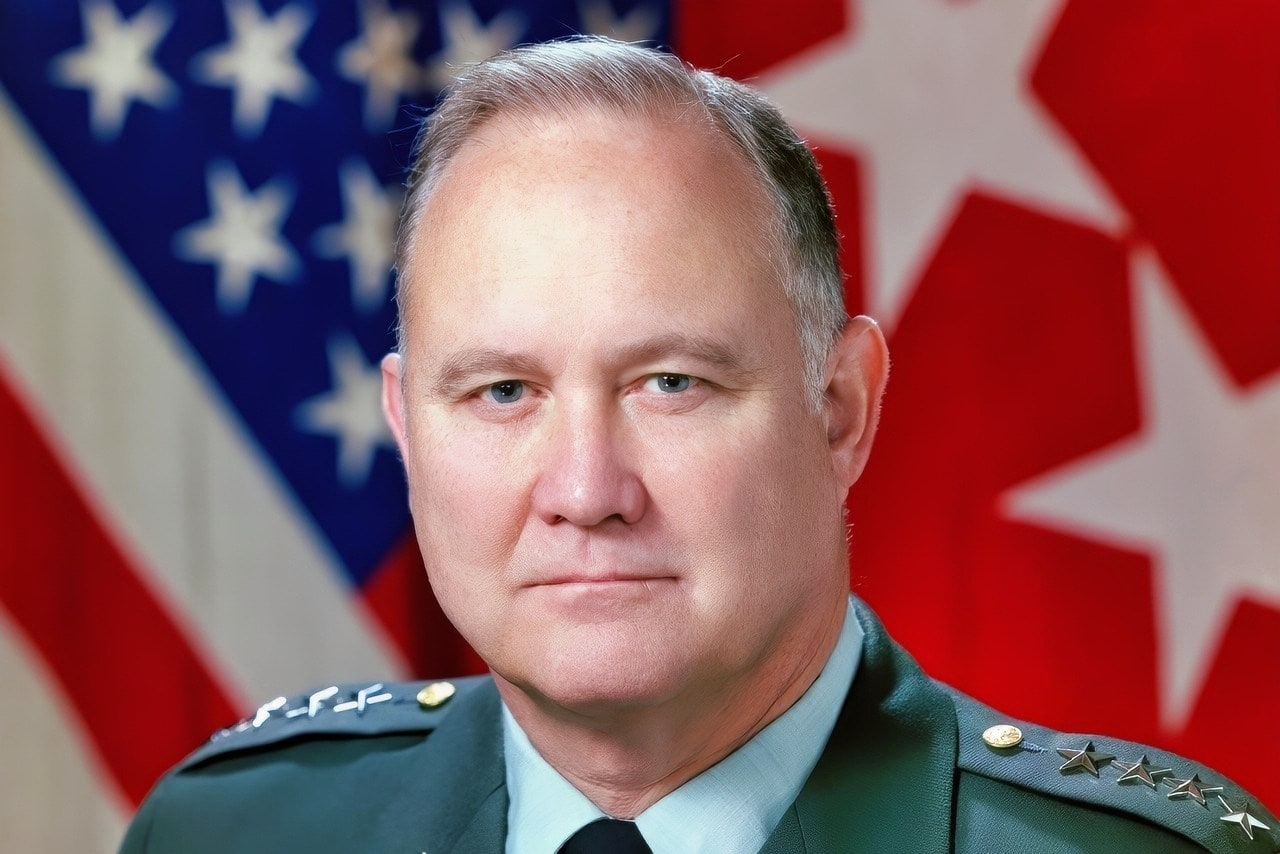
“War is a profane thing,” Gen. H. Norman Schwarzkopf said in his 1992 autobiography, It Doesn’t Take a Hero. But it wasn’t the first time he said it, really.
Gen. H. Norman Schwarzkopf was one of the public faces of one of the most decisive American military victories in modern history – but the commander who defeated Saddam Hussein’s forces in the 1991 Persian Gulf War rejected the romanticization of combat and made it clear that war should always be avoided.
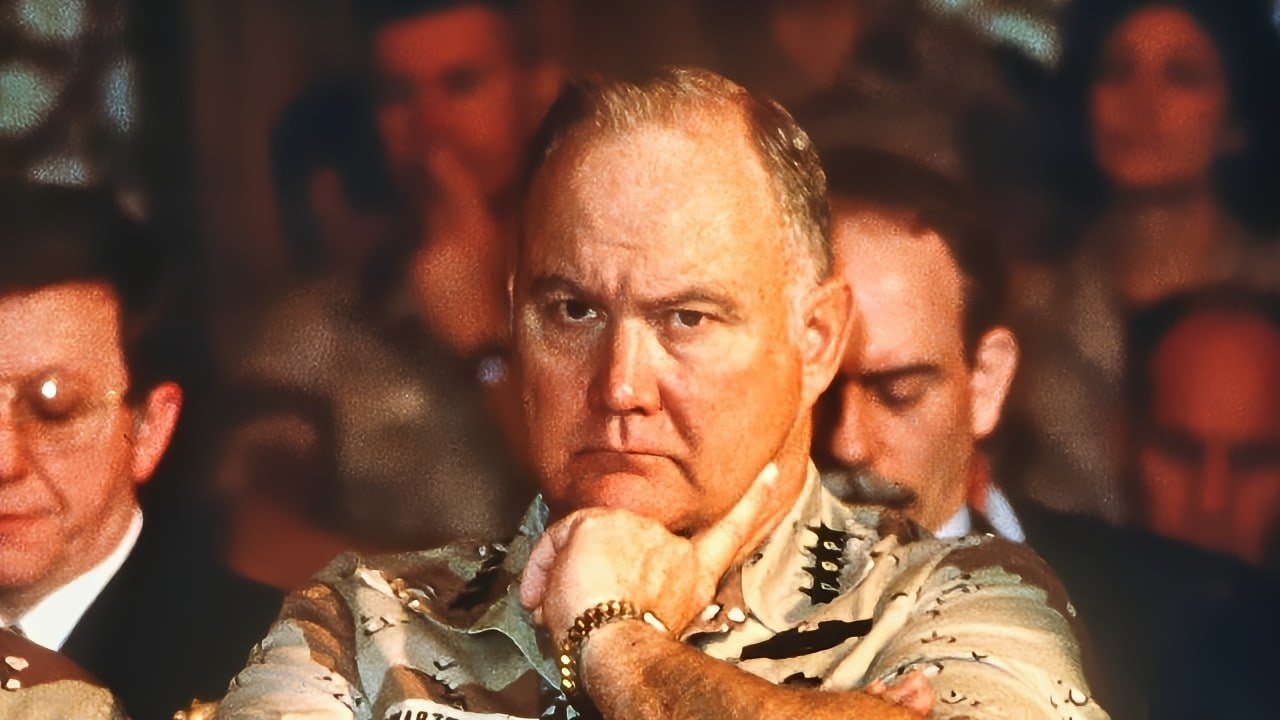
Paul D. Wolfowitz, under secretary of defense for policy, right, takes notes while Gen. Colin Powell, chairman, Joint Chiefs of Staff, and Gen. Norman Schwarzkopf, commander-in-chief, U.S. Central Command, listen to Secretary of Defense Richard Cheney answer questions from the media. The men are taking part in a press conference held by U.S. and Saudi Arabian officials during Operation Desert Storm.

Secretary of Defense Richard Cheney; Gen. Colin Powell, Chairman Joint Chiefs of Staff; and Gen. Norman Schwarzkopf, Commander, U.S. Central Command, during an award ceremony prior to the Welcome Home parade honoring the coalition forces of Desert Storm.
His words from his autobiography have since entered the modern lexicon and are often simply repeated as “war is a profanity.” Schwarzkopf knew his words caught on, and he had been saying much the same thing for a long time even before the book, explaining during an interview with the Los Angeles Times in Saudi Arabia on November 28, 1990.
During the interview, as American forces were preparing for the possibility of war with Iraq, Schwarzkopf recalled seeing troops being killed and maimed during the Vietnam War.
He said that war inevitably produces suffering among soldiers and civilians, and he said that made it impossible for him to favor it as a solution to conflict.
But his opposition to war in principle did not mean that he opposed fighting cautiously once a battle had become completely unavoidable.
The Making of “Stormin’ Norman”
Herbert Norman Schwarzkopf Jr. was born in Trenton, New Jersey, on August 22, 1934. His father was a New Jersey State Police superintendent who worked on the Lindbergh kidnapping investigation before returning to the Army and serving overseas.
He spent much of his childhood in Iran, Switzerland, and Germany before later attending the United States Military Academy at West Point. He graduated in 1956 and was commissioned as an infantry officer.
He then served two tours in Vietnam, and during his second, he commanded a battalion of the 23rd Infantry Division.
In May 1970, he entered a minefield to help wounded soldiers after one of his soldiers triggered an explosive device.
He was injured during that effort after a mine detonated, but he continued helping the casualties escape.
He received his third Silver Star for his bravery.
Those are just some of the experiences that shaped his famous sentiments about war.
Schwarzkopf saw the consequences of war up close and personal, rather than just through maps or operational updates.
It was real for him.
Prepared to Fight – But Reluctant To Start
Schwarzkopf was not a pacifist — obviously. But he did argue that soldiers should oppose war because they understand its cost, while also recognizing that some objectives are still worth fighting for.
Speaking to the Los Angeles Times, Schwarzkopf described his general opposition to war, noting that he cannot be in favor because “war means that those troops are going to be put into a situation where they’re going to get killed.”
Once civilian leaders ordered military action, Schwarzkopf believed commanders should use sufficient force to win quickly and protect their personnel.
Grenada and Central Command
After his time in Vietnam, Schwarzkopf kept rising through the ranks of the U.S. Army.
In 1983, he served as deputy commander of the joint force responsible for the invasion of Grenada.
That operation ultimately removed the island’s Marxist government, but it exposed serious weaknesses in communications and coordination between the United States’ armed services.
He became the commander of U.S. Central Command (CENTCOM) in 1988, giving him ultimate responsibility over operations across the Middle East.
Iraq invaded neighboring Kuwait on August 2, 1990, putting Saddam Hussein’s forces close to Saudi Arabia and threatening the balance of power in the Persian Gulf.
Schwarzkopf would oversee Operation Desert Shield — the massive deployment intended to protect Saudi Arabia and prepare a coalition force to liberate Kuwait.
That operation would eventually see hundreds of thousands of American troops assemble alongside troops from Britain, France, Saudi Arabia, Egypt, and other coalition members.
It was during that buildup that Schwarzkopf described war as a profanity, and he knew that he might soon be forcing those soldiers into combat.
Victory in the Persian Gulf
Operation Desert Storm began on January 17, 1991.
It began with an air campaign that saw coalition aircraft attack Iraqi command centers and air defenses, as well as communications systems and military formations, among other targets, for more than a month before the ground offensive began on February 24.
Under Schwarzkopf’s plan, coalition forces moved west through the desert before turning east into Iraq. They bypassed positions and attacked the Iraqi army from an unexpected direction — and the result was the liberation of Kuwait.
President George H.W. Bush suspended offensive operations after just 100 hours of ground combat, and the coalition did not advance on Baghdad because the United Nations mandate was to expel Iraqi forces from Kuwait — not to overthrow Saddam.
The result of the operation reflected his philosophy that war should be avoided wherever possible, but decisive force should be used to end it.
About the Author: Jack Buckby
Jack Buckby is a British researcher and analyst specializing in defense and national security, based in New York. His work focuses on military capability, procurement, and strategic competition, and he produces and edits analysis for policy and defense audiences. He brings extensive editorial experience, with a career output spanning over 1,000 articles at 19FortyFive and National Security Journal, and has previously authored books and papers on extremism and deradicalization.