
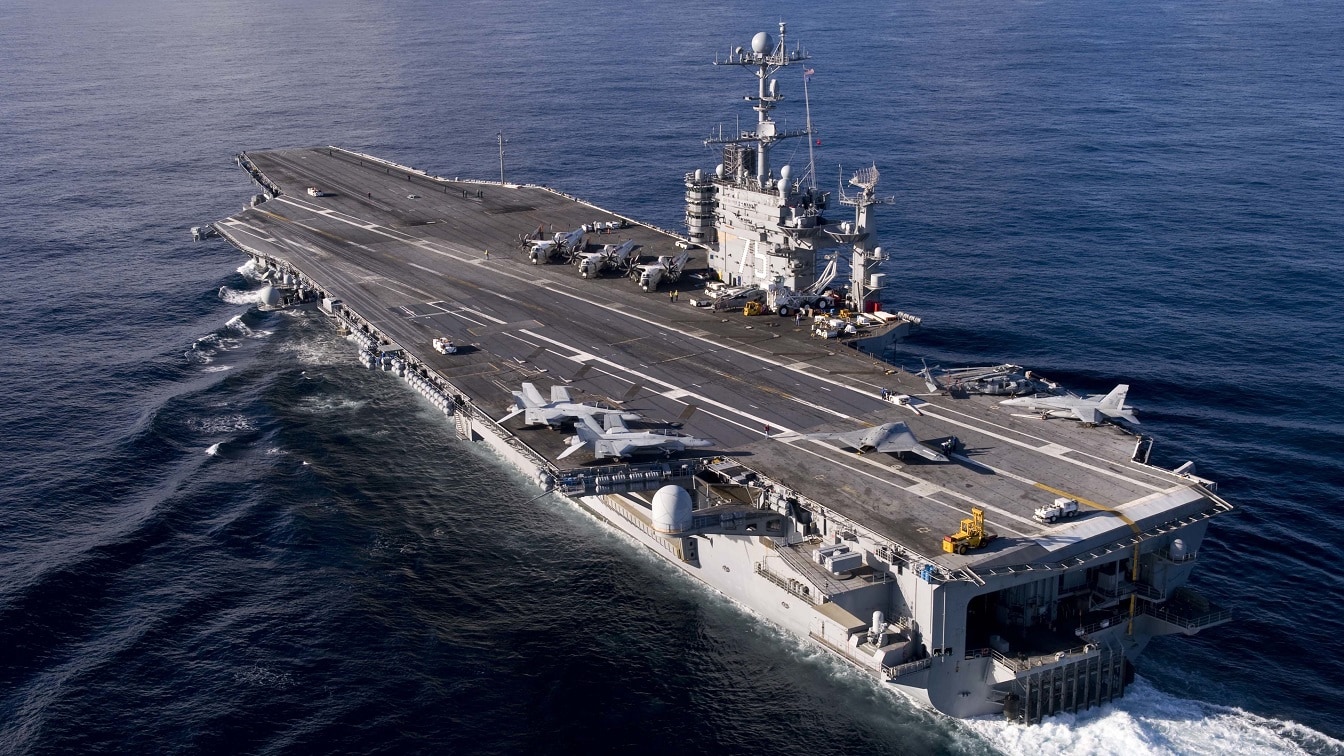
Summary and Key Points: On September 30, the Navy awarded Newport News Shipbuilding a $5.1 billion fixed-ceiling incentive contract to put USS Harry S. Truman through a refueling and complex overhaul, due every 25 years. RCOH means cutting a hole in the hull and replacing everything from catapults to water purifiers; USS George Washington’s kept her out of action for 2,100 days, and Truman, the eighth Nimitz to go through it, is not expected back before November 2031.
USS Harry S. Truman CVN-75 Is Out of Action Now for Years
Harry S. Truman, America’s first Cold War-era President, was famous for saying “The buck stops here.” But in the case of the U.S. Navy’s Nimitz-class nuclear-powered supercarrier (CVN-75) named in his honor, it’s more like “The ship stops here for RCOH, but the taxpayer bucks don’t stop flowing.” Taxpayer bucks that are still flowing to the tune of $5.1 billion USD.
Okay, So What is RCOH?
We’re glad you asked.
“RCOH” stands for “refueling and complex overhaul,” a costly and time-consuming maintenance procedure for nuclear-powered aircraft carriers (CVNs) that embodies the phrase “necessary evil.”
It involves cutting a massive hole into the hull and replacing everything from catapult systems to water purifiers.
Nuclear-powered “flattops” must undergo RCOH every 25 years, and to illustrate the mind-numbing slowness of the process, the USS George Washington (CVN-73) was out of action for a whopping 2,100 days.
RCOH, in turn, requires Navy logisticians to apply a “rule of thirds” to CVNs: At any given time, one-third of carriers are deployed, one-third are preparing for deployment, and one-third are undergoing maintenance.
With 11 carriers in the fleet, this means only three to four flattops are typically performing operational duties, thus saddling the deployed seamen with task saturation and longer time away from homeport—just ask the long-suffering crew of the USS Abraham Lincoln (CVN-72).
ROCH Rigamarole and CVN-75
For that, we turn to an official U.S. Navy press release dated 30 September 2026. It announced that the Navy had just awarded a $5.1 billion Fixed Ceiling Incentive contract to the Newport News Shipbuilding division of Huntington Ingalls Industries, Inc.
(HII) in order to perform RCOH services for the USS Harry S. Truman, or as she’s affectionately nicknamed, “HST.” HST now becomes the eighth Nimitz-class carrier to undergo RCOH.
The contract is historically significant as the first CVN RCOH contract awarded since the standup of Portfolio Acquisition Executive (PAE) Maritime, which is the single accountable organization for delivering surface warships for the U.S. Navy.
PAE Maritime, incidentally, is not to be confused with that other PAE, as in Pacific Architects & Engineers, the former government contracting firm acquired by Amentum in October 2021…coincidentally when Yours Truly was in the middle of a contract stint with PAE in Germany.
As for the Fixed Ceiling Incentive, the press release describes it as a structure that “appropriately shares risk, and which incentivizes improved shipbuilder performance to achieve required delivery dates.” Rear Admiral Casey Moton, Acting PAE Maritime, elaborated accordingly: “This award is the latest example of how we are leveraging innovative contracting approaches to drive improved outcomes.
Our program management and contracting teams have worked side by side to arrive at a contract that incentivizes schedule performance, addresses key lessons learned, shares risk appropriately so that we can re-deliver Truman to the Fleet on budget and on schedule.”
Time-Consuming, Yes, But Long Overdue
However, even with the “improved outcomes” that RADM Moton describes, CVN-75 isn’t scheduled to complete RCOH in November 2031.
Yet, as we already stated, it’s still a necessary evil; what’s more, in the case of the Truman, the work is commencing no sooner.
On 12 February 2025, “HST” collided with the Panamanian-flagged bulk carrier M/V Besiktas-M whilst transiting near Port Said, Egypt, at the northern end of the Suez Canal.
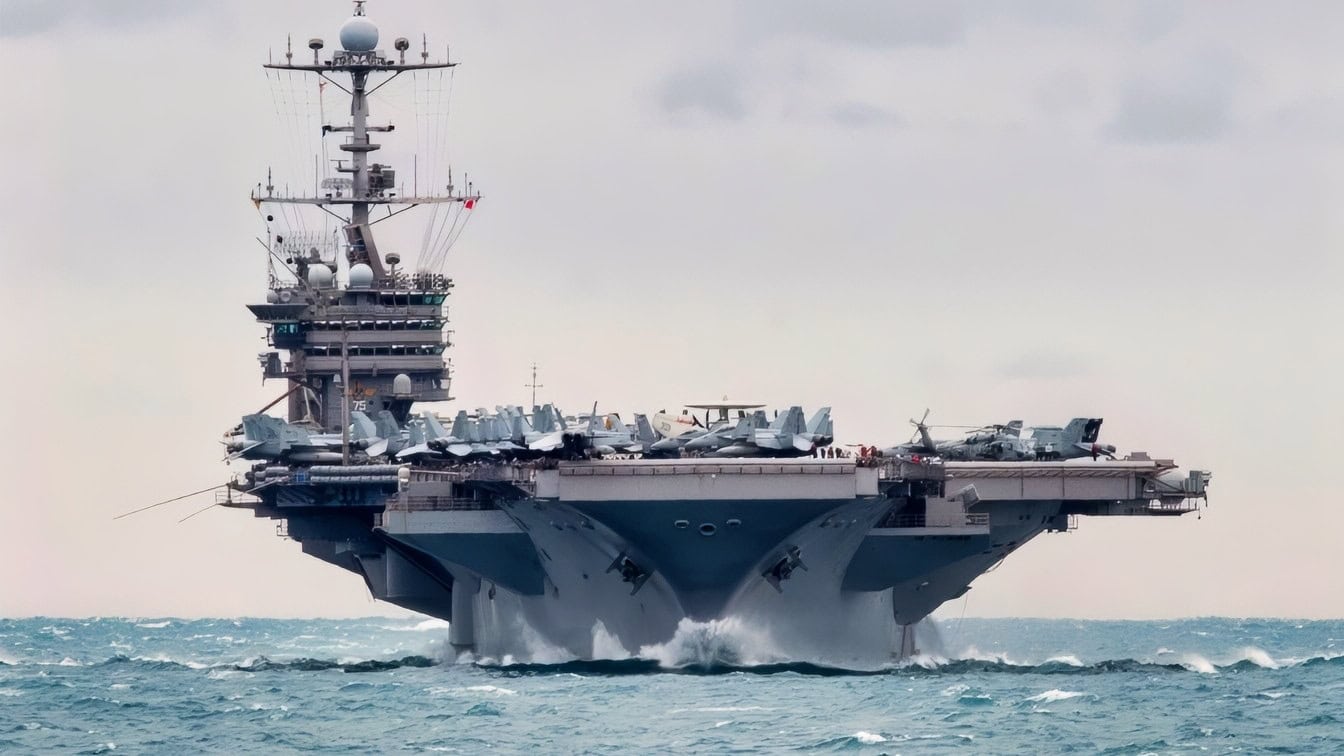
(Dec. 26, 2015) — Aircraft carrier USS Harry S. Truman (CVN 75) transits the Straight of Hormuz. Harry S. Truman Carrier Strike Group is deployed supporting maritime security operations and theater security cooperation efforts in the U.S. 5th Fleet area of responsibility. (U.S. Navy photo by Mass Communication Specialist 2nd Class M. J. Lieberknecht/Released)
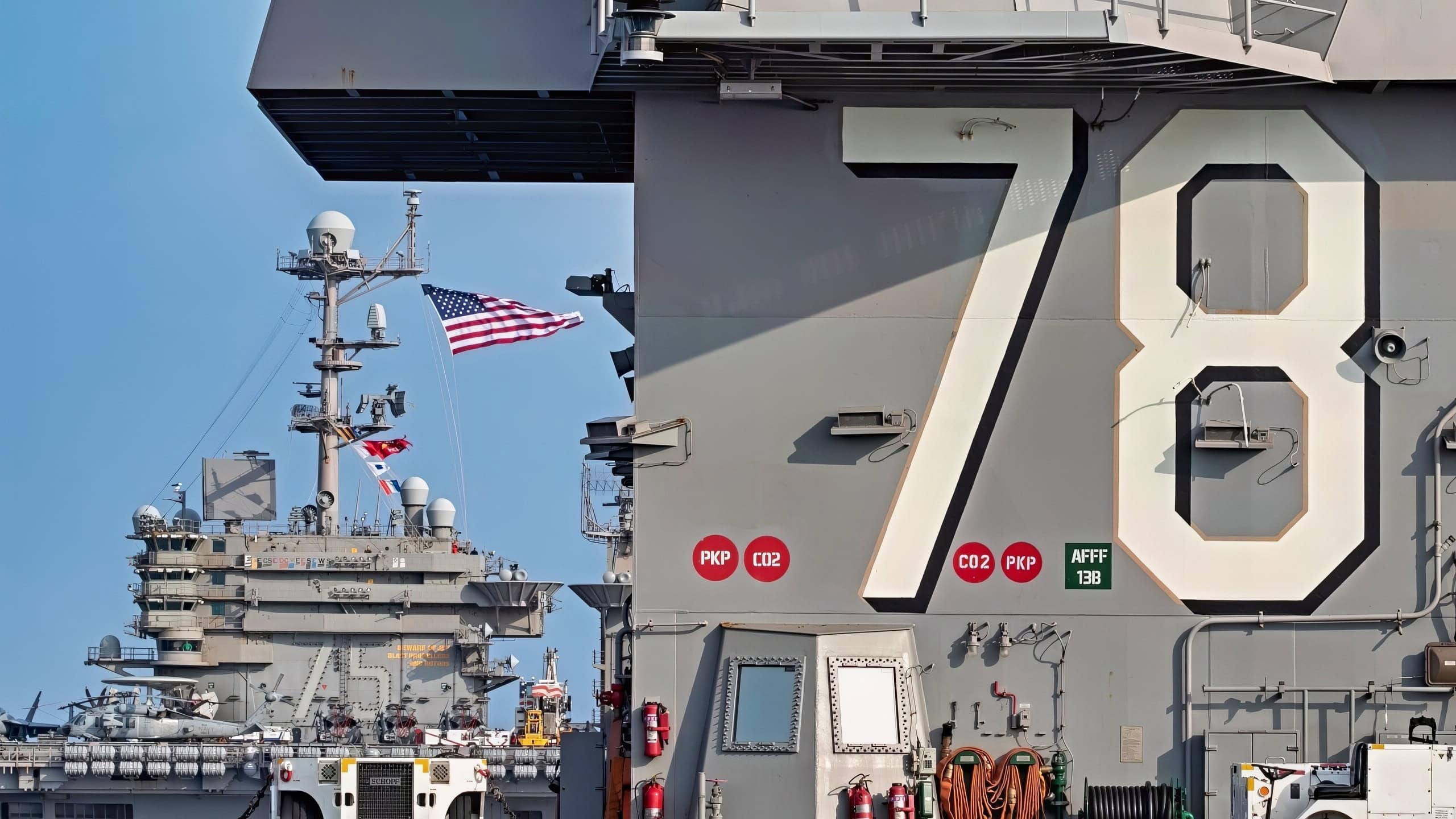
The Ford-class aircraft carrier USS Gerald R. Ford (CVN 78) and the Nimitz-class aircraft carrier USS Harry S. Truman (CVN 75) transit the Atlantic Ocean June 4, 2020, marking the first time a Ford-class and a Nimitz-class aircraft carrier have operated together underway. Ford is underway conducting integrated air wing operations, and the Harry S. Truman Carrier Strike Group remains at sea in the Atlantic as a certified carrier strike group force ready for tasking in order to protect the crew from the risks posed by COVID-19, following their successful deployment to the U.S. 5th and 6th Fleet areas of operation. (U.S. Navy photo by Mass Communication Specialist 2nd Class Ryan Seelbach)
The bulk of visible damage occurred on the starboard side aft of Elevator #3, damaging the underside of a sponson with one of the carrier’s .50 caliber machine guns; external damage was also observed at the line handling space, the fantail, and the platform above one of the storage spaces.
The exterior wall of two storage rooms and a maintenance space.
Fortunately, there were no physical casualties as a result of the incident, but there was at least one career casualty: HST’s skipper, Captain Dave Snowden, who was relieved of command eight days later due to loss of confidence in his ability to command.
Channeling both the late former President’s aforementioned famous motto, a senior Navy official told Fox News that “Something didn’t happen that should have happened.
A ship that hasn’t taken measures to avoid a collision, it’s on the captain. The buck stops with him.”
Four days after the collision, the Truman entered Naval Support Activity (NSA) Souda Bay in Greece for an Emergency Repair Availability (ERAV) assessment.
However, the warship wasn’t able to undergo a complete repair job right then and there, as the Souda facility simply wasn’t equipped to provide that in-depth level of service.
Indeed, the Navy has a mere four national shipyards capable of carrying out carrier repairs.
Many experienced workers have retired, and the newbies lack hands-on expertise.
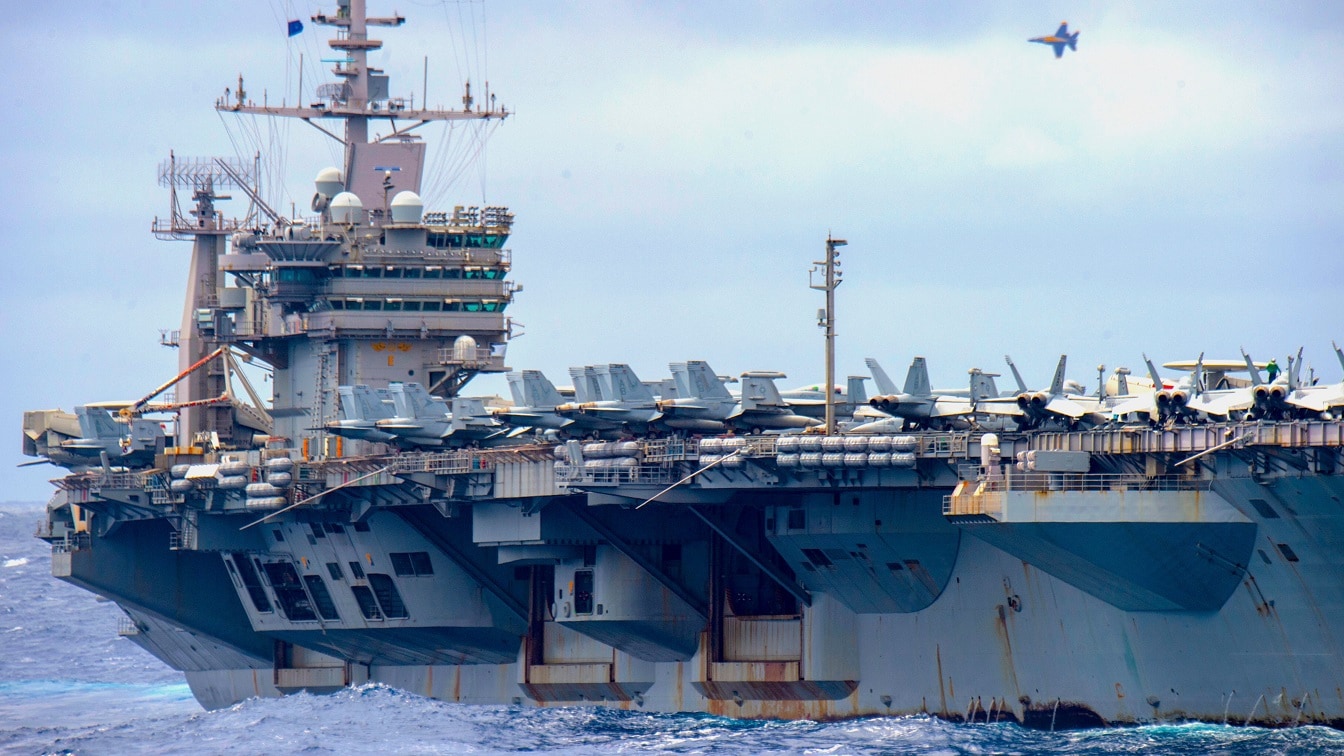
The Blue Angels, flies over the Nimitz-class aircraft carrier, USS Harry S. Truman (CVN-75) on May 20, 2020. US Navy Photo/
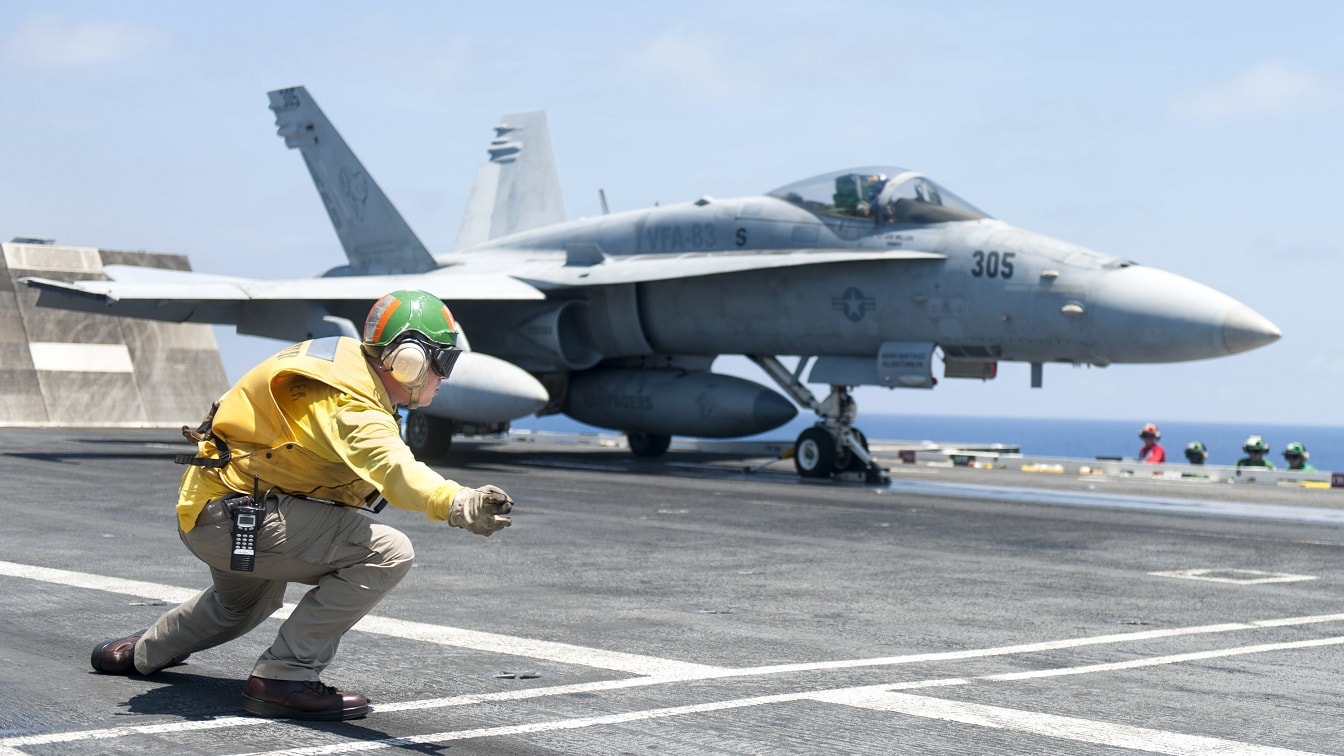
(June 15, 2015) Lt. B. J. Burnham signals to launch an F/A-18C Hornet, assigned to the “Rampagers” of Strike Fighter Squadron (VFA) 83, on the flight deck of aircraft carrier USS Harry S. Truman (CVN 75). Truman is underway conducting Tailored Ship’s Training Availability (TSTA) off the east coast of the United States. TSTA is the first combined training event of a ship’s inter-deployment training cycle that tests and evaluates shipboard drills, including general quarters, damage control, medical and firefighting. Upon successful completion of TSTA, Truman will be considered proficient in all mission areas. (U.S. Navy photo by Mass Communication Specialist 2nd Class K. H. Anderson/Released)
The draconian COVID-19 lockdowns exacerbated production and maintenance shortfalls even further, creating multi-year delays that continue to affect readiness throughout the fleet.
In the meantime, as the saying goes, “No rest for the weary.” Over the following three months, HST was called upon to carry out airstrikes against the Houthi terrorist group in Yemen; alas, in the process, the mighty warship experienced additional suffering by losing two of her F/A-18 Super Hornet fighter jets.
One of the warbirds fell overboard whilst the warship was executing a hard turn to avoid a Houthi missile strike, whilst the other plane was lost when the vessel’s arresting gear failed to stop its further movement during landing.
About the Author: Christian D. Orr
Christian D. Orr is a Senior Defense Editor. He is a former Air Force Security Forces officer, Federal law enforcement officer, and private military contractor (with assignments worked in Iraq, the United Arab Emirates, Kosovo, Japan, Germany, and the Pentagon). Chris holds a B.A. in International Relations from the University of Southern California (USC) and an M.A. in Intelligence Studies (with a concentration in Terrorism Studies) from American Military University (AMU). He is also the author of the book “Five Decades of a Fabulous Firearm: Celebrating the 50th Anniversary of the Beretta 92 Pistol Series,” the second edition of which was recently published.