
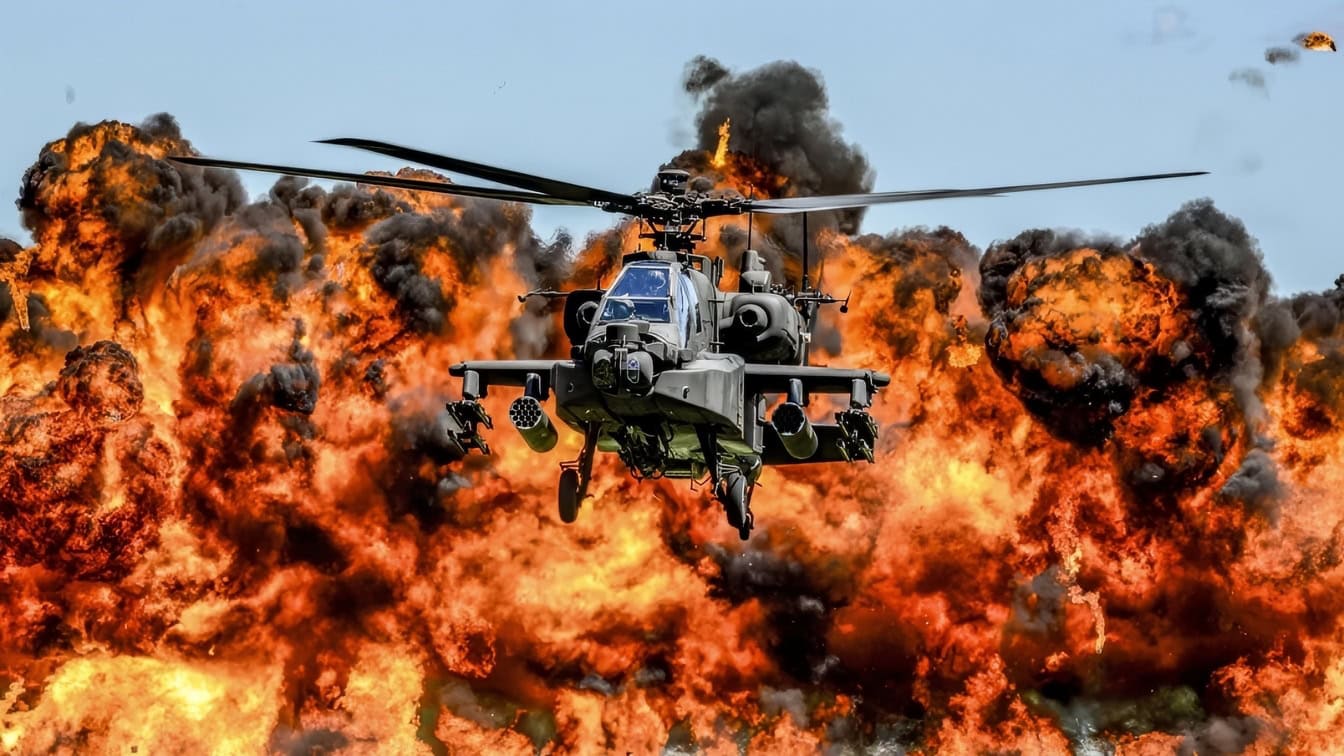
Summary and Key Points: The US Army wants a laser on every helicopter it flies. It has awarded Northrop Grumman $4.8 billion to continue producing the Common Infrared Countermeasures system, or CIRCM, which jams the seekers of shoulder-fired missiles such as the Stinger. The plan covers the AH-64 Apache, the Black Hawk, and the CH-47 Chinook, aircraft that entered service between 1962 and 1986, as well as the MV-75 tiltrotor, due in 2030. It comes even as the Army cuts its helicopter fleet to make room for drones, which means more of that money for each aircraft it keeps.
The US Army’s Big Helicopter Laser Upgrade
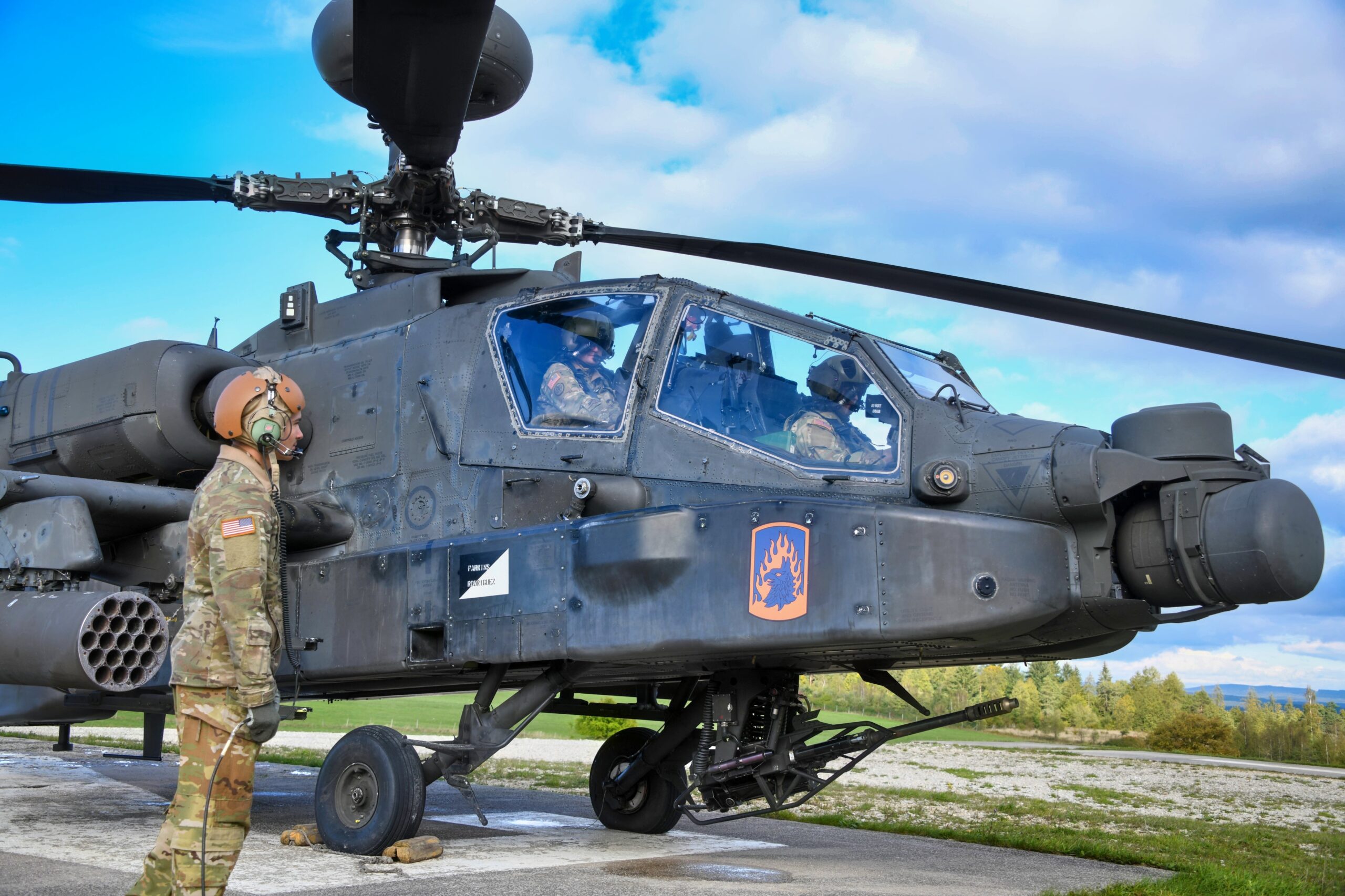
U.S. Soldiers assigned to 12th Combat Aviation Brigade conduct pre-flight checks on an AH-64D Apache longbow helicopter at the Grafenwoehr Training Area, Germany, Sept. 28, 2022. 12th CAB is among other units assigned to V Corps, America’s Forward Deployed Corps in Europe. They work alongside NATO Allies and regional security partners to provide combat-ready forces, execute joint and multinational training exercises, and retain command and control for all rotational and assigned units in the European Theater. (U.S. Army photo by Sgt. Randis Monroe)
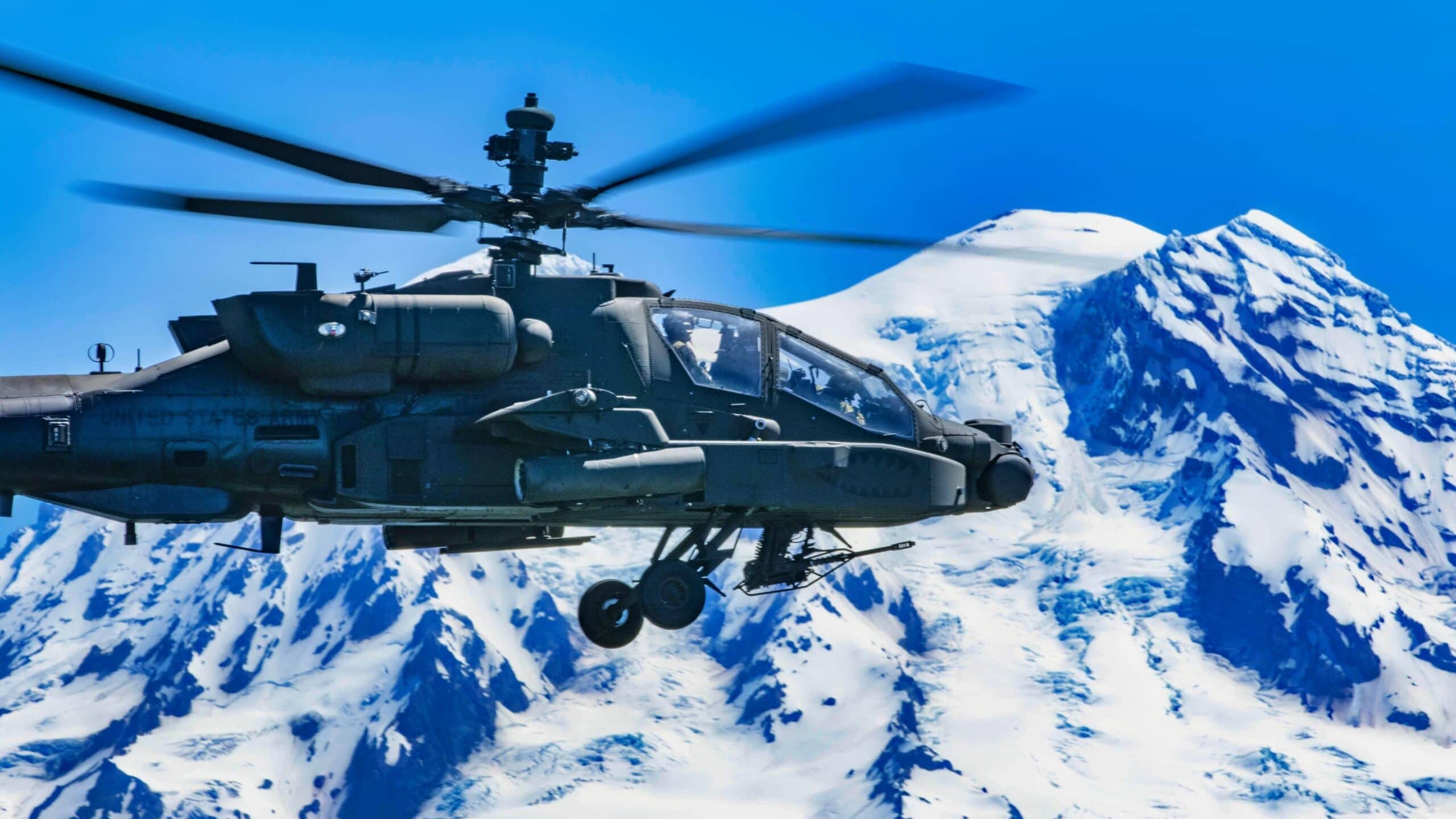
Apache Helicopter U.S. Army. Image Credit: Creative Commons.
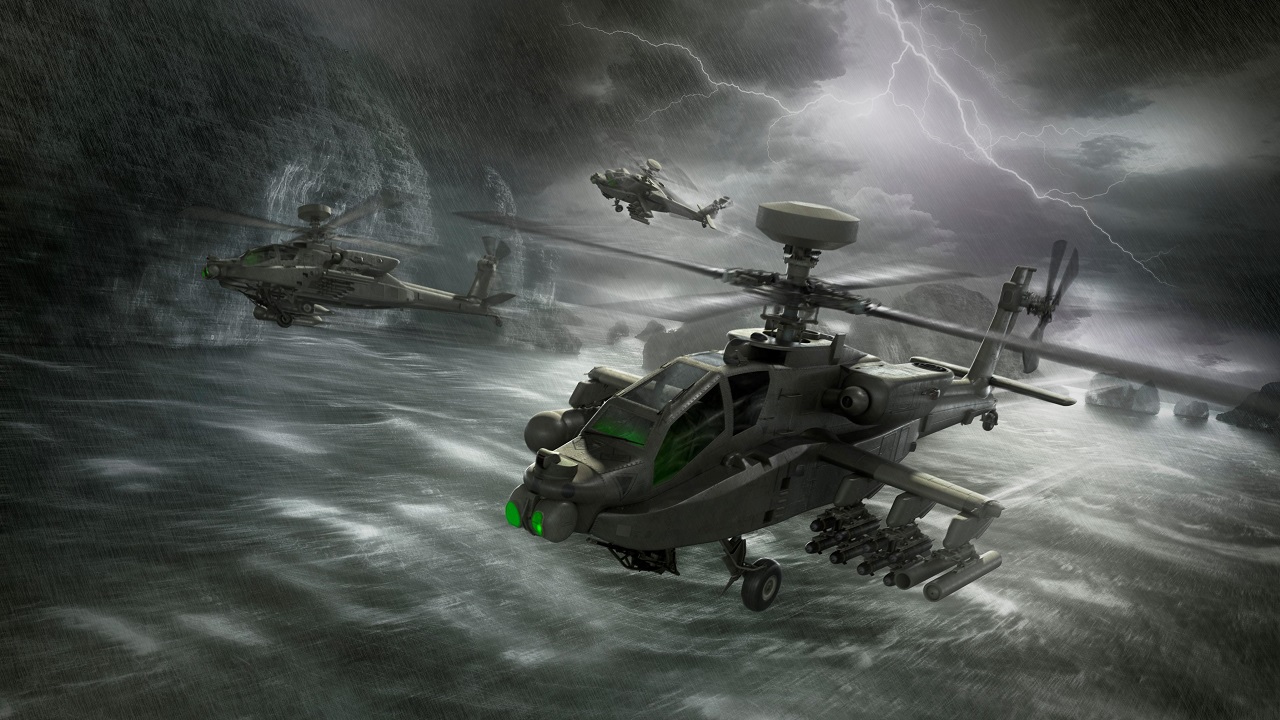
Modernized Apache Helicopter. Image Credit: Boeing.
As is true of main battle tanks (MBTs), the seemingly never-ending Russia-Ukraine war has demonstrated the vulnerability of helicopters to 21st-century weapon systems, so the United States Army is taking note and spending a pretty penny to upgrade its own choppers’ defense systems, to the tune of $4.8 billion USD.
So what sort of bang will the Army’s whirlybird soldiers—and American taxpayers—get for these bigger bucks?
Bottom Line Up Front (BLUF)
This latest development came to our attention via a September 16, 2026 article by Patty Nieberg for Task & Purpose titled “Army pays nearly $5 billion for massive defensive upgrade to helicopter fleet.” To wit: “The Army awarded Northrop Grumman $4.8 billion to produce laser-based missile defense systems for its Common Infrared Countermeasures, or CIRCM, program…The countermeasures are designed to protect against threats like shoulder-fired Stinger missiles. After receiving a notification from the missile warning system, the system tracks the incoming munition and jams the sensor, ‘degrading the tracking capability of the missile and causing it to miss the aircraft,’ Army budget documents describe.”
Digging Deeper
More specifically, this means protection against laser-guided man-portable air defense systems (MANPADS) for: (1) the Army’s existing fleet of venerable, time-honored, and battle-tested Boeing AH-64 Apache helicopter gunships, Lockheed Martin-Sikorsky Black Hawk utility choppers, and Boeing CH-47 Chinook transport helicopters; and (2) the new MV-75 Future Long Range Assault Aircraft, aka the Bell V-280 Valor, a tiltrotor aircraft that’s been designated as the successor to the Black Hawk.
The Apache, Black Hawk, and Chinook—nicknamed the “S**t-hook” during the Vietnam War as both a wordplay on its official name and due to the you-know-what stirred up by the twin rotor blades of its sizable Lycoming T55-GA-714A turboshaft engines—are all Cold War veterans, having been in service with the Army since 1986, 1979, and 1962, respectively.
Meanwhile, the MV-75 is expected to attain official operational status in 2030, with the 101st Airborne Division (Air Assault)—the “Screaming Eagles”—as the first beneficiary.
CIRCM will replace ATIRCM, i.e., the Advanced Threat Infrared Countermeasure System—nicknamed “R2D2” on account of its resemblance to the culturally iconic Star Wars character—which has served faithfully and reliably for 16 years but was bogged down by the weight, to the tune of 160 lbs., on the Chinook; by contrast, CIRCM weighs a mere 50 lbs.
The Army had nearly 3,700 rotary-wing helicopters as of 2023, but since then the service announced major cuts to its aviation fleet in the move towards more UAVs.
That’s bad news for the employment prospects for both current Army rotary-wing soldiers and future career aspirants, but if there’s any potential silver lining behind that cloud, it means more CIRCM dollars to allocate towards each remaining individual Army helicopter; perhaps this could reduce the risk of those oh-so-dreaded cost overruns and a breach of the Nunn-McCurdy Act.
Meanwhile, the Army isn’t the only branch of the U.S. Armed Forces looking to upgrade its whirlybirds’ defensive systems.
Back in April, the Air Force awarded a contract to equip its HH-60W Jolly Green II combat search-and-rescue (CSAR) helicopters with infrared countermeasures.
This decision was motivated by an Air Force Materiel Command (AFMC) Sources Sought notice which warned that the lack of a countermeasure system “significantly increases the risk of infrared-guided missile engagement, jeopardizing mission success, aircraft survivability, and crew safety.”
Officials Weigh In
–Ellen Lovett, U.S. Army public affairs specialist: “The Army’s plan is to equip all Army rotary wing aircraft with CIRCM. Other services have shown interest in CIRCM but are in the early review stage… For operational security reasons, we cannot share how many systems have been fielded to date, but more than 700 systems have been delivered.”
–Leah Hooten, Vice President, Mission Survivability Systems Business Unit | MSTS Division at Northrop Grumman Mission Systems: “The recent contract award from the Army sustains full‑rate production of CIRCM. The contract provides a long‑term framework to keep equipping Army helicopters with CIRCM, while preserving flexibility for the Army to adjust quantities over time…While the fundamental concept—using a precision-pointed laser to disrupt the missile seeker—remains the same, the system itself has advanced substantially. CIRCM incorporates upgraded hardware and sophisticated software to counter the latest threats.”
The Rank-and-File Weighs In
An unnamed Army aviation mission survivability officer adds that “It’s the best solution we have now because the magazine is unlimited. I can shoot down missiles all day long with CIRCM. Once I’m out of my flare bucket, I’m gonna get shot by a missile…[laser defense is] way faster than my ability as a pilot to drop a countermeasure, specifically a flare.”
Warning Signs from the Recent Past: The Apache Iraq War Example
The U.S. Army’s sense of urgency to upgrade its rotary-wing assets’ defensive systems doesn’t draw only on the Russian armed forces’ woes with their Ka-52 “Alligator” and Mi-28 “Hind” losses in Ukraine.
It can also look at its own chopper losses in a 21st-century war: the 2003 Iraq War, aka Operation Iraqi Freedom (OIF).
During a 21 March 2003 attack against the elite Republican Guard forces of then-Iraqi dictator Saddam Hussein, American Apaches succeeded in destroying 12 MBTs along with several sundry vehicles and anti-aircraft artillery (AAA), but took a more severe than expected beating in exchange: one AH-64 was shot down with its crew taken prisoner, and virtually all the choppers took damage, with multiple crewmen being wounded in action (WIA); one of them was shot in the neck.
This prompted the Army to ground all of its Apaches for nearly a week whilst repairs were conducted.
Fast-forward to the present day, and the Apache has dramatically demonstrated that it’s not obsolete yet, showing an extra degree of venomous versatility not originally envisioned by its designers: destroying Iran fast-attack boats and Shahed drones.
But the vulnerabilities of these rotary-wing warbirds remain an ominous reality that can ill-afford to be ignored.
About the Author: Christian D. Orr
Christian D. Orr is a Senior Defense Editor. He is a former Air Force Security Forces officer, Federal law enforcement officer, and private military contractor (with assignments worked in Iraq, the United Arab Emirates, Kosovo, Japan, Germany, and the Pentagon). Chris holds a B.A. in International Relations from the University of Southern California (USC) and an M.A. in Intelligence Studies (with a concentration in Terrorism Studies) from American Military University (AMU). He is also the author of the book “Five Decades of a Fabulous Firearm: Celebrating the 50th Anniversary of the Beretta 92 Pistol Series,” the second edition of which was recently published.