
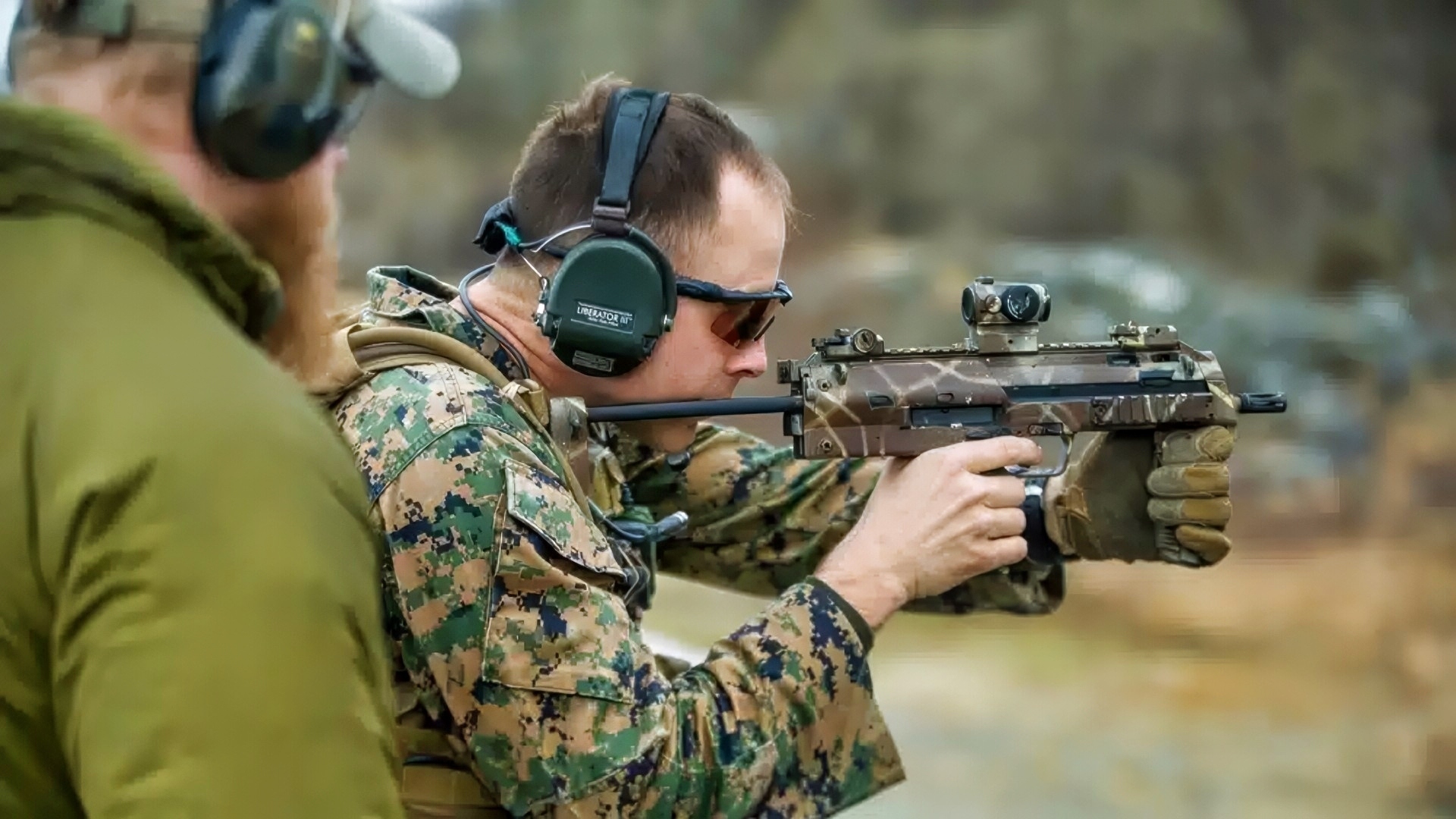
Some weapons are built to win firefights. The MP7 was built to win them in hallways, on ladders, and in rooms where the man next door is asleep. That last part isn’t an exaggeration. In No Easy Day, retired SEAL Mark Owen wrote that his teammates shot fighters in one room with a suppressed MP7 while “their comrades next door didn’t wake up.”
That one line explains most of what makes Heckler & Koch’s little personal defense weapon so popular with the people who kick doors for a living. However, the MP7 didn’t start life as a door-kicker’s gun at all.
A Cold War Problem, A New Century Answer
In 1989, NATO issued a requirement for a submachine-gun-type weapon with greater capability to defeat Kevlar body armor.
The idea was to arm the troops who weren’t frontline infantry, such as vehicle crews, artillerymen, and support personnel, with something smaller than a rifle that could still stop a Soviet paratrooper wearing a vest.
Pistol-caliber submachine guns couldn’t do it.
A standard 9mm round fails completely against NATO’s CRISAT test target, a 1.6mm titanium plate backed by 20 layers of Kevlar.
FN answered with the P90 and the 5.7x28mm.
HK answered with the MP7 and its proprietary 4.6x30mm cartridge. HK showed the first prototype in 1999 and started production in 2001, and the improved MP7A1 followed in 2003.
The two cartridges went head-to-head in NATO trials between 2000 and 2003.
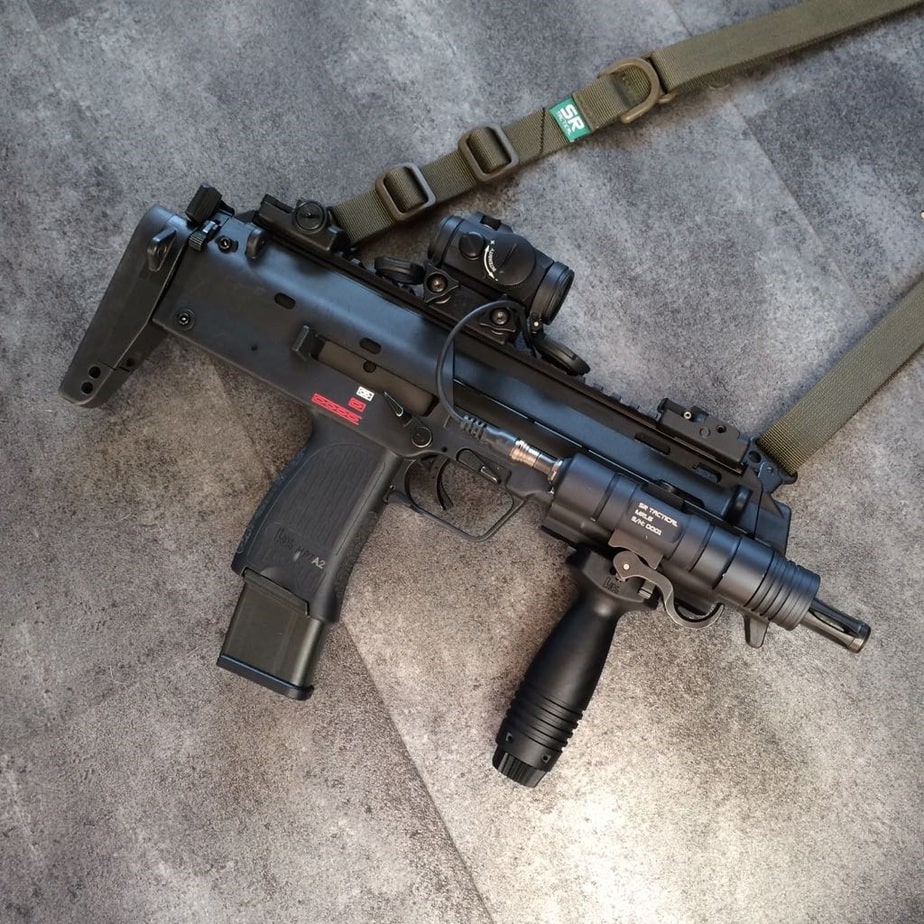
MP7A2 with attachments, including a weapon lamp, weapon belt light, and an Aimpoint Micro T2.
The testers concluded the 5.7mm was “overall the better cartridge,” but Germany rejected that recommendation, so neither round was standardized. The Bundeswehr bought the MP7 anyway, and so did a long list of special operations units.
The Scaled Down Rifle Cartridge Is The Whole Point
The 4.6x30mm looks like a scaled-down rifle cartridge, which it is.
The DM11 military load pushes a 31-grain steel-core projectile at about 2,362 feet per second, generating roughly 373 foot-pounds of energy.
That isn’t a lot of energy.
However, all of it is focused on a pointed steel penetrator with a diameter of .183 inches, and that load reportedly defeats the CRISAT target at more than 200 meters.
The gun is built around the round. The MP7 uses a short-stroke gas piston borrowed from the G36 and HK416 family rather than the simple blowback of most submachine guns, which helps keep recoil soft.
It weighs just under four pounds and measures about 16.5 inches with the stock collapsed. It cycles at around 950 rounds per minute and feeds from 20-, 30-, or 40-round magazines that fit in the pistol grip. You get the idea. It packs a lot of capability into something about the size of a large pistol.
Why The EAL Teams Love It
So why would SEALs carrying HK416s want a second, smaller weapon?
Because the missions demand it.
DEVGRU is listed among the MP7’s users, and it was allegedly carried by some members of SEAL Team 6 on the bin Laden raid, though the fatal shots came from an HK416. Owen wrote that the suppressed MP7 came in handy during ship boardings and in the jungle.
Think about what a boarding looks like.
You’re climbing a caving ladder up the side of a moving ship at night, then moving through narrow passageways and hatches.
A 14.5-inch carbine is a lot of gun for that.
The MP7 can be run one-handed, which matters on a ladder, in a tunnel, and for a K9 handler with a dog on a leash in the other hand.
Then there’s the suppressor.
The small 4.6mm round gets very quiet under a can, and Travis Pike wrote at SOFREP that a suppressed MP7 works “like a squirt gun in action.”
That is the real selling point for a hostage rescue or capture-kill mission. Quiet buys time, and time keeps people alive.
The Ammunition Has Drawbacks
None of that makes the 4.6mm a magic bullet.
Its biggest weakness is against targets not wearing armor.
The small steel penetrator can zip straight through, leaving a narrow wound channel that critics have compared to being stabbed with an ice pick unless the bullet tumbles.
Loads designed for soft targets exist, but they give up the armor penetration that justifies the cartridge in the first place.
Logistics is the other problem.
The 4.6x30mm is proprietary, and HK’s plan for a companion pistol in the same caliber, the UCP, was canceled in 2009.
FN fielded both a PDW and a pistol for its 5.7.
HK never did.
That leaves MP7 users stocking an oddball round that nothing else in the kit fires.
Out Of The Shadows And Into The Mainstream
The MP7 has also turned into a protective detail’s gun. U.S. Capitol Police adopted it for their Dignitary Protection Division after the 2017 Congressional Baseball Game shooting.
It went viral this spring when an agent in a tailored suit was photographed carrying one during the April 25 incident at the White House Correspondents’ Dinner.
Abroad, it serves with Germany’s GSG 9, France’s GIGN, the UK Ministry of Defense Police, and a long list of other units.
It was designed for a tank crewman who would probably never fire it. It ended up in the hands of the men most likely to need it, in the places a rifle doesn’t necessarily fit.
About the Author: Steve Balestrieri
Steve Balestrieri is a National Security Columnist. He served as a US Army Special Forces NCO and Warrant Officer. In addition to writing on defense, he covers the NFL for PatsFans.com and is a member of the Pro Football Writers of America (PFWA). His work was regularly featured in many military publications.