
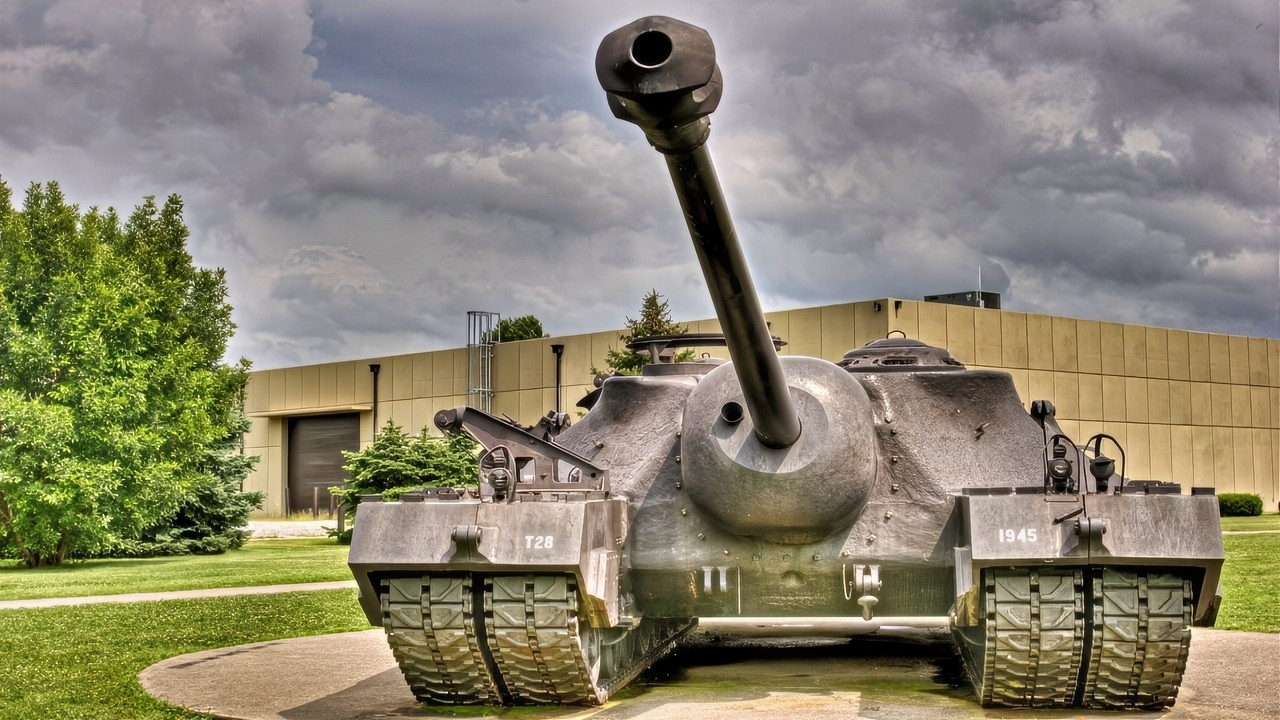
Summary and Key Points: When the United States entered the Second World War, the Army realized it needed a new type of heavy armored vehicle to break through Germany’s heavily fortified Siegfried Line. At the time, the U.S. had virtually nothing with enough armor and firepower to suit its needs. The 105 mm Gun Motor Carriage T95 (later renamed Super Heavy Tank T28) was designed to meet these needs. The T28 was a massive armored behemoth with a turretless, forward-facing gun and steel armor over a foot thick in certain areas.
Because the project was a lower priority, the tank wasn’t ready until August 1945, after the war was already over.
T-28: Building a Super-Heavy Tank
In 1939, as Germany invaded Poland, America’s tank forces were unimpressive.
Although the Army realized it needed to field a large tank fleet, the U.S. was farther from the war in Europe and lacked the urgency to develop a grand tank force.
By the time America entered the war in 1941, it was still unprepared in this regard.
The development of the M4 Sherman and M3 Stuart helped dramatically, but one area had been persistently ignored: the heavy tank category.
One reason was that tanks had to be carried from the factory across the Atlantic and then to the front lines.
Meanwhile, German, British, or Soviet tanks did not have to travel nearly as far to reach the front lines.
The U.S. had experimented with heavy tanks like the M6, but like many pre-war designs, it was unreliable.
In 1943, before the invasion of Normandy, opinions on heavy tanks began to shift.
The U.S. needed a more reliable way to breach German fortifications.
The Army feared that the Sherman lacked sufficient armor and firepower to take on the heavy fortresses it expected to encounter on the Siegfried Line.
Furthermore, German developments such as the Ferdinand tank destroyer offered improved protection and firepower.
In response, the U.S. Ordnance Department promptly began work on a new vehicle under the Assault Tank (AT) Project.
The AT project cycled through multiple heavy tank designs.
From the start, the tank was to be fitted with a 105mm gun, based on its reported performance against concrete.
However, the Department spent nearly a year deciding on the tank’s design.
The design called for a low profile, a turretless gun, and absurdly thick frontal armor.
The T28’s Unique Design
The AT project gave rise to the Heavy Tank T28.
The T28 featured a unique design compared to most heavy tanks.
For one, it lacked a turret, instead utilizing a fixed casemate mount for its 105mm gun.
Even among other casemate tank destroyers, however, the T28 stood out.
It had a notably lower profile than some contemporaries, measuring 2.84 meters high, and an elongated hull measuring 11.1 meters long.
Unlike some contemporaries, the tank required a crew of only four.
The British A.39 Tortoise, for example, had a crew of seven, while the Maus had six.
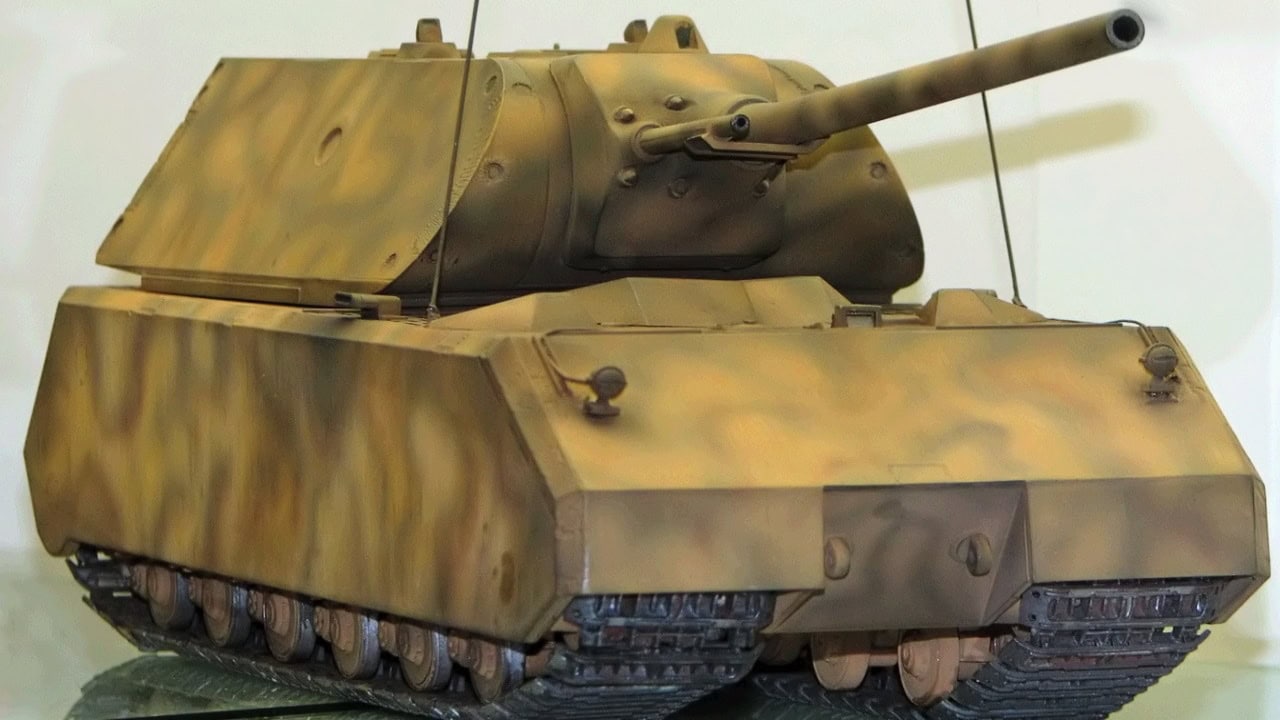
MAUS Tank Creative Commons Photo
Its most distinctive feature, however, is probably its double-track system.
The T28 had two sets of two tracks to reduce the steel monster’s ground pressure.
To reduce its weight and allow easier transport, the outer tracks could be removed, making it about 29 tons lighter.
The AT project’s main emphasis was crew survivability. To that end, the T28 had exceptionally thick armor.
The armor around the gun port measured 12 inches thick, while the ball-shaped gun mantlet measured 11.5 inches.
To the left and right of the main gun, the armor was slightly thinner, measuring only 8.5 inches.
These areas, however, were steeply sloped, allowing most rounds to ricochet off the tank at nearly all angles.
4-inch-thick side skirts protected the tank’s sides, and the double-track/double-suspension system itself provided more than enough protection for the crew.
The thinnest or least-protected areas were the lower front of the hull, which measured only 5.5 inches thick, and the driver’s cupola, at 9.2 inches thick.
An Interesting But Impractical Design
Mobility was by far the T28’s weakest aspect. Weighing 95 tons, the tank was absurdly heavy, beaten only by a few other super-heavy tank projects of the time.
A Ford GAF V-8 gasoline engine powered the tank, producing only 500 horsepower.
As a result, the tank had a measly speed of 8 miles per hour and was poorly suited for any difficult or rugged terrain.
Its insane weight also made the vehicle extremely difficult to transport, although it had a range of around 100 miles.
The program produced only two T28 super-heavy tanks before it was terminated.
The war’s end was the main reason for its cancellation.
By the time the prototype rolled off the assembly line, the Siegfreid line had already been breached, and Germany had already surrendered, thereby eliminating the tank’s main purpose.
The two prototypes underwent testing at the Aberdeen Proving Ground, but the tank never entered full service.
One prototype was subsequently scrapped, while the other was eventually turned into a museum piece at the Patton Museum of Cavalry and Armor in Kentucky and later the U.S. Army Armor & Cavalry Collection at Fort Benning, Georgia.
About the Author: Isaac Seitz
Isaac Seitz, a Defense Columnist, graduated from Patrick Henry College’s Strategic Intelligence and National Security program. He has also studied Russian at Middlebury Language Schools and has worked as an intelligence Analyst in the private sector.