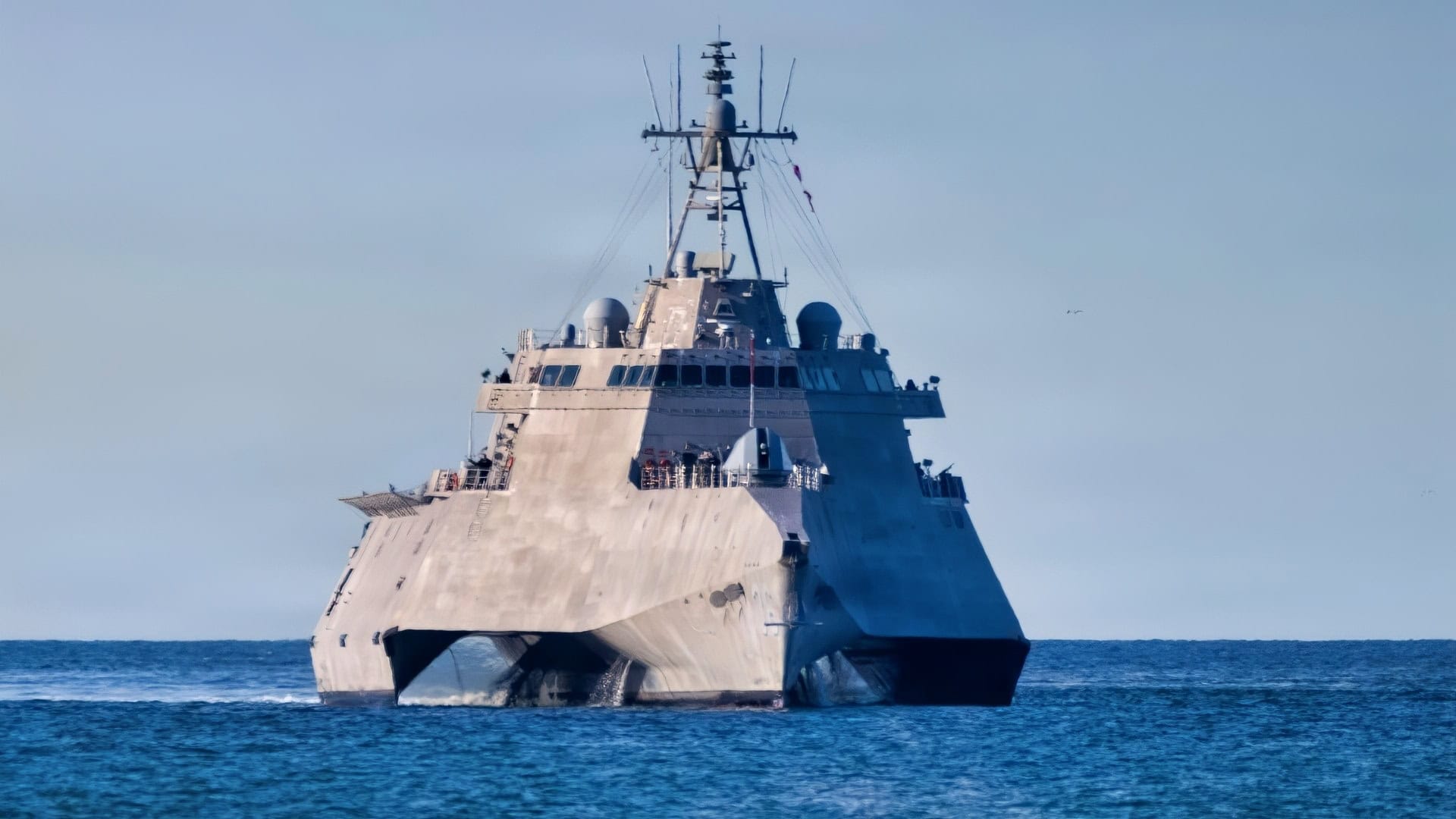
When the Cold War ended, the United States Navy looked for new warship designs better suited to the post-Cold War era.
At the time, the United States saw itself as the world’s undisputed power.
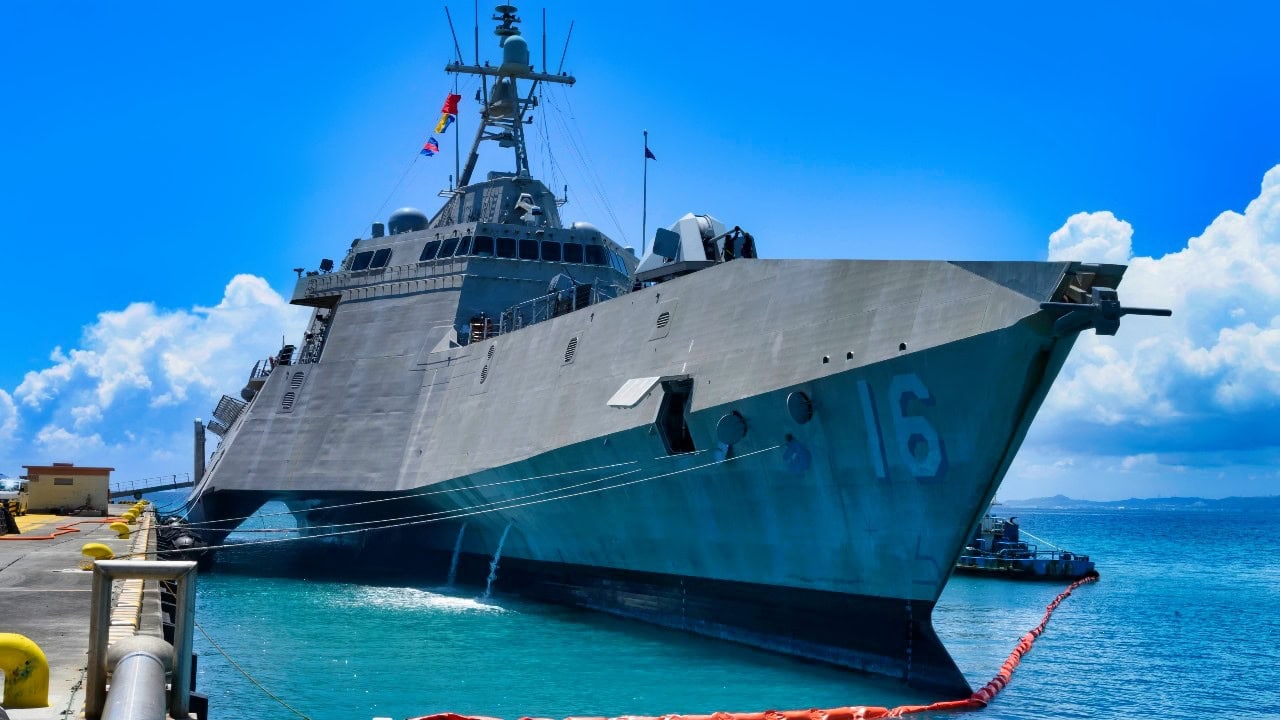
(Sept. 2, 2021) Independence-variant littoral combat ship USS Tulsa (LCS 16) sits pierside at Commander, Fleet Activities Okinawa White Beach Naval Facility, Okinawa, Japan, Sept. 2, 2021. Tulsa conducted a brief stop for resupply at CFAO White Beach Naval Facility. Tulsa, part of Destroyer Squadron Seven, is on a rotational deployment in the U.S. 7th Fleet area of operation to enhance interoperability with partners and serve as a ready-response force in support of a free and open Indo-Pacific region. (U.S. Navy photo by Mass Communication Specialist 1st Class David Krigbaum)
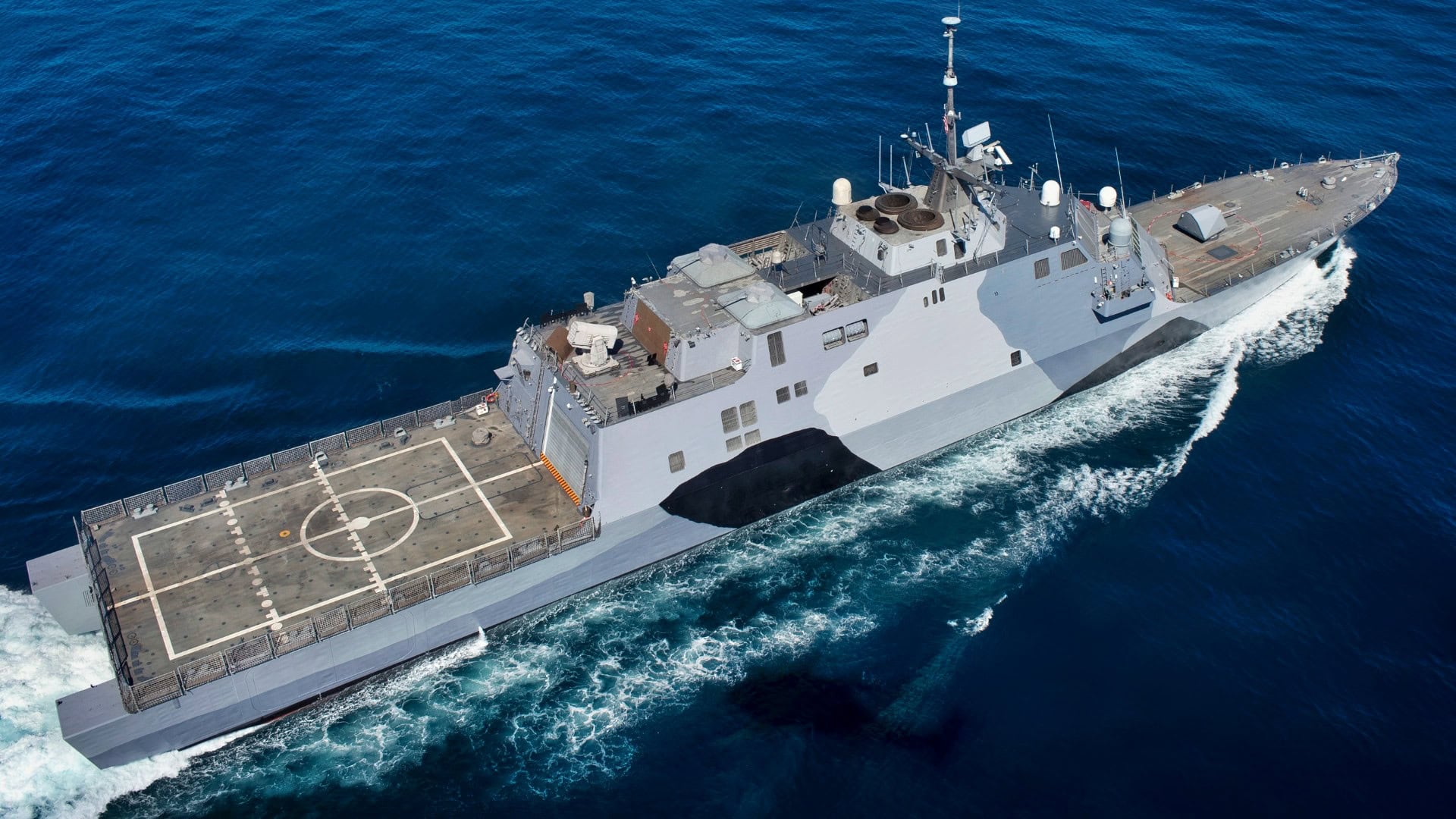
(Feb. 22, 2013) The littoral combat ship USS Freedom (LCS 1) is underway conducting sea trials off the coast of Southern California. Freedom, the lead ship of the Freedom variant of LCS, is expected to deploy to Southeast Asia this spring. (U.S. Navy photo by Mass Communication Specialist 1st Class James R. Evans/Released)
Therefore, the Navy would need ships capable of operating much closer to the shores of regions that might pose security challenges.
The Navy wanted the Littoral Combat Ship (LCS) to be a mainstay in the post-Cold War unipolar era.
A Floating Embarrassment
But the LCS became synonymous not with significant combat power close to the shorelines of rival states and regions.
Instead, it became better known for the moniker several sailors who served aboard these warships created: Little Crappy Ships.
The Navy didn’t love these warships either.
The Navy fought hard to make these systems work rather than walk away (because it had committed so much time, effort, and resources to the LCS program over the years).
Essentially, the LCS became known for its high operating costs, major mechanical flaws, and the specialized maintenance required to keep the warship running.
The Navy built two variants of the LCS (neither performed as expected).
There were the Freedom-class and Independence-class variants of the LCS. The Freedom-class was particularly problematic for the Navy.
This version of the Little Crappy Ship suffered from high operating costs and significant maintenance issues — including gear failures and hull cracking.
Now that it is clear the Navy cannot use these warships and is retiring them, the question is: what does the Navy do?
How does the Navy make up for the resources spent building and maintaining these ships over the last 20 years?
In May 2022, then-Chief of Naval Operations, Admiral Michael Gilday, argued before Congress that the Navy should transfer its surplus Freedom-class Littoral Combat Ships to some unlucky South American partners.
Because these warships, per Gilday’s rationale, needed relatively small crews to operate and could function at high speeds, they’d be useful for maritime patrols–especially counter-narcotics missions–and other regional security operations.
Of course, what cash-strapped, resource-strained South American country would want to inherit one of the most troubled warships in American naval history?
What kind of friend would wish that upon anyone?
A Nightmare Ship
The problems with the Freedom-class LCS were legion.
Fixing that warship variant required specialized engineering, unique replacement components, excess shipyard capacity, and ongoing technical support.
All of that meant more time and money.
If the world-spanning US Navy lacked the resources to accomplish this effectively, how could a country like Colombia or even Mexico?
Plus, a recipient of this “gift” would need to finance the fuel and other equipment needed to support this warship.
That’s to say nothing of the specialized ammunition and weapons–along with all the training that accompanies them.
Sure, these boats require fewer crew than larger frigates or even older patrol vessels that many Latin American nations operate.
Then again, the time and money it’d take to update crews’ training and familiarity with the LCS’s more automated systems would be another costly affair for Latin American militaries.
Specifically, the Navy wanted to make the USS Jackson and Montgomery available for foreign military sales. But in January of this year, the service reconsidered those plans.
The Independence-class has, after all, assumed key mine-countermeasure missions in the Middle East as the older Avenger-class minesweepers are retired and some Freedom-class ships are now set to be retained rather than retired (even though it remains a mystery how the US Navy intends to make those lame turkeys fly).
Anyway, the United States does have a history of selling excess, older warships to its partners. The Oliver Hazard Perry-class frigates were the most obvious example.
Then again, those warships proved successful.
These LCS variants are floating disasters.
If a partner nation in Latin America were saddled with them, its navy would be on the hook for the excessive costs associated with these warships.
These nations are already in the fight for their lives against drug runners and human trafficking organizations. Why add to their headaches?
Can the US Navy Even Afford to Lose the LCS?
Plus, the US Navy now faces a real strategic bind: it must run a seemingly endless blockade against an increasingly complex and advanced adversary in the Middle East while preparing for a larger war, possibly with peers like China and Russia.
It is doing so at a time in which the Navy is stretched to its breaking point.
The service needs numbers at this point, so the Pentagon is actually willing to maintain at least some of these Little Crappy Ships, not just because of the minesweeping mission that the Independence-class variants are conducting, but because the Navy clearly needs numbers.
Whether the LCS will ever live up to its promise remains to be seen (though it is clear it won’t).
And whether the Navy can make some money by selling these ships (more like duping) to foreign partners remains to be seen as well.
Clearly, the Pentagon is concerned that these ships will, at the end of the day, be sunk costs in the truest sense of the term.
About the Author: Brandon J. Weichert
Brandon J. Weichert is the Senior National Security Editor at 19FortyFive.com. He also manages The Weichert Brief on Substack. Weichert also hosts “National Security Talk” on Rumble. He is the author of four bestselling national security books, most recently A Disaster of Our Own Making: How the West Lost Ukraine (Encounter Books). Follow him via Twitter/X @WeTheBrandon.