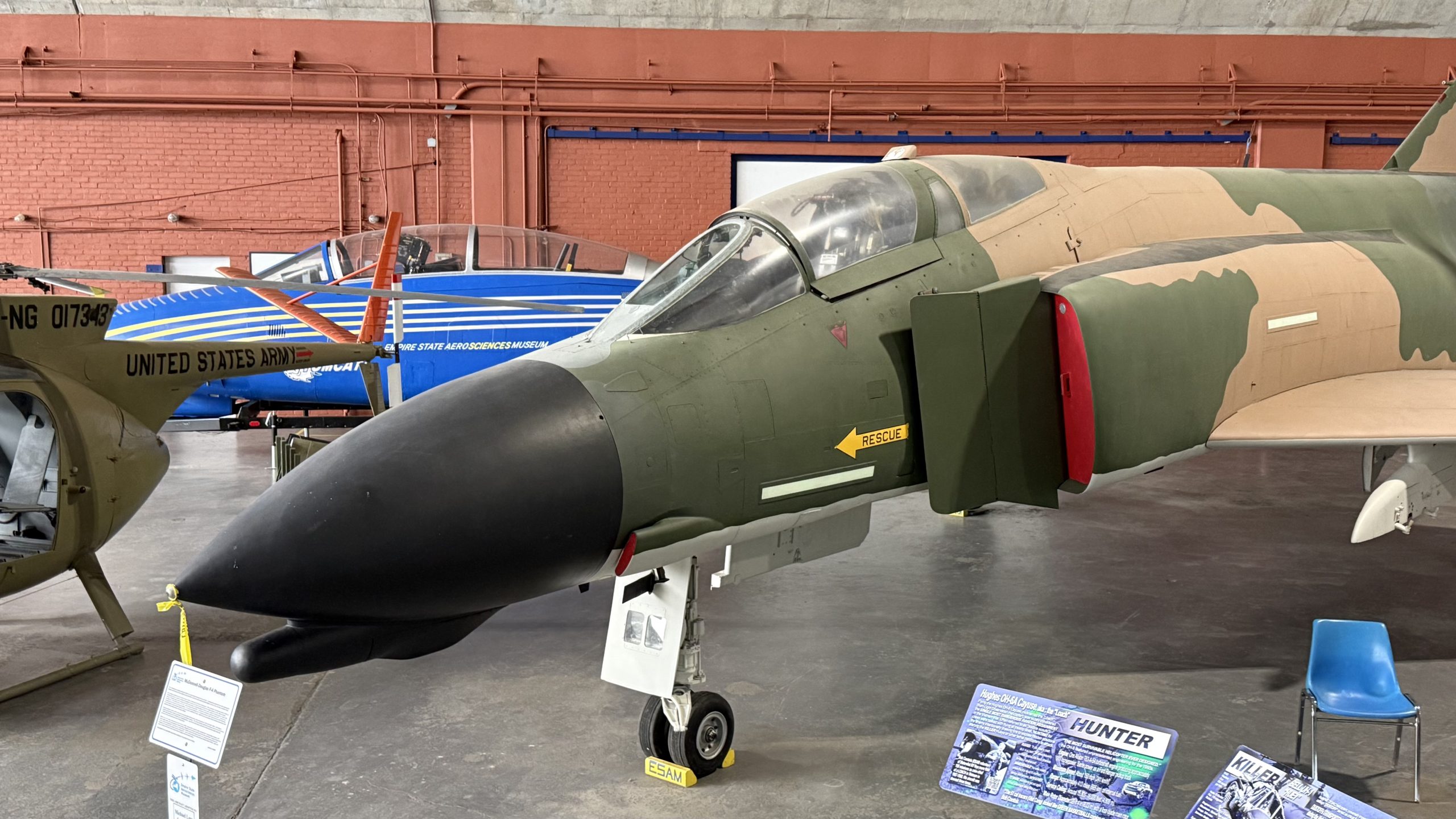
United States Air Force pilot Major Phil “Hands” Handley was flying his F-4E Phantom II (call sign “Brenda 01”) with First Lieutenant Jack Smallwood in the rear cockpit about 40 miles northeast of Hanoi during the Vietnam War on June 2, 1972.
Handley’s four-aircraft combat air patrol (CAP) flight was patrolling between the Gia Lam and Kep airfields when the formation reacted to what appeared to be surface-to-air missile (SAM) launches.
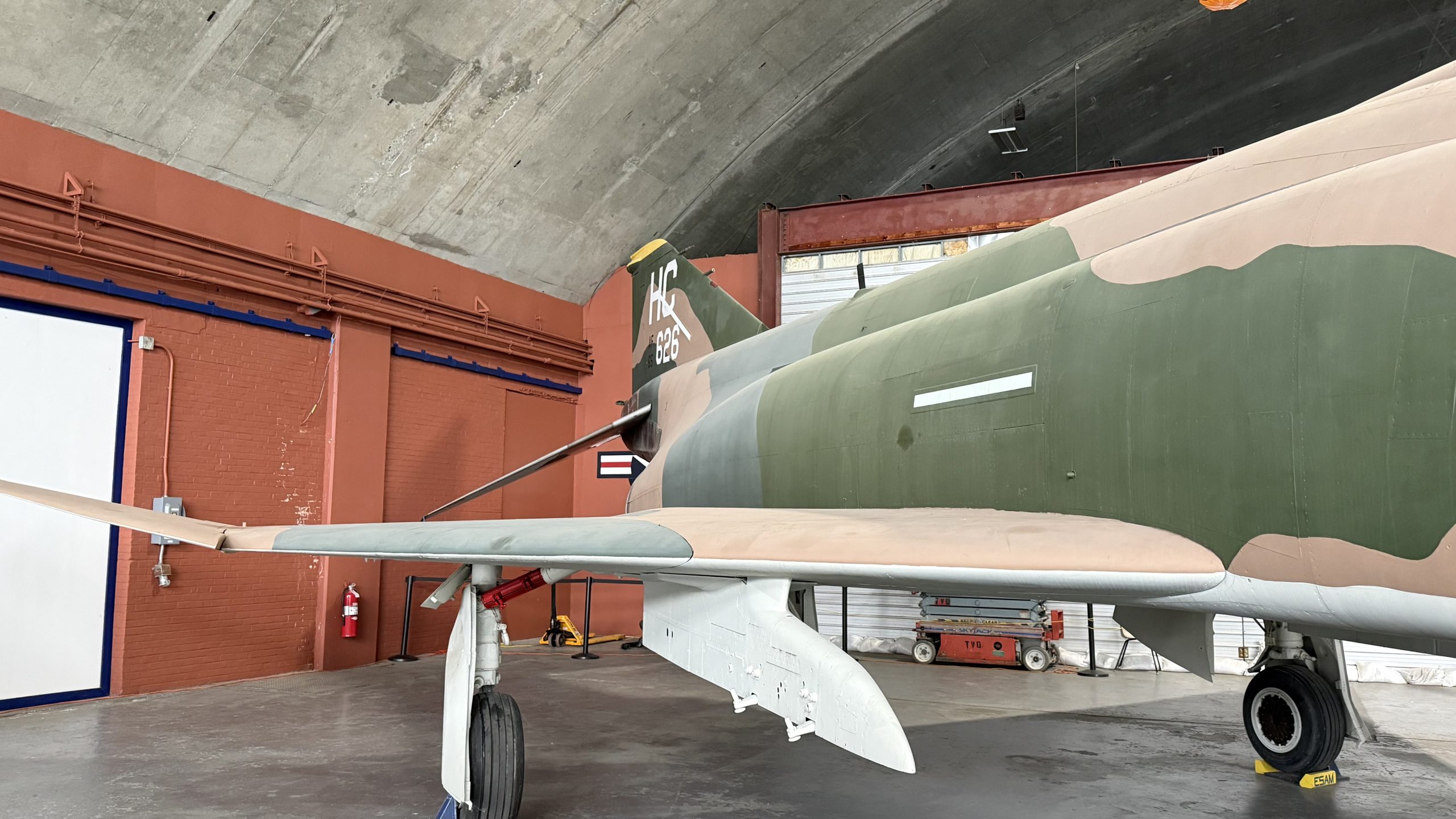
F-4 Phantom. 19FortyFive museum visit and photo shoot.
An Incredible Story
A recent story in Aviation Geek Club, a popular online trade publication, details how the four birds in Brenda Flight separated, with Brenda 03 eventually reaching minimum fuel and being forced to head east.
At the same time, though, two MiG-19s deployed from Gia Lam to intercept the American fighters.
Smallwood warned his pilot, Maj. Handley, that enemy aircraft were approaching.
So, Handley accelerated.
At first, Handley obtained a radar lock on the trailing MiG-19 and fired two AIM-7 Sparrow radar-guided missiles at the incoming North Vietnamese planes.
The radar-guided missiles failed to guide themselves properly to the incoming targets.
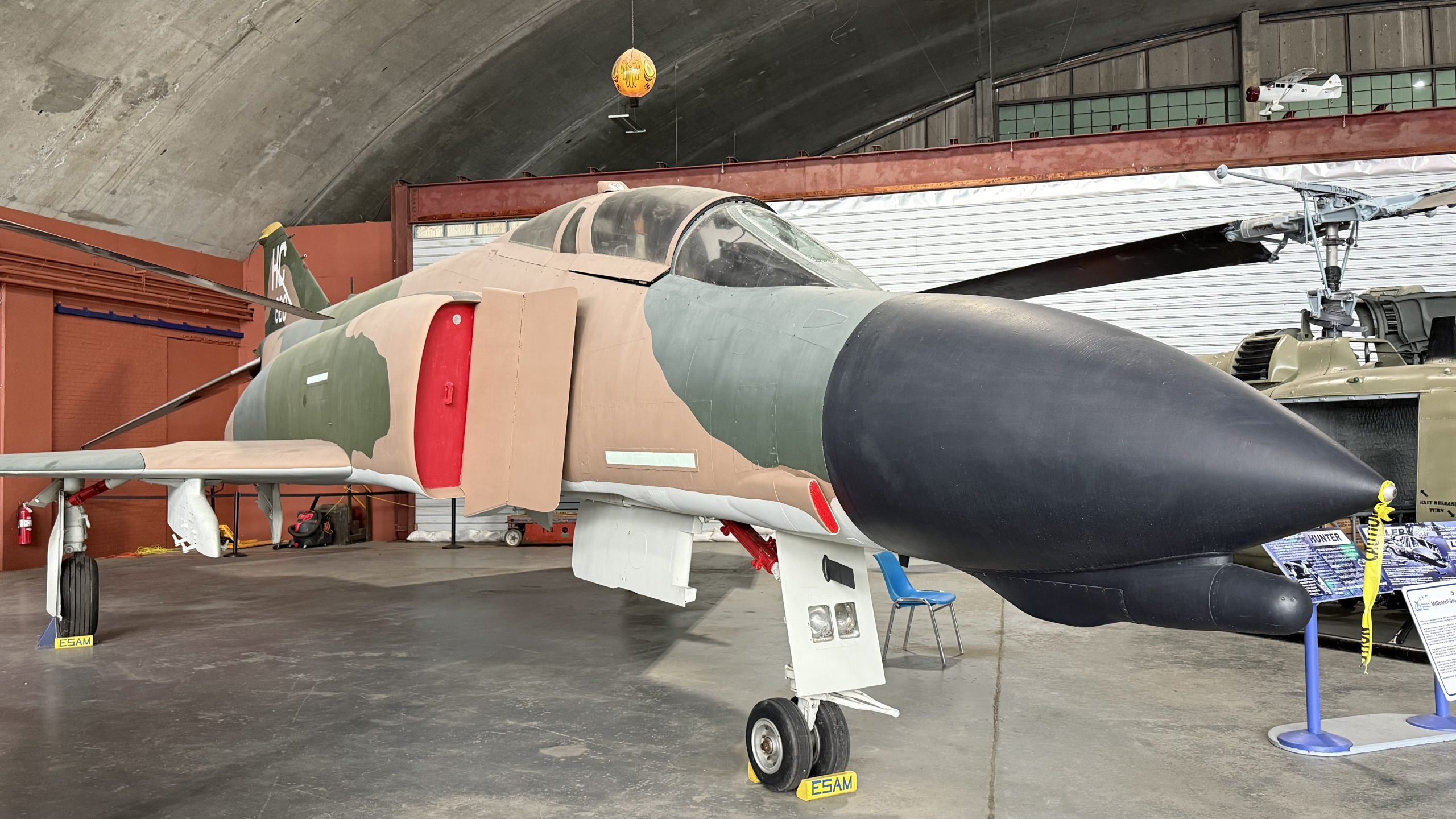
F-4 Phantom. 19FortyFive museum visit and photo shoot.
The first AIM-7 suffered a rocket-motor failure.
The second missile launched but failed to guide properly.
Handley’s F-4E Phantom had something that previous iterations of the iconic plane lacked, though.
It had a potent M61A1 Vulcan 20mm rotary cannon in the nose.
That was a critical evolution for a plane originally envisaged as a giant missile truck.
The original F-4 Phantom, you see, was designed around the concept that guided missiles would dominate future aerial combat.
As a result, early Phantom II variants lacked an internal cannon.
But combat over Vietnam highlighted that design’s limits.
Missile reliability, minimum engagement ranges, and rapidly developing close-range fights meant US warplanes often found themselves within gun range of enemy birds without a similar capability.
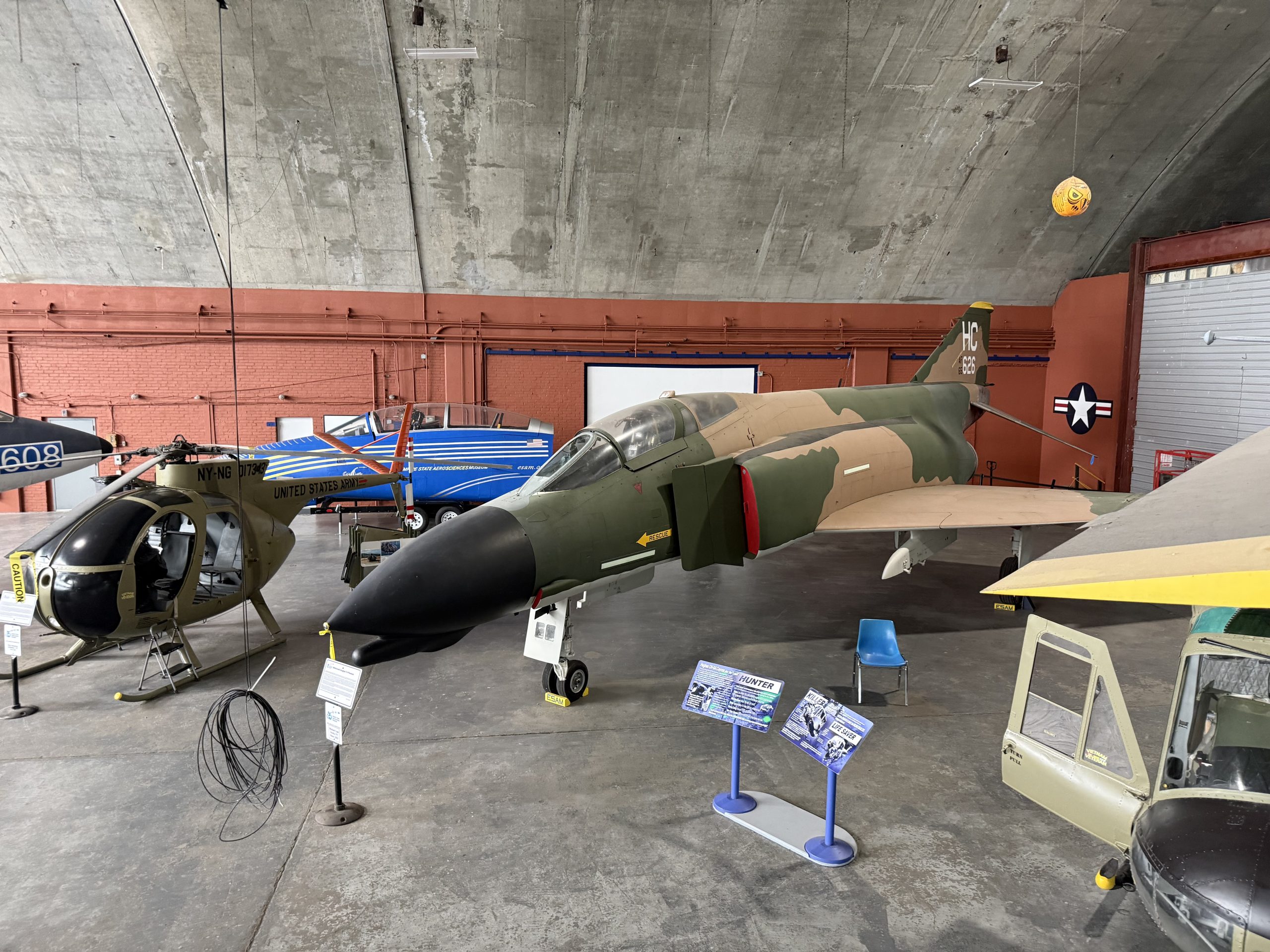
F-4 Phantom. 19FortyFive museum visit and photo shoot.
Designers went back during the war and fixed that flaw with the F-4E Phantom II variant.
Powerful J79-GE-17 engines, combined with the M61A1 Vulcan 20mm rotary cannon in the nose, made a potent mix. The weapon ensured that Phantom pilots had optionality when in combat with dogged North Vietnamese (read: Soviet) pilots and warplanes.
Suppose missiles failed to launch or lock on properly, as Maj. Handley experienced, the planes needed to defend themselves with guns.
Failure to Launch
What’s more, the communist fighter pilots liked to close in with the American pilots, so missiles weren’t always useful. Again, the guns made the difference in those instances.
Indeed, once introduced, the F-4Es scored seven aerial victories with the 20mm cannon throughout the Vietnam War.
When the AIM-7 Sparrow radar-guided missiles failed to lock onto the incoming MiG-19s properly, Handley switched to AIM-4 Falcon infrared-guided missiles.
These missiles failed him, too.
The first AIM-4 Falcon went ballistic after launch, and the second refused to leave its launcher.
In other words, Handley’s Phantom’s entire missile arsenal failed at the crucial moment.
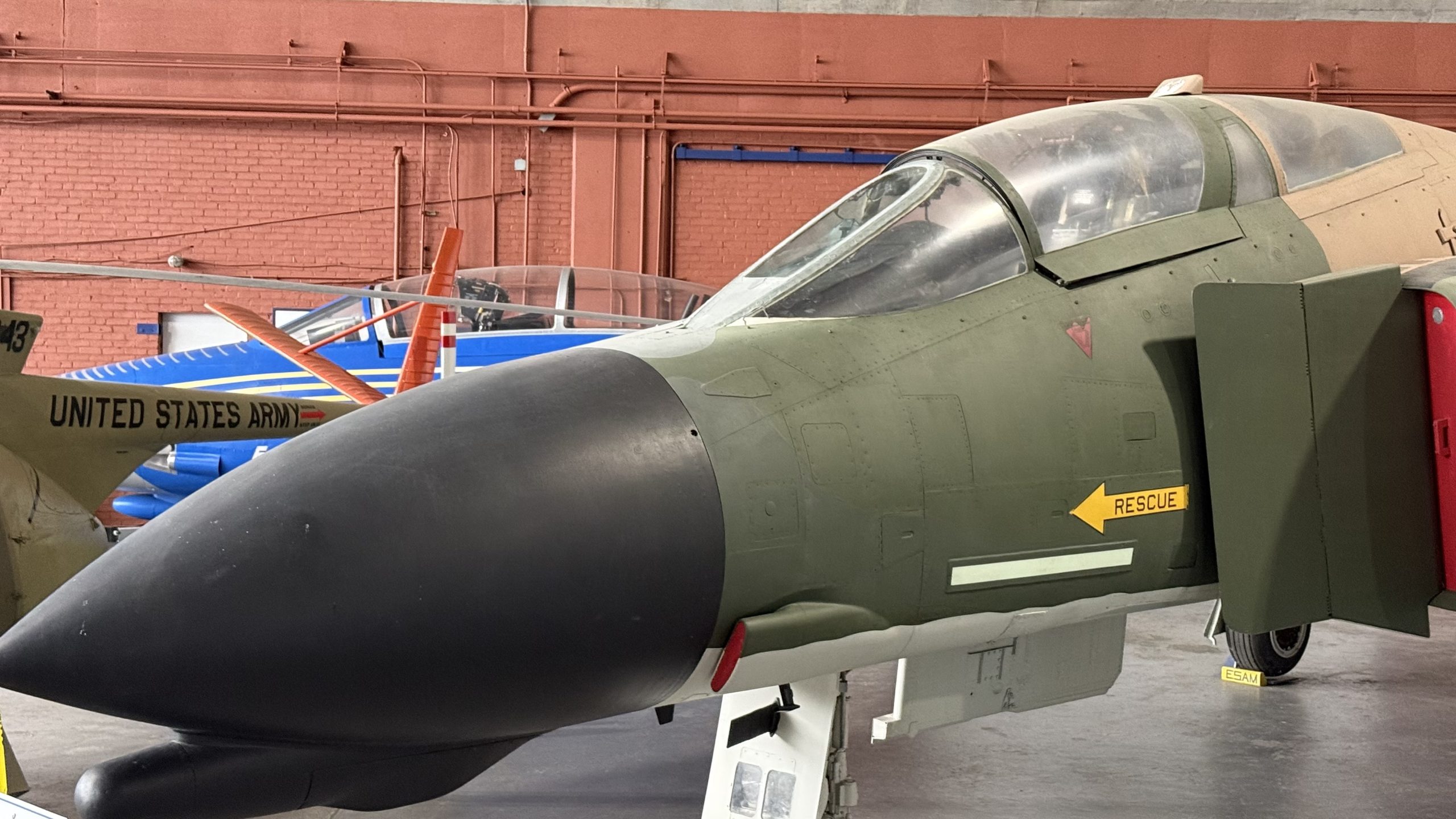
F-4 Phantom. 19FortyFive museum visit and photo shoot.
Had this been a former variant of the F-4, Handley and his backseater, Smallwood, would have been toast. But Handley had the 20mm gun.
The fight was rapidly descending. Handley’s Phantom was traveling at Mach 1.2, while the pursuing MiG-19s were traveling around Mach 0.77.
They were dogfighting at around 500 feet above the ground. The MiG crossed the Phantom’s flight path at a 90-degree angle.
The planes were less than 300 feet apart! Handley toggled the M61 cannon, pulled the F-4 into a lead pursuit, and tried to place the MiG in the path of his fiery cannon stream.
Breaking Records
At first, the F-4’s nose obscured the MiG from Handley’s view, but the North Vietnamese fighter passed through the molten stream of rapidly fired lead.
Multiple 20mm rounds hit the enemy aircraft.
Instantly, the North Vietnamese let out fire and debris from its airframe, its wings rocked, and it went careening toward the ground–but not before it exploded.
It took 300 rounds to bring that MiG-19 down. Only ten rounds remained.
The shootdown occurred at supersonic speeds, just hundreds of feet above the jungle below.
And the target crossed almost perpendicular to its flight path at extremely close range.
Handley’s victory is among the confirmed American aerial wins in the Vietnam War.
It is the only confirmed supersonic gun kill in aerial combat history.
And it is an extraordinary feat.
Sometimes it’s best to go “Old School” even in modern combat.
About the Author: Brandon J. Weichert
Brandon J. Weichert is the Senior National Security Editor at 19FortyFive.com. He also manages The Weichert Brief on Substack. Weichert also hosts “National Security Talk” on Rumble. He is the author of four bestselling national security books, most recently A Disaster of Our Own Making: How the West Lost Ukraine (Encounter Books). Follow him via Twitter/X @WeTheBrandon.