
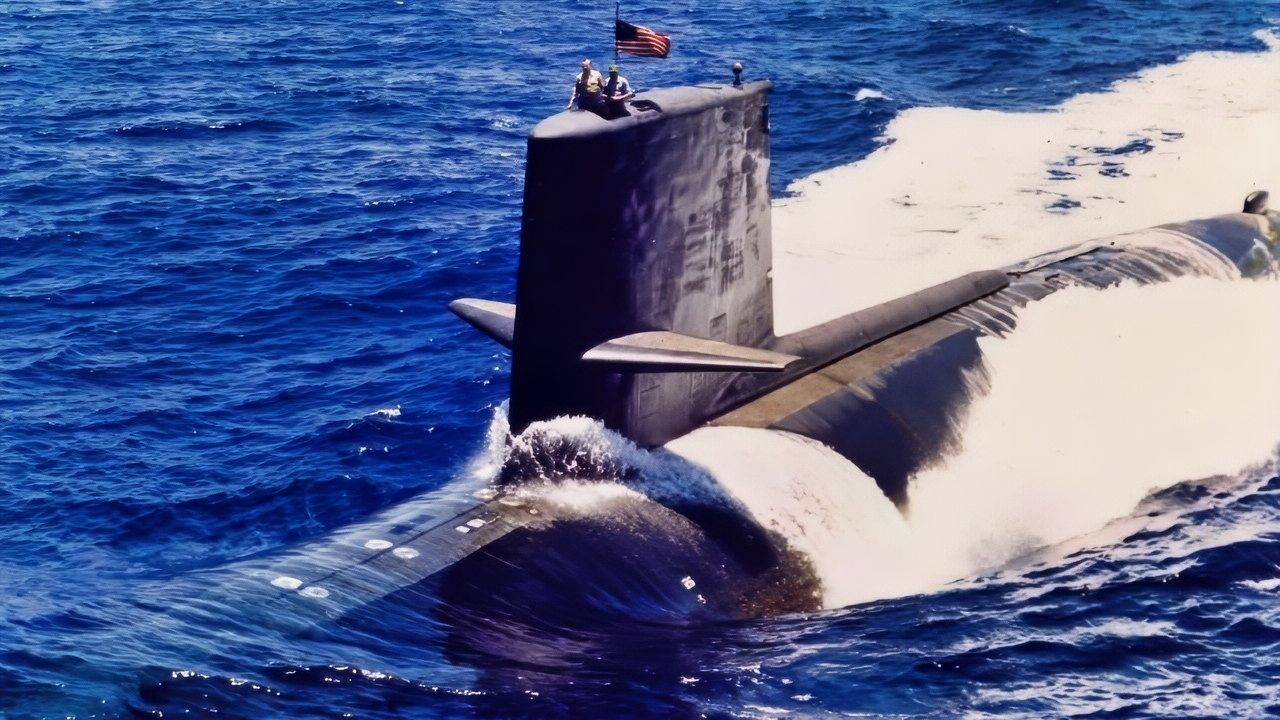
Summary and Key Points: Journalist Stephen Silver revisits the May 1968 loss of USS Scorpion (SSN-589), the Skipjack-class attack submarine that sent its last transmission on May 21 and missed its May 27 Norfolk return. Drawing on Ed Offley’s February 2025 Naval History account, he contrasts the Court of Inquiry’s 1993 declassified finding of an external explosion, likely a Mark 37 torpedo mishap, with Vice Adm. Arnold Schade’s flooding theory, backed by Adm. Ephraim Holmes and CNO Thomas Moorer, and Soviet-encounter claims.
The USS Scorpion US Navy Submarine Accident Is Dark US Military History
The USS Scorpion, a Skipjack-class nuclear attack submarine (SSN-589), was an American nuclear submarine that mysteriously sank in May 1968, during a deployment to the Mediterranean. Nearly 60 years later, it remains a mystery exactly what caused the submarine to sink.
According to an EBSCO account published in 2022, the Scorpion underwent maintenance at Norfolk Naval Shipyard before heading to the Mediterranean on a mission. On May 21, 1968, after completing the work, the sub sent its last confirmed radio transmission. The submarine was scheduled to return to Norfolk on May 27, but it never appeared.
As the Baltimore Sun noted, the tragedy was “lost in the tumultuous events of 1968,” having taken place in the month between the assassinations of Martin Luther King and Robert F. Kennedy.
Several theories emerged about what happened, from torpedoes to enemy sabotage, but subsequent investigations debunked them all. Despite it being a nuclear submarine, there wasn’t any evidence of radioactive leakage.
However, other forms of damage remained.
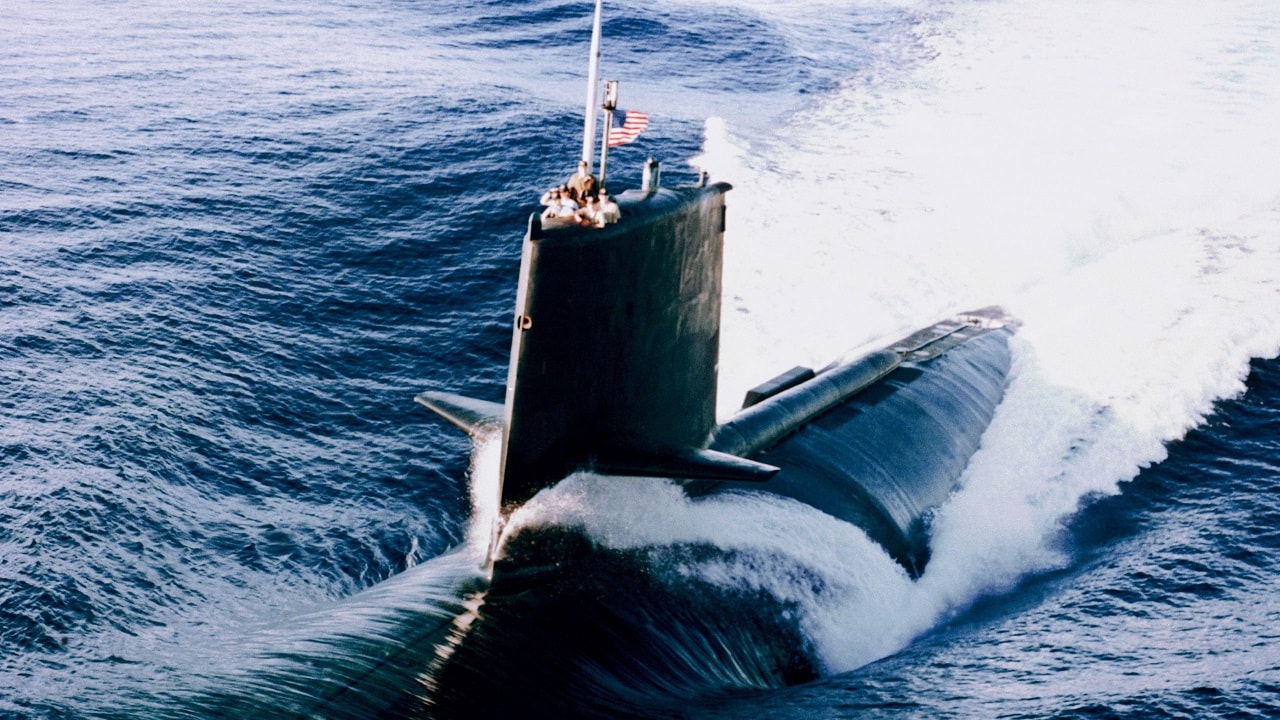
A port bow view of the nuclear-powered attack submarine USS SHARK (SSN-591) underway.
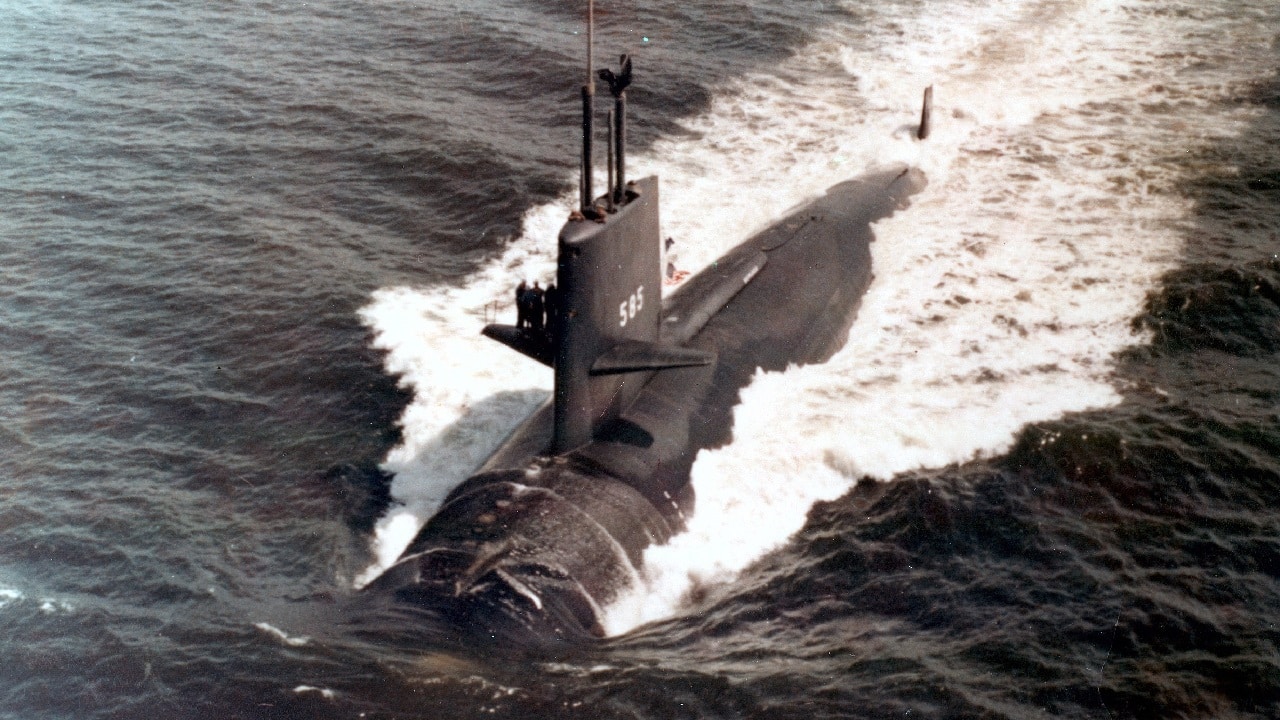
The U.S. Navy submarine USS Skipjack (SSN-585) underway, circa in the 1960s.
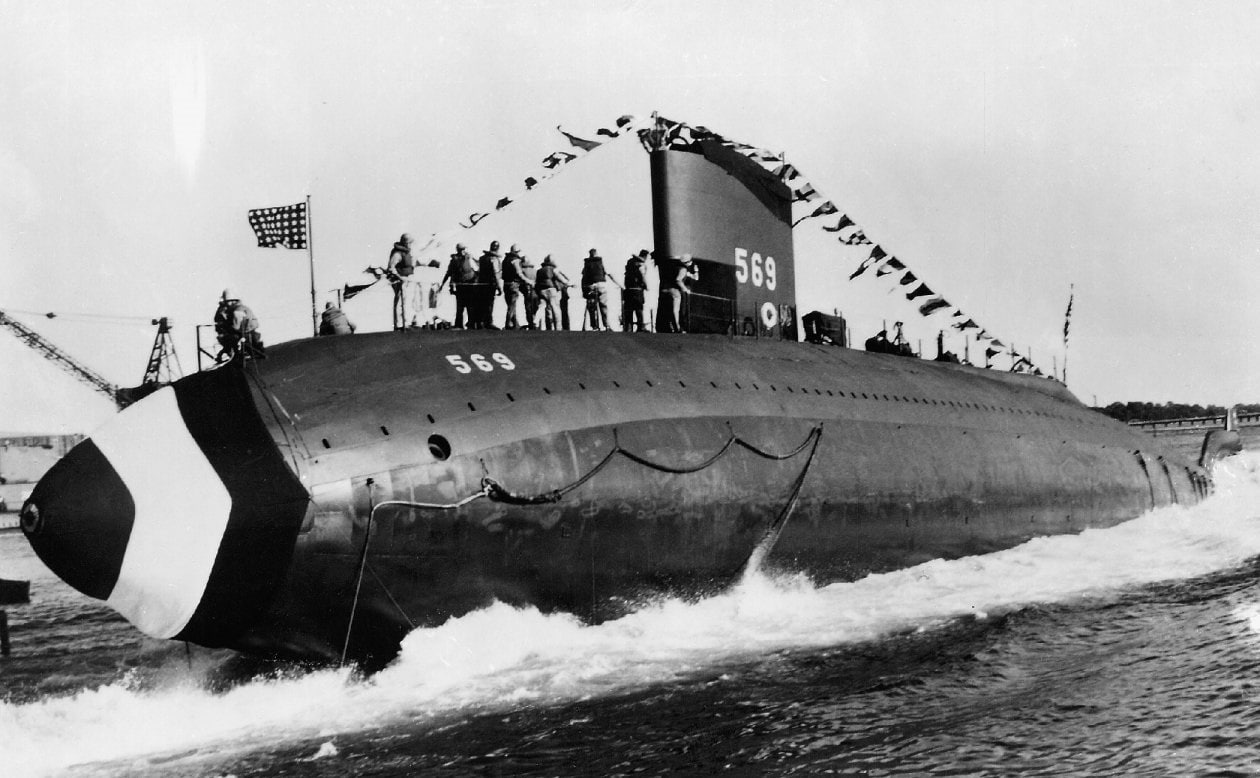
Skipjack-class Submarine. Image Credit: Creative Commons.
“The tragedy left behind a significant emotional impact, resulting in sixty-four widows and ninety-nine children, with a majority of the crew members being relatively young,” the EBSCO account said.
It’s one of only two nuclear submarines the Navy has lost; the other was the USS Thresher in 1963.
What Happened That Day: A Nuclear Submarine Lost
In February of 2025, for the US Naval Institute’s Naval History magazine, Ed Offley wrote a history of the Scorpion’s sinking. Offley described the sinking as “one of the more closely guarded secrets of the Cold War.”
According to Offley’s account, the Navy took and continues to take the position that “the Scorpion most likely sank due to an unspecified mechanical malfunction that caused the 252-foot-long submarine to plunge below its crush depth, about 1,300 feet below the surface.”
A Court of Inquiry convened and concluded, in findings released in early 1969, that “the certain cause of the loss of Scorpion cannot be ascertained from any evidence now available.”
Offley’s report added that, while that was the conclusion, the court and Navy brass had disagreed at the time, and that disagreement remained classified for 30 years until the veil was lifted in 1993.
The court’s “Findings of Fact, Opinions and Conclusions,” declassified then, revealed that the panel concluded the “most likely” cause was “an explosion of large charge weight external to the pressure hull.” In other words, they deemed that the most likely cause, but not with enough certainty to declare it the actual cause.
In 1993, around the time of that release, the Baltimore Sun interviewed some of the families of those who lost their lives in the sinking.
Of the four families interviewed by the Sun in 1993, “none embraces the Navy’s scenario. Some react numbly. Others become angry and call it a cover-up of a catastrophic Navy blunder or of a deadly encounter with the Russians that, acknowledged publicly, might have touched off World War III.”
So What Was it Really?
In Offley’s article, several Atlantic Fleet officials testified that no Soviet submarine was anywhere nearby. They therefore settled on what they saw as the most likely scenario: “A mishap involving one of the Scorpion’s own conventionally armed Mark 37 torpedoes.”
However, per his account, Vice Admiral Arnold F. Schade, who commanded the Atlantic Submarine Force, had a different explanation: He believed that the submarine was lost “ as a result of a flooding type casualty which originated at a depth of [deleted] feet or less; that for undetermined reasons the flooding caused the ship to sink near or beyond the hull designed collapse depth; that the Engine Room telescoped into or around the Auxiliary Machinery Space at a depth of around [deleted] feet, and that this was the initial acoustic event.”
The full court, however, disagreed with that hypothesis.
“The weight of evidence leads to the conclusion that such a sequence of events was not probable,” they concluded.
Other leaders, such as Atlantic Fleet Commander Admiral Ephraim P. Holmes and Chief of Naval Operations Admiral Thomas H. Moorer, sided with Schade, Offley wrote.
“The Commander in Chief, U.S. Atlantic Fleet, while not an expert in many of the areas which were considered by the Court, is of the opinion that the conclusions of the Court concerning the most probable cause of the loss of the USS Scorpion, although logical, cannot be confirmed, and therefore, the cause of the loss cannot be definitely ascertained,” Holmes wrote in a subsequent report.
If it was a torpedo, whether ot came from the Soviets is disputed
Was It the Russians? Speculation of What Might Have Been
Offley states that there are some Navy personnel who have another belief about the fate of the submarine: “Some former Navy personnel with firsthand knowledge of the Navy’s handling of the incident have stepped forward to allege that the sinking was no accident. Rather, they state, it stemmed from a hostile encounter with a Soviet submarine.”
In 1998, around the 30th anniversary of the tragedy, the Seattle Post-Intelligencer wrote about a “darker scenario” of what might have happened to the submarine. The author of that story? Ed Offley, Jr., who was then a military reporter for the newspaper.
“In fact, the Scorpion was at the center of a web of espionage, high-tech surveillance and a possible Cold War military clash that resulted in alleged agreement by both the United States and the former Soviet Union to cover up the full accounting of what happened,” Offley wrote at the time.
Some Russian admirals, he wrote, claimed Navy officials in both countries had agreed not to disclose what happened with either the Scorpion or a Soviet submarine that sank a few months earlier. Both incidents led to 1968 being dubbed “the year of lost submarines.”
To this day, most experts have ruled out any sort of Russia/Soviet connection to the tragedy.
The Scorpion Today: A True US Navy Nuclear Submarine Accident History Must Remember
The submarine was never raised, and its wreckage remains on the North Atlantic floor. Ironically, research into the Scorpion and the Thresher led to the discovery of the Titanic’s wreckage in 1985, in what National Geographic described as “a secret Cold War Navy mission.”
About the Author: Stephen Silver
Stephen Silver is an award-winning journalist, essayist, and film critic, and contributor to the Philadelphia Inquirer, the Jewish Telegraphic Agency, Broad Street Review, and Splice Today. The co-founder of the Philadelphia Film Critics Circle, Stephen lives in suburban Philadelphia with his wife and two sons. For over a decade, Stephen has written thousands of articles on politics, national security, technology, and the economy. Follow him on X (formerly Twitter) at @StephenSilver, and subscribe to his Substack newsletter.